
Steve Mitchelmore responds to my recent interviews at This Space.
Economic anxiety came suddenly upon me and all too close … then suddenly confusion [war and revolution] broke loose … I produced more powerfully than ever, but more than ever like a dying man. In the direction of Christianity it is the highest yet accorded me, that is certain. But in another sense it is … to high for me to assume responsibility and step forth openly in character. That is the deeper significance of the new pseudonym [Anti-Climacus], who is higher than I.
Kierkegaard, Journals
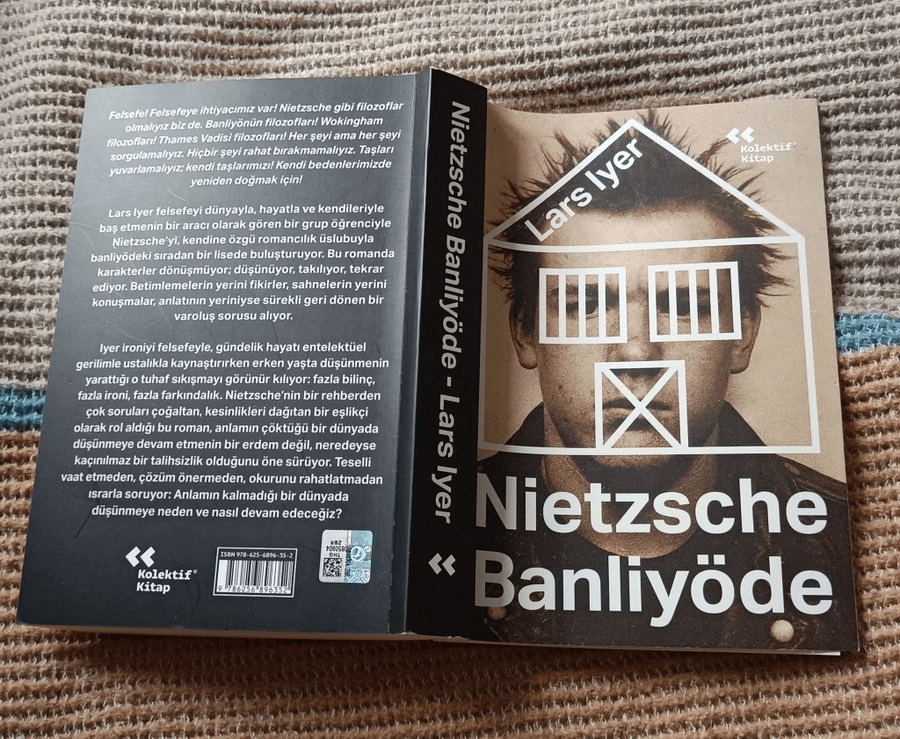
Review of Nietzsche and the Burbs from the Sunday Times, 5th January 2020:
A rock-music caper loaded with adolescent yearning.
Houman Barekat
Lars Iyer is not one for changing the record. Between 2011 and 2014 he published three short, satirical novels inspired by his time as a philosophy lecturer. The Spurious trilogy affectionately skewered the pretensions and anxieties of over-earnest intellectuals; a fourth nove, 2016’s Wittgenstein Jr, ploughed a similar furrow. The theme is reprised in Nietzsche and the Burbs, albeit this time by focusing not on cloistered scholars but a gang of sixth-formers at a comprehensive in a Thames Valley suburb.
The narrator, Chandra, and his pals, Art, Merv and Paula, are united by a hatred of all things mainstream. When they’re not tormenting their teachers with precocious backshat or sabotaging the annual cross-country (‘Sure, we could have run. But we chose not to, like gods’), they enjoy knotty discussions about madness, suicide and the climate apocalypse.
They befriend an engimatic new boy, whom they nickname Nietzsche on account of his brooding demeanour and love of philosophy, and invite him to join their dodgy band as lead singer. The group, rechristened Nietzsche and the Burbs, is plagued by creative differences: ringleader Art – who regards potato chips as ‘false consciousness’because they keep the masses happy’ – wants them to play ‘tantric dub metal’; Paula denounces this as ‘aural wanking’ and would rather make music people can dance to.
Iyer’s co-protagonists don’t entirely convince as a depiction of contemporary youth: when Chandra declares that ‘No one will ever have been more bored than we are. More purely bored’, he sounds more like a 1970s punk-rocker than a 21st-century digital native. Their cud-chewing – on the redemptive power of art, the yearning to transcend the banality of modern existence and so on – grows wearisome.
But Iyer does a good line in pithy dialogue, and the landscape of late adolescence is evocatively rendered, encompassing everything from the ‘Hieronymus Bosch grotesquerie of the PE changing rooms’ to the thrill of anticipation of nights out: ‘Why not secede, sit life out, bury ourselves in our bedrooms? Because of possibility. Because of what might happen’.
Deep uni posturing (Times Literary Supplement)
Simone Weil comes to Manchester in Lars Iyer’s latest campus novel
The new field of “Disaster Studies” is booming in Lars Iyer’s sixth novel, My Weil. It is a product of the philosophy department at Manchester’s fictional “All Saints Uni”, which, as police helicopters patrol the increasingly dysfunctional city, is home to academics on the make, busily turning “the end of the world into an academic fuel”. The coming apocalypse is full of promise and, if exploited correctly, might propel Disaster Studies students into academic jobs. The trouble is, as the narrator, Johnny, acknowledges of himself and his fellow PhD students, “we’re actually disastrous”.
Johnny and his peers are too busy keeping the “afternoon terrors” of the humanities at bay, by “day drinking” at “Ruin Bar” and filming re-enactments of scenes from Tarkovsky, to work on their dissertations. In their midst, meanwhile, Business Studies postgrads make “a mockery of the PhD student” with their focused, goal-orientated study. “Where’s their doom? Where’s their crushedness? Their diseases of the soul?” The Business Studies students seem oblivious to the fact that a PhD requires nothing short of “reinvent[ing] philosophy all by themselves, or whatever it is we’re doing”.
The arrival of a new student who wears nun shoes and calls herself “Simone Weil” does little to address their tormented procrastination. It does, however, add a new dimension to the day drinking, as Simone (who sticks to mineral water), with her unwavering belief in God and the triumph of good, provides a foil to the bleak outlook of the Disaster Studies cohort. The introduction of such a character is typical of Iyer, and My Weil completes a trilogy of sorts, following the author’s fourth novel, Wittgenstein Jr (2014), which features a young Cambridge Professor of Logic dubbed “Wittgenstein”, and his fifth, Nietzsche and the Burbs (TLS, February 7, 2020), with its suburban sixth-former nicknamed “Nietzsche” for his nihilism. If Iyer’s admixture of philosophy and fiction is not exactly subtle, it is nonetheless good fun, and no more so than when it exposes the disjunction between the life of the mind and the contemporary university. We are in the world of the “deep uni”, where figures such as “Professor Bollocks” deliver, to Johnny’s dismay, compulsory PhD lectures on topics such as time management:
TIME! MANAGEMENT! TIME! MANAGEMENT! Within the walls of a uni! As if Henri Bergson never existed! Nor Martin Heidegger! As if Deleuze had never formulated the three syntheses of time!
The grandiose posturing of Johnny and his fellow postgrads is often just as absurd as the conditions imposed by the bureaucracy and management speak of the modern university. It is never quite clear who is responsible for the most bollocks, and Iyer is at his sharpest – and My Weil at its funniest and most moving – when simultaneously lamenting and ridiculing the tragicomic plight of intellectual life in the contemporary world.
[This written interview was the basis of an interview/ profile in The Morning Star in 2023. Here it is in full:]
You’re one of the few contemporary writers who can make me laugh on the 0630 bus. From your perspective, what’s the attraction of a comic approach and where is the humour coming from?
Is the comedy a (Beckettian) coping mechanism? A provocation? The only viable means of critiquing the devastating impact of C21st capitalism?
The novels are supposed to be fresh and funny: that first of all. Laughter is important – it’s necessary to breathe. ‘Everything I’ve written, I wrote to escape a sense of oppression, of suffocation. It wasn’t from inspiration, as they say. It was a sort of getting free, to be able to breathe’: that’s E.M. Cioran in an interview. For me, that getting-free involves laughter: laughing at the Man. Laughing at the madness. Laughing at the po-faced and humourless absurdity that is all around us.
The attraction of comedy: it allows some freedom, and perhaps might grant freedom in turn. A way of diagnosing what’s happening to us, but not being crushed by it. Perhaps it might be the beginning of a critique, which is only possible if we can find others to laugh with.
In My Weil (and throughout your fiction) there seems to be a genuine and deep-seated sense of despair below the erudite wit and sharp observations. Do you believe we’re doomed? If so, why? If not, what do you believe will save us?
Definitely despair. About what? Numerous disasters on the horizon; perhaps as disastrous are the means meant to solve them.
Problem: ecosystem collapse, soil microbiology exhaustion, insect biomass erosion. Solution: the seizure and financialisation of the global commons; nature valued as a natural asset which can then be managed, controlled and, of course, profited upon.
Problem: inequality. Solution: human capital investment, which is to say, opening a new futures market by betting on the life-outcomes of prisoners, refugees and welfare recipients.
Problem: the financial crisis, unpayable debt (53 trillion dollars worldwide and counting; 31 trillion dollars in the US alone.) Solution: the Going Direct Reset initiative, as agreed to by the Federal Reserve and the big asset management corporations at Jackson Hole, Wyoming in 2019. This will see the replacement of currencies with the Central Bank Digital Currency, allowing complete control over every transaction, cutting off the wealth of deplorables. Tyrants of the past only dreamed of such power …
Are we doomed? Not if we awaken to what’s happening. What will save us? Human unmanageability, perhaps. It’s just such unmanageability that is shown in my characters’ laughter, in their friendship. Internal struggles between various factions of the powers-that-shouldn’t-be, perhaps … Something contingent, miraculous, perhaps …
My reading of Spurious, Exodus and Dogma is that there’s a focus on individual despair. In My Weil there is a collegiate spirit, but it’s mired in chaotic inertia. To what extent does this reflect an implicit rejection of the possibility of intelligent and impactful collective action?
The characters in My Weil consider various possibilities for collective action. There’s becoming lumpenproletariat – living like the raggle-taggle of criminal-types, unmanageable déclassés that Marx wrote about, who keep to the shadows. There’s becoming apocalyptic – gathering like the early Christians awaiting the Second Coming; only this time, they’re waiting for an incoming, shattering transcendence that would explode the present order of the world. There’s secession – going under the state, on the model of villages in Alpine valleys that that have their own currency, that keep low-tech – using mechanics, not electronics; or those parts of Mexico that just do their own thing, regardless of central government decree.
My characters have little faith in present institutions. My question would be whether and how we might make them more accountable, transparent and democratic. My characters are tired of all that. They say they only want to let the present world go down. I’m not sure I’d take them at their word. Perhaps we can see a viable form of collective action – or rather, collective inaction – in their common drifting, their vagueness, their abandonment of proper ends.
I’ve seen reviews of your work in which it’s suggested characters are secondary to ideas and comic situations. I don’t accept this. The dialogue fizzes and – while your characters knock lumps out of each other, with serious discussion lurching into banter and then drifting into invective – you give some serious consideration to the themes of friendship and intellectual affiliation. In terms of the Disaster Studies PhD candidates in My Weil, is this driven by a fascination with these types of personal/professional relationship, or is it rooted in the sentiment reflected in an David Bowie song: “While troubles are rising we’d rather be scared together than alone”?
Being scared together: yes, that’s the thing. Despairing together. Sharing such moods, being humorous about them, comically exaggerating them, ringing changes upon them, which means they’re no longer solely negative. Things might seem hopeless, but hope is there in our capacity to talk. We might think that we that we can’t do much about the disasters ahead of us – about neuroweaponry or weather warfare, about education capture and health capture, about destabilisation agendas, about transhumanism, but we can discuss and diagnose them. Laughing together at their folly, shaking our heads together at their evil, we needn’t be merely passive victims.
To what extent is the rejection of plot in your six novels tied into your apparent fatalism about the future (of academia, of our culture, of humanity)?
No fatalism from me. And there is some plot, at least in the last three novels. The end of Nietzsche and the Burbs sees its characters high as kites, full of wild plans. They’re together, joyful, engaged in what anthropologist Victor Turner has called ‘communitas’: a radically egalitarian, non-hierarchical community of associative friendship.
Communitas, Turner explains, can never last; its liberatory joy must inevitably give way to a restoration of order, of the ‘societas’ of familiar social bonds and roles, the usual hierarchies. The question my characters begin to ask concern the relation between the joy of communitas and the societas to which they have to return.
In My Weil, my characters, equipped with their studies in philosophy, are better able to consider this question. True, they don’t formulate it as such, but they’re constantly thinking about ways of escaping the system. The opposite of fatalism!
Focussing on your satirical take on academia. It’s particularly sharp in My Weil: how much of an exaggeration is Professor Bollocks and the notion of ‘accountability buddies’? Is it really getting worse? [I’m particularly interested in this because, in the 1980s, under the Thatcher government, I worked in an Alvey-funded AI project – each of the research teams in receipt of his funding was monitored by a figure called an “industrial uncle” (sic). I wonder if that was when the Bollocks began in earnest?]
An ‘industrial uncle’: wonderful! – I’ll borrow that. Nothing of the novel is exaggerated. The language of management theory has colonised the university. Expressions like ‘best practice’ and ‘seedcorn funding’, used without irony … No one laughs or rolls their eyes … Everything, taken straight.
In academia, at all levels: the emphasis upon self-motivation, self-directed action, self-management. The student, the academic as a self-initiating entrepreneur, realising themselves as a piece of human capital; as an economically significant commodity … Management is the task, distributing resources, actions, practices to make them more efficient, more productive. As if every problem that counts could be solved through administrative power – through correct implementation of the system.
The logic here is technological – it reflects the deepening of the technological system so well diagnosed by Jacques Ellul. Systematisation, schematisation, tabulation, bureaucratisation, qualification, rationalisation, mechanisation, standardisation, materialism and scientism: that’s what’s at work. The bollocks began long ago. To make it worse, this process of stripping away meaning, comradeship, a sense of the absurd is accompanied by the grotesque parodying of the same notions that this process hollows out: to the university as your ‘family’, to your fellow students as potential ‘buddies’, etc.
My characters, in response, cultivate counter-techniques of failure and ineffectiveness, of wandering and vagueness and of displacing ends from means. They aim at a deliberate incompetence, in which not finishing your PhD dissertation is more of a sign of honour than completing it on time; in which failure is a better sign of scholarly integrity than system-rewarded success. And they laugh – they have fun, which is pretty much forbidden in these over-serious times.
I’d argue that all six of your novels are literary fiction / new weird hybrid – based on the criteria of “[exploring] the boundaries of reality of reality and experience through philosophical speculation” (Jason Sanford, 2009). This is notable in My Weil, particularly in the supernatural (maybe?) sequences set in the Ees. [Would you be happy with the label critical realism?] Did this approach an emergent property of the subject matter, or is it a style of writing you particularly enjoy?
The Ees, a scrap of woodland in Chorlton-cum-Hardy, Manchester – meant to resemble the Zone from Tarkovsky’s film Stalker – permits the wandering and vagueness, the displacement of ends from means to which I have referred. It’s about dis-activation, which is why it’s full of all kinds of junk.
As such, the Ees is an embodiment of the students’ relationship to their PhD dissertations and, more broadly, to study. It allows them to be stupid, ignorant, disoriented – but in a positive sense. In an antidote-to-Professor-Bollocks kind of sense.
No coincidence that the character most strongly linked to the Ees is least committed to finishing his dissertation. In all things, romance included, my protagonist Johnny’s aim is to stay with potential without submitting it to an purpose, without actualising it in any course of action. And in the end, the Ees seems to ‘reward’ Johnny by letting him dwell permanently in the suspension of development.
Why Manchester? What fascinates you about the music and culture of that city in the 1980s?
The Manchester I discovered when I moved there in 1989 still had areas that were like the Ees of the my novel: unproductive areas, temporary autonomous zones such as the Hulme Crescents, an edgy zone of low-rise, system-built flats. They’re described an excellent recent article in The Guardian, and which I’ve tried to write about in my own way. It was from such places that so much great mancunian culture came.
Manchester was regenerated in the ‘90s. Investors and financiers, gentrifiers and speculators, transformed the cityscape with statement architecture, with steel-balconied warehouse conversions: monuments to cheap credit. My characters dream of battering back the mancunian regenerators, of re-opening the figurative cracks and the crevices where you used to be able live unnoticed and unbothered on government benefits. Only the Ees is left to them of that world now – the Ees and the great mancunian music to which they still listen.
What attracts you to the philosophers featured in your second (loose) trilogy, Wittgenstein, Nietzsche and Weil?
All of them I regarded as philosophical ‘enemies’ – thinkers who were, I thought, were remote from my own philosophical allegiances and concerns, but with whose work I nevertheless wanted to spend time. And I’m glad I did. You sharpen your thought by working with what you’re against …
You’ve written two books on Maurice Blanchot – is he a thinker you believe can have a transformative impact on life in the C21st? Why?
Blanchot’s a subterranean influence on so many thinkers – think of Marcuse’s notion of refusal, for example. Currents from his thought run everywhere.
What led you from philosophy to creative writing? What can fiction achieve that philosophy can’t?
- M. Cioran says regarding his own break with philosophy: ‘I realised that in moments of great despair philosophy is no help at all, and offers absolutely no answers. So I turned to poetry and literature, where I found no answers either, but states of mind analogous to my own’.
I don’t quite agree: philosophy helps in diagnosing the causes of despair, and thereby achieving some distance from the horror. Philosophy is about self-knowledge, but this is not about our inner selves so much as learning about how our inner selves are constituted. It is in this way that philosophy can provide answers about the sources of despair – about the sources of joy, too; about the meaning of friendship, about Turner’s notion of communitas and its relationship with societas.
But I agree with Cioran about poetry and literature, which can embody despair so directly, making it tangible, real. And I admit that sometimes philosophy is of no help. I want company. Thank goodness for Dostoevsky, for Mann, for Beckett, for Duras, for Blanchot, for Lispector, for Cixous and the others. For Bernhard above all! No doubt they’ll ban him soon …
In My Weil, Marcie veers from enthused earnestness to heartbreaking cynicism to naïve absurdity. Is this a satirical take on the trials and tribulations of writing a doctorate or a metaphor for the competing identities of higher education?
Although they have each other, my characters become increasingly deranged by what they fear. They know so much about what’s going on – about, say, the dangers of surveillance: behaviour tracking, compliance tracking, predictive analytics (‘pre-crime’), warning us when and where lawbreaking will emerge; even prescriptive analytics: programmes to prevent the possibility of that emergence, sending in robot dogs and supersoldiers to where our masters think a rebellion might break out; locking down the population of a troublesome district just in case …
Marcie’s Vision, capital ‘V’ – you’ll have to read the novel for context – shows her even more. She discerns the coming internal surveillance, too: synthetic biology that could see so-called ‘electroceuticals’ introduced into the bloodstream, keeping an eye on our insides. She senses the possibility of the live-editing of our DNA – of the so-called improvement of the human genome to make us more compliant, more useful. Just right for when attention turns from the enemy without to the enemy within, treating us all as potential threats to be neutralised in advance.
There’s more, much more, that Marcie sees. It’s unbearable. All she can hope for is human unmanageability, which she understands as the capacity to love …
Nothing satirical intended with my depiction of Marcie, who tries to revive a myth of sorts, the story of the Antichrist, to give her a sense that something might be done, to inflate the issue to the level of the cosmos …
An A to Z of Spurious (2011)
I hope Spurious can be enjoyed by a reader entirely unfamiliar with the names and ideas mentioned in its pages. In large measure, I think, it is the way W. and Lars enthuse about a scholarly project or a specific thinker that makes the novel entertaining (if indeed it is entertaining). On the other hand, perhaps there is something to be gained from focusing in a little more depth on some of the recurring ideas, names and objects in Spurious, since they are not entirely arbitrary. That is the aim of this A to Z.
I have underlined all words in the following entries that are covered elsewhere in the A-Z, in order to facilitate hyperlinking.
A is for …
Peter Andre, 1973-
Australian born singer and television personality, known for his huge hit ‘Mysterious Boy’ and his Reality TV assisted comeback, which saw him meet and subsequently marry Katie Price, AKA Jordan. They have since divorced.
Lars reads about the exploits of Peter Andre and Jordan in his gossip magazines.
Apocalypse
The end of times; violent, climactic events. Etymologically, the word suggests a lifting of the veil, a revelation of a hidden truth. Thus, the Biblical prophet vouchsafed an apocalyptic vision learns something of God’s plan – for example, how the wicked will be punished. As such, for the righteous the apocalypse is entwined with a sense of hope: the destruction and suffering to come may well make room for the coming of that restorative figure called the Messiah. More loosely, any event that sees the overturning of the security and predictability of life can be seen as apocalyptic – for example, climate change or the current financial crisis.
Lars, according to W., has a particularly keen sense of the apocalypse, but lacks what, for W., is the intertwined hope that he calls messianism. This might well be due to Lars’s Hinduism, W. says.
W. credits Rosenzweig with having a particular insight into the apocalypse, perhaps because of his experiences in World War I.
B is for …
Benjamin, Walter, 1892-1940
German Jewish critic and philosopher. Friend of Scholem and mentioned in passing in Spurious. Benjamin is famous for combining ideas drawn from Jewish messianic thought and Marxism.
W. compares Lars’s sagging trousers to those of Benjamin, which, in what W. calls a well known photograph (I’m not sure if it’s the one above), are pulled up tight around his waist.
Brod, Max, 1884-1968
Writer friend of Kafka and famous for refusing his friend’s request that his manuscripts be burned after his death. Brod’s renown in his own lifetime – he was a prolific author across a number of genres – has been almost entirely eclipsed by those he generously supported, Kafka among them. Brod encouraged his friend in his writing, and eventually oversaw the posthumous publication of The Trial, The Castle and America and other works in contravention of Kafka’s wishes. He wrote several works on Kafka, in the form of biography and fiction, proposing a pious, almost hagiographical, interpretation of the life and work of his friend. Brod has not been forgiven for this by legions of Kafka’s admirers. In a famous essay on Kafka, Benjamin called Brod a ‘question mark in the margin of Kafka’s life’.
W. and Lars wonder which one of them is Kafka, and which Brod, before entertaining the troubling idea that they might both be Brod, and altogether lacking a Kafka.
Blanchot, Maurice, 1907-2003
Eminent French novelist, literary critic and philosopher. A concern with the significance of speech, and its relation to networks of power, is, arguably, as abiding in Blanchot’s work as his better known interest in writing. In this regard, Blanchot bears the influence of his lifelong friend Levinas. Blanchot was also part of the group of intellectuals and activists who met in Duras’s flat on the rue Saint Benoit, and he was a friend of Dionys Mascolo.
W. and Lars discuss the photograph shown here of Levinas and Blanchot, reproduced in Salomon Malka’s biography of Levinas. Levinas is at the top of the picture, with Blanchot seated to his right.
C is for …
Canada
W.’s utopia, where he spent much of his childhood and to which, through numerous job applications, he has tried and failed to return.
Cawsands
Town in southwest England, reached from Plymouth by passing through Mount Edgcumbe. W. and Lars visit a pub there.
Cohen, Hermann, 1842-1918
German-Jewish Neo-Kantian philosopher, who, in his late work, argued for the ethical significance of Judaism. His account of what he called the correlation of God and human beings, whereby, although independent, they reciprocally determine one another, was very important to Rosenzweig’s thought.
Also notable in Cohen’s work is the role of prophetic messianism, which sees the defeat of injustice in the movement towards the realisation of ideal ethical laws.
W. finds Cohen’s work particularly suggestive regarding the notion of the infinite.
Conic Sections
A conic section is any of a group of curves (circle, ellipse, parabola, hyperbola) formed by the intersection of a right circular cone and a plane. Originally studied by the ancient Greeks, Kepler found an important scientific application for them in the seventeenth century when discovered that planets move in ellipses.
W. reads Cohen on conic sections, and dreams he might himself become the philosopher of conic sections just as Lars might become the philosopher of the infinitesimal calculus.
D is for …
Damp
Moisture on an inner surface of a building, promoting the staining of walls by salt and mould. Leads to the loosening of wallpaper and the rotting of wood, and sees paint and plaster flaking away.
Damp has a number of causes: condensation damp comes from water vapour in areas of the building where air doesn’t circulate; penetrating damp results from precipitation entering an inner surface as a result of faulty roof flashing or missing pointing; and rising damp is caused by capillary action dragging ground moisture up a masonry wall.
The cause of damp in Lars’s flat is, however, mysterious. Although we see W. helping Lars to clear the kitchen and bathroom in the flat in preparation for the application of a damp proof course, it appears that this remedy fails. The kitchen remains damp, and there is still the sound of rushing water. We next learn that the ceiling has been taken down, and new joists installed: presumably some kind of leak has been fixed. But the sound of streaming water persists. No amount of dehumidifying and fan heating seems to make any difference to the damp, which Lars calls his apocalypse.
Deleuze, Gilles, 1925-1995
French philosopher mentioned in passing in Spurious. Lars justifies his inactivity by comparing it to the ‘five year hole’ in Deleuze’s career. Deleuze actually refers in an interview to an ‘eight year hole’, the gap between his monographs on Hume (1953) and Nietzsche (1961) in which he was busy teaching in the lycées and working as an assistant in the history of philosophy at the Sorbonne. Deleuze’s expression is borrowed from F. Scott Fitzgerald, who writes of a ‘ten year hole’ in one of his short stories.
Dundee
Scottish city on the Tay estuary, the fourth largest in the country. It seems to enjoy a microclimate that, while it is in the far north of Britain, makes it surprisingly warm and bright. This is why Lars puts on his sunglasses, which W. so despises, on their visit to the city.
E is for …
Esteem Indicators
Marks of respect from scholars and researchers in a particular academic field, including awards, fellowships of learned societies, prizes, editorial roles, conference organisation, positions in national and international strategic advisory bodies etc.
W. suggests that Lars, who lacks any of the above, fill in humiliation indicators instead.
Europe
American readers might find it surprising that the British speak of Europe as though they didn’t belong to it. But Europe, to the British, is invariably continental Europe, i.e. over there, across the channel.
W. and Lars also speak of Old Europe – a sense of culture and history very different from that in Britain. Indeed, they claim that the British no longer live in history. They feel they will never be part of that milieu from which the thinkers they admire emerged, neither speaking its languages nor having the necessary depth of scholarship and religious feeling.
F is for …
Flat, The
Lars owns a damp-ridden flat, the floors of which noticeably tilt because the flat was built above a mineshaft. The damp in the kitchen has long since prevented the electricity in there from working. Behind the flat, there’s an equally grotty yard. Sal refuses to visit Lars’s flat, and W. does so only under protest.
Freiburg
Full name: Freiberg im Breisgau. Small city on the edge of the Black Forest in the southwest of Germany. Freiburg was known as the ‘city of phenomenology’ in the 1920s, with Husserl and then Heidegger holding university Chairs there. Freiburg was painstakingly reconstructed street by street, house by house, after extensive bombing during World War II.
The Fish Quay
Historic part of North Shields, a small coastal town to the east of Newcastle, on the Tyne. Ferries run from the nearby terminal to the Netherlands (not Norway, as W. and Lars seem to think).
Friendship
W.’s touching faith in friendship and love can seem at odds with his perpetual hounding of Lars. But nagging, he says, is part of friendship; how else might friends push one another to greatness?
W.’s plan only to publish with his friends has led him into difficulties with his editor, whose publishing company seems to have failed, resulting in W.’s book having gone almost immediately out of print.
G is for …
God
The characters cannot but struggle with the idea of God. They are not, in any usual sense of the word, men of faith, but they do see themselves as, in some measure, religious: that is, they feel a kind of religious pathos. Alas, this is not enough to save them from atheism.
Golem
In Jewish Folklore, an anthropomorphic being brought to life by supernatural means. In some stories, the Hebrew word ‘truth’ needs to be written on the golem’s forehead in order to animate it. Other stories tell of writing letters on a piece of parchment, which is then placed inside the golem’s mouth in order to bring it to life.
Godspeed, You Black Emperor!
Canadian post-rock band, known for writing long instrumental songs making use of sampled sounds. ‘Dead Flag Blues’, which W. continually plays to his students, is the opening track on F♯ A♯ ∞ (F sharp, A sharp, infinity) from 1997.
Gossip
Lars is much given to reading downmarket gossip magazines (‘chav mags’) about celebrities, which W. finds particularly exasperating.
Greek
W. has tried several times to learn classical Greek, but has been defeated each time by the difficulty of understanding the operation of the aorist, a form of the verb that expresses action without indicating its completion or continuation. At one time, W. and Lars studied Greek together, but Lars, according to W., only retained one word from these lessons: omoi. Lars is said to have used classical Greek in one of his moments of illumination.
H is for …
Hinduism
Ancient religion of the Indian subcontinent, characterised by a belief in reincarnation.
Lars is Hindu, and exhibits what W. calls Hindu fatalism – the sense that what is to happen is preordained. Presumably this is one of the things which, for W., gives Lars his vivid sense of the apocalypse. At the same time, W. insists that the Hindu never really experiences the apocalypse. He argues that whereas for the Jew and the Catholic, time is linear, and the End Times really are the End, for the Hindu, time is cyclical. According to Hinduism, our age might indeed be the End of Times, but it will in turn be superseded; after the destruction will come the great flood from which the universe will be reborn. So Hindu fatalism is, W. argues, a comfort. At the same time, W. notes, with the idea of moksha (see below), Hinduism does promise a release from the cycle of life and death, providing a second kind of comfort.
Lars, according to W., has tried and failed to become a significant scholar of Hinduism.
Howard Hughes, 1905-1976
Aviator, film producer and director. Hughes suffered from obsessive-compulsive disorder, once occupying a screening room in a film studio for four months without leaving, living only on chocolate and milk and relieving himself in empty bottles. He did not cut his hair or nails in this period. In his later life, he became a recluse, living in hotel penthouses around the world. When Sal’s away, W. fears he’ll give in to his agoraphobia, turning into a scholarly Howard Hughes.
I is for …
Idiocy
Alleged state of W. and Lars in Spurious. W. claims Lars’s idiocy is the simple absence of thought, whereas his idiocy is the result of indolence. Either way, W. says that he and Lars share the fact that they have always known they were idiots, even as they’ve endeavoured to struggle against their idiocy.
Illness
The great figures that the characters in Spurious admire were often ill: Kafka died at 42 of tuberculosis; Rosenzweig, locked in by paralysis years earlier, succumbed to ALS aged 40; a botched medical procedure left Blanchot incapacitated for much of his very long life. W. and Lars suppose that the illnesses in the thinkers they admire was linked to their ability to think. A tempting idea, but the characters’ illnesses (coughs and colds) are not, alas, similarly productive.
Infinite judgement
A logical classification which appears in Kant’s typology of judgements in the Critique of Pure Reason. In Religion of Reason, Cohen discovers in this notion a positivity prior to both affirmation and negation – that is, to a superlative or transcendence which he links to a certain conception of the negative in ancient Greek thought. This leads W. to conclude that the in- of infinite should not merely be understood privatively (that is, as a mere lack of finitude); there is a positive sense to the word, too.
The Infinitesimal Calculus
Branch of mathematics comprising differential calculus and integral calculus developed by both Leibniz and Newton in the 1660s. The method of infinitesimal calculus, based on the summation of infinitesimal differences, has been treated sceptically by mathematicians and philosophers. However, Cohen made use of it in his discussion of the existence of God, influencing Rosenzweig. W.’s enthusiasm for Cohen’s discussion of the infinitesimal calculus is tempered by his inability to understand it.
J is for …
Jordan, 1978-
British celebrity and TV personality. Former glamour model.
Judaism
The main philosophical source for the ideas discussed in Spurious is the thought of those German speaking Jews who sought, early in the twentieth century, to address a crisis of traditional values.
Rosenzweig, Scholem, Benjamin and others share the view that the human suffering caused by World War I spelled the end of a simple faith in historical progress and the meaningfulness of history. More generally, they concur with Nietzsche that our time is marked by the ‘death of God’, a collapse of those traditions that made sense of the world, although they do not draw the same conclusions from this as Nietzsche did.
It is primarily with the thought of Rosenzweig that Spurious is concerned. In response to Nietzsche’s challenge, and under the influence of Cohen, Rosenzweig attempts to unfold a hidden, utopian dimension of Jewish messianism that creatively interrupts linear history. Scholem and Benjamin have similar ambitions. In his letters to Rosenstock, a Christian convert, Rosenzweig argues that Judaism is exemplary for the rest of humankind in its preservation in liturgy of its peoples’ relation to God.
Scholem and Benjamin follow some aspects of Rosenzweig’s thought in this regard. Levinas and, in his own way, Blanchot do the same in the second half of the twentieth century.
W. has a Jewish ancestry, although his family are converts. He is, among other things, a scholar of ancient Hebrew.
K is for …
Franz Kafka, 1883-1924
Prague born Jewish writer. Kafka’s unfinished, posthumously published novels The Trial and The Castle and Kafka’s many stories, notebook fragments, aphorisms and letters, are marked by a sense of a vanished religious authority. Many of his fictions, as Benjamin noted, are similar to parables: they seem to have a code, pointing to some meaning hidden to the reader. Alas, they are not truly allegorical – there is no Truth behind the fable. If Kafka’s work, as Scholem argues in his correspondence with Benjamin, ‘belongs to the genealogy of Jewish mysticism’, if, like that mysticism, it seeks to present a revelation, it is a revelation of the impossibility of revelation, an allegory of the absence of Truth.
Kafka’s life was marked by a faith in his vocation as a writer and a perpetual disappointment with the fruits of that vocation. He has been held up by many critics as a model of writerly integrity and an exemplar of the modern predicament of living in the wake of settled traditions.
W. and Lars immensely admire Kafka’s work. W. describes his life as having been marked by a sense of falling short of Kafka, which, given Kafka’s own sense of consistently fallen short of his own vocation – indeed, falling short because of that vocation – is a double banishment. W. has even attempted, but without success, to write literature in imitation of Kafka.
Kant, Immanuel, 1724-1804
Enlightenment philosopher, mentioned in Spurious solely for his condemnation of Schwärmerei.
L is for …
Lars
Narrator of Spurious, Lars lives in a damp-ridden flat in Newcastle. He is a friend and collaborator of W., who he visits in his hometown of Plymouth, as well as travelling with him to Freiburg and Dundee, among other places, to attend academic conferences and give presentations.
What we know of Lars is almost entirely refracted through W., conversations with whom, as recorded by Lars, form the substance of Spurious. He is, we can presume, employed in some kind of academic job, probably as a lecturer in philosophy, has published at least two books (according to W., they’re very bad), and has a role in the college where W. teaches, at one point inspecting W.’s teaching. He is also prone to making desperate bids to escape from his current position, attempting and failing over the years to become a scholar of Hinduism and of music. W. notes that because Lars has suffered periods of unemployment, he is ingratiating towards authority.
Like W., Lars cannot drive and has a penchant for flowery shirts. Lars is a Hindu by origin, but is, like W., an atheist.
For W., Lars is characterised by idiocy, obesity, over-exercised thighs and arms, continual illness, apocalypticism, administrative facility, emotional reticence, an inability to converse, Schwärmerei, whining, a sense of persecution, a victim mentality and general hysteria.
Leibniz, Gottfried, 1646-1716
Philosopher mentioned briefly in connection with Cohen, presumably since Leibniz invented the infinitesimal calculus so important to the Jewish thinker.
Levinas, Emmanuel, 1906-1995
Lithuanian born philosopher who spent his working life in France. Levinas is best known for his account of the relational genesis of the self. It is in our address to the presence of the other person, he argues, that we awaken to ourselves as individuals. In speaking to the other human, we become properly ethical. Levinas is distinctive in attempting to provide a phenomenological justification for this claim, and giving a new twist to what W. calls the logic of relations.
Leaders
W. and Lars have decided that their true role is to promote and serve the thought of others. This might in some measure redeem their own idiocy.
W. and Lars have picked out three leaders over the years, each of whom refused to accept that role. The first was characterised by his seriousness. The second was a man of faith and an expert in financial matters, who predicted economic collapse within the next few years. The third, apparently the greatest of them all, spoke with such profundity that he almost convinced W. and Lars that they could think.
The spiritual leader of W. and Lars is Kafka. They would like Tarr to lead them, too, if they could persuade him, which is unlikely.
Leper Messiah
The Talmud reports a conversation between Rabbi Joshua ben Levi and the prophet Elijah. ‘When will the Messiah come, and by what sign may I recognise him?’, asks the rabbi. Elijah tells the rabbi is already here, sitting among the poor lepers at the gates of the city. The Messiah binds his sores one by one, instead of bandaging them all at once, Elijah says, because he might be needed urgently, at any time.
Literature
The downfall of both W. and Lars, they agree, is that their literary enthusiasm has compromised their philosophical investigations. Reading Kafka’s The Castle set both of them off on the wrong path, W. spending years attempting to imitate Kafka in his own literary writing before giving up, and Lars, according to W., still thinking that he might be Kafka.
Logic of Relations, The
A synonym for the interhuman relation as explored in the German Jewish tradition exemplified by Rosenzweig and Scholem, as well as by Levinas and Blanchot.
M is for …
Man bag
Form of receptacle that W. finds vastly superior to the rucksack, which Lars favours. W.’s man bag is the perfect home for his notebook, he claims, and for his wipes.
Martini
Cocktail made with gin and vermouth, and garnished with an olive or lemon rind. W. and Lars find the Martinis at the members-only cocktail bar at the Plymouth Gin distillery to be particularly noteworthy.
Mathematics
Under the influence of Cohen and Rosenzweig, W. wonders whether mathematics might be the royal road to God. W. is a poor student of mathematics, however, having tried and failed to understand the infinitesimal calculus.
Mascolo, Dionys 1916-1997
Political activist and philosopher. Mascolo is best known now as a member of the Rue Saint-Benoit group, which gathered informally at the flat of Marguerite Duras. Mascolo met Duras, Bataille, Blanchot and others through his job as a reader for the French publishers, Gallimard.
Mascolo joined Duras in the Resistance in 1943, and followed her into the French Communist Party a few years later, before leaving it in 1949 with the aim of developing another institutional form for the left. With Blanchot, he drafted the so-called ‘Manifesto of 121’, and was also active in the Students and Writers Committee during the Events of May 1968.
W. sends Lars a quotation from Mascolo’s book, Communism, which reflects many of the views of the friends who gathered at Rue Saint-Benoit.
The Messiah/ Messianism
A restorative figure found in the Bible. Biblical prophets look forward to his coming, which will transform the world, punishing the sinful and rewarding the righteous. The figure of the Messiah gains particular importance in times of instability and persecution. It is also possible to speak of messianism, which is not simply a belief in a coming Messiah, but the sense that a new epoch is approaching.
Cohen gives the notion of the Messiah a new significance in his work, arguing that prophetic messianism names the defeat of injustice in the movement of humanity as a whole towards the realisation of universal ethical laws. The thinkers who followed him, Rosenzweig and Scholem among them, had, by contrast, lost their faith in such a movement. For them, messianism would intervene, if it did, by interrupting history, by showing that official history, the linear account of events, contains within it a utopian promise.
It is the relation to this messianism, this source of hope, to which Rosenzweig and Scholem, and thinkers who emerge from the same tradition (Levinas, and to some extent, Blanchot), link their reflections on ethics, politics and religion. They share a common sense that messianism is associated with the capacity to speak, to dialogue between human beings. For W., likewise, conversation can be said to be messianic, if approached in the right way.
In Spurious, W. and Lars are researching the topic of messianism with the aim of writing two parallel essays on the topic. They discuss the apostate Messiah, Sabbatai Zevi, as well as the story of the Leper Messiah, and consider the doubling of the figure of the Messiah that Scholem writes about, which sees the Messiah of the old world duplicated by the Messiah of the new one. Their reflections are animated by a vivid sense of what W. calls the logic of relations.
Moksha
Liberation from the cycle of birth, life, death and rebirth (reincarnation) in Hinduism. Through moksha, the soul attains ultimate peace and enlightenment in the union with God. It is only through moksha, W. says, that Lars will really accept the damp spreading through his flat.
Moment of Illumination
Rare event when Lars actually has an idea, according to W. Sometimes they involve using terminology from ancient Greek. W. mentions two moments of illumination in Spurious: once in a pub garden in Oxford, and another time on the long pier at Mount Batten.
Mount Batten
Outcrop of rock in Plymouth Sound, on which Mount Batten Tower, a circular artillery fort, was built. Mount Batten is a gateway to Turnchapel and other parts of the coast. Reachable from Plymouth by water taxi, it was the site of one of Lars’s moments of illumination.
Mount Edgcumbe
Country house and extensive grounds, bequeathed to the city of Plymouth by the Duke of Edgcumbe. Reachable by ferry, it is a favourite haunt of W. and Lars.
N is for …
Newcastle upon Tyne
City in the northeast of England, on the north bank of the river Tyne. Newcastle played a major role in the Industrial Revolution of the nineteenth century, and was a major coal mining and shipbuilding area until the 1980s. Subsequently, the city was marked by poverty and unemployment. Newcastle saw concerted regeneration in the late 1990s and 2000s.
Lars lives in Newcastle, a city he and W. greatly admire not least because it, like Plymouth, is on the periphery.
Notebooks
Both W. and Lars have notebooks, W. following the advice of a friend, to write about the ideas of others using black ink, and, at the back, to develop his own ideas using red ink. Lars, according to W., fills his notebook with pictures of cocks and monkey butlers.
O is for …
Overpraise
Only hyperbolic praise can help one’s friends survive the Stalinist control procedures imported into British academia from business. Without it, as in Stalin’s USSR, there’s always the risk that ‘somebody’s going to be shot’.
Omoi
Classical Greek word meaning alas. The only word of ancient Greek that Lars learned from his studies, according to W.
P is for …
Puerility
Childishness, immaturity, triviality. Defining characteristic of W.’s and Lars’s sense of humour, which they’ve always regretted.
Philosophy
Branch of investigation that deals with questions concerning the nature of reality and the source of values. Most of the intellectual figures W. and Lars refer to in Spurious are philosophers, and we can deduce that they are employed in some capacity to teach philosophy. It also seems evident that W.’s and Lars’s route into philosophy was through Kafka, and therefore through literature. Indeed, both W. and Lars blame their inability to philosophise on the baleful influence of literature, and wonder what they might have become if they had a background in mathematics.
As they tell Sal, W. and Lars regard as impossible coming up with their own original philosophy, presumably given their idiocy. Nevertheless, they both rise early each morning to read and write philosophy, and W. in particular thinks he might be on the brink of having a philosophical idea.
Plymouth
City in the southwest of England, magnificently located on the stretch of coastline called the Sound, between the mouths of the river Plym and the Tamar. The Hoe, the public space running along much of the Sound, gives a splendid view of what is the largest natural harbour in the country.
Like the equally peripheral Newcastle, Plymouth is a poor city, which condition the imminent departure of the Royal Navy will only exacerbate.
Plymouth Gin
Gin distilled at the Black Friars Distillery in Plymouth, formerly a monastery of the Dominican Order. With corporate buyouts in the 2000s, Plymouth Gin was relaunched as a brand, and its bottle redesigned. Gone, sadly, is the depiction on the inside of the label of a monastery friar, whose pictured feet, it was said, should never run dry.
Plymouth Gin is best in enjoyed with water, rather than tonic, and should be sipped from a wine glass for full appreciation of its bouquet.
Poland
W. and Lars recall a visit to Poland, which took place before the events recorded in Spurious. They journeyed from Warsaw to Wroclaw in the company of a guide, and claimed to have learnt a great deal from the steadily paced drinking of the Poles.
R is for
Ringlets
Locks of hair hanging in corkscrew-like curls, as worn by Orthodox Jews. W. is cultivating his ringlets, which, he claims, are particularly disliked by drivers.
Franz Rosenzweig, 1889-1929
Great German Jewish thinker, known for developing what he called the ‘new thinking’, which combines philosophy and theology. Unlike what he calls the ‘old thinking’ of previous philosophy, which placed emphasis on an abstract, atemporal attempt to grasp reality, Rosenzweig takes up the insights of Kierkegaard and Nietzsche in order to understand what is particular to individual human existence in its relation to God. In their correspondence, he and his friend Rosenstock co-develop an argument as to the significance of speech in human moral life, claiming that the moral self awakens in its address to the other person in speech.
The Star of Redemption, his masterpiece, was written in a six month burst of creativity whilst Rosenzweig was in military service during World War I. Upon his return to civilian life, Rosenzweig founded a well-known centre for Jewish adult education in Frankfurt, the Lehrhaus, which attracted Kafka, among other German-Jewish intellectuals, through its doors. Shortly afterwards, Rosenzweig was diagnosed with a progressive paralysing illness which soon saw him completely ‘locked in’. In the years that remained to him, Rosenzweig was, through a method of ‘dictation’, able to keep up a prolific correspondence and translate the Hebrew Bible in collaboration with Buber.
Eugen Rosenstock (later, Rosenstock-Huessy), 1888-1973
German born philosopher and sociologist, known to posterity chiefly as a friend and correspondent of Rosenzweig, who he influenced with his idea of ‘speech-thinking’. Rosenstock argued for the importance of speech as a responsive and creative act, claiming, in particular, that theoretical thought has thus far failed to attend to the significance of the vocative case in speech, in which the self is summoned or called by the other person. He thus replaces Descartes motto Cogito, ergo sum, I think therefore I am, which grounds the experience of the world in the thinking subject with the motto ‘Respondeo etsi mutabor’—‘I respond although I will be changed’.
As has been revealed in recently published correspondence, Rosenzweig fell in love with Rosenstock’s wife, Margit Heussy, or Gritli. This love was reciprocated with Rosenstock’s knowledge, and inspired the central notion of revelation in The Star of Redemption.
S is for …
Sal
W.’s partner and inspiration. A talented worker with glass, she has practical skills, which W. and Lars entirely lack. Sal wonders why W. and Lars haven’t developed their own philosophy, and finds their work, when presented, to be vague and boring.
Sansrkit
Ancient language of the Indian subcontinent, with a status analogous to that of Latin or ancient Greek in Europe, being of only scholarly interest outside its use in religious liturgy. According to W., Lars tried and failed to learn Sanskrit as part of his study of Hinduism.
Schelling, F. W. J., 1775-1854
German idealist philosopher mentioned in passing in Spurious, whose unfinished Ages of the World was a particularly important influence on Rosenzweig.
Scholem, Gershom 1897-1982
Philosopher and scholar of Judaism, known for his writings on Jewish mysticism, messianism and Sabbatai Zevi. Scholem was one of several thinkers who sought to rethink the relationship to Jewish tradition in the wake of the World War I. He placed particular emphasis on the tradition of philosophical commentary on Jewish sacred texts and ideas. The story that Scholem tells in Major Trends in Jewish Mysticism, which is paraphrased in Spurious, was originally from a Hasidic lesson told by Agnon.
Schwärmerei
Literally meaning to swarm, it is used in German to mean something similar to enthusiasm, exaltation or fanaticism. In a late essay, Kant characterises as Schwärmerei all attempts to access an immediate knowledge of the supersensible. For him, all such claims of direct knowledge – of ‘supernatural communication’ or ‘mystical illumination’ – entail ‘the death of all philosophy’ since the knowledge being claimed is not demonstrable to others.
Southwest, The
Region of England, encompassing the counties of Devon and Cornwall. The southwest is particularly admired for its natural beauty and warm, sunny climate.
Spinoza, Baruch, 1632-1677
Rationalist philosopher, famed for his claim that nature is an indivisible, uncaused substantial whole identical to God. For Spinoza, talk of God’s purposes, intentions, aims or goals is anthropomorphising; rather, everything which exists is brought into being with necessity by nature. In his masterpiece, the Ethics, Spinoza argues that human happiness depends upon the life of reason, as distinct from the ephemeral goods we normally pursue. Our main good, Spinoza argues, is the difficult to attain knowledge of God – of nature in its entirety. It is this knowledge which allows us to experience part of the infinite love that God/nature has for itself: in short, beatitude.
Spurious
Spurious is a novel, presenting the conversations and adventures of W. and Lars had over the course of two years. It would seem that the book derives from conversations that Lars has recorded and put on his blog. Some of these conversations are fictional, W. protests: he claims not to recognise himself in everything Lars has written.
It is also a name of a weblog, on which W. and Lars were introduced. http://spurious.typepad.com/
Strasbourg
French city on the borders of Germany, and home to the university where Levinas and Blanchot studied in the 1920s.
Syriac Book of Baruch, The
Apocryphal apocalyptic text written in the decades following the fall of Jerusalem and the destruction of the Temple in 70 CE. Baruch is a scribe in the Book of Jeremiah, but is here promoted to prophet. Like Jeremiah, he is subject to various visions concerning the apocalypse and the coming of the Messiah.
T is for …
Talmud, The
A compilation of rabbinical discussions concerning the Jewish law, ethics and other topics forming the basis of religious authority in Orthodox Judaism. W. sends Lars two quotations from the Talmud, the first of which looks forward to the restoration of the Kingdom of the House of David, that is, the coming of the Messiah.
The second quotation reflects the despair that followed the Roman persecution of the Jews after the second destruction of the temple. The claim that ‘those that emit semen to no purpose delay the Messiah’ might seem a surprising one, but was directed against contemporary practices. Rather than bringing children into a corrupt world, men masturbated, or took wives too young to have children. For the rabbis, who believed that all souls are stored in heaven since the beginning of the creation, waiting only to be born, such practices only prevented the coming of the Messiah.
Béla Tarr, 1955-
Hungarian film director, whose work is characterised by a narrative slowness, bleakness of vision and apocalyptic sensibility that reflects their source material, the novels of Tarr’s close friend and collaborator, Krasznahorkai. Tarr, unlike Tarkovsky, refuses to give any sense of religious redemption in his films.
Tarr’s productions are notoriously disaster prone. He has said that his latest film, currently shooting in Budapest, will be his last. Tarr is an extraordinary interviewee, seeming to have stepped directly from one of his own films.
Playing Tarr’s films to his students comprises a great deal of W.’s teaching. He particularly admires the director for his devotion to the concrete, which is quite the opposite of W.’s and Lars’s windy enthusiasm for lofty philosophical ideas.
Andrei Tarkovsky, 1932-1986
Spurious alludes to Nostalghia, Tarkovsky’s bleakest film, which sees the madman Domenico, played by Erland Josephson, set himself on fire in a public square in Rome as a warning to humanity.
Titisee
Resort in the Black Forest, close to Freiburg, where W. and Lars hire a pedallo to go out onto the lake.
Tohu vavohu
Hebrew phrase, used in the Books of Genesis and Jeremiah. It is translated in the King James Bible as ‘without form or void’ and has the general sense of chaos and disorder. This phrase can be found on the cover of Godspeed You Black Emperor!’s 1999 mini-album, Slow Riot for New Zerø Kanada.
Turnchapel
Village in the southwest of England, for which Lars has a special love. It is reachable from Plymouth Barbican by water taxi.
V is for …
Vortex of Impotence, The
Phrase used in a quotation W. sends Lars. It’s from one of the essays in Virno and Hardt’s collection Radical Thought in Italy.
W. is for …
W.
Central character in Spurious, W. lives in a large, damp-free townhouse in a deprived part of Plymouth. He is a friend and collaborator of Lars, who he visits frequently, and has a teaching role in a college, probably in philosophy, though perhaps in theology (or, indeed, a mixture of both). He is a Hebrew scholar, and has recently published a book.
W. spent several of his childhood years in Canada, before returning to the prosaic city of Wolverhampton, where he attended a grammar school. It is not clear from Spurious when or where he met Lars, but W. thinks of his friend as a protégé.
A great deal was expected of him as a thinker in his early days, W. reports, but his sense of the apocalypse, as well as his enthusiasm for drinking and smoking, have prevented him from reaching his potential. The presence of Lars in his life has only made things worse, he says.
W.’s partner is Sal, who he loves and admires.
W.’s hair is long, with ringlets. He is of Jewish origin, though his family were Catholic converts. He is an enthusiastic reader of the work of Cohen, Rosenzweig and Spinoza, and admires Tarr’s films. He keeps Lars up to date with his research by emailing quotations to him.
W. characterises himself as having great generosity as a host, a love of conversation and a feeling for the messianic, as well as a general enthusiasm for rivers, the sea and the Southwest. He credits himself with a higher IQ than Lars, and is a reluctant atheist. W. is frustrated by his mathematical and linguistic inability.
W. dreams of returning to Canada, and of having a genuine philosophical idea. He is a great believer in friendship and an advocate of overpraise. Despite their many professions of gloom, he and Lars are essentially joyful people, W. believes.
Wipes
Disposable tissue for wiping clean one’s hand or anything small, which W. and Lars use to dab their wrists and behind their ears before giving a presentation.
Wolverhampton
City in the West Midlands, to which W. returned with his family after a few years in Canada.
X is for …
Mill on the Exe
W. and Lars drink at the pub called Mill on the Exe in Exeter, where they reflect on the splendour of the Southwest and the threat it poses to serious philosophical work.
Y is for …
Yard, the
Lars’s backyard particularly depresses W. It is a concrete patch behind Lars’s flat, shared with the flat above and filled, according to W., with rats, sewage, bin bags and rotting plants. W. suggests that only Béla Tarr would have interest in such a place, allowing it to tell its story in one of his famous tracking shots.
Z is for …
Sabbati Zevi, 1626-1676
Self-proclaimed Messiah who, although treated with suspicion by religious authorities, was able to attract a large following in Turkey and elsewhere in Europe. Zevi was known for his ‘holy sins’, which began early on with his eating of non-kosher food, and speaking the forbidden name of God, and, later led him to pronounce the Tetragrammaton in Hebrew, an act forbidden to all but the Jewish high priest on the Day of Atonement. Zevi’s conversion to Islam in 1666 was viewed as a betrayal by most of his followers, but by others as a sign of his messianism; many followed him. W. mentions Zevi’s apostasy as the outcome of a tradition in messianic thought that holds that the Messiah breaks the law rather than merely fulfilling it.
Barnes and Noble Review: Guest Books (2012)
1. Henry Green, Concluding
My favourite books are curates’ eggs, one-offs that are utterly unthinkable without their very particular author. Such a book is Henry Green’s peculiar and beautiful and ironically titled Concluding, set in alternative present during a single day at a girls’ boarding school, after two pupils have disappeared. What happened to them is never revealed, even when one of them is found, but it seems that they sought to escape the strictures of their education at the hands of the sinister State. Nor do we learn of the outcome of the struggle between the State-aligned governesses, Miss Edge and Miss Baker, and the retired scientist, Mr Rock, whose presence in the school grounds they find so irksome. These, and other unresolved plotlines, are really only the occasion for the beguiling meanderings of Green’s novel, which pitches against bureaucratic conformism not only Rock’s old-world commonsense, but also the pagan energies of the girls. I love Concluding for the glorious, syntax-straining sentences that flare out of nowhere, and are full of those same wild
energies.
2. Denton Welch, A Voice Through A Cloud
Denton Welch, like Henry Green, has a small, but devoted following, and his life is as fascinating as his work. Welch began to write after a terrible accident as an art student, when his bike was hit by a car. His third novel, A Voice Through A Cloud, left unfinished when he died of his injuries at the age of thirty-three, recalls Welch’s accident and rehabilitation, and showcases the powers of precise description that are so evident elsewhere in his writing. Perhaps it is the subject matter of the novel which makes it so moving, but there is also something deeply affecting in Welch’s delicate tracing of the psychic tropisms of a young patient, invalided at a time when his life should have taken flight, lonely for companionship, struggling with his dependency on stern and businesslike nurses, and fascinated by the seductive figures of his doctors, who, sympathetic and interesting, are too busy with their work and their lives to give him the companionship he craves.
3 Robert Walser, Jakob Von Gunten My third choice is also a ‘little’ book, by that author most enamoured of the small and the unobtrusive: Robert Walser. His third novel takes the form of a diary recording the impressions of a runaway, Jakob, enrolled at the Benjamenta Institute, which trains its young charges as servants. Like so many other of Walser’s characters, Jakob actively seeks obscurity, wanting nothing more than to lead his life as a ‘zero’. Happily bent on that course, he enjoys speculating about the eccentric Benjamentas, the brother and sister who run the Institute, as well as about the secrets which might lie within the institute’s mysterious ‘inner chambers’. The charm of this novel, which brings together folk tale and Bildungsroman even as it echoes with contemporaneous novels of introspection, is unparalleled in Walser’s oeuvre. Particularly admirable is the fussless way in which Walser leads us into his strange world, his unornate language as direct as Kafka’s, a good counterpoint to the strength of his vision – so confident in its oddness; so unique.
From Literary Hub, 2019
Five Great Books About Visionary Youth
LARS IYER, THE AUTHOR OF NIETZSCHE AND THE BURBS, SHARES FIVE BOOKS IN HIS LIFE
Ferdydurke by Witold Gombrowicz
(Yale University Press, 2012, originally published, Poland, 1937)
Witold Gombrowicz’s mapcap novel Ferdydurke is a celebration of immaturity, mocking convention, propriety, officialdom and high culture. However, this is no straightforward hymn to youth—the protagonist, magically turned from a thirty-year-old writer into a teenage schoolboy—suffers all kinds of humiliations. Still, it’s clear where Gombrowicz’s sympathies lie. Ferdydurke depicts the anarchy of youth—its wildness, its impatience—but it also exposes the anarchism at the base of our schools, our families, and of middle-class life. All authority, Gombrowicz’s novel declares, is usurped. Chaos reigns.
Jane Ciabattari: Why was Ferdydurke banned in Poland for many years after its publication in 1937? What’s so dangerous about its depiction of youth’s anarchy?
Lars Iyer: In a word, ludism. Youth’s queer anarchy, in the rolling riot of Ferdydurke, is the opposite of self-solemnity, of the ponderous weight of adulthood, of the staidness of the old order, of the old monosexualities, just as it laughs at the new order, too: at the new avatars of the Modern, of the Young Girl (a figure later borrowed by the Tiqqun collective) and her right-thinking family. The spirit of youth, of humor, serves no ideological certitude, thumbing its nose at the Nazi-occupiers of Poland and the communists who succeeded them.
Hamlet is perhaps not technically a teen (we never learn his exact age—only that he is a student), but I think it’s inevitable that we read him as such—as a doomed adolescent, caught in the Limbo before adulthood in which he lacks a role in the world, a capacity to act. The older generation are either corrupt—his mother has married his father’s murderer, arousing his disgust of the body, of sexuality—or suffocatingly conventional; whence his particular contempt for the all-too-sensible blandishments of Polonius, the advocate of normalcy. The larkishness of his university friends can offer no cheer, and he cannot reciprocate Ophelia’s love. Hamlet’s melancholy leads in one direction. His prevarication, his mixture of juvenile caprice and adult seriousness, finds its fitting resolution in the nihilistic tableau of the final act, with dead bodies littering the stage.
JC: What might be the signature lines from Hamlet that most resemble the nihilistic themes in your new novel?
LI: The first soliloquy has so much:
O, that this too too solid flesh would melt Thaw and resolve itself into a dew! Or that the Everlasting had not fix’d His canon ‘gainst self-slaughter! O God! God! How weary, stale, flat and unprofitable, Seem to me all the uses of this world! Fie on’t! ah fie! ’tis an unweeded garden, That grows to seed; things rank and gross in nature Possess it merely.
Life as “rank,” “gross,” as an “unweeded” garden that has run wild, full of disgusting things. Better not to exist at all than to be part of chaos and corruption. My central cast of characters, never as depressed as Hamlet, although they might to think of themselves as so, run up against the old problem of the meaning of suffering. They’re tempted simply to lay down their arms, to give in. But they’re too alive for that, asking instead how they might impose meaning and order on a dead world—to cultivate their figurative garden in the middle of the suburbs. Nietzsche, their new schoolmate, advises them to drop their pity and self-pity, prizing suffering for the chance of genius that might spring from it. They, in turn, become convinced of Nietzsche’s genius, persuading him to become the frontman for their band…
Yukio Mishima is the laureate of fanatical youth. The Sea of Fertility, a novel tetralogy, is about a transmigrated soul, reincarnated at four moments in southeast Asia in the twentieth century. The second novel of the tetralogy, Runaway Horses, set in the early 1930s, depicts a samurai-inspired group of young ultra-nationalists who aim to attack members of the country’s financial elite. The group falls apart. Yet Isao, the reincarnated soul, acts alone, assassinating his target, and then, satisfied that he’s fulfilled the central purpose of his life, commits seppuku, ritual disembowelment, before the rising sun. Has anyone but Mishima conveyed the desire for death, for cleansing self-sacrifice, visible in young men?
JC: Mishima certainly captured a sense of nihilism in his Sea of Fertility tetralogy. And he proved his own commitment by his suicide shortly thereafter; his ritual seppuku mirrored that of Isao and overshadowed his final work. Why do you think the novelist and the man converged in this way?
LI: Mishima’s own terrorist action took place on the same day he completed his tetralogy, storming the Tokyo headquarters of the Eastern Command of the Japan Self-Defence Forces, with his private army of adolescents, and taking his life in the samurai style. He sought to turn himself thereby in a glorious object, hoping to inspire the coup that would restore the power of the Emperor. The obvious futility of the action did not concern him, indeed, it made it only shine the more brightly.
Curious, then, that the fourth volume of The Sea of Fertility, set in the Japan of the 1970s, presents a far more farcical suicide. Torū, the protagonist of The Decay of the Angel, is psychologically poisoned by his guardian’s cynicism and disgust. His botched suicide leaves him blind and bitter, living on beyond the age in life at which his previous incarnations died. Did he miss his appointment with destiny—or was there no such thing as destiny in the first place?
Completing the truncated, malformed, blackly cynical The Decay of the Angel on the day of his seppuku, Mishima provides an ironic commentary upon his own action.
Tiqqun’s provocative work of “trash theory” presents us with The Young Girl—a figure of both the ultimate consumer and the ultimate worker of contemporary capitalism. She’s frivolous about the important issues—the climate crisis, total financialization and commodification—but serious about frivolous ones: the advancement of her career, getting ahead on social media—OMGing and LOLing, tweeting and posting and linking and liking. Why is this figure female? Because of the widely remarked upon feminization of labor in the workplace, and, increasingly, outside of it, which have seen a new emphasis on social skills and emotional work. The Young Girl does not refer to women per se, but to the prematurely cynical shock troops of our financialized hellworld, which, what with looming climatic and financial catastrophe, might not last very long.
JC: You’re drawing a direct line to Tiqqun’s work in your new novel, creating a character, Nietzsche’s sister, who is a Young Girl. How does she go about recruiting other Young Girls?
LI: Nietzsche’s unnamed sister in my novel is a “futurist,” advising companies how to adapt themselves to current trends. She also founds the FailBetter Recruitment Agency and visits the sixth-form of my novel to spread the word. A current business trend has firms encouraging the anti-corporatism of its potential Millennial and Generation Z employees. Efforts at “internal marketing” see firms promoting work for charity, with feed-the-homeless days, as well as virtue-signaling green initiatives, to make their workers feel part of a meaningful enterprise. It’s a continuation, in many ways, of the playful workplaces of the Dotcoms, aimed to encourage staff loyalty. Nietzsche’s sister is very much part of a world of entrepreneurial rhetoric that looks increasingly threadbare in the face of the climate crisis and looming financial collapse.
Exodus reviewed in Literateur by Nikolai Duffy (2013)
Nikolai Duffy
Exodus: the second book of the Old Testament, which recounts the departure of the Israelites out of Egypt; shemot (‘names’) in the Pentateuch; literally a ‘going out’: ex, meaning ‘out’, and hodos, way. Also, from the Greek, exodus, ‘a military expedition; a solemn procession; departure; death.’
***
In a short essay on Derrida’s notion of différance, translated as ‘Elliptical Sense,’ Jean-Luc Nancy invokes the phrase ‘the lightening of meaning’ which, Nancy writes, refers to the ‘knowledge of a condition of possibility that gives nothing to know.’ In such a situation, he suggests, ‘meaning lightens itself […] as meaning, at the cutting edge of its appeal and its repeated demand for meaning.’ [1]
***
Exodus is the third instalment of Lars Iyer’s much celebrated trilogy (after Spurious, 2011,and Dogma, 2012) cataloguing the existential, professional, political, and economic ruination of Lars, W., philosophy, universities, academia, life, and everything else. Lars and W. are a classic double act: acerbic, perplexed, frustrated, bound. And they are extremely funny, tragically funny. Think Beckett, think Laurel and Hardy, Little and Large. Across the wastes of Britain, academia, one playing off the other, each reprising roles laid out before any of this began, sticking to them, by and large, for lack of any clear sense of any other way to behave. This is the stuff of intimacy: W.’s abuse of Lars; Lars’ acquiescence. Lars: the half-Danish, half-Indian, used to work in a warehouse; W., the academic with great leanings towards what he describes as ‘the majesty of thinking’, contemplation, the big questions, and who claims Irish and Jewish heritage.
***
‘Critical discourse has this peculiar characteristic: the more it exerts, develops, and establishes itself, the more it must obliterate itself; in the end it disintegrates. Not only does it not impose itself – attentive to not taking the place of its object of discussion – it only concludes and fulfils its purpose when it drifts into transparency.’ [2]
***
This time, Lars and W. go on one last lecture tour of Britain to assess the ‘ruins of the humanities’ and the conditions for W.’s sacking.
Not much happens. They come and go; they drink gin; they talk, a lot, not necessarily about anything in particular. They have a sense of the ridiculous. They go on and on, relentlessly.
***
Surfaces can be difficult to read and the slate is never wiped clean, really, no matter the scourer used. Lines of reference are tangled, an entire condensed pattern of connection. Driven to entertainment.Besides, it is not always easy to be what one says; matter lost in grammar and convention, and convergence, too, the edge of letting go.
To move in the spaces language opens.
A place where life and writing come together; an engagement with history, ground, that is also a way of thinking the rifts of life, its relative strangeness, the stuff of things, some of it choppier than the rest; a whole made up of pieces, fragments: the gaps, the inconsistencies, the blindsights. Most often, contradictions are restless and ambiguity pulls in more than one direction.
***
Lars and W. are great refuseniks, even of refusing. Idealism figures as cynicism; certainty is a fine example of irony; and thinking about what irony might mean is just another reason for apathy.
And no wonder: as Paul de Man comments in ‘The Rhetoric of Temporality,’ irony is duplicitous and undecidable; it doesn’t say what it says, but neither then does it say what it doesn’t say, such that the duplicity of irony necessarily also extends to any discourse on irony.
‘Curiously enough,’ de Man writes, ‘it seems to be only in describing a mode of language which does not mean what it says that one can actually say what one means.’ [3] The ‘not-itself’ of irony does not mean that irony is negative but simply that irony establishes a way of speaking that undoes what is said.
***
‘The moment’s come, W. says on the phone. They’re closing the philosophy department at Middlesex.
W. imagines them like giant crabs, the destroyers of philosophy. As giant crabs with great metallic claws. But in the end, they’ll only be managers. Manager-murderers, with profit-and-loss spreadsheets.
‘It’ll be our turn next,’ W. says. ‘They’re coming to get us.’ The cursor, on someone’s monitor, is already hovering over our names.’ [4]
***
In The Writing of the Disaster Maurice Blanchot, about whom Iyer has written two books, writes that the grand irony is apathy: ‘not Socratic, not feigned ignorance – but saturation by impropriety (when nothing whatsoever suits anymore), the grand dissimulation where all is said, all is said again and finally silenced.’ [5]
And then, as Blanchot goes on, ‘if the “possibility” of writing is linked to the “possibility” of irony, then we understand why one and the other are always disappointing: it is impossible to lay claim to either; both exclude all mastery.’ [6]
This disappointment is everywhere in Exodus, and joyously so. Iyer makes exuberance out of folly. As he puts it in interview, ‘For me, the art of exaggeration is the literary art of our times. It is only through exaggeration that we can express ourselves in this sentimental age; that we can break through to the truth. Exaggeration and wild despair: that’s the remedy. Hyperbole is all you have left when you’re being backed into a corner.’ [7]
***
‘It occurred to me as I made my way here and there along these paths of history that there is a joy in independence, in the risk of independence in one’s thinking and making, and there is joy even in contemplating the works of the independent thinker. But what also occurred to me is that there is safety, reassurance, in being an uncritical follower, especially of an independent thinker, a revolutionary […] and that the challenge to the follower […] is to remain independent in turn – even of those we admire, of those who are themselves independent. That is, to continue to look with clear eyes, with the eyes of the “critical scholar” […] For fear that otherwise we have eyes but do not look. Or maybe it should be: we look but do not see.’ [8]
***
In interview, the poet Rosmarie Waldrop comments how continuities, smooth transitions, tend to be false. The sense that one thing follows on from another is bluff, an illusion of order. ‘There is always,’ she says, ‘the feeling that I never have enough information. The process is not so much “telling” as questioning. This implies interruption. And in the gaps we might get hints of much that has to be left unsaid – but should be thought about.’ [9]
***
‘There’s a fundamental difference in our philosophy of walking, W. says. He is a Jewish walker, for whom every walk is an exodus, a leaving behind of the house of bondage. For the Jew, every walk is a political act, a determined effort to found a new community, to journey together away from the captivity of Egypt.
But I am a Hindu walker, W. says, for whom walking is not political, but only ever cosmological – ‘You set out to come back again! You go forth only to return!’ [10]
***
essay, n. from the French, essai, to weigh, try,
measure, inquire into; a rough copy; first draft.
***
‘We were to learn about our transferable skills, I’ve told W. We were to learn about personal branding. We were to learn about time management and planning and organisation. We were to learn about working well with others, and forming good working relationships. We were to learn about motivation and enthusiasm, about showing initiative and being self-starting. We were to learn about sharing a firm’s mission…’ [11]
***
Absurd, from the Latin, absurdus, meaning:
out-of-tune, discordant, awkward, uncouth, uncivilized,
preposterous, ridiculous, inappropriate.
***
‘We need novels forged in the black fire of despair. Personal despair, political despair, even cosmic despair. Novels shot through with a sense that the end is nigh, that all our efforts are in vain, but that we might at least laugh at our predicament. Laugh — but with a laughter as black as the forces that we laugh at.’ [12]
***
Exodus; lights out… and then the very fact of tomorrow.
***
It brings to mind Blanchot’s essay on ‘The Laughter of the Gods’, particularly the part where he quotes Pierre Klossowski: ‘And thus it appears that the doctrine of eternal return is conceived yet again as a simulacrum of doctrine whose very parodic character gives account of hilarity as an attribute of existence sufficient unto itself, when laughter rings out from the depths of truth itself, either because truth bursts forth in the laughter of the gods, or because the gods themselves die laughing uncontrollably: when a god wanted to be the only God, all of the other gods were seized with uncontrollable laughter, until they laughed to death.’ [13]
***
It’s rare to read a book, let alone a trilogy, that makes you laugh out loud this often, especially given the very pressing questions it raises but refuses to answer about the value of the humanities, economics, thinking, the way of things, books. And it’s even more rare, I think, to read a book that does all this while also being this smart, and biting, and entertaining.
Dogma, reviewed at The Answer is Probably No (2012)
More or less a repurposing of 2011’s Spurious, and equally hilarious. As previously, Lars faithfully notates W.’s endless catalogue of taunts and dyspeptic rants on his failing career, capitalism, religion, the end times and the surely imminent apocalypse. We learn more biographical details about Lars – his Hindu beliefs and the rat infestation in his flat – and W. moves in with his girlfriend Sal. Iyer sends the pair on a farcical speaking tour of the Deep South of America, as well as to Liverpool and to an ATP-esque festival to see Josh T Pearson. They also attempt to start a would-be philosophical movement (Dogma), whose tenets are blatantly lifted from Dogme, the mid-90s Danish manifesto for cinema; it’s a predictably short-lived failure. Lars and W. are given several new cultural referents to obsess over and feel inferior to: Walser, Celan, Mandelstam, Leibniz, Krasznahorkai. And we discover that Lars is, ludicrously, a devoted fan of Jandek, one of whose best lines (“I don’t care about philosophy / Even if it’s right”) gets quoted, and all of whose albums are loathed by Sal and mercilessly derided by W., inspiring him to some of his finest insults. Much of the novel’s appeal lies in this combination of high learning and low banter, exchanged by two stupid men who happen to have very high IQs – and are so crippled by their accumulated learning they’ve convinced themselves they’re too stupid to understand the true extent of their idiocy. Iyer’s breezy prose, smoothly organised into concise chunks, ventilates the dialogue, conveying the relationship as a mixture of mutual dependency and inverted bromance.
Spurious, reviewed in the BN Review (2011)
In this comic novel, the sequel to Lars Iyer’s Spurious, two British academics — narrator Lars and his friend W. — journey across America on a literary lecture tour. In pubs and at bus stops along the way, they discuss religion, capitalism, and philosophical matters delivered with a droll sense of humor that buoys the weighty topics. A madcap road trip of the mind.
Quarterly Conversation
Outside Literature: The Lars Iyer Interview (2013)
Interview by Tim Smyth
Since the appearance of his novel, Spurious, in 2011, Lars Iyer has made a challenging and vigorous contribution to our sense of the importance of literature and thought in our vexed cultural moment. The intellectual anguish and inventive bickering of his two UK philosophy professors sees him steer a middle course between Mercier and Camier and Withnail and I. His combination of almost-total bleakness and bracing humour enables him to dip perilously close to despair, only to escape at the last minute.
With the sequel to Spurious, Dogma, Iyer confirmed his importance as part of an “enclave outside literature,” whose work extends the territory outside the contemporary canon to new and challenging distances. This novel extended W.’s and Lars’s itinerary across America, with little more than Plymouth Gin and the word omoi for company. As the humour deepens, so too does the despair, recalling both the Thomas Bernhard of Frost and Mark and Jeremy from Peep Show.
The final instalment of Iyer’s trilogy, Exodus, is the funniest, most hopeful, most despairing, and most gin-soaked episode of the three. Despite the impossibility of true endings, it is a final instalment—and a satisfying one at that. I talked to Lars, via email, over the course of nearly two months, during which we talked about hot tubs, the Bible, endings, and the collapsing borders of literature.
Tim Smyth: I think the first question I’d like to ask concerns naiveté. I remember you writing about this in your essay on Aharon Appelfeld. Is Lars’ (comparative) taciturnity a version of this naïveté, or does he constitute a “poor idiot professor” version of naïveté? He’s quiet, but he’s not quiet enough, even if his pronouncements (the “insight” fits, and his poems and pictures) are usually quite accurate. Also, W.’s antagonism is no doubt a distraction from “true” naïveté, which rises above the kind of thing W. baits him with. I wonder if the two characters, taken together, aren’t closer to avatars of Flaubert’s bêtise than the naiveté of someone like Aharon Appelfeld, even as the trilogy seems to declare allegiances with the likes of Appelfeld. Could you describe the difference?
Lars Iyer: Naïve art, that is, art characterized by an apparently childlike simplicity in technique, is a longstanding interest of mine. It is part of my more general concern with outsider art, that is, art produced outside the institutions of art, and which is often characterized by extreme mental states. I am also interested more generally in the notion of the “outside” as it appears in various guises in twentieth century thought (see Leonard Lawlor’s work for an account of this). These converging interests of mine strongly inform my trilogy, particularly its last volume, Exodus.
With his novel Tzili, Appelfeld attempted to write a “naïve modern art.” “It seemed to me that without the naivety still found among children and old people, and, to some extent, in ourselves, the work of art would be flawed,” Appelfeld says in an interview. Appelfeld’s character, Tzili, has some of the simple goodness of the Holy Fool in the Russian Orthodox tradition. She shows a lack of self-reflection; she is not wise in the ways of the world. Sometimes, she seems to neglect herself, but at other times, she shows a steely tenacity—the force of life itself.
As W. presents him, Lars does have some features of the naïf: he seems barely capable of taking care of himself, living in squalor and neglecting his person; he blindly follows his desires (for food and alcohol, for escape from conferences); he shows a kind of manic graphomania, with little regard for scholarly standards of writing; he seems to have unwitting powers of prophecy; he is possessed by a wild apocalypticism, believing that the world is going to end . . .
W. endlessly complains about these and other features of Lars, but is clearly drawn to his friend because of these supposed traits. W. wants a protégé—someone he can shape into a companion in thought. At the same time, he wants a friend who licenses his own discontent with academic life, who will give him an excuse to behave badly. But we should be on our guard about believing W.’s account of Lars. Is Lars really as wild as W. claims? Can an academic, even one who exhibits certain ‘outsider’ traits, ever be a real naif—a version of Tzili? A holy fool? If Lars is so naive, then how was he able to narrate the trilogy? How was he able to make his friend W., appear in an often preposterous light?
It may seem that it is the significance of Lars for W. that is important for the trilogy. But equally important, as some reviewers have pointed out, is the significance of W. for Lars. That is what the unusual narrative structure of my novels makes clear. From this perspective, Lars is certainly no naïf. He is no holy innocent, like Chance in Being There. If Jane Austen pioneered the indirect free style in fiction, then my novels, as an interlocutor of mine recently remarked, are written in a direct constrained style: it is not simply our view of Lars that is constrained, filtered as it is through W.’s reported speech; for our view of W. is likewise constrained by the third person pronoun with which he is mostly referred to even when talking directly about himself. It is Lars, the narrator, who speaks more directly after all. But having said this, perhaps it is the force and vivacity of what W. says that remains with the reader after the novel is put aside. Perhaps W. is able to burst through the narrative filtering to which Lars subjects him . . .
Are the characters stupid in the Flaubertian sense? There is a self-awareness to W. and Lars which Flaubert’s characters lack. Bouvard and Pécuchet really believe themselves to be undiscovered geniuses, and they go about their enquiries with total earnestness. In the end, of course, they are mere copyists, regurgitating the work of others. W. and Lars are aware of their inadequacy; they know they fall short, not only in terms of their knowledge, their capacity to reason, but also in terms of their ability to respond to the political crises of today. As such, they cannot take refuge in a self-deluded happiness, as Flaubert’s Bouvard and Pécuchet do. The joy W. and Lars sometimes claim to feel is much more difficult to achieve, and much more precarious.
TS: You’ve described Gillian Rose’s Paradiso as “contemporary wisdom literature.” But that definition has a bit of a bite: Paradiso shows us “how our lives repeat old heresies . . . even as they are redeemed by certain relationships with others.” Lars & W.’s discussions sustain a particular kind of relationship, but do not seem to redeem any ideas. Does it matter if the activity begins as “redeeming an idea” and ends by creating a bond? There is something exemplary intended by W.’s & Lars’ relationship, but to endorse it on the basis simply that they’re mates seems to stop short of the intended mark, and makes both activities seem like bad faith. Could you describe the “certain relationship” which seems to redeem even these “old heresies”? And how much of a redemption can it be if the relationship and the idea are antagonistic and banal respectively? While Lars and W. are accomplished in their careers, the horizon of their ignorance seems to cancel out any real intellectual distance run. In this context, what do you mean by the “redemption” of ideas?
LI: Wisdom literature is a way of classifying some of the books in the Bible that are supposed to give us lessons in practical wisdom, in negotiating life—Job, the Psalms, Proverbs, and so on. These resonate with certain popular works of Greek and Roman philosophers—Epictetus’s Enchiridion, for example—which are supposed to give us rules of conduct for day-to-day life. More generally, wisdom literature is distinguished from properly philosophical writings, which are dedicated to broader concerns. Gillian Rose’s autobiographical writings are unusual in the way that they join her abstract philosophical work with her own everyday concerns. It is in that sense that they might be called wisdom literature.
Of course, my trilogy cannot be considered wisdom literature in a straightforward sense! Neither Lars nor W. is wise, in any ordinary understanding of the word! Unlike Gillian Rose—or, for that matter, the philosophers Žižek, Mladen Dolar and Badiou, who all crop up in Exodus—they have yet to arrive at a philosophical system that they can call their own. They are not persuaded, as Rose or Žižek are, of the fundamental truth of a particular philosopher, whose ideas they can then explore and apply in various contexts. W. and Lars go from thinker to thinker—from Rosenzweig to Hermann Cohen, to Mazzari and Virno, to Marx and Kierkegaard—without electing any of them as their particular sage. Yes, W. and Lars have a sense of the crises of our time, and of the necessity of giving a philosophical response to these crises, but they are not invested in a particular philosophical position. It is for this reason that they might be said to remain as what Žižek calls “poor idiot philosophers,” dabbling in the work of this thinker and that.
What separates W. and Lars are the stakes of their respective philosophical inquiries. Philosophy seems a very serious endeavor for W., whereas Lars, according to W., is content to act the buffoon. W., as I’ve said, is drawn to Lars for this very reason. But, for W., there is also something fascinatingly serious about Lars’s buffoonery! Over and over again, W. grants Lars the power of a kind of insight, a capacity to witness the truth, that he himself lacks. Lars is presented as a savant, as a “non-thinker,” where the “non-” is not to be understood privately. Only a poor idiot can think at the end of times: that’s what W. seems to believe. The last thinker—the thinker whose thought corresponds to the apocalypse—will be indistinguishable from an idiot: that’s the possibility W. entertains. It is in this sense that Lars might be said to embody, relative to W. a kind of negative wisdom—a non-wisdom deeper than conventional standards of wisdom. A kind of “outsider” wisdom, which knows (if only unwittingly, half-consciously, requiring an act of interpretation by others) what those “inside” do not . . .
You imply that there is a distinction Lars and W.’s relationship—their friendship—and the ideas that interest them. But one of the ideas that most fascinate the characters is that of messianism, which some thinkers, whose names recur in the novels, argue is embodied in a certain relationship to the other person, even to a certain kind of friendship (see, e.g. Scholem’s book The Idea of the Messiah). From this perspective, the distinction you make is not operative in the novel. The work of friendship, for Lars and W., is at one with the work of thought.
TS: W. and Lars have a kind of holy terror before ideas of apocalypse and messianism. Yet their experience, their image of these ideas is entirely abstract. Are they sublimating a petty fear of their own exposure as frauds through recourse to such grand images? Or is there a political element to this fear? They are part of a system which allows them the luxury of feeling irrelevance at the expense of a whole (obliquely mentioned) underclass? They’re both living in pretty tough cities, but there’s little sense of social decay: it’s more a mood of sterility. I’m reminded of the echatological imagery of Matthew 13 (the wheat and the tares), or the lines “because you are lukewarm, and neither hot nor cold, I will spit you out of my mouth” (Rev. 3:16), which fit as much with Benjamin’s writings on revolution as they do with theological ideas. If they were to enter into their ideas of apocalypse a bit more, what political or metaphysical fears would Lars and W. find?
LI: We ordinarily use the word, apocalypse, to mean a kind of catastrophe, perhaps an epoch-ending event. But etymologically, the word suggests a kind of unveiling, a revelation. The Book of Revelations, which plays a central role in Exodus, shows how the wicked will be punished, and the good rewarded. The apocalypse makes sense of things.
It seem as if W. believes that a certain judgement is coming—that the real apocalypse is about to occur. And indeed it is, if we understand the word apocalypse in its ordinary sense, in terms of a catastrophe! We are in the throes of financial catastrophe, and climatic catastrophe will only intensify. But if we understand the word apocalypse in its older sense, as a kind of revelation, in which God’s plan is revealed once and for all, and the wicked are punished and the good rewarded, then, for W. and Lars, there can be no apocalypse. There will be no final revelation; nothing will ever become clear. The good will suffer along with everyone else, and the wicked will never be punished for their wickedness. My novels imply that there won’t even be an end, just as there was never a simple and stable beginning—and that, as such, the end times will last forever. Nothing will be revealed except the absence of revelation, the absence of God’s plan, and the omnipresence of chaos and contingency. For W., Lars’s character is strongly linked to this chaos and contingency.
Having said this, W. is still capable of a kind of hope. Granted, he does not believe in the Messiah of the Bible—that restorative figure who, with the apocalypse, is the agent of revelation of God’s plan. But W. does seem persuaded by those twentieth-century Jewish thinkers who proffer a different conception of messianism, claiming that each of us might be understood to constitute a kind of Messiah, in the moment when we address ourselves to other human beings. In this tradition, I become the Messiah in that act of speech in which I implicitly pledge myself in service to my human neighbor—an echo of the “Here I am” we find on the lips of Moses in the Bible. For thinkers like Rosenzweig and Levinas, this speech-act is understood as the origin of goodness, of meaning, of the order of the world. They argue that a momentary utopia opens in the act of speech.
This utopia can be found elsewhere in the novels. W. claims the messianic era is opening, during the occupation of his university campus. By this, W. means that the occupiers speak to one another in such a way that they interrupt the ordinary course of things. If, as W. seems to believe, following Benjamin and Scholem, there could be such a thing as a messianic politics, it is to be found here, however ineffective the occupation may seem.
You’re right to note that Plymouth (W.’s hometown) and Newcastle (Lars’s hometown) are, in many respects ‘tough’ cities, with a large population of the impoverished. Both cities have suffered because of right-wing policies—in particular Newcastle. But, for W., the very marginality and deprivation of these cities is a source of hope. W. finds himself moved to speak to the local populations of both cities, in the exalted sense in which he uses this word. When W. dreams of his post-capitalist utopia, it is in terms of an exodus to Dartmoor, to that hilly expanse that surrounds Plymouth.
So you see I disagree with you: I don’t think W.’s and Lars’s ideas of the apocalypse and the Messiah are “entirely abstract.” And I don’t think the fear that they fear that they are frauds, or that they are repressing a sense of their usurpation of an “unmentioned underclass.” Having said that, it was my intention to foreground, for largely humorous purposes (though there are also serious points to be made here), the disconnection between the ideas of the apocalypse and the Messiah, and the situations in which W. and Lars find themselves. There really is something ridiculous about W.’s address to his fellow pub-goers in The Dolphin in Plymouth, and about the messianic significance he attributes to his football-conversations with his fellow pub-goers in The Crown Pasada in Newcastle. There is something derisory about the occupation itself, which seems to have no wider effect; something laughable about the world-historical significance that W. seems to accord to the occupation. To his credit, W. seems to know this—a kind of sarcasm or self-irony marks some of the great claims he seems to make.
TS: At one level, this seems like an attack on the “trending” mentality that “poor idiot professors” seem to go on with. At another, it makes them seem like symptoms of a wider “cultural hysteria,” like Don DeLillo finds in the making of lists. Lars & W. are essentially fanboys. But your novels don’t limit themselves to academic satire. How would you summarize the target of your attack?
LI: To be sure, the trilogy contains some elements of academic satire. But academia is an easy target—too easy. I also wanted to write directly, non-satirically, about the horrors of capitalism—that’s why there are ‘history lessons’ concerning the aftermath of the Emancipation in the southern United States in Dogma, or with respect to working class life in nineteenth century Manchester in Exodus. It’s why the characters speak of unemployment and employment precarity, about the regeneration of urban areas, about the poverty of the homeless, of slum-dwellers, of refugees. I intend the trilogy to register real suffering, real horrors, not least the effects of financial and climatic catastrophe.
TS: To go back to the discussion of naïveté: I’m glad you mentioned the “holy fool,” it made me think of that opening scene of Andrei Roublev where the guy gets hauled up by the balloon. It seems like W. and Lars are both victims in this way. What is holding back Lars, in particular, from being a proper, exemplary holy fool?
LI: Like Yefim, the guy in the balloon, in the prologue of Tarkovsky’s film, W. and Lars are looking to escape a situation—in their case, neoliberal Britain. Alas, like Yefim once again, they cannot help but crash-land—they confront what they take to be failure after failure. But are they really failures? Aren’t they, after all, ordinary academics, ordinary “poor idiot professors”? Shakespeare is unlike other men in that he is like all other men: Borges said that. What makes W. and Lars unlike other academics is that they know their shortcomings. They’re aware of them, and they laugh at them (W., perhaps, less than Lars). This gives them, in my view, a refreshing honesty.
What holds Lars back from being a holy fool? Lars represents a terrible and seductive instability for W. W. often presents Lars as a kind of seer—he is closer to the essence of religion than W. is, closer to the essence of unemployment, closer to the essence of the suburbs and of the everyday. W. sometimes presents Lars a kind of saint, as a kind of prophet. But more often, W. casts Lars as a kind of anti-Messiah, as a Son of Perdition, as the Anti-Christ. He associates Lars with the Biblical Flood, with the monsters of Near-Eastern religions, with fanaticism and the apocalypse, with chaos and contingency . . .
This is what, for W., holds Lars back from being a holy fool. As to what I think holds Lars back from being a holy fool: look at the narrative itself, the three books Lars writes—are they the work of someone holy? And a fool? It’s quite clear that if the trilogy is, as is suggested in the narrative, collections of blog posts that the fictional Lars wrote about W., then it is also clear that W. is wildly hyperbolic in claiming that Lars is an outsider writer, or is subject to an involuntary logorrhoea.
TS: In Vila-Matas’ response to your manifesto, he gets quite programmatic about Beckett, Bolaño, and Thomas Bernhard. Your focus on “outsider art” is interesting: it allows you to sidestep the trap of “trending” authors. I know that you construct something of a canon in “Nude in Your Hot Tub. . .,” but it’s an anti-canon. Even so, it doesn’t feel like a rip-it-up-and-start-again attitude. Nor is it in thrall to the “quick, find someone new to write about” attitude of the university-based aspect of the critical industry. It’s impossible to compress a manifesto, I realize, but how would you clarify its argument? It would be easy to summarize the discussion and say that you and Vila-Matas are singing from the same hymn-sheet, but your position strikes me as being more developed than his.
LI: I have no disagreements with Vila-Matas’s article, which should be read in the context of his novels—in particular, as regards the topic that interests us here, Dublinesque. His “anti-canon” and mine are very similar!
What about the relationship between outsider art and my “anti-canon”? In an award-winning review of Dogma, the critic David Winters suggests that we should think of a “non-literature” as modelled on what W. calls “non-thinking”.[1] For W., the “non-” of “non-thinking” is not privative; it is more than a simple negation. Likewise, a “non-literature” would be more than a simple negation of literature. The prefix “non-” in my trilogy is used to suggest an outside that, in a peculiar way, encompasses the term to which it is attached. It is in this sense that W. judges Jandek to produce non-music:
Non-melody, non-competence . . . in each case, the “non-” is not privative, W. explains. Non-melody is larger than melody, he says. Non-competence comprehends competence. The universe of non-music is much, much greater than the universe of music. (Dogma)
By attaching the prefix “non-” to these terms, W. suggests that melody, competence and music should be understood as part of a larger circulation of forces.
In my trilogy, I play on the idea of this “non-” for laughs. There’s supposed to be something ridiculous about this idea. But I think Winters is right to point to the notion of non-literature in this way, and to suggest that the claims in my manifesto should be recast in these terms. But that would take a lot of work—at the very least, an engagement with those authors who already link literature and the “outside”: Blanchot, Foucault, Derrida, Deleuze, and others.
TS: I’ve read you talk about the “difficult joy” of reading. What is the difference between “difficult joy” and happiness? Is W. and Lars’ friendship a version of this “difficult joy,” or are they sufficiently aware of the meaning of their antagonisms to practice it?
LI: Like Flaubert’s Bouvard and Pécuchet, W. and Lars take a certain joy in their friendship. But unlike Bouvard and Pécuchet, their exchanges center upon their inadequacies. W., of course, is constantly berating his poor friend Lars. But Lars, in his constrained direct style, constantly, if affectionately, takes the piss out of W. The characters know they fall short, particularly with respect to political questions. They feel themselves to be usurpers. They know themselves to be caught in complex networks of exploitation. As such, the joy they feel comes at the price of a strong sense of their inadequacies.
TS: According to Blanchot, literature can always be read as pointing to its own disappearance, but writers like the ones Vila-Matas mentions (and indeed Vila-Matas himself) seem to feel as though our cultural moment exposes and historicizes this disappearance. Do you think we’ll learn anything from this? Or will there just be more hot tubs, more lists, more distraction? What would an ideal literature be if the difficult lesson of disappearance were to be learned? Are literatures of naïveté or new forms of wisdom literature appropriate, or have we enough of both?
LI: In Vila-Matas, we find a humorous recapitulation Blanchot’s sense that a certain way of literary writing is at an end, and that a new kind of writing, one which registers this end in some way, is beginning. Andrew Gallix has much of interest to say on the topic of the various “ends” of literature that have occurred.[2] In one sense, I want to say that literature is always ending! The end is eternal. It will go on forever. There can be no “apocalypse” of literature. And for that reason, there will always be more hot tubs, more lists, more distractions! But I also want to insist on the specificity, on the singularity of this end . . . I believe in it . . .
Let me risk pretension by putting as follows. Historically, any simple avant-gardist idea of a new literary practice necessarily reconsolidates the traditional institution of literature that it claims to critique. A literary practice that is ostensibly “outside” literature posits an “inside” of literature. By disobeying the police who maintain the borders of literature, they simultaneously confirm the role of those police; avant-garde practices depend on them. But what happens when the police leave their posts? What happens when no-one mans the border—when the sanctity of literature becomes a matter of indifference? There can no longer be an “outlaw” avant-gardism, because there is no law to transgress. But nor is there a literature self-certain enough, secure enough, to arrest, domesticate or tame its “outside.” The authority of literature has vanished. The house of literature is deserted. Granted, that house is haunted. There are such things as literary ghosts, even a literary “hauntology,” as Gallix calls it.
Our time, for me, is marked by the vanishing of the last traces of authority. Josipovici has it that Modernism has always been a response to the absence of a sense of authority. You lack a model. You can imitate no one. Modern writing is bereft. But for me, the Modern writer is still not bereft of literature. Literature maintains its authority for the Modern writer, its prestige. In our time, that authority is disappearing. Literature is vanishing, but no one is there to notice it. The end of literature is not an apocalyptic explosion. As Milan Kundera says, “There may be nothing so quiet as the end”:
. . . when the agony draws to a close, we are already looking elsewhere. The death becomes invisible. It’s some time now since the river, the nightingale, the paths through the field have disappeared from man’s mind. No one needs them now. When nature disappears from the planet tomorrow, who will notice? Where are the successors to Octavio Paz, to René Char? Where are the great poets now? Have they vanished, or have their voices only grown inaudible? In any case, an immense change in our Europe, which was hitherto unthinkable without its poets.
For poets, read literature.
You ask me about the “ideal literature” in which this “disappearance” might be registered. For me, it a mode of writing haunted by the literary past, for the lost futures of literary modernism. It is a writing marked by melancholy, even if it is a laughing melancholy . . . And it is a writing marked by a sense of its own anachronism, its own marginality and imposture.
TS: I wonder about the effectiveness of “negative wisdom” and “non-thinking.” It suggests, first, that the conditions which demand non-thinking can be either escaped or obliterated. This simultaneously affirms the existence of such conditions. Second, it suggests that the individual is the point at which a way out can be opened. Yet almost everything in the trilogy seems to militate against the possibility of either. Is it your intention, by reproducing an ineffective gesture, to show how all critical knowledge is ineffective? Or are the other, smaller alternatives that the trilogy posits sufficient?
LI: Although my trilogy is certainly linked to the writers and philosophers of the “outside,” it also very insistently marks the difference between the “Old European” traditions that produced those thinkers, and contemporary Britain. I intend there to be a humorous effect when I allow my characters to use terms like “non-thinking,” which seem, in a British context, hopelessly obscure and pretentious. There is a real incongruity, between the situation of my characters as lecturers in provincial Britain, and their intellectual interests—W. And Lars are would-be thinkers interested in the thought of “Old Europe,” in a place and a period in which there is virtually no interest in such thought.
In truth, anyone working in continental philosophy (and perhaps in critical/cultural theory, though this is much more “canonical” by comparison) must be aware of this incongruity. How much more difficult it is to believe in what you are doing, in the face of the indifference and even hostility of the world around you! In the face of the indifference and hostility of other academics!
For me, there is something of great value in “Old European” thought, however incongruous and untimely it may be. As such, W.’s and Lars’s project of bringing together Kierkegaards –the philosopher of subjectivity—with Marx (and the Italian Marxist thinkers)—for whom capitalism has begun to operate directly on our subjectivity—is perfectly cogent, however parodically I present it. It’s a small step, but a potentially valuable one.
TS: “There will always be more hot-tubs”: it seems to me that the more our culture focuses on dissemination over production, that the more the general conversation centers around reviews, interviews, and nominations, the more that triviality will continue to thrive. Your decision to work with a reputable independent press and your extensive use of the Internet in your project might seem like you, too, are putting dissemination over the virtues of obscurity. However, this follows the same course as “non-thinking” in starting off down the track of thinking before veering into totally different territory. There is a kind of gratuity about your means of dissemination which at once parodies and improves upon the tendency you wish to correct. Would you agree with this description of these aspects of your project?
LI: Our media environment is certainly more concerned with appearing than doing. Getting attention, increasing circulation, is all. This also applies to an author published by an independent publisher. You have to hustle to be heard. There is a continual “arms race” between sellers and consumers, which means searching for inventive new methods by which my novels can be publicized. There’s a joy in this. You’re battling for the “little trilogy that could,” the literary underdog. Your fight seems righteous. You’re on the side of the angels. You have an alibi, a defense: I have to promote my work, I have to do interviews . . . I have to blog, to tweet, to Facebook . . . Once upon a time, you could have said that this kind of self-promotion obliterates your work: that to explain or “curate” your writing, to link it to an author photograph, to discuss it in terms of your biography, is to dishonor it in some way. We might think of Blanchot’s reluctance to speak to the media. At the same time, this attitude seems too precious, almost anachronistic—as if honoring your own work, giving space to it, actually mattered. I am tempted to say that publicity subjects your work to a kind of parody that it—as so-called “literary” writing—deserves! It is a way of laughing at what you’ve written; a wholly appropriate response . . . But this, I think, is too easy a view. It gets me off the hook of being a tireless self-promoter. It gives me too ready an excuse for my endless hustling. I think I lost my soul the minute I retweeted some enthusiastic comment about my writing . . . !
Melvile House press kit interview for EXODUS
At its core, what would you say Exodus is about?
Exodus is my attempt at a ‘big’ book, a kind of comic Book of Revelations, its philosophy-lecturer characters careening through Britain in the midst of the financial collapse of the late 2000s. Inspired by a range of maverick thinkers – including Žižek, Badiou and Dolar, who feature in the novel – its protagonists dream of taking a fierce last stand against the forces of capitalism, which are arrayed against the life of the mind. Is it really easier to imagine the end of the world than getting rid of capitalism? Anticipating the Occupy movement, and the British student demonstrations of 2011, Exodus is a love letter to would-be thinkers and maverick utopians everywhere.
Where did the idea for the trilogy come from?
W. and Lars are characters I developed as comic relief on my philosophy blog. I meant them to amuse my friends, including the real-life prototype of W. But they began to draw a much broader audience, and I decided that they deserved their own book – and even a series of books – which, although constantly rooted in the cartoon-like intellectual slapstick of the characters, would also bear upon larger concerns.
Why did you decide to write a trilogy? Do the three books need to be read in sequence, or can a reader pick up Dogma or Exodus?
Why a trilogy? I felt that the exuberance of the characters merited more than one book. And there’s the exuberance of the style, too, as crazed as that of Dr Seuss, which is able to encompass virtuosic insult, apocalyptic lament, choice quotations from favourite writers, lyrical accounts of the great thinkers, and potted histories of capital flight and industrial decline. I had a sense that the delirium of my books might measure up to the delirium of our times. That’s what led me from the pared-down settings of Spurious to the much more expansive panorama of Britain in Exodus.
There’s no need for the novels to be read in sequence. Each of them (and pretty much each part of them) is a fractal of the whole. From section to section in my novels, I wanted to retain the immediacy of a daily strip-cartoon like Charles Schultz’s Peanuts, in which characters and situations would have to reveal themselves very quickly to their audience.
How do you feel about the frequent comparisons to Beckett that you’ve received from critics?
Who wouldn’t be flattered to be compared to Beckett? There are similarities indeed between my trilogy and Beckett’s Godot: both concern a pair of bantering frenemies, eternally wavering between hope and despair. But my novels are more fixed in a particular place and a time than Beckett’s fiction. They’re part of a postmodern age, an age of mass media, in a way that Beckett’s are not. My characters surf the ‘net and play computer games. They read gossip magazines and watch trash TV. These are not incidental details. My characters are very much on our side of the great mountain range of modernism.
I would make a similar claim with respect to the flattering comparisons which have been made between my work and Thomas Bernhard’s. My characters, unlike his, are engulfed in ‘low’ culture. They experience the distance between the contemporary world and the life of the mind much more acutely. The intellectual pursuits of W. and Lars are that much more absurd, that much more anachronistic, because they are undertaken in no supporting context whatsoever. Bernhard satirises Viennese high culture; but in Britain, there is no high culture to satirise. W. and Lars are almost alone in their interest in philosophers like Rosenzweig or Hermann Cohen. The thinker-friends they admire are likewise entirely cut off from contemporary British life. There is pretty much no interest in Britain, academic or otherwise, in the figures W. and Lars venerate.
W. and Lars remind me of Roberto Bolaño’s quixotic characters in The Savage Detectives, who are dedicated to living a poetico-political life – the life of Rimbaud or the Surrealists, the life of the Beat Generation – in a world in which poetry and left-wing politics are utterly irrelevant, and apocalypse waits round the corner. The story I tell of the lost generation of former Essex postgraduates reminds me most of all of the diaspora of Bolaño’s Visceral Realists. W. and Lars are as quixotic, hopeful and deluded as Bolaño’s Robert Belano and Ulysses Lima, driving into the desert. But W. and Lars are not even part of a movement, as Bolaño’s characters were. They’re quite alone… As alone as Beckett’s Vladimir and Estragon, albeit in very different way.
How do you see the future of philosophy & academia? Is it as bleak as it seems to be in the book?
In the last couple of years, we have adopted the U.S. model of higher education in Britain, effectively privatising the university, and vastly increasing fees. Graduates will be burdened with huge debt, and people from poorer backgrounds have been discouraged from academic study. In Britain, there’s another twist, which Mark Fisher has called ‘market Stalinism’. Bureaucracy and managerialism are rife, and audit-culture has spread throughout the academy. Older models of teaching are being abandoned in favour of a kind of professional training. These are desperate times! End times!
Dogma, reviewed in the Times Literary Supplement, by Toby Lichtig (2012)
The epithet ‘Beckettian’ is perhaps the most overused in criticism, frequently employed as a proxy for less distinguished designations such as ‘sparse’ or ‘a bit depressing’. But Lars Iyer’s fiction richly deserves this appellation. His playfully spare – and wryly depressing – landscape, incorporating a bickering double act on a hopeless, existential journey, is steeped in the bathos, farce, wordplay and metaphysics of the man John Calder referred to as ‘the last of the great stoics’, its characters accelerating towards a condition of eternal silence, fuelled only by the necessity of speaking out. Other influences abound, self-consciously so, including Franz Kafka and Maurice Blanchot, Ludwig Wittgenstein and Antonio Gramsci; but it is what these thinkers share with Samuel Beckett that stands out: an interest in what might be termed the tragicomic flight of Zeno’s arrow.
Following on from Spurious (also the name of his blog), Dogma is the second in Iyer’s proposed trilogy of buggering-on-in-spite books, featuring a narrator also called Lars (half Danish, half Hindu) and his splenetic companion W. (half Jewish, half Catholic), vagrant philosophers (where Beckett was fond of philosophical vagrants) bound by a friendship of loving antagonism). Lars and W. shamble around the corridors of academe, attending ever-more futile seminars and lecture tours, and sinking with increasing resolve into degradation, alcoholism and insult. This bullying is superficially one-directional: W. ridicules Lars, but it is Lars who reports this ridicule to us.
Thus we learn that our narrator is (for W.) gauche in his emotions, simian in his manners, stone-age in his intellect, at best a ‘savant’, at worst ‘Scandotrash’, ‘a squalid man amidst the squalor’, a ‘Homo Floresiensis of thought’, ‘an administrator of the spirit’, ‘fundamentally bureaucratic’, ‘a petty man, yes; a troubled man, no’. This tool of reported insult, as well as being entertaining, provides a curious sketch of the tormentor himself, a frustrated minor academic who cannot come to terms with the endless disappointments offered by the contemporary life of the mind. W.’s own sense of self-worth (despite his many self-acknowledged talents) is wavering at best, but perception, pace Derrida, being a system of relations, there is thankfully always Lars to buck him up: ‘W. feels like Socrates, he says. And I am Diogenes, Socrates’s idiot double’. At other times, our narrator merely appears to drag his friend down: ‘Somehow I always stand in the way of his beatitude’. The endless affront also serves a higher purpose: it provides a language for the author’s exploration of existential crisis.
With their souls in such a parlous state, there is clearly only one thing for it: they must found a new philosophical movement to while away the time between the morass and the apocalypse (an inevitability that Lars, with his Hindu’s attitude towards cyclicality, cannot, says W., hope to comprehend). Taking their inspiration from the avant-garde realism of the filmmakers Lars Von Trier and Thomas Vinterberg, as outlined in their ‘Dogma 95’ manifesto, W. (with dubious help from Lars) invents ‘Dogma’, a school of thinking rooted in spartanism, sincerity, collaboration and plagiarism, before expanding its principles to include reticence, alcoholism and something far more violent (‘But we got scared and backed out’). The first Dogma presentation, on Kafka, goes well: ‘W. spoke very movingly of his encounter with The Castle in a Wolverhampton library. I spoke very ineptly (W. said afterwards) …’. Further talks on love and friendship lead to fissures: by the eighth lecture ‘we were almost incoherent’ with drink and for the ninth ‘we went to the pub instead’. The fifteenth presentation ‘was for our benefit only. We gave it in secret, under cover’. In their babbling, beer-sodden hopelessness, they gradually, and failingly, approach what for Beckett, as for Wittgenstein and Blanchot, one always feels was the preferred option: silence.
Along the way, there is much scope for garrulous reflection on the human condition, fuelled by the characters’ (and author’s) academic interests, including the (Henri) Lefebvrean conception of ‘eternullity’, the Blanchotian ‘infinite wearing away’, the Gramscian crisis (‘the old is dying and the new cannot be born’) and the Leibnizian differential: ‘It is the infinite that founds the finite and not the finite the infinite – this is why the infinite is not a negative concept’. At times, Iyer’s fiction feels more like literary philosophy than philosophical literature, and the relentless metaphysical hammering can wear thin. Ungenerous reviewers might even ask whether we need another quasi-Beckettian prober of the abyss, retreading the old ground between late modernism and poststructuralism with a pair of grim-gay revelation-awaiting no-can-ers and a series of disposable quotations from a doubtless impressive library (Iyer is a lecturer in philosophy at the University of Newcastle upon Tyne and the author of two books on Maurice Blanchot).
Those critics, however, would be ignoring the countless charms of the text. Iyer’s fiction isn’t likely to change the world but perhaps that’s the point, and in the meantime we can be diverted by its irreverence, intelligence and, perhaps above all, its darkly cheerful exploration of friendship. The real joke of the novel is less W.’s cruelty than the fact that Lars retains the upper hand by controlling the reportage. This opposition sustains it, and within it there is sufficient love almost to gesture towards something beyond the void.
Dogma, reviewed in Bookslut. Apologies, I don’t know the reviewer’s name.
For Scheherazade, storytelling cannot end; for Lars Iyer, it cannot begin. Two novels in, and some reviewers are wondering where his trilogy is going, if anywhere. According to Alfred Hickling, in The Guardian, this “lack of direction becomes self-defeating.” He has a point. It is, in fact, the point.
Spurious, last year’s debut, precedes Dogma, its nominal sequel, but it would make little difference if one were to read them in reverse order, simultaneously, or even back to front. Both volumes can be dipped into at random, safe in the knowledge that the very same obsessions and characters will recur, like some trauma-induced repetition compulsion. Readers of Spurious will rediscover Lars and W. — the self-styled “landfill thinkers” — modeled on the author himself and his colleague William Large, two English philosophy lecturers who have both published books on the works of Maurice Blanchot. Their relationship revolves around the cruel but hilarious abuse that W. constantly heaps on Lars, a modus operandi that baffles their North American hosts: “Don’t they understand that it’s the only way we can express affection? It’s a British working class thing, W. told them, but they only looked at us blankly.” Lars is mocked for everything from his lack of style (“No woman would have permitted your vest phase“) to his non-thinking (“‘It’s like Zen,’ says W. ‘Pure absence'”). On the very first page, W. likens the roaring of the sea to his friend’s alleged stupidity: “It’s the sound of unlearning, he says. It’s the sound of Lars, of the chaos that undoes every idea.” They go off on a sparsely-attended lecture tour of the Deep South (“Six bored people, looking at their watches. Did we come all the way for this?”) during which they pontificate over pints of Big Ass Beer, buy souvenir togas in Athens, and are immortalized on the banks of the Mississippi for W.’s Facebook page: “He rides me like a horse. I ride him like a horse. Sal rides both of us, like two horses, with the camera set on automatic.” W. and Lars also attend music festivals, where they neck Plymouth Gin from water bottles, discussing Jandek’s “non-music” (“the ‘non-‘ is not privative”) and Josh T. Pearson’s integrity (“He speaks from inside the burning bush”). They look for religion in the everyday (“‘Are you going religious?’ says Sal. ‘I hate it when you go religious'”) and attempt to step into life like Rosenzweig (“This is where philosophy must begin anew, right here in the pub!”). Most significantly perhaps, they launch their own intellectual movement, the eponymous Dogma: “Dogma was greater than us. Dogma was broader, more generous. Weren’t we only swallows in the updraft? Weren’t we leaves swept up in an autumn storm?”
On the final page, W. asks his companion to be his Boswell, thus providing the trilogy with its creative primal scene. Lars, Dogma‘s narrator, plays the part of the Delphic Pythia, speaking for the Oracle”: he carries out his duties to the letter, almost completely erasing his own voice from the book. Most of the time, it is W. we hear speaking through Lars. He speaks of Lars, but also for Lars — in his place — as though he were a ventriloquist, but the ventriloquist is himself ventriloquized since Lars is reporting all of this. W. even begins to wonder if Lars has not conjured him up “from a sense of his own failure,” and some reviewers have speculated that he may indeed be a figment of the narrator’s imagination. Lars’s very self-effacement provides a kind of passive (possibly passive-aggressive) resistance to W., simply by letting him express himself fully. One is reminded of that medieval depiction of Socrates taking dictation from Plato, in which Derrida makes out “Plato getting an erection in Socrates’s back” (The Post Card: From Socrates to Freud and Beyond). Moving on from Lars’s hypothetical erection, there are two explicit references to ventriloquism in Dogma. The second one is clearly attributed to W., and provides a nice instance of dramatic irony: “Our eternal puppet show, says W. Our endless ventriloquy. Who’s speaking through us? Who’s using our voices?” The first reference, however, remains anonymous. W’s external monologue seems to have been completely absorbed, here, by a narrative voice whose origin is no longer clearly Lars: “We were ventriloquised; we spoke, but not with our voices.”
Like its predecessor, Dogma is composed of individual fragments that originated as blog posts on the author’s website. In spite of this episodic pattern, the novel is expertly crafted throughout. A few throwaway remarks about the “famous Poles of Plymouth” in the opening pages segue seamlessly into an evocation of Stroszek; itself forestalling the American lecture tour during which W. and Lars identify with the protagonists of Herzog’s film: “They’d come to escape the past! And what did Bruno find? The dancing chicken, W. says.”
Some of these fragments are arranged in sequences, while others could be shuffled around like the loose pages in Marc Saporta’s book-in-a-box. Structurally, as well as thematically, each stand-alone vignette embodies the hope — ever dashed, but eternally springing — of a radical new departure: “We need a realitatpunkt, W. says. A point of absolute certainty, from which everything could begin. But the only thing of which he can be certain is the eternal crumbling of our foundations, the eternal stop sign of our idiocy.”
The very possibility of starting afresh — of turning over a new leaf, and then another — seems to have vanished, hence the lack of direction; of narrative drive. Spurious never really begins: it opens in medias res. Dogma never really ends, as the final Beckettian sentence testifies: “It’s time to die, says W. But death does not come.” The novel stops and starts; it repeats on itself as though it had binged on Plymouth Gin: “Every day, the same failure.” Lars and W. mooch about in the dead time of stasis, a disjointed time, which is not so much dead, as endlessly dying. “But that’s just it: death doesn’t want us, W. says,” in an earlier passage, “It isn’t our time, and it will never be our time.” Things are forever coming to an end, but the end itself never comes: “The conditions for the end are here, W. says, but not the end itself, not yet…” The two characters are suspended in this liminal state, stupefied by the nonstop inertia of late capitalism, “pushing [their] shopping cart full of Plymouth Gin through the gathering darkness,” biding their time: “The apocalypse is imminent, things are coming to an end, but in the meantime…? It’s always the meantime in the pub, W. says.” And again: “Only the disaster is real, W. says. There is no future. And isn’t that a relief: that there is no future? And meanwhile, his long fall. Meanwhile our long fall through the clouds…” And yet again: “Perhaps this is a great waiting room; this, the time before a dentist’s appointment, when nothing very important happens: we leaf through a magazine, we gaze out of the window … But they’ve forgotten to call our names, haven’t they? They’ve forgotten we are here, in the eternal waiting room.”
And what exactly is this mean limbo time? Even the seemingly gormless narrator has an answer, albeit a second-hand one: “The infinite wearing away, I said, quoting Blanchot. Eternullity, I said, quoting Lefebvre.” “We’re dead men,” W. later concurs, “the walking dead.”
Messianism — that desperate hope, or hopeful despair — lies at the very heart of Dogma. “You need a volume of Rosenzweig with you at all times,” W. explains, producing The Star of Redemption from his trusty man bag aboard a Greyhound bus bound for Memphis (of all places). Back in Britain, he boasts that he is “still reading Rosenzweig, very slowly, in German, every morning” despite failing to “understand a word” of it. He describes himself as “a man of the end who yearns for the beginning,” but beginning and end are but interchangeable opt-outs from the “endless end,” symbolized by the “eternal scratching of the rats” under Lars’s floorboards, or the “endless, remorseless teaching” that is the “wreck of the humanities.” The Mersey Estuary at sunset is likened to “the end of the world” or “the beginning,” as though both times were indeed identical. The desire to be born again is just that: a desire to be born again, to be borne back. W.’s longing for the Apocalypse is thus mirrored by his nostalgia for an idyllic childhood (“Ah, his Canadian years!”), his vision of Lars and himself as “idiot Whitmans” in “blousy shirts” roaming a prelapsarian America, and even his matutinal work routine:
Four AM; five AM — he’s ready for work; he opens his books, he takes notes as the sky brightens over Stonehouse roofs. He’s there at the inception, at the beginning of everything, even before the pigeons start cooing like maniacs on his window-ledge. He’s up before anyone else, he knows that, but there’s still no chance of thinking. Not a thought has come to him in recent months; not one. He’s stalled, W. says. […] But when wasn’t he stalled? […] No matter how early he gets up, he misses his appointment with thought; no matter how he tries to surprise it by being there before everyone else.
It is never early enough for W. (who believes things started going downhill in the mid-Neolithic); but neither is it ever late enough. Just as the end keeps on ending endlessly, the novel itself keeps on beginning inexorably. In the paradoxical incipit of Grammars of Creation, George Steiner declares that “We have no more beginnings”: here, we have nothing but beginnings, but it comes to the same thing really. One is reminded of W., “looking for the America hidden by America”: “a perpetually new America stretching its limbs in the sun.” Dogma is also constantly in the process of becoming, which is why — for all the talk of exhaustion and Armageddon — it feels so vital and remarkably angst-free. We learn that Lars had once travelled to Patmos, where the Book of Revelations was written, but ended up by accident on Paros, “the party island.” Short of a revelation, the novel turns into a comic celebration.
Each new fragment harbors the potential to disrupt the continuum represented by the (theoretically infinite) succession of paragraphs. This promise of a revolutionary revelation — the achievement of artistic closure — is never fulfilled, and it produces a daisy chain of failed fragments: a compulsion to re-tread the same ground. W. claims that our reading is “only the shadow of reading, the search for the world-historical importance that reading once had.” Likewise, Dogma is only the shadow of a novel, the search for the world-historical importance that novels once had. It gestures towards the kind of book it could be if novels still mattered; if only it could take itself seriously enough to really get going. At times, this phantom book shines through the pages “like a watermark.”
Roland Barthes famously argued “to be modern is to know that which is not possible any more.” By this token, Dogma is resolutely modern. Lars and W.’s saving grace is their acute awareness of their limitations; an awareness that can be extended to the book itself: “We know we fall short, desperately short. We know our task is too great for us, but at least we have a sense of it, its greatness.” In a recent interview a Ready Steady Book, Iyer explained that “Kafka’s work transmits a sense of the importance of notions of God, of belief, even as it deprives us of them.” This is precisely what Dogma does for literature. The book’s apparent lack of direction is part of a strategy to sabotage its literariness; to ensure that it does not become another bogus piece of literary fiction.
For the Romantics, the early German Romantics, in particular, a fragment was a synecdoche standing for a larger, ideal work left to the reader’s imagination. What is missing here is not a bigger, better book that could have been, or indeed could still be, written, but one that is no longer possible at all. In Dogma, W. is nagged by the fear that he may already have had his great idea without knowing it. When he finally loses his university job, he is caught unawares, although it is something he had been predicting right from the start: “He had been waiting for the end, W. says, and still the end surprised him.” Gradually, almost imperceptibly, we move from a sense of impending doom to a feeling that the disaster is already behind us; haunting us: “It’s time, W. says. No, it’s after time. It’s too late. We’re living a posthumous life.” In the final pages, Lars is also described as living each day “as though it were the day after the last.” According to Iyer, who recently wrote an anti-manifesto on the subject, ours is a “literature which comes after literature.” If John Barth (“The Literature of Exhaustion,” 1967) and the High Postmodernists wrote literature’s conclusion, we are now writing its epilogue. Whereas Harold Bloom’s Romantic poets felt “belated” vis-a-vis their illustrious predecessors, we feel belated with regards to literature itself. For us, literature can no longer be “the Thing itself”; it can only be “about the vanished Thing.” From this point of view, Lars Iyer’s work ranks alongside the hauntological novels of Tom McCarthy and Lee Rourke, which excavate the lost futures of literary modernity.
Dogma reviewed in The New York Times by Cameron Martin (2012)
Iyer’s uproarious novel, the sequel to “Spurious,” follows the combative relationship between two British philosophers, W. and Lars, as they embark on an alcohol-soaked speaking tour of America, unable to persuade people to repent before an apocalypse they insist is imminent. “There’s something entirely lacking in us, W. says, although he’s not quite sure what it is. Shame — is that the word? Anyone else would have stopped doing what we do.” The caustic W. never passes up an opportunity to criticize the uncouth Lars, often calling him a “chimp.” Yet it’s tough love, W. insists. “It is meant as a sign that he expects better. Would that he had a similar tutor! Would that he had someone to list his betrayals and half-measures!” As they tour, often drunk and speaking to near-empty venues, they compose a quasi code of living. “Always write as though your ideas were world-historical. And always steal from your friends. Steal from everyone! In fact, that should be compulsory: Dogma plagiarizes. Always steal other people’s ideas and claim them as your own.” W. is worried about losing his job in academia. But if he does, we can take comfort in knowing his ribald adventures with Lars will continue, as this is the middle volume of a planned trilogy.
Nietzsche and the Burbs reviewed in Dublin Review of Books by Daniel Fraser (2019)
What happens at the end of the novel? Does the novel die? Can it become obsolete? (Perhaps it already has.) Maybe the novel has just gone straight, found a steady job and settled down to its well-kept rooms, a manicured lawn and laminate flooring. The long-lamented ubiquity of the “realist” mode of fiction, a kind of kitsch Victoriana, would certainly suggest this to be the case. Realism here narrowly-defined as a kind of seamless effacement of the narrative boundary, a text designed to facilitate the most placid segue from one world to another, diverting any critical attention away from the act of transformation, the suspension of awareness. Lars Iyer’s first three novels were a welcome antidote to such rehashings, which extend like suburbs from bargain airport fiction to prize-winning “literary” monstrosities. In Spurious, Dogma and Exodus, a fictionalised Lars and his companion W. drank and talked their way through the end times, finding what little community could be left among a world in ruins: a friendship capable of temporarily suspending the spread of rot and the teeth of rats (the apocalypse, like the rest of the hypertrophic world of capitalism, being just another disappointment).
Iyer’s new novel, Nietzsche and the Burbs, like his previous book Wittgenstein Jr, continues this project of philosophical comedy and, in the same manner, does so through the creation of a doppelgänger, a reanimation of a prominent thinker. The book follows the exploits of a group of nihilistic teens in the Wokingham suburbs as they head towards their final school exams. A new student joins their class, a boy with NIHILISM scrawled across his notebook and a blog full of quotes from Emil Cioran and Samuel Beckett. One of the group, Paula, notices that the new boy in class bears a striking resemblance to a certain moustachioed German philosopher (minus the moustache) and the gang dub him Nietzsche. They eventually manage to convince Nietzsche to become the singer of their band, now renamed Nietzsche and the Burbs. As the end of term approaches, the group wrestle with the tumult of teenage life and strangulating landscape of Wokingham, the inevitable economic and geological apocalypse, and their impending first gig at a Reading open mic night. These forces are in no way discrete events but a whirl of interwoven and overlapping currents, feeding and fuelling, destroying and derailing one another at every turn.
The novel’s narrator, Chandra, along with Paula, Art and Merv, pulse with this juddering energy, talking with, over and through one another like a dissonant chorus. The new boy, Nietzsche, joins them, forever pushing their conclusions beyond their bounds:
Economics.
The Old Mole, with graphs. The rise of stocks. The fall of government bonds. The continual inflation of the housing bubble.
The Old Mole, asking what the graphs might mean.
[…]
Global economic collapse, miss, Paula says.|
The Old Mole, looking up from her despair.
Hyperinflation, then new Weimar, possibly a new Hitler, miss, Art says.
Stagflation, then another world war, to boost production, leading to mutually assured destruction, miss, I say.
[…]
The new boy, hand raised.
The Old Mole, nodding.
The New boy: Nothing.
The Old Mole, no longer nodding: Nothing!?
The new boy: Let it all come down.
Around the group and their elected leader orbit a maelstrom of caricatures and semi-mythological bullies, Sirens, and faceless drudges, as well as ineffectual and equally doomed faculty members. Mr Merriweather, purveyor of philosophy as wellness. The Old Mole, shadow of a failed orthodox Marxism. Mr Zachary: depressed environmentalist. Mr Varga in the corner, reading Bernhard. Mr Varga, his attention elsewhere. Mr Varga, mysteriously out of place. The novel revels in repetition, hyperbole and disillusion. The voices pulse against one another and harmonise, creating waves of humour and absurdity, speech flaring and subsiding, saying and not saying, cascading and undoing.
The landscape of desolation which the group are so desperate to overcome, to destroy and kick back against, the suburbs, is a middle class ubiquity that stretches over every horizon. It is an all-devouring stasis, enervating everything in its path. In such a situation philosophy, which the five discuss constantly, is in no better condition than the novel, seeming entirely ill-equipped to face the proliferating void. The suburbs “defeat philosophy”. Even distraction proves impossible. The attempts the gang make to escape from that which encloses them: drugs, drinking, riding around on bikes, all eventually come up short. Nothing seems capable of serving as a container for any kind of meaning, and so the gang pour their meaning into nothing. Nietzsche, as one might expect, takes this nothing more seriously. The only one of the group who does not wish to escape, for Nietzsche the condition of the suburbs is something which has to be gone through; one has to study the suburbs, become saturated in them. The suburbs are “complete obviousness” where “everything has already taken place”; they are the only place where nihilism can be “truly encountered”. Here then lies a kind of destructive creation, a “striving for nullity, for insignificance”.
The one outlet which brings them together, in which they find value, music, is still beset by problems; crushed by the suburbs, by the unoriginality of the present. Their moments of musical invention tend toward either dull abomination or accidental plagiarism until something switches, propelled by Nietzsche’s half-whispered vocals:
Vocalese. Glossolalia. Nonsense syllables […]
Supersoft sound. Microscopic. Ocean Arcadia …
Warm marimba pulses. Warm laptop beeps. Ocean-warm synth. Upper-waters synth, sun-warmed, balmy. Blue-in-blue waters; light on the wave-crests. The waves, working. The waters, rocking. All things borne. All things accepted. All things shining. All life, all death.
The one weapon they have, the one convergence, is Nietzsche’s indeterminate song: both something and nothing, silence and speech.
This paradox of radical confluence and stultification, explosivity and nothing, and boredom, is, of course, also part of the pervasive atmosphere of being a teenager. It is a time of burgeoning potentiality and intensity but also of disaffection and cynicism. Chandra’s observation about the reciprocity between philosophy and adolescence is an astute one and such an emotive surface could not be more suitably attuned for Nietzsche’s philosophy and its declarative, exhilarating excess; the very expression of opposites that are neither inviolably oppositional nor resolvable in synthesis. Nietzsche and the Burbs does an excellent job of allowing such parallels to develop. The end of school is an exhaustion of the world of childhood, a moment of renewal which is both resisted and longed for, and a desperation for a mode of being which is not just more of the same. In this way adolescence displays something of Nietzsche’s overman: a potentiality within the human condition, the restless possibility of humankind to reach beyond itself. The world of Wokingham conversely is a realm of the last man, the being of comfort, contented health and unyielding stasis. Iyer’s task however is not to write a Nietzschean novel. That task would only be possible (if at all) if literature were still possible, if fiction’s capacity to mean something still burned with even a flicker of (eternal) flame. Instead the elements of the book shift and swirl through affirmation and deterioration, potency and exhaustion. These are not codes which can be cracked, masks which can reveal something hidden underneath.
The desire then, for a triumph, for a harnessing of the suburbs, of taming it, even through music, proves impossible. The gig in Reading ends up being something of a failure. Nietzsche has another mental breakdown and collapses. The band dissolves on the spot and the support act, Merv and his lover Bill’s disco revival act Dancin’ Star, is the real hit. It’s lacking portent and grand themes, it’s fun. It is also, of course, closer in spirit to Nietzsche’s, or his own marionette Zarathustra’s, vision: he could never trust a God that didn’t know how to dance. Even the movement between language and silence, that dark and whispering song, cannot defeat the suburbs. All that can be done is to stand by the abyss and laugh.
These elements and others come together to make Nietzsche and the Burbs, in large part, hilarious, powerful and intensely enjoyable. The one place where the book occasionally falls flat however is precisely on the question of rhythm, of music. The lack of distinction between certain characters, particularly between the narrator, Chandra, and other members of the group, tends to flatten the tone of the novel not into a disconcerting thrum but rather something that can feel constricted, tiring. The gang can dance, but only to the same tune. This often means that, given the episodic structure of the novel, the experience of reading is one analogous to looking at a series of photographs: well composed, provoking and dynamic in isolation but collectively static. The condition of the suburbs thereby becomes unwittingly displaced onto the textual fabric of the work and undercuts the potency of its laughter. This is, in part, the risk of Iyer’s mode of writing. By laughing too easily, too heartily, at the void, by failing to give accordance to the dead world of meaning/verisimilitude one risks failing to invest enough faith in the abyss that is the very source of the laughter, potentially leaving it with a note that is hollow, or worse, comfortable. This is partly the effect of the excess of parody in the supporting cast and narrative flattening: they leave the space of Wokingham as something less like a proliferating emptiness and more like a prop, something to be used to represent the void. Its horror is endlessly discussed, but rarely felt.
Ultimately Nietzsche and the Burbs, like Iyer’s other work, is a novel that pushes away from the heaviness and satisfaction of much contemporary fiction, with passion, wit, and a combination of philosophical depth and comedic play that are engaging, frequently brilliant, joyous. Unlike the very best of his fiction, the content and form of the work sometimes detract from one another’s effect, and the contracted literary space provides too little a world for its inhabitants to kick against.
Nietzsche and the Burbs reviewed in the Literary Review by Jonathan McAloon (2019)
In Lars Iyer’s 2014 novel Wittgenstein Jr, undergraduates follow their philosophy tutor around Cambridge, wishing to become, ‘if not fellow thinkers, then at least … companions in thought’. The narrator of Iyer’s brilliant trilogy of novels, Spurious, Dogma and Exodus, meanwhile refers to himself as ‘a friend of a friend of thought’. You might call Iyer’s books novels of ideas, though it is perhaps more accurate to think of them as novels of an idea of ideas: his characters always believe they live at a remove from things of importance. In Nietzsche and the Burbs, a chorus of hyper-intelligent provincial teenagers yearn to be at the centre of things, and for spiritual intensity.
Chandra and his friends Paula, Merv and Art are about to sit their A levels at a comprehensive in Wokingham, Berkshire. While they feel stifled by their suburban existence, it also gives them something to rail against. They talk about films by Lars von Trier and Andrei Tarkovsky. They hold themselves above – or are merely shunned by – the school’s acknowledged ‘cool’ kids. They glory in despair, mistaking malaise for serious depression (which they glamorise and envy in others).
Into this world comes a surly, mentally unwell former private school student. Chandra and the rest hero-worship him, nickname him ‘Nietzsche’ and ask him to join their band, where he sings ‘snatches of sense’, or words that are only ‘like real lyrics’. But as Nietzsche’s nihilism deepens, he comes to believe that the suburbs can teach him something about unselfconscious, happy living.
The teenagers’ lives are constructed day by day almost entirely through dialogue. Because there isn’t much straightforward narrative movement, the conversations have to be very funny, and they usually are. Chandra and his friends are relentlessly cruel and puerile. Theologians, for instance, ‘talk about how generally fabbo God is … How big God’s cock is.’ But nothing is above or below being mocked, even Anne Frank. This, one guesses, is nihilism in action, and it’s done with a spring in the step. Iyer isn’t quite so hot, though, when evoking the rhythms and rituals of today’s youth. Self-knowing sixth-formers probably wouldn’t call their peers ‘trendies’. They also probably wouldn’t do PE, which in the sixth form is no longer a dreaded compulsory activity foisted on the uncoordinated. They probably wouldn’t take the synthetic stimulant mephedrone as ‘tablets’, then have a ‘baaaaad trip’.
Nietzsche and the Burbs is Iyer’s most novelistic novel so far. It has delineated characters and a slowly building plot. But this in some way runs contrary to Iyer’s natural gifts. His comic style, bristling with italics and based on mirrored phrases and repetition, can itself become repetitive in a way that isn’t rewarding: ‘How can this be? The best mind of our generation, scooping peanut satay and taramasalata into tubs? The great philosopher of our time, scooping peanut satay and taramasalata into tubs?’; ‘We scratched the words, WE’RE FUCKED, into the desk. We scratched the words, KILL US NOW, into the desk.’ More than three hundred pages of this is overwhelming. His other books have been much shorter, offering luminous slices of the void. If his artistic goal has been to structurally represent the monotony of the suburbs, this is perhaps an unideal one for a novelist. Still, it is in some way true to form that Iyer should be seeking to subvert or sabotage his own victories. By casting Nietzsche as a post-Nietzsche teenage nihilist, Iyer captures something of the real Nietzsche’s showy lack of substance and of the essential futility of nihilism in any age. He also captures the basis of his ongoing appeal. Chandra and his friends think they are ‘the most useless generation that has ever lived’. Many may be quick to concur. And yet for decades before the real Nietzsche came along, a good number no doubt felt the same, seeking to emulate the suicide of Goethe’s hero Young Werther in Teutonic conifer forests, wearing blue coats. Teenage nihilism is universal. Maybe that’s a comfort.
Nietzsche and the Burbs reviewed in The Times Literary Supplement by Andrew Irwin (2019)
Lars Iyer’s Nietzsche and the Burbs is the story of a suburban sixth-former so enthralled by proto-existentialist philosophy, and by “nihilism” in particular, that it consumes his life: he doesn’t do chit-chat or gossip; only the biggest talk will do (“So what should we do? Art asks. What should we want?”). He blogs (“Suburban events: eternally larval, eternally on the brink of happening. Suburban time deepens”). The local gang of outsidery, intellectualish teenagers take him on as their leader and spiritual guide (and lead singer of their band), nicknaming him Nietzsche and quickly coming around to the nihilist lifestyle themselves. Very markedly its premiss recalls that of Iyer’s previous novel, Wittgenstein Jr (2014), the story of a Cambridge professor of logic and the students who call him “Wittgenstein”.
This young Nietzsche’s life tracks that of the real Friedrich so closely that he starts to seem like a kind of Nietzschean reincarnation (perhaps just one of his eternal returns). Nietzsche struggles with his mental health, loathes his overbearing sister, falls for a girl called Lou (Salomé?), competing for her affections with a friend called Paula (Rée?), and eventually collapses into madness, to be cared for by his sister, delighted to find him under her control. (One wonders, though, why our hero, well versed in the real Nietzsche’s work, isn’t a bit more alarmed by all the weird similarities in his own life.)
The novel covers ten weeks in the lives of these sixth-formers, as they attempt to forge their identities, figure out romance, pass their exams and gaze into the endless post-school summer that will bridge their pasts and futures, conveyed in lyrical and often moving passages. And at the same time, it is an affectionate satire on intellectual life and a certain sort of grand philosophical thinking. With a kind of Nietzschean flair, Iyer illuminates the ways in which strongly held beliefs are often the product not of a “cold, pure, divinely unperturbed dialectic” (as Nietzsche wrote) but (as he continued) of a “desire of the heart sifted and made abstract”; and so the philosophical speculation that Iyer’s young protagonist expounds is born from his descent into misery, and that of his friends springs from their desire to feel superior to their fellow suburbanites.
Iyer’s prose is immersive, dominated by dialogue, and his plot is recursively repetitious (in the way that schooldays and revision are). The almost formless story is given order by precise time markers: the novel is broken down into weeks, each broken into days. Individual passages, read in isolation – with the friends’ meandering yet pugnacious ruminations, interspersed with bursts of sweary rudeness – form sharp, witty vignettes of bright teenagers grasping for meaning:
I like his death-to-the-world stuff, not his God stuff, Art says.
You can’t have one without the other, Paula says. Why do we have to believe in anything? I ask. Why can’t we just accept the world as it is?
Look around you, doofus, Art says. The world’s a shithole.
We don’t believe in the world: that’s the problem, Paula says. We don’t believe in anything.
So we’ve got to become religious again? I ask.
But with paragraph after paragraph of this stuff, chapter after chapter, it starts to feel relentless. Whole sections are dedicated to the friends’ opinions on their new, radical approach to music:
Music as open as the sky. Like the sea beneath the sky. Music mirroring the sky … This is what it means to Order. We’re continuing the Creation … We’re furthering the Creation … A controlled explosion. Energy, cascading. Energy, shaped.
At times it shifts from the merely tedious to the almost insufferable. What a relief when a character outside the core “nihilist” group gets a line: “Nietzsche – is that what you call him? Tana asks. Jesus. He’s a philosopher, I say. A philosopher of the suburbs. You guys are full of shit, Tana says”.
Dogma reviewed in The Quarterly Conversation by Jacob Silverman (2012)
There’s a rarely acknowledged fallacy at the heart of both book reviewing and that loftier and more expansive discipline, literary criticism: the judgments that critics put forth are mostly subjective—albeit based on evidence, argument, and elucidation—and each critic works with his or her own rubric. Even so, we must acknowledge that whatever we hold as our traditional rules of book reviewing must at times be set aside when the work in question is sufficiently experimental or, simply, unusual.
Such is the case with the novels of Lars Iyer. A lecturer in philosophy at the University of Newcastle upon Tyne, Iyer is the author of Spurious—which won The Guardian’s “Not the Booker Prize” last year—and, now, Dogma, a sequel to the previous work. Both books are novels in name only—bookstores require these convenient taxonomies. In reality Iyer has written scabrous philosophical comedies about two men—W., a moderately successful writer and intellectual, and his layabout failure of a friend, Lars Iyer. The plots follow their delirious, often drunken, conversations about life, religion, and the end of the world (which they believe is soon approaching). They’re like two very well read David Mamet characters, skydiving without parachutes and laughing all the way down.
The Iyer character narrates the books, and he actually says very little. Most of the text is W. incessantly hectoring his friend, telling him that he’s a wastrel, a drag on his own life and work, a ghastly mess, and various other forms of disappointment. Spurious began its life as a blog—something I only learned after reading—and the book does, in retrospect, have a bloggy feel: the chapters are short and jumpy; there’s almost no organizing principle; and W.’s pronouncements tend to have an off-the-top-of-my-head kind of spontaneity, albeit offered with humor and even brilliance. Here’s one of W.’s typical rants, from Spurious:
Which one of us is Kafka and which Brod?, W. muses. We’re both Brod, he says, and that’s the pity of it. Brods without Kafka, and what’s a Brod without a Kafka?
We are both Brod, W. says, and Brod for one another. When an ass looks into the gospels, no apostle looks back; when Brod looks into Kafka, it’s only Brod who looks back. I am his Brod, W. tells me, but he is my Brod, too.
I am his idiot, but he is mine, and it’s this we share in our joy and laughter, as we wake each day into the morning of our idiocy, wiping the sleep from our eyes and stretching.
This is how it goes for these “mystics of the idiotic.” W. is the pontificator; Iyer is his amanuensis, recording, listening, rarely chiming in, absorbing the fire hose of his ramblings. Kafka is their god, with various other European intellectuals of the modernist Jewish varietal occupying lesser places in the pantheon.
Little happens over the course of Spurious. There is no progression per se, except in Iyer’s flat, which is being consumed by mold. When Dogma opens, the mold, or “damp,” has receded, but now the apartment is infested with rats. One plague leaves, another enters.
Dogma has slightly more story than Spurious, though you might need a magnifying glass to find it. For part of the book, W. is on a lecture tour through the American South. The sense of an impending apocalypse is now more acutely felt, though occasionally the two men find solace in “Dogma,” a sort of religious code that may be intended to form the heart of this book but is quickly lost in the hurricane of chatter. As in Spurious, W. and Iyer wander (it’s not always clear where; there are no real “scenes”), exchange religious parables (Iyer is a Hindu; W. appears to be a lapsed Jew), and prattle on. Occasionally W. lets loose with some criticism of capitalism (“How long was it before market forces triumphed?, W. wonders. How long before competitiveness did away with friendship and community?”), but Iyer, the author, is not interested in building a sustained argument.
It is here that Dogma forces me to question the utility of my traditional reviewer’s rubric. Because anyone reading Iyer’s work and expecting pathos or unity of time, structure, and narrative—any of those pesky shibboleths of the novel—will be disappointed. On the other hand, these books, if considered under the broader banner of “fictions,” are genial entertainments—like encountering your favorite college professor slumped over a bar, desperate for a willing listener.
A professor himself, Iyer is an omnivorous consumer of the humanities. There doesn’t seem to be a European artist or intellectual who he hasn’t chewed over. And his related ability to invoke anyone from Wittgenstein to the Austrian poet George Trakl is a crowd-pleaser for those readers who appreciate writers who are voracious in their appetites. Moreover, his characters’ overriding sense that we are living in some sort of pre-apocalyptic time—fated to be undone by climate change, civilizational decay, or our own incipient madness—seems to reflect something authentic about our own unstable reality. When these thoughts are communicated in darkly, desperately humorous ramblings, there is then a lot to enjoy, if not much to move you.
Well steeped in the Western canon, Spurious and Dogma at times reminded me of the experimental novels of David Markson. While there isn’t any of Markson’s encyclopedic sensibility, the books share a tendency to accrete information, often of a very dark bent, and they are attuned to mortality’s quickening approach. Like Markson, Iyer repeats himself and continually returns to the same things, seeking perhaps to create an impression of something, rather than to communicate the thing itself.
And yet, that leaves us sifting through the pile in hopes of finding something to hold onto. I appreciate Iyer’s references; his worshipful excitement is infectious; and there’s a welcome way in which these books feel quite up-to-date, such as a funny anecdote when W. becomes addicted to the game Civilization 4, destroying one newly purchased, unopened copy before he can relapse. Iyer has distinguished himself as a writer of great comic ability, and I would certainly snap up anything else he might write to see how he deploys this blend of erudition and wit.
But in the end, it’s hard to divorce oneself from the notion that these books are insubstantial (however deliberately), and that we enjoy the mind behind them more than the books it produced. Spurious and Dogma ask us to forgo the pleasures of story without leaving us much to feast on in its stead. Pursuing one of the book’s threads—the narrator’s infested apartment, W.’s academic life, their road trip through the U.S.—with even half-hearted attention would have left a far more solid foundation on which Iyer could present his monologues. The voice, after all, requires a body.
One can still find tantalizing fragments of satire here—for example, W.’s “college is going to specialize in sport instead” of academics—but this kind of imaginative brio is mostly left in reserve. Spurious and Dogma also lack the formal innovation of Markson’s work while failing to stake out new ground in the admittedly difficult terrain of experimental fiction. I had fun reading these books, but they left me little to savor or to long remember. Unfortunately, that makes them more Brod than Kafka.
Exodus reviewed in Rain Taxi by E. J. Iannelli (2013)
When Martin Amis’s Lionel Asbo was published last year, its cover bore the pretentious subtitle State of England. According to the author, this was an ironic nod to a ‘very boring, monotonous’ subset of British fiction concerned with precisely that. Of course, Amis’s sneering aspersions on the ‘state-of-England’ novels weren’t tempered by the fact that his own father’s work might be counted among them. The subtitle also handed several critics a club with which to give Lionel Abso the sound beating its chavvish antagonist so desperately needed.
Unlike Amis, Lars Iyer isn’t so bold as to position his bleak comic trilogy as a definitive sociopolitical take on anything. The trilogy itself has no overarching title; the episodic books that comprise it were awarded just one thematically significant award each: Spurious, which debuted in 2011, followed by Dogma (2012) and then Exodus (2013). Instead Iyer leaves the pontificating to his characters, two hapless philosophy lecturers named W. and – in a fittingly meta sort of way – Lars. The pair is very much concerned – to a monomaniacal degree of fixation – with the state of England, symbolized by places like Oxford University, “this facade of old England, this facade of study, this facade of research,” which has allowed itself to be steamrolled by the “privatisation of thought,” part of a capitalist phenomenon that is driveing the closure of university philosophy departments across the country.
Aside from Lars’s corpulence and general wretchedness, this cultural collapse is the duo’s sole topic of conversation – or rather, the sole topic of W.’s sententious diatribes, since Lars seems to exist only to serve as his companion’s whipping boy and stenographer. As they pine for the halycon days when philosophers were “remade in thought’s crucible” and contemplate the future that is destined to spring from this grim present, W. and Lars are moved to an all-consuming form of despair of Kierkegaardian proportions. The profundity of their despair gives them a perverse satisfaction – or at least something else to kvetch about.
Spurious, as the title suggests, was loosely about claims to authenticity. W. dreamed of thinking ‘a single thought that might justify his existence’ while he and Lars continued a longstanding quest to find someone, anyone they might call their philosophical messiah. In Dogma, the two ventured abroad to America, and, thwarted, set about imagining the foundation of a new philosophical system. Here, in Exodus, this Laurel-and-Hardy duo are wandering Jews – or more specifically, a dubious practitioner of Hinduism and a blowhard with vague claims to Judaism – who, now cast out of the comfort of their ivory towers, are engaged in a peripatetic search for a new homeland. But instead of a Moses to lead them toward the promised land of Canaan, they have W., who pulls them toward a bygone Essex.
The utter hopelessness of Exodus’s England – there are extended ruminations on melancholy, despair, and “life-disgust” – is offset by the Beckettian comedy of its bumbling interlocutors, whose peculiar dynamic is reminiscent of Withnail & I. W. is an amalgamation of several comic archetypes: the pompous academic, the obnoxious self-loathing drunkard, the beta male in the company of omegas. Lars is an inherently absurd figure, the sort who only seems to exist in novels and movies. Yet he takes life off the page. The lingering image is one of him transcribing W.’s bloated rhetoric in a pink notebook with a purple pen (“like a Japanese schoolgirl”), suffering W.’s relentless insults without protest (“Do you have a sense of your idiocy?” W. prods during one boozy, gin-soaked interrogation; “Do you grasp just how desperately you have fallen short?”), a copy of the celebrity tabloid Hello! and ample snacks always by his side like a child’s security blanket.
Compared to the previous novels, however, Lars is a diminished presence. Not in terms of girth) at one point (at one point, W. makes a show of Googling “morbid obesity,” “liposuction” and “gastric bands” to drive a particularly humiliating point home) but rather his very selfhood. He does manage to rise to the occasion for a couple of rousing speeches, much to W.’s vocal surprise, but on the whole he exists under his companion’s thumb. Here, in the final book of this trilogy, this self-styled scholar and philosopher has the entirety of his thoughts dictated to him by a man who professes to have no worthwhile thoughts. Here he is doubly in thrall to a washed-up mentor who openly regards him as “a living excuse for his failure, his inability to think.”
And therein lies the sly subversiveness of Iyer’s tragiccomic trilogy – and it is indeed tragic, given that W. and Lars’s lamentations are at least partially rooted in real-world events. When, all the way back in Spurious, W. moaned that “we’re fucked, everything’s fucked” and insisted to Lars that they “should only speak of each other to others in world-historical terms,” he was echoing a more grave and pervasive sentiment that we – that is, not just England in its current state, or America, but all of humanity – are hastening toward end times on all possible fronts: political, social, environmental and, yes, even educational. Amid the onslaught of W.’s facetious blotivation, his droll lists of all the ways in which Lars gives expression to his idiocy, his reflexive parody of the academic philosopher, Exodus and its two predecessors place serious points on the table: the danger of political defeatism, the idea that thought “is indistinguishable from dread,” or the question of finding the path to salvation “in truly experiencing our despair.”
“Philosophy gives substance to our suffering,” W. expounds at one point. “That’s what does combat with the senselessness of the world.” And there’s a genuine kernel of truth in that, despite its supercilious fictional source. With Exodus, as he did with Spurious and Dogma before it, Iyer has shown that a picaresque novel can be as good a vehicle for philosophy as any.
Exodus, reviewed in the Newsletter of the Social Enterprise Group Systems and Cybernetics into Management, Autumn (2013), p. 3, by Rod Thomas.
Stafford Beer told a joke that went like this: ‘What do you get from a postmodernist Mafioso? – An offer you can’t understand!’ Only viewers of ‘The Godfather’ movie might get this, but only those who have read what is variably called ‘continental’, ‘post-structural’ or ‘postmodern’ philosophy might find it funny. The joke perhaps implies that Beer was unimpressed with the so-called postmodern turn and its discussants, a movement that is not easily summarised, but one that stressed the West’s retreat from the Enlightenment: from a belief in the unity of humanity and a faith in science, truth, reason and progress. In place of these, postmodernism emphasised ideology, a moral and epistemological relativism, and an unfolding crisis as the social legitimacy of key institutions crumbled – sometimes under the barrage of a postmodernist’s own ironic ridicule. By way of example, readers of this newsletter might wish to consider Robert Lilienfeld’s 1978 book: The Rise of Systems Theory: An Ideological Analysis (Wiley). My own sense is that continental philosophy forms the backdrop to Lars Iyer’s trilogy of novels: Spurious, Dogma, and Exodus. Iyer, a philosophy lecturer at Newcastle University, constructs each book around two British philosophy academics – “W” and “Lars” – who do pretty much nothing else other than converse with one another about the difficulty of being a thinker in modern British society. To them, the “majesty of thinking”, especially when directed toward imminent personal and societal apocalypse, must dominate their lives, just as it dominated the lives of the continental philosophers to whom they pay regular homage. W does most of the talking, and Iyer’s narration of his intellectual administrations – all other kinds of administration being anathema to him – has a peculiarly mesmeric quality: Iyer’s oft repeated playschool marker that “…, W says” quickly embeds itself in the reader’s psyche. Each of the books detail W’s prolonged philosophical lamentation on Lars’s inadequacy. His barbs span virtually every dimension of Lars’s being, but one suspects that the meaning of it all is that their friendship is unbreakable, something, in true philosophical style, to be shown and not said. If the apocalypse comes, we can be sure of one thing: W and Lars will face it together with a glass of their favourite Plymouth Gin in each hand. In Exodus, Iyer’s latest offering, W is the subject of a botched redundancy at his university, where the humanities department is closed down, but a job for him is reserved because of a legal technicality; he is thereby left to teach philosophy to sports science students. This compels the duo to investigate “the conditions of his sacking”, which means, to them, an investigation into the state of the British university in an age of unabashed capitalism and marketised education. The book chronicles their tour of British universities as they present lectures at a series of philosophy conferences. Needless to say, visits to Oxford, Reading, Manchester, London and Newcastle offer plenty of scope for Lars and W to offer some side-ways observations on the state of the nation, its economy, its history, and its universities. Whilst systems theory might not have been to the taste of sociologists like Lilienfeld, philosophers like W and Lars are not afraid to explore, if only in despair, the connectivity of things. The book ends with the duo finally abandoning the majesty of pure thinking; they lead the last of W’s post-graduate philosophy students into the protest occupation of the curb side outside of his university. Iyer’s novels offer a useful, albeit indirect, insight into the mind-set of those thinkers influenced by continental philosophy – an offering that one might well feel every inclination to decline. But the novels are at times great fun and I would certainly recommend their light-hearted touch over the kind of philosophy books that W and Lars, whilst visiting Foyles bookshop, vent their spleen upon: ‘The Idiots Guide to… ‘, ‘The PreChewed Guide to…’, ‘The One Minute Guide to…’ etc. Indeed, Exodus meets W’s criterion for a worthy book: “Does it make you think more?” But at the same time, it supplies a kind of cautionary warning against reading the original sources that have made W into the kind of man that he is: books that he says made him “experience his idiocy”.
Nietzsche and the Burbs reviewed in The Big Issue (2019)
Staying on the theme of despairing nihilism (‘come on in, there’s coffee and doughnuts for everyone’), Lars Iyer follows up his sublime Wittgenstein Jr with another high school-set novel, Nietzsche and the Burbs. Philosophy academic Iyer has created his own little sub-genre – a combination of enlightening philosophical discourse, adolescent chatter, and smartass (in a good way) humour. Nietzsche and the Burbs is the metal band fronted by the new sixth form boy, nicknamed after Friedrich due to his bleak outlook and extreme cleverness. The kids hang out and talk about life, the future, why everything is fucked, and how they can change the world. Think The History Boys with (loads of) added philosophy. Completely delightful.
Wittgenstein Jr reviewed in the New York Review of Books by John Williams
In the philosophical prankster Lars Iyer’s latest, a group of students at Cambridge nickname a professor Wittgenstein Jr. (more for his “visible despair” and tormented mind than any physical resemblance). The narrator, a student named Peters, relays Wittgenstein Jr.’s entertaining rants about subjects like his hatred for dogs and why England can be seen as “the quintessence of lawn.” The professor’s brother committed suicide and now he “means to enter the region in which his brother lost his mind, and to come back out.” Like the actual young Wittgenstein, he’s searching for a logical solution to “all the fundamental problems of philosophy.” His students continually disappoint him — and themselves. They know they are “too late for politics” and “too late to march on the streets.” Mr. Iyer, himself a philosophy professor in England, is a deeply elegiac satirist. As in a previous trilogy that featured two bumbling philosopher frenemies, he manages to both send up intellectual life and movingly lament its erosion.
Wittgenstein Jr reviewed in Literateur by Jacob Knowles-Smith (2014)
It is somewhat problematic to write a review of a novel in which little happens apart from philosophising without the review itself turning into a treatise. Lars Iyer’s Wittgenstein Jr is such a novel. However, few people living or dead have ever fully understood the philosophy of Wittgenstein himself – the Tractatus Logico-Philosophicus famously confounded a mind as brilliant, though deeply flawed, as Bertrand Russell’s – so all the lay reader can hope to achieve are brief glimmers of insight in an otherwise unilluminated world (usefully bearing in mind Wittgenstein’s warning against the seductive powers of language).
Wittgenstein Jr, however, is not about the actual man but a contemporary faux-Wittgenstein; he is a simulacrum of all aloof, demanding philosophy teachers as observed by a dozen or so of his feckless Cambridge students, who believe their tutor to be ‘Wittgensteinisch’. The students are baffled by his rambling, abstracted lectures, and so are we. But, there again, ‘Denken ist schwer,’ ‘thought is hard’, Wittgenstein tells them/us very early in the book, and, a page later, ‘At this stage, you should have no idea what’s going on.’
These are both sentiments which we might still feel at the end of the novel. But no matter, because as we trundle from one end to the other we encounter passages of almost poetic rumination:
‘All of England was once a lawn… was once the quintessence of lawn… England has always imagined itself in terms of rural idyll.’
And more fiery political rhetoric:
‘The new don has sold his soul!, Wittgenstein says. The new don has sold his university! The new don has monetised Cambridge! The new don has made Cambridge into an advert.’
The author is himself a lecturer in philosophy, so perhaps these latter sentiments are closer to his own concerns about academia than they are to his fictional philosopher. They are certainly very un-Wittgensteinisch, who was no Sartrean, publically-engaged intellectual. When asked how one might change the world, Wittgenstein (the actual one) replied: ‘Improve yourself; that is the only thing you can do to improve the world.’ This is advice the other Wittgenstein fails to heed as he gradually slips into an abyss of paranoia, much to the amusement, or at least intrigue, of his students.
In its structure and its regard for what characters say rather than what they do, the book recalls the glorious symposium novels of Thomas Love Peacock. Of course, the book isn’t all vague philosophising. Colour is provided by the after-hours hijinks of the students – who don’t need to be described, they are all neo-Theophrastian ‘types’ of one kind or another: a drug fiend, an aesthete, a minor aristo – which involve toga parties, competitively ridiculous summer/winter holidays and the platitudes of drug culture (many an a-hole disappears down a k-hole). All of this is somewhat less entertaining than it is simply a way of breaking up the drier – though more entertaining – philosophic tracts (themselves littered with the students’ hungover whining).
The faux-Wittgenstein speaks about not being able to read a book without throwing it across the room. I didn’t have that problem with this novel but its pseudo-philosophy prompted me several times to return to the real work of Wittgenstein, as well as to the fascinating man found within Ray Monk’s biography. This is one mark of a good book, that it encourages wider reading and, in this particular case, achieves the very aim of a novel of ideas by expanding thought. Ultimately, however, Wittgenstein Jr does leave us with rather a bleak picture of the academic world, students in general, and philosophy in particular: ‘He watches our faces, he says. He looks for signs of understanding. But what does he see? Nothing! Nothing!’
Exodus reviewed in Library Journal by Henry Bankhead (2013)
The third in a series after Spurious and Dogma, this work offers a series of short vignettes involving two disillusioned academics on a philosophical tour of Britain. One is referred to as W. and the other, our narrator, is sometimes referred to as Lars. As they proceed from university to university they decry the death of philosophy and engage in clever criticisms about clever criticisms. Kierkegaard, Kant, and Deleuze as well as many other philosophers are repeatedly mentioned and considered. While the tone seeks to be light and jovial, the reading is ponderous. The work is enlivened by references to the movie Blade Runner and to the band Joy Division. However, a chunked-up narrative creates a sort of schizophrenic antinovel; there are brief moments of lucidity but the whole reads like a dissonant series of overlapping, overheard conversations. VERDICT A very challenging work, the mental equivalent of being slapped lightly in the face 50 or 60 times by academics posturing about academic posturing: only for the most intrepid.
Gabriel Josipovici on Exodus, as part of the Goldsmiths Prize (2013)
Who would have thought that a book about two disillusioned teachers of philosophy travelling round the country, talking about, among other things, Kierkegaard and the death of philosophy could be so gripping? Lars Iyer, however, has made it so, partly because he is often so funny and partly because he and his protagonists really do believe, and persuade us to believe, in the values they see disappearing before their eyes, under the pressure of successive philistine governments. In the end this, like the work of Patrick Keiller, but much funnier, is a book both about Britain today and about what is precious and needs to be preserved.
 Lars Iyer's Blog
