
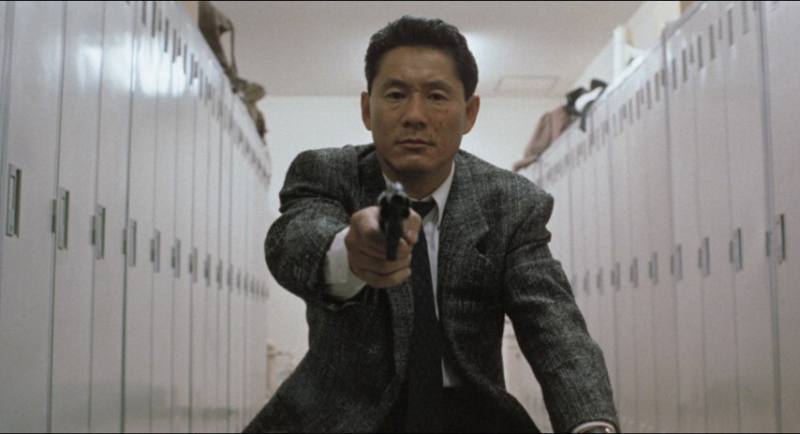
Kitano's films are largely built around his own body's formidable presence as the leading actor in most of his films. Beat Takeshi, Takeshi's acting name, becomes the image of a wounded masculinity in two intersecting ways: through the pursuit or experience of death, and through a consistent performance of exhaustion as the affect that allows for the commingling of life and death in one single body. […]
The most characteristic imagine of Beat Takeshi in many of the films where he plays a tough, yet affectively wounded yakuza (or ex-cop) [….] is a frontal, purely exhibitionistic shot of his body dressed in a black Armani suit and white shirt, and wearing shades. His hands are either kept in his pockets in a relaxed stance or they are brandishing a gun at somebody in utter confidence of his shooting powers. His expression is invariably deadpan, and, as such, beyond sadness.
Elena del Rio, The Grace of Destruction
Beat Takeshi is always fatigued in his movies. His roles never require him to act lively…. Sonatine's Murakawa appears to have already passed beyond the state of exhaustion [found in Boiling Point's Uehara]. He does not ahve sexual intercourse in this film … he has already fallen into a state of sexual impotence.
Casio Abe, Beat Takeshi vs Takeshi Kitano
 Lars Iyer's Blog