Out in December.


Out in December.
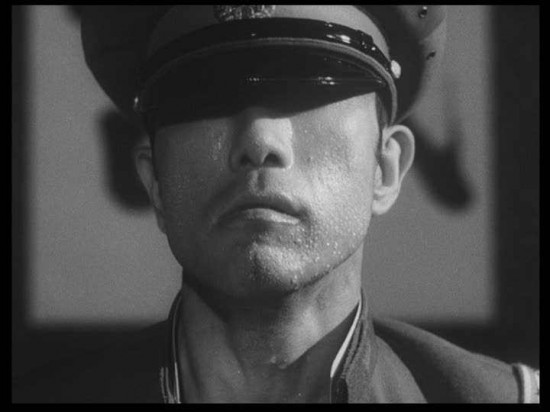
… there is also a sense in which Mishima wants Japan to be in decline so that he can be its last defiant hero, a kamikaze of Japanese beauty. I read his entire project – in which I include his literary genres, his essays and critical writings, his public lectures and media appearances, and his violent suicide – as a single, sustained decadent lyric that ironically flaunts its own contradictions and its futility. Mishima's work is suffused with a sense of ending – the end of art, the end of eroticism, the end of culture, the end of the world – and it conforms to a decadent aestheticism that holds that beautiful things radiate their most intense beauty on the cusp of their destruction.
… Mishima does not rush toward death. On the contrary, he takes his time. Assiduously and manipulatively he constructs a narrative that will enable him to give a logical cohesiveness to his character, to link himself to myth and to tradition, to turn his eroticism into an ethical obligation, and to make his death serve as the terrorist culmination of his desire to impose his conception of beauty on the world, whether the world likes it or not.
[…] Mishima's death is, in obvious ways, the culmination of his life's work and of all the aspects of his thinking that we have investigated in this book. His extreme aestheticism, his narcissism, his eroticism, his desire to transcend modernity and link to the spirit of Japan's classical literature, to turn himself into a sublime object, and his compulsion toward crime, toward evil, and toward the divine terror, all achieve their clearest expression and, we must assume, their personal fulfillment. Mishima's death also affects a permanent change on his literary works, every one of which now appears to point inevitably to this moment, as if every word he had written was posthumous. Through originality in the arrangement of his fate, Mishima has given his work a seemingly indestructible cohesion.
As for Morita's role, on the level of psychodrama it is best to think of him as alternative Hiraoka [Hiraoka was Mishima's original name – Lars]. A Hiraoka free of artistic sensibility, with no interest in literature at all. A strong and healthy and happy Hiraoka. A Hiraoka who passed the military inspection and joined the Imperial Army. A heterosexual Hiraoka. This Hiraoka becomes Mishima's executioner.
The question that is always asked about Mishima is: was he sincere or was he acting? This really equates to asking: Is it real or is it art? But in Mishima's case, as I have tried to show, this is a nonquestion. For Mishima, art is not the opposite of reality. Art for him is a different kind of reality. Mishima represents an apotheosis of the Nietzschean idea that life can be justified only as an aesthetic phenomenon. His act of aesthetic terrorism was not a failed coup d'état but a triumphant coup de théâtre, a spectacular piece of performance art that was simultaneously a radical anti-artistic gesture. Mishima believed that he had taken the idea of life as art to its extreme point, beyond which no one could go any further.
Jean Baudrillard says, 'The supreme consecration for a work: to be realised by the very event that destroys it'. Mishima has surely done more than this. The supreme consecration for an artist: to be destroyed by the very event that realises and completes his entire life's work.
An artist who actualises all his creative possibilities, good and bad, beautiful and ugly, and succeeds – through the pure realization of a will to power that will not yield to anything in this world – in condensing them into a single momentous event, the effect of which is so beautiful yet so shocking that those who contemplate it are left wondering whether it is a work of art or an act of madness, has surely achieved a masterpiece of some kind. It is, as Mishima intended it to be, a cruel and defiant masterpiece: a terror attack on the modern consciousness, a warning to the 'last humans', and a challenge to all those coming after Mishima who would dare to call themselves artists.
Transcription mostly from the final, brilliant pages of Andrew Rankin's Mishima: Aesthetic Terrorist
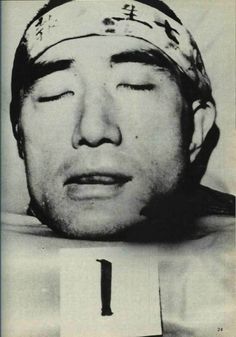
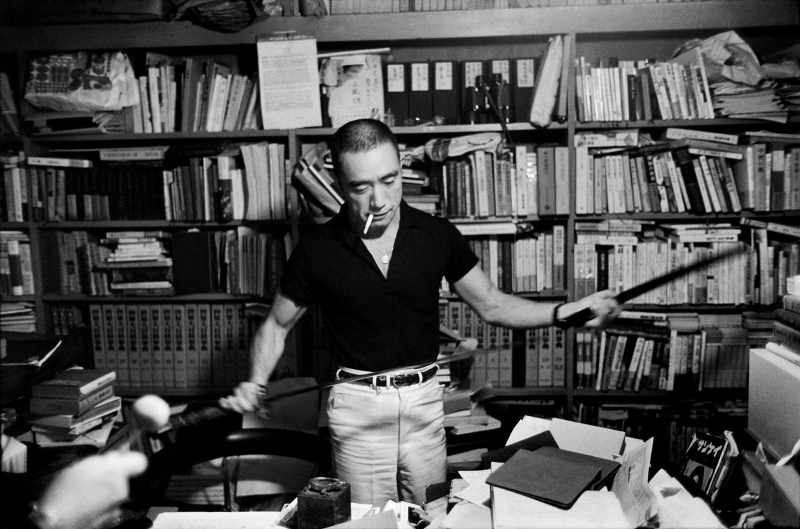
… the coupling of art and terrorism is not perverse. Acts of terrorism are calculated displays of violence that speak to us through their impact on our senses. Visually spectacular and highly dramatic, often they seem to blur or reject conventional distinctions between performance and reality. This, of course, is a feature they share with modern art. Modern artists challenged the boundary between art and reality because they realised that they were addressing an audience whose sensitivity to act had atrophied. The shock tactics of modern art have been an attempt to stall this process of atrophy, to resuscitate art's magical communicative power. What drives modern artists to utilize 'terroristic' tactics is the ambition to overcome what Mishima calls 'the hell of relativity': the loss of absolute values, the transfer of art into the realm of aesthetics, the disconnectedness of artists from their material, from tradition, and from modern audiences who seemed to have grown immune to art.
… from shock to terror is not great step, and the dream of making a work of art that will dangerously overwhelm both the audience who experiences it and the artist who makes it has a great appeal to a certain kind of visionary mind. Mishima, acutely aware of sickly, wilting Japanese writers imploding under the pressure of art, determines to break this stereotype by shockingly and triumphantly exploding into his art. To that end, the modern tradition of Japanese terrorism offers him an ideal template for his project. As he observes, 'The ideology of Japanese terrorism is charaterised by its intimate bond to the ideology of suicide'.
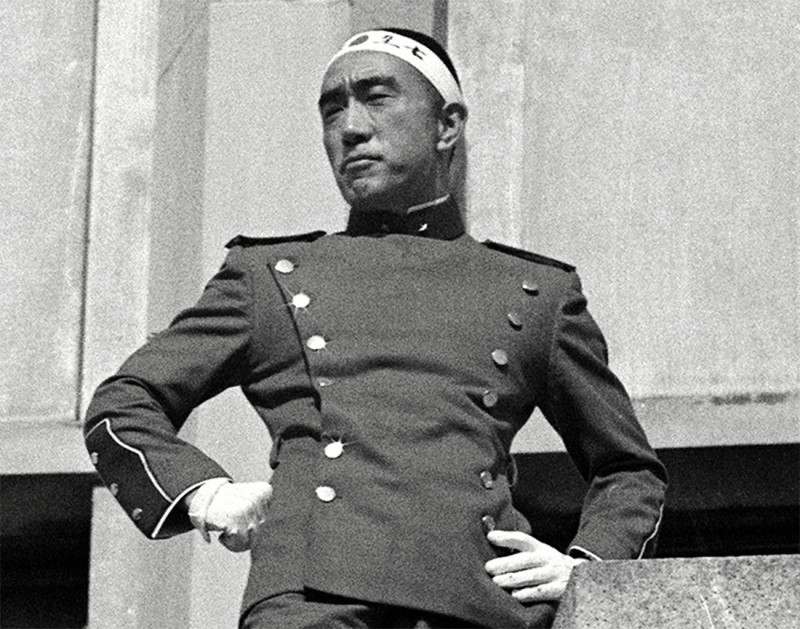
[…] while Mishima hyperbolizes the issue of the emperor's divinity, there is no question that the humanization of the emperor after the war was a momentous event in the spiritual history of modern Japan. People ought to have been stricken with panic, yet superficially they carried on as if it were merely a minor readjustment. It is this evasiveness, this willful repression of collective memory, that Mishima wants to attack. His intention is not just to melodramatize the trauma of the loss of the emperor as a value-guaranteeing absolute, but to insist that Japan's experience of this loss has not been traumatic enough.
As Japan approached what many were hailing as the completion of its astonishingly rapid process of modernization and democratization after the Wesern model. Mishima taunted Japan by lauding aspects of its history and traditions that seemed most at odds with that process: aggressive ultranationalism, military glory, samurai ethics, ritual suicide, the way of the sword, religious reverence of the emperor, the ancient myths of violence and insurrection, the kamikaze, and so on.
[…] 'I refuse to believe in the future', declared Mishima in one of his many media interviews, 'I prefer to think that I carry all of tradition on my shoulders, and that literature will end with me'. Mishima's chief inspiration for this attitude was Hagakure, which instructs samurai to deepen their experience of the present by giving no thought for the future. 'Only the weak put their hopes in the future', says Mishima, 'only people who think of themselves as processes'. Refusing to believe in the future does not, he insists, mean living only in the present moment: 'We must think of ourselves as the result of many generations of culture and tradition, in order to perform our present work fully'.
But even as he says this, Mishima repeatedly portrays Japan as a culture in decline. His final statements are full of gloomy prophesies:
I no longer have any great hopes for Japan. each day deepens my feeling that Japan is ceasing to be Japan. Soon Japan will vanish altogether. In its place, all that will remain is an inorganic, empty, neutral, drab, wealthy, scheming, economic giant in a corner of the Far East. I will not listen any longer to people who are content with that prospect.
[…] we are the last humans, and there's nothing any of us can do about it.
Andrew Rankin, Mishima: Aesthetic Terrorist [At last – a book worthy of its subject.]

When Murakawa/ Beat Takeshi puts the gun to his head and pulls the trigger, he displays a wholly anomalous grin, which, to his underlings, proces more frightening or disturbing than the act itself.
Elena del Rio, The Grace of Destruction
The face of Beat Takeshi, playing Murakawa, transcends the category of realism … [His] grin is like some sort of existentially alien substance that expresses the sheer anomality of Murakawa's flirtation with death…. On a superficial level, it seems that Takeshi is merely 'wearing' this grin…. His grin has a strange intensity, as if to dispel any meaning in excess of the grin itself…. it is nothing beyond a grin, transcending the viewer's ability to judge whether it is merely a shallow grin or a laugh from the depths of Murakawa's existence that has heretofore simply been suppressed.
Casio Abe, Beat Takeshi vs Takeshi Kitano
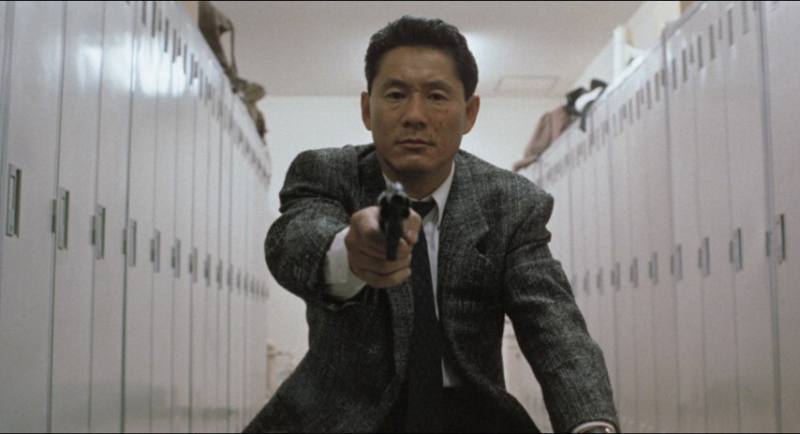
Kitano's films are largely built around his own body's formidable presence as the leading actor in most of his films. Beat Takeshi, Takeshi's acting name, becomes the image of a wounded masculinity in two intersecting ways: through the pursuit or experience of death, and through a consistent performance of exhaustion as the affect that allows for the commingling of life and death in one single body. […]
The most characteristic imagine of Beat Takeshi in many of the films where he plays a tough, yet affectively wounded yakuza (or ex-cop) [….] is a frontal, purely exhibitionistic shot of his body dressed in a black Armani suit and white shirt, and wearing shades. His hands are either kept in his pockets in a relaxed stance or they are brandishing a gun at somebody in utter confidence of his shooting powers. His expression is invariably deadpan, and, as such, beyond sadness.
Elena del Rio, The Grace of Destruction
Beat Takeshi is always fatigued in his movies. His roles never require him to act lively…. Sonatine's Murakawa appears to have already passed beyond the state of exhaustion [found in Boiling Point's Uehara]. He does not ahve sexual intercourse in this film … he has already fallen into a state of sexual impotence.
Casio Abe, Beat Takeshi vs Takeshi Kitano
The idea of becomings as encounters we have with partial deaths while still alive takes us back to Deleuze and Guattari's notion that 'the experience of death … occurs in life and for life … in every intensity as passage or becoming'. From this stanspoint, processes of becoming, in which we undergo continuous small deaths, can put us in the path of a more impersonal more sober relation to our own death. if we are successful at confronting and sustaining their intensity, processes of becoming can soften the rigidity of our selves, weaken our grasp of permanent realities and identities, and mitigate our fears and anxieties toward change. In fulfilling the immanence of death to life – offering us rudimentary but real instances of the experience of death-in-life – processes of becoming help us accept the idea of life continuing beyond 'me'.
Elena del Rio, The Grace of Destruction
Life itself is eternal … when it is lived with maximum intensity, or when the extrinsic and durational existence of a mode is brought into line as closely as possible to its essence's 'force of existing' … its elan vital, or 'life-force'.
Bruce Baugh, 'Death and Temporality in Deleuze and Derrida', on Spinoza
Thought today about what I, an old man, should do…. Several times in my life I've considered myself close to death. And – how foolishly! – I would forget, or try to forget it…. And now, because of my years, I naturally consider myself close to death, and there's no point in trying to forget it, and I can't forget it. But what should I, an old feeble person, so?, I asked myself. and it seemed that there was nothing to do, that I had no strength for anything. But today I realised so clearly the clear and joyful answer. What should I do? it's already been revealed – I must die. This is my task now, as it always has been. And I must die. This is my task now, as it always has been. And I must perform this task as well as possible: die, and die well. the task is before you, a noble and inevitable task…. This made me very glad. I'm beginning to get used to regarding death and dying not as the end of my task, but as the task itself.
Tolstoy, Diaries, 1906
Getting closer to death…. How fortunate that memory that disappears with death and only consciousness remains…. Death is a window through which one observed the world, and which has been slammed shut, or lowered eyelids and sleep, or a walk from one window to another…. Death is becoming more and more simple, more and more natural…. Living is dying. To live well means to die well. Try to die well…. the whole difference between a man and an animal is that a man knows he will die, but an animal doesn't … Death is the only place one can really go away to…. I feel death approaching nearer and nearer.
Tolstoy, Diaries, 1902-1910 (cited)
Proust says that Dostoevsky is original in composition above all. It is an extraordinarily complex and close-meshed whole, purely inward, with currents and counter-currents like those of the sea.
Robert Bresson
Style is … all rhythm. Once you get that, you can't use the wrong words. But on the other hand here I am sitting after half the morning, crammed with ideas and visions … and can't dislodge them, for lack of the right rhythm. Now this is very profound, what rhythm is, and goes far deeper than words. A slight, an emotion, creates this wave in the mind, long before it makes words to fit it; and in writing … one has to recapture this, and set this working (which has noting apparently to do with words) and then, as it breaks and tumbles in the mind, it makes words to fit it.
Woolf to Sackville-West, 1926
… one must live without time, in the present alone.
Tolstoy, The Gospel in Brief
If we take eternity to mean not indefinite temporal duration but timelessness, the eternal life belongs to those who live in the present.
Wittgenstein, Tractatus
A year before his own death, which came twenty years after Beckett’s, the painter Avigdor Arikha spoke to me of his friendship with the man who had, as he put it, made his life meaningful. I think it’s fair to say that Avigdor was the Irishman’s closest friend during the last thirty years of his life. He was surely the only one who was Beckett’s intellectual peer, with his seven languages and his encyclopaedic knowledge of Western literature and art. Suddenly, Avigdor broke down in tears. Here was a man who had known unimaginable hardship in his life, a deportee and camp survivor, now eighty years old himself and sobbing before me. “I miss him more and more every day,” he told me through his tears. I had the temerity to ask him: “What in particular do you miss?” He summoned the words, though he knew they were not quite right, that Beckett was no saint and would have been appalled to hear his friend attribute any special quality to him. “He was the only one,” Avigdor continued, “the only person I ever met on whom the dirt of the world, the nastiness, had left no trace. It could not touch him.”
Dan Gunn, remembering George Craig
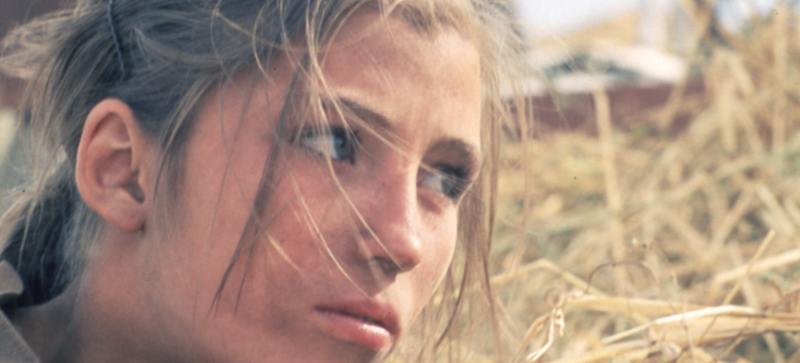
I met this guy named Ding Dong. He told me the whole earth is going up in flames. Flames will come out of here and there … and they'll just rise up. The mountains are gonna go up in big flames. The water's gonna rise in flames. There's gonna be creatures running every which way … some of them burned, half their wings burning.
People are gonna be screaming and hollering for help. See, the people that have been good, they're gonna go to heaven … and escape all that fire. But if you've been bad, God don't even hear you. He don't even hear you talking.
Linda, Days of Heaven
Nietzsche and the Burbs, my next novel, out December 3rd. Launches will take place in January 2020.
Similarly [to Terry Eagleton] Willy Maley writes across theoretical, critical, and literary genres, although one might say that his creative writing is influenced by a theoretical tendency rather than explicitly reflects one. This is in contrast to Lars Iyer whose trilogy of short novels Spurious (2011), Dogma (2012) and Exodus (2013) are an account of what it means to have been a humanities academic in the UK since the 1980s and how theory has circulated around the lives of scholars and in the new university of ‘excellence’ and human capital. In this sense, these novels are not mimetic but are inculcated within the institutions and discourses they describe, leaving their own mark within them, consciously philosophical, and opening the topic in the manner of speculative inquiry.
From Martin McQuillan’s introduction to Critical Practice: Philosophy and Creativity.
Bouvard and Pécuchet. Robinson (Kafka’s) and Delamarche. Robinson (Céline’s) and Bardamu. Robinson (Keiller’s) and the Narrator. Beckett’s Mercier and Camier, and then Vladimir and Estragon in Waiting for Godot. The characters played by Richard E. grant and Paul McGann in Withnail and I (1987), written and directed by Bruce Robinson. A recent twosome: Kruso and Ed in Lutz Seiler’s Kruso (2014). And here’s another: W and Lars in Lars Iyer’s Spurious (2011; and then Dogma and Exodus).
Here we are at the end of Literature and Culture, stripped, bereft, embarrassed. We are children tromping in old boots’. This is Lars Iyer in ‘Nude in Your hot Tub, facing the Abyss (A Literary Manifesto after the End of Literature and Manifestoes’.
A belief that one is living at the end of something is not unique to now; many people believed this in, say, the 1990s, and the 1890s. Maybe all people over a certain age. The beginning of the particular end that Iyer is talking about is dated back to the decade during which I was at boarding school, moving on from Rider Haggard and Conan Doyle to Lowry and Updike: Sometime in the 1960s the great river of Culture, the Literary Tradition, the canon of lofty works began to braid and break into a myriad distributaries, turning sluggish on the plains of the cultural delta’. By now ‘literature’ as it used to be known – ‘revolutionary and tragic, prophetic and solitary, posthumous, incompatible, radical and paradoxical’ – is ‘a corpse and cold at that’; and authors have been replaced ‘be a legion of keystroke labourers, shoulder to shoulder with the admen and app developers’. Conclusion: ‘don’t be generous and don’t be kind. Ridicule yourself and what you do. Savage art, like the cannibal you are’. This is heady stuff, up there with the manifestos of yesteryear.
Enter two low-level academics, W and Lars, one in the south-west of England and the other in the north-east. Lars lives in an apartment that’s assailed by an apocalyptic damp (it’s ‘off the scale’; the professionals shake their heads and mutter that they’ve ‘never seen anything like it’). They bicker, tease, read books they don’t understand and drink neat gin. Briefly, they wonder which is them is Kafka and which Brod, before agreeing that they are both Brod. Canada, ‘with its pristine blue lakes and bear-filled wilderness’ and its different kind of cold (‘not a wet cold like over here’) is the place to go to, a place where one could be ‘a different kind of man’, and Lars writes references for W (‘the finest thinker of his generation’) and they hear nothing back, the Canadians are ‘remote as Martians’. But their joint acceptance that they are living in End Times – and the notion that salvation might lie in books is a joke – goes to their head as least as much as the gin: ‘I am his idiot, but he is mine, and it’s this we share in our joy and our laughter, as we wake each day into the morning of our idiocy, wiping the sleep from our eyes and stretching’.
On the other side of – or underneath – Exquisite doom is Hilarious doom. If the comedy here is black it’s not matt black, it’s glossy, even fluorescent: lurid, twitchy (odd spasms of hope still flickering uselessly, ‘like the animals who come out of their burrows after winter, shivering but exited’), jerky – and now I’ve written that word I think of Punch and Judy shows, the way the puppets bash each other flat and then spring up and go through it all again and again. Spurious is threaded through with a crazy End Times glee, the glee that you feel when your team, which you do genuinely support, is losing five-nil and a balance is tipped, no way back now, and you decide that if they’re going to fail then let them at least fail spectacularly, with abject abandon, pile it on.
From Robinson, by Jack Robinson (Pen Name of Charles Boyle)
A favourite song (and performance) of Blanchot's: Schumann, from 12 Gedichte, Op.35: No. 10, 'Stille Tränen', performed by Marian Anderson.
The ordinary man survived God without too much difficulty and, rather, is today unexpectedly respectful of law and social conventions, instinctively inclined to abide by them, and, at least with respect to others, eager to invoke their implementation. It is as if the prophecy according to which ‘if God is dead, then everything is permitted’ did not concern him in any way: he continues to live reasonably even without the comfort of religion and endures without resignation a life that has lost its metaphysical sense, a life about which he does not, after all, seem to have any illusions.
… he does not end the pathos that distinguished the two figures of the human after the death of god: Dostoevsky's underground man and Nietzsche's superman.
In each act of creation there is something that resists and opposes expression.
In the face of ability, which simply negates and abandons its potential not to play, and talent, which can only play, mastery preserves and implements in the act not its potentiality to play but the potentiality not to play.
… mastery is not formal perfection but quite the opposite: it is the preservation of potentiality in the act, the salvation of imperfection in a perfect form.
Josephine sings with her impotentiality to sing …
As Klee writes in a 1922 note, ‘Creation lives as a genesis beneath the visible surface of the work’: potentiality, the creative principle is never exhausted by the actual work, but continues to live in it, and rather is ‘ what is essential in the world’. For this, the creator can coincide with the work, find in it his only abode and his only happiness: ‘A painting does not have specific ends; its only aim is to make us happy’.
Agamben, The Fire and the Tale
… it turns out that I had the misfortune, which I consider a stroke of luck, to have spent my childhood in a monstrous world. It taught me a lot, and I don’t regret it. Later, I was a young woman in a world that seemed instead a paradise. My children have experienced it as well. Since I had children very early, they have shared in it with me. They were my companions through the happy times of the ’70s, when the gems of thought of what is called French theory spread from France to the rest of the West. When I began to write, I had Blanchot and Gracq at my side. One must try to be worthy. There were noble philosophers, dazzling linguistics, applied mathematics, psychoanalysis. After Freud, there was Lacan. A slew of luminaries and innovators: Derrida, Deleuze, Foucault… It was a happy time: those researchers were able to come together thanks to the movement of 1968. They finally met, exchanged, gathered together, and effected a worldwide change in thought. Now we are in a fallow period. It is not pleasant. I feel sorry for my grandchildren. I find they are living in an era of ashes.
Hélène Cixous interview from a couple of years back.
… if to constituent power there correspond revolutions, revolts, and new constitutions, namely, a violence that puts in place and constitutes a new law, for destituent potential it is necessary to think entirely different strategies, whose definition is the task of the coming politics. A power that has only been knocked down with a constituent violence will resurge in another form, in the unceasing, unwinnable, desolate dialectic between constituent power and constituted power, between the violence that puts the juridical in place and violence that preserves it.
A form-of-life is that which ceaselessly deposes the social conditions in which it finds itself to live, without negating them, but simply by using them.
Because power is constituted through the inclusive exclusion of anarchy, the only possibility of thinking a true anarchy coincides with the lucid exposition of the anarchy internal to power. Anarchy is what becomes thinkable only at the point where we grasp and render destitute the anarchy of power.
… there is form-of-life only where there is contemplation of a potential. Certainly there can only be contemplation of a potential in a work. But in contemplation, the work is deactivated and rendered inoperative, and in this way, restored to possibility, opened to a new possible use. That form of life is truly poetic that, in its own work, contemplates its own potential to do and not do and finds peace in it. The truth that contemporary art never manages to bring to expression is inoperativity, which it seeks at all costs to make into a work.
The Arcanum of politics is in our form-of-life, and yet precisely for this reason we cannot manage to penetrate it. It is so intimate and close that if we seek to grasp it, it leaves us holding only the ungraspable, tedious everyday. It is like the forms of the cities or houses where we have lived, which coincide perfectly with the life we have frittered away in them, and perhaps precisely for this reason, it seems suddenly impenetrable to us, while other times, at a stroke, it is collectively innervated and seems to unveil to us its secret.
Agamben, The Use of Bodies

Don’t be mistaken, what I’ve written here for Maria, is a tale of spiritual transcendence. Maria’s break with the world, her crisis, occurs when she realizes she has accidentally killed her father. This is also the brutal culmination of a day of hard-to-take realities. She has been brought low. She can now see the world for exactly what it is. She has become enlightened. She sees the vanity and pointlessness of human ambition. And begins to transcend these things. That’s her physicality, the physicality of the saint, the person without: simple, relaxed, patient, the clarity of decision and movement.
Hal Hartley, interviewed by Martin Donovan in 1992 on Trust
The specific form of solitude he praises, however, derives its appeal from its dependence on a logically prior ethical community […] Solitude independent of community is indistinguishable from loneliness. Nietzsche speaks fondly and repeatedly of his unknown ‘friends’, precisely because they represent a community from which his self-imposed exile involves only a temporary respite.
‘We Europeans of the day after tomorrow’ … ‘these brave companions and familiars’ served ‘as compensation for the friends I lacked’.
… the pedagogical aim of his writing is neither to convert not to ‘improve’ his readers, but to announce himself to kindred spirits and fellow squanderers. His moral pedagogy is designed not to ‘cure’ the sick and infirm, but to embolden and encourage the healthy – much as his ‘friends’, the fictitious free spirits, served as ‘brave companions and familiars’ during his own convalescence.
… Nietzsche depicts friendship as a mutually empowering agon, in which select individuals undergo moral development through their voluntary engagement in contest and conflict. On this agonistic model of friendship, one has no ethical obligations to those who cannot contribute to one’s own quest for self-perfection …
One ‘becomes what one is’ by overcoming oneself, which always involves elements of both self-creation and self-discovery. While his voluntaristic rhetoric suggests the construction of selfhood, his fatalism recommends the discovery of an authentic self.
… only the combination of self-creation and self-discovery engenders the cruelty – both to oneself and to others – that endures the nomothetic impact of self-overcoming.
Nietzsche’s model of self-overcoming is strongly Apollonian, insofar as it promotes the mastery within a single soul of as many tensions and contradictions as possible. But this model is undeniably Dionysian, for it promotes internal mastery only as a means of further expanding the capacity of the soul, in an ever-escalating process that must eventually culminate in the destruction of the soul. The philosopher who constantly overcomes himself thus ‘builds his city on the slopes of Vesuvius’. For he voluntarily stations himself on the brink of Dionysian excess and disintegration.
… the philosopher ‘creates’ a community only indirectly and unwittingly, through his expenditure of the excess affect required to turn the hammer on himself. He thus becomes a sign unto himself, irrepressibly projecting his self-directed legislations in to the public space that surrounds him.
… it is the business of politics, Nietzsche believes, to oversee the production of those rare, exotic individuals who, by virtue of their overhuman beauty, excite in others the stirring of eros.
… such individuals are ‘lucky strikes’ … culture itself usually arises only as a fortunate accident within the sumptuary economy of nature.
… askesis begets eros. …the experimental disciplines developed by the philosopher arouse in (some) others the erotic attachment that alone forges the ‘circle of culture’.
Nietzsche often speaks of self-overcoming In terms of self-creation, and thus fecund metaphor conveys his sense of the nomothetic influence of exemplary human beings. Great individuals are always artists in Nietzsche’s sense, for, in the course of their self-overcomings, they inadvertently produce in themselves the beauty that alone arouses erotic attachment.
… the irresistible public nature of the philosopher’s self-overcomings. Independent of the philosopher’s own aims and aspirations his overflowing will enters the public sphere as a sign, presenting itself for reception by observers and witnesses who do not share his first hand, artist’s perspective.
… the ethical life of any community is made possible only by the amoral self-creation of the exemplary human beings who found – and then desert – it.
Lovers ‘attach their hearts’ to a great human being and are thereby consecrated to culture, but their love is not reciprocated. Because eros only strives ever upward, these exemplary figures never come to love those whose eros they have inadvertently awakened. Their gaze fixed firmly on the simmering horizon of human perfectibility, great human beings love only themselves and their ‘next’ selves, which immediately vanish upon consummation. In a pithy statement of his own tragic view of the human condition, Nietzsche submits that all great love, but its very nature, stands unrequited.
Nietzsche consequently identifies his own self-overcoming as his greatest contribution to the permanent enhancement of humankind: ‘my humanity does not consist in feeling with men how they are, but in enduring that I feel with them. My humanity is a constant self-overcoming’ (Ecce Homo).
Through his self-experimentation, Nietzsche hopes not only to resist his twin temptations, nausea and pity, but also to furnish his unknown ‘friends’ with aversive strategies designed to postpone the advent of the will to nothingness.
Daniel Conway, Nietzsche and the Political
I’m going to write a few lines to you, by which I mean accomplish my first act as a solid living being, because I’ve already accomplished numerous acts as a living being: I’ve cried, for instance, and tears are as far as possible from death. But it is you I write to first because I want you to able to maintain within yourself, perhaps for a little while longer, the wondrous feeling of having saved a man. I say ‘a while longer’ because to the same degree that the one saved holds eternally before him the image of the saviour, the saviour has the tendency to see the image of his act grow indistinct and even to render common the subject he tore from evil.
Thus, my dear Dionys, we are in some sense now completely separate. Our consciences respectively no longer weigh the same. There will always be some indiscretion in my eyes, in my words. You will try not to see it.
I’d like to tell you other things on this subject that seem important to me but I’m aware that I run a fairly grave danger. Dionys, I think I no longer know what is said and what is not said. In Hell, one says everything and it must be for this that we recognise it. For my part, it is certainly in this way that it was revealed to me. In our world, on the contrary, we are accustomed to choosing, and I believe I no longer know how to choose. Well, in what represented Hell for me and others, saying everything was where I lived my paradise. For you must know this, Dionys, that during the first days that I was in my bed and spoke to you, to you and to Marguerite first of all, I was not a man of this earth. I stressed this fact that haunts me retrospectively. To have been able to give freedom to words that were barely formed and had no years, no age, but took shape in relation to my breath. This you see – this happiness – wounded me definitively and, at this moment, I who believed myself so far from death by some affliction – typhus, fever and so forth – could think of dying only from this very happiness. And now I have begun again to give a form to things; at least, my spirit and my body try to.
But, I repeat, I think I can no longer choose. In what I am saying there are surely tremendous vulgarities and what you call in your laughter ‘an incredible tyranny’. So, am I going to have to reclassify myself; whittle myself down so that one sees only once again a smooth envelope? You’ll tell me that my language is ill-fitting and that the best oil is one that reveals a thousand rough points without ceasing to be oil. In reality, I believe that the problem I am posing is nonetheless a moral one. I have the feeling, which perhaps not all of my comrades have, of being a new being. Not in Wells’ sense of the word – in the fantastic sense – but on the contrary in the most hidden sense, so that my true sickness, which began so tenderly, just a few weeks ago now, and at that time it was still bearable, now reaches its maturity and becomes very intractable.
Here is an appendage that grows; a spirit without channels or compartments. A freedom perhaps ready to grasp itself; perhaps ready to annihilate other freedoms. Either to kill them or, better, to embrace them. So, if one wanted to see a man take form, one might observe me up close, taking into account the morbid character of the formative process.
Forgive me for insisting – it must be unbearable for you who go on to hear someone speak of his original indeterminacy. I think there is even something boorish in all this, and then you would be right be right in answering that in a few months I will have ceased being reborn; that I too will get on and no doubt even along that abandoned path that I left a year ago. You will tell me this, Dionys, or not; you’ll think it, or not. Depending on whether you will or will not have some faith in man. You are certainly one of the few beings in whom I fear fatigue; I mean, despair. There are many who I have loved a great deal and whose despair left me indifferent. By which I mean, a kind of definitive state. I left them in this state, or I revelled and struggled to bring them back. For you, Dionys, whose despair must constantly mix with joy, flights and unfathomable pauses, I could not bear that this despair fix itself and become established. I told you I was not afraid and that such was my sole fear. If you laugh, if you tease me in saying you have never seen so much future, I will tell you that I recognised in myself the right to have this fear.
I stopped there because my hand was hurting.
June 1945
Robert Antelme, writing to Dionys Mascolo, transcribed by Steve Mitchelmore, and paragraphed by me.
You can’t write a novel the night before dying. Not even one of the very short novels that I write. I could make them shorter, but it still wouldn’t work. The novel requires an accumulation of time, a succession of different days: without that, it isn’t a novel. What has been written one day must be affirmed the next, not by going back to correct it (which is futile) but by pressing on, supplying the sense that was lacking by advancing resolutely. This seems magical, but in fact it’s how everything works; living, for a start. In this respect, which is fundamental, the novel defeats the law of diminishing returns, reformulating it and turning it to advantage.
from Cesar Aira, 'Novels Defeat the Law of Diminishing Returns' (1999)
Schumann, Ich grolle nicht, the song sung by Claudia in Blanchot's Au Moment Voulu:
When Tarr ceased to be a marginalised outsider and became one of the touchstones of the mainstream high-brow art-film culture, he decided it was time to stop.
For Tarr filmmaking has always been a question of inner moral conviction rather than a profession.
For Tarr no film of his was 'just a film'. Each of them was a 'cause' to which everybody in the crew had to dedicate himself or herself entirely with inner conviction.
Each shot is a long sequence, a block of time, and it has to have an exact atmosphere, an opening and closing, and a dramaturgical curve of its own, depending only to a small extent on the next or previous shot.
The basic theme of all Tarr's films is entrapment. The main problem Tarr resolves in different ways in different films is how to create the deceptive sense that the characters' situation is evolving toward some solution and, at the same time, to make one feel the hopelessness of this situation right from the beginning; the art of Béla Tarr is thus to make believe without hiding anything.
On The Turin Horse:
In no other Tarr film is the helplessness of the characters laid bare so powerfully as in this film[….] everyone in this film faces ultimate helplessness, and for the first time in Tarr's oeuvre, the characters do not make their own life or others' lives any harder. They are entirely at the mercy of exterior circumstances, and these circumstances have no mercy for them. No real human qualities are manifested by the characters of this film; be it good or bad, there is only base human existence reduced to its simplest physical and biological substance. That is why the last sentence uttered in the film is what the father says to his daughter; 'One must eat'.
… extensive representation of temps mort is more excessive in this film than in any other Tarr film. In fact, what is represented all through the story is empty time, since nothing is envisaged in the plot, nothing adds up, and the characters' acts lead nowhere. The story represents the time elapsed between two extraordinary events: Nietzsche's final mental breakdown, related to the beating of the horse, and the final apocalyptic blackout. But this is not the empty time within a process between two significant events representing important turns in an event series. The empty time in the story will not end. This is the process of time emptying out for good, which is represented on the concrete level by the events contributing to the disappearance or the fading out of the world. The last event, the fade out, therefore, is not an event. It is the end of all events, the end of time. The time of the plot takes place in a kind of 'day after', where the apocalyptic event in Nietzsche's mental breakdown followed by an undetermined natural catastrophe where the chances of survival are zero.
The most spectacular thing about the narrative is that there is no progressing element in it related to the characters. The characters have no intentions, goals, plans, or desires that could become the motivational basis of the narration.
… since the last human connection is the manifestation of the final mental collapse, the apocalypse occurring in the story can be interpreted in a way as a result of nor as a metaphor for Nietzsche's mental breakdown, as if Nietzsche's collapse were a premonition, the first sign of the apocalypse. Or else, as if the latter were a consequence or the physical continuation of the former.
On Damnation:
Causes and effects go round and round and everything is part of the same web of circumstances that takes it impossible for anyone to step outside of this infernal circularity. this conspiracy-like structure is what evokes the universality of this human condition, which is not specifically moral, social, historical or psychological. It is not geographically located either. It is also natural (no consolation in natural beauty), meterological (constant rain and mud) and physical (run-down environment): universal, in one word.
… the only hope they have is to push back the inevitable bad ending a little. His only hope is to slow down the process leading to his downfall, or, in other words, slowness is his only hope. We can see now how how the only positive element of the story is intimately linked to slowness. Slowness postpones the tragedy, making the characters and the viewer believe that there remains some hope. On the other hand, slowness together with suspense raises a presentiment of something inevitable to come.
In Damnation, it is no longer 'Hungary of the 1970s or 1980s', but an unspecific degraded, deserted semi-urban, semi-rural landscape on the way to slow, gradually disintegration displayed in a careful visual composition, fitted with meticulously chosen objects and architectural elements, and lit in a strong chiaroscuro style. Yet the elements are recognisably East European, bearing the signs of a destroyed tradition and an unfinished modernisation blocked halfway to completion.
András Bálint Kovács, The Cinema of Béla Tarr
Bereshit is not a constituent power that can establish a new world order. Genesis 1-11 teaches that the basis of everything is an abyss. Bereshit is not the ground on which things stand but the hand that pulls the rug out from under them. The first chapters of Genesis do not resemble a constitution of any sort. On the contrary, they convey a distinct sense of destitution. Consequently, an organized religion runs a considerable risk by acknowledging Bereshit as its groundless ground. Under Bereshit's spell, the religious apparatus that purports to bind together (religare) the human and the divine can easily fizzle out.
Unlike 'creation' in English, which has artistic and other connotations, the Hebrew word only applies to the creation of the world. After the conclusion of the seventh day, it is said that heaven and earth 'were created', in the passive voice (2:4). But there is no indication as to who should get the credit for this creative act. The only thing for certain in this verse is that God 'made' both heaven and earth […]. But it never explicitly stated, either here or anywhere else in Genesis, that God was indeed the creator of the world.
If Adam means 'human', is Noah in some sense already post-human? To see oneself as a descendant of Noah […] is above all to understand that the secure ground on which we appear to walk, where we seem to breathe freely, is nothing more than the deck of an ark. It is also to realise that most creatures on board have no access to this exclusive space because they are kept in the hull, just as most people and virtually all animals living on earth today are still relegated to the margins of society, to a kind of social death.
Noah, like the baby Moses, is saved by an ark [teva], not a ship [oniya]. This is an important distinction, because the latter needs a captain to steer it in the right (or wrong) direction, while the former drifts passively hither and thither (7:18), being led by the wind, water, God or fate.
… Noah's passivity allows him to safeguard both his subjectivity and her potentiality. His strength lies in silently forfeiting his own will.
… Noah's name … means relief or rest, comfort or consolation (5:29). A reliever is not to be confused with a redeemer.
The seventh day is declared holy not because it was when something magnificent was made, but because nothing was. Hence the Hebrew word for seven (sheva) can also be read as satiation or saturation (sova), while the word for Saturday (shabat) is closely linked to the idea of going on strike (shavat). God's supreme and highest achievement is not the creation of humanity , but his own recreation.
… the Sabbath was instituted as a temporal temple to stop the linear flow of everyday life.
In the beginning was formless life. Instead of creating the universe, God finds himself in a position to give it some order. He does not bring it about ex nihilo, out of nothing, a world external to his divine being. Rather, he imagines ex anihilo, out of the abysmal and chaotic rubble with which he was entrusted, a cosmos, an organised and articulated form, mainly through a series of divisions, distinctions and definitions. This process, as described in the first chapter of Genesis, is surprisingly akin to what contemporary biologists aptly call ontogenesis, the organism's development through cell division.
… although the Hebrew God encompasses or monopolizes the entirety of nature, he is not equivalent to it. Instead of being the life of the sun or the sea, he now functions as the life of the whole world: he is how the world is; the fact that it exists is beyond him.
The anguished earth is […] described as a devastated battlefield: 'unformed and void, with darkness over the surface of the deep' (1:2).
The simplistic assumption that God is beyond the world as if looking at it from a distance, stems from misunderstanding the idea that he is the life of the world. Life in this context has nothing to do with vitalism or animism. Life is not some nebulous force but simply the way the world is.
Even God does not seem able to change and certainly not to remake the world in its entirety. The way it was established during the first week remains intact. Instead, God chooses to cultivate his own perfect-yet-limited garden and forsake the unmanageable wasteland that has spread all around. The bitter truth that lies beyond the gate of Eden is set aside so he can focus on the fantastic truths that grow within.
Life is not a physical, psychological, or spiritual phenomenon that can be either gained or lost. It is more like a relation: something is the life of something else. For example, God is the life of the world, and the world is the life of humanity.
The prolonged entanglement of the human race with this world – what is retrospectively called the Anthropocene – is more profound, consequential, and ancient than any other loyalty or devotion. Being on earth takes precedence over other types of belonging or identity – familial, national, ideological, spiritual, cultural, geographical, historical – all of which easily obfuscate humanity's primary terrestial fidelity (something only the Gnostics dared to contest). This breach between human beings and the word is as old as their bond. Yet it appears that those who entered the garden of Genesis and left unharmed were also able to eat from the tree of life and live for the world.
According to Baruch Spinoza, eternity is 'existence itself', insofar as it follows from the definition of God. Now recall what happens to the God of Genesis when he is considered not as a character in a mythology, but as a concept in a theology: he becomes the life of the world. rather than indefinitely prolong an individual's existence, Genesis aspires to address humanity's true limitation, which has nothing to do with its short lifespan and everything to do with its strained relationship with the world. One can thus see why Spinoza thinks that death should be feared least of all things. to see things from the perspective of eternity is to be, above all, a being in the world. This world life is what the different characters that inhabit 1-11 before the advent of civilization epitomize.
A real state of exception is the exact opposite of a chaotic or anarchic situation.A state of law and order is always exceptional, even when it pretends to be the prevalent rule. The garden of Eden […], along with Noah's Ark […] are perfect examples of such exceptional zones. these are small pockets of calm surrounded by an overwhelmingly hopeless desolation. the rare life cultivated within is shielded from the majority of nature without.
Humans retreat into a kingdom within a kingdom, where violence can be at least partially, locally, and temporarily suspended. as concrete as such safe spaces can be, they are not designed to spread and expand successfully across the world. A shining example tends to end up as oppressive darkness since its limited applicability is ignored. Survivors of shipwrecks search for lifeboats that over time become the new battleships.
David Kishik, Book of Shem
He just loved to work. It was ingrained in his personality. He was happiest when he was working and I think that’s what made him so prolific. He was also smart and aware enough to see when he was on a roll. He made a lot of incredible albums in a very short amount of time – in just a few years. He knew he had to capture that 4-5 year span as he was really growing into his own as a master songwriter. I think he was afraid it’d go away as he’d seen with so many of his heroes; so he decided worked fast as he was on a clock. And to an extent that happened. His talent never disappeared, but I think there came a point where he had to work a little harder to expand his boundaries, to “get there”. That probably happens in every profession, and I think its a real challenge when musicians are faced with that.
Ben Swanson on Jason Molina
 Lars Iyer's Blog