There was a moment there, about 1916, let's say, when beards and thought separated. Until that date, to think was to have a beard. This was no mere fashion: women have no facial hair. Monks do. Scholars do. They are men. The practice of thought, of gravity, was the prerogative of the bearded. The threat of the modern was multiple: it threatened manhood, what was understood by 'thinking', and it allowed women to practice. The beards of the 'great' thinkers, Marx, etc. thinned out into the goatees of Freud and Lenin, as philosophy transitioned to modernity. Hair is not frivolous, as the British court still understands. Hair is philosophy. The fact that both men and women have it, in a manner domesticated by 'civilization' (which is only the manufacture of hair-islands), means that a strict division of labour had to be established when the bourgeoisie distributed commodities: thought was produced by face-hair, psychology by womanish long hair. bankers and Jews (identical in the mid-18th to late 19th centuries) were compelled to shave clean to show that they were producers neither of thought nor of reproduction.  In an age when artists masqueraded as thinkers […] Tzara's clean-shaven mug proclaimed  its solidarity with abstraction, i.e., money and relativity. Until Wassily Kandinsky and Roman Jakobson, unbearded Russian philosohpers were inconceivable: abstraction was born in Russia only when the clergy shaved.

Andrei Codrescu, The Posthuman Dada Guide: Tzara and Lenin Play Chess

Nor should one underestimate the importance of the time spent being inactive. I think it was Flaubert who once termed “the marinade” those countless hours that you while away spread out on your couch, seemingly impassive and dejected, not doing much of anything, certainly nothing of social use. And yet, afterwards, when you’ve finished your text, you realize those protracted moments were not only vital but essential to where you were going.

Aris Fioretos, interviewed (via wood s lot)

Natural history museum, Vienna. The schoolchildren with W. in the dinosaur skeleton exhibit. W's theory that systems of a certain size tend to catastrophe. All inventions, the true ones, are in the beginning too small. All insane ideas by contrast are large. But also the true inventions grow eventually to insane ideas. The murmuring of children among themselves as W. comes to the end of his disquistion.

W.G. Sebald, passage from a draft for his uncompleted 'Wittgenstein Project', a film, abandoned by the late '80s.

[Beckett’s] late plays and fictions move […] from repetition as compulsion to repetition as release, testing out the ground, no longer concerned to separate the one firmly from the other. As we ourselves are lapped in the rhythm of repetition we sense that the work only exists, that we only exist, within the folds of that repetition, within the rhythm of that rocking.

Josipovici, On Trust

I am called the last philosopher because I am the last man. No one speaks to me except me myself, and my voice reaches me like that of a dying man. With you, lovely voice, with you, last breath of a memory of all human happiness, let me be with you for just one more hour; through you I trick solitude and I let myself be deluded in multiplicity and love, because my heart refuses to believe that love is dead; it cannot sustain the shiver of the most solitary of solitudes and it forces me to speak as if I were two.

Do you still hear me, my voice? Do you murmur a curse? If only your curse could break up the viscera of this world! But the world still lives, and alone it watches me, full of splendour and ever colder with its pitiless stars. It is alive, stupid and blind as always, and only one dies – man.

And yet! I am still listening to you, lovely voice! Another beyond me also dies, the last man, in this universe: the last breath, your breath dies with me, the long Oh! Oh! breathed down on me, the last man of pain, Oedipus. 

Nietzsche, 'Oedipus', fragment from 1872

We ought perhaps to admire a book deliberately deprived of all resources, one that accepts beginning at that point where no continuation is possible, obstinately clings to it, without trickery, without subterfuge, and conveys the same discontinuous movement, the progress of what never goes forward. But that is still the point of view of the detached reader, who calmly considers what seems to him an amazing feat. There is nothing admirable in an ordeal from which one cannot extricate oneself, nothing that deserves admiration in the fact of being trapped and turning in circles in a space that one can't leave, even by death, since to be in this space in the first place, one had precisely to have fallen outside of life. Aesthetic feelings are no longer appropriate here. We may be in the presence not of a book but rather something much more than a book: the pure approach of the impulse from which all books come, of that original point where the work is lost, which always ruins the work, which restores the endless pointlessness in it, but with which it must also maintain a relationship that is always beginning again, under the risk of being nothing.

Blanchot on Beckett's The Unnameable, from The Book to Come

Trust in the eternal laws of the gods has vanished, and the Oracles, which pronounced on particular questions, are dumb. The statues are now only stones from which the living soul has flown, just as the hymns are words from which belief has gone. The tables of the gods provide no spiritual food and drink, and in his games and festivals man no longer recovers the joyful consciousness of his unity with the divine. The works of the Muse now lack the power of the Spirit, for the Spirit has gained its certainty of itself from the crushing of gods and men. They have become what they are for us now – beautiful fruit already picked from the tree, which a friendly Fate has offered us, as a girl might set the fruit before us. It cannot give us the actual life in which they existed, nor the tree that bore them, nor the earth and the elements which constituted their substance, not the climate which gave them their peculiar character nor the cycle of the changing seasons that governed the process of their growth. So fate does not restore their world to us along with the works of antique Art, it gives not the spring and summer of the ethical life in which they blossomed and ripened, but only the veiled recollection of that actual world.

Hegel, Phenomenology of Spirit, on the unhappy consciousness.

The end of my writing is coming, for things have now been revealed to me that make everything I have written and taught look foolish, and so I hope that with the end of learning that of life will also come soon.

Aquinas on his deathbed, confiding to a friend 

All the things that I see, hear, breathe, touch, eat; all the beings I meet – I deprive the sum total of all that of contact with God, and I deprive God of contact with all that insofar as something in me says ‘I’. I can do something for all that and for God – namely, retire and respect the tete-a-tete … I must withdraw so that God can make contact with the beings whom chance places in my path and whom he loves. It is tactless of me to be there. It is as though I were placed between two lovers or two friends. I am not he maiden who awaits her betrothed but the unwelcome third who is with two betrothed loves and ought to go away so that they can really be together. If only I knew how to disappear there would be a perfect union of love between God and the earth I tread, the sea I hear …

Simone Weil

In this way, Company foregrounds equally the two dimensions of Beckett’s writing which make up the paradox I would like to discuss – formalizing abstraction and obtrusive affect, the ‘timeless void’, with its indeterminate blanks, and the time of life on earth – and it shows how these dimensions are inextricably linked in the language issuing from a narrative voice. And Beckett’s voices, despite their attenuation, are committed to being narrative voices: voices that tell stories and posit worlds in which events are said, however equivocally and indefinitely, to unfold in time. The repulsion of the subject and of a past thus draws into fictions that would be absolute, but that continually meet with the stuff of a singular time, on a scrambled border that divides ‘my own’ from the pure forms that make it possible.

Another way to pose this problem is to point out that, regarding the apparently forced synthesis of abstraction and affect in the preceding passage, for example, it is impossible to determine which of these two terms has priority – that is, which one was forced on the other. The passage suggests, as does most of Company, that an impersonal language drones on in a void and nowhere’ space, blankly and indifferently, determined more by a machinelike grammar than by anything like ‘experience’, injecting its tales with a perfunctory and artificial pathos.

But the fact that this droning language drones from a voice, and that each time it speaks it has a given source in a singular instance of language, entails its own inevitable structural implications. The most important of which is perhaps this: if a voice exists, it must have come into existence, thus it must have an origin in time and it must have a past that has marked it in its idiomatic singularity.

The unavoidable logic of this situation can be called a logic of birth, a logic of time and finite existence which necessarily saddles every voice with an at least implicit narrative of a life: am embodied existence marked by the violence of birth, and by all the dear old names. The logic of birth, however, is easily confuted by a logic implicit in the very conventions of literary, fictional narration, but which an unlocatable narrative voice is conceived as speaking anonymously from the void – or at least from the irreducible space separating the narrator from the empirical author – as positing its creatures with the sovereign speech of a god, that is, at the inevitable extreme so often evoked by Beckett, as an absolute and creative instance of language.

Such a logic of creation ex nihilo opens a space in which a voice may well exist without, apparently, being burdened by the eight, the deposits or ‘precipitates’ of a prior life, and Beckett is one of the first modern writers to radicalise the implication of this logic, revealing it both as inherent to any fictive gesture whatever, and as sharply untenable, riddled by the emptiness and vanity of a language that can in no way create what it names but that is strangely struck with the stuff it calls forth.

Now the paradox I am pointing to consists precisely in the simultaneous incommensurability and inseparability of these logics (of ‘birth’ and ‘creation’), and in the undecidable status into which this casts the question of what is real and what is artificial in a fictional text as such, what is irreducibly prior and what is a gratuitous supplement. For, referring again to the quote from Company, between the deadpan voice in the algebraic void and the sentimental attachment to a name and its past, which is the added artifice and which the true irreducible? Is there an originary impersonality inherent to language that somehow produces affect (and memory) as a sheer illusion of grammar and of the protocols of ‘verisimilitude’? Or is there a fundamental (and painful) affective drive, intimately bound to the names and places of a particular past, that has been distanced and defused by the fiction of a placeless language without history? Is the attachment to a past merely a palliative for the horror of being at bottom nowhere and no one (and therefore of being radically, uncannily interchangeable, as Beckett’s characters tend to be), or is the space of blanks and variables a desperate escape route from the places that stubbornly remain , from the painful residue, so hard to completely efface, of having been someone, of having had a life, out of which speech cannot help but draw its very breath – the rhythm, style, and contours of its habitus? Finally, which is more fundamental, the impossibility of expression, or the inevitability of expression?

It is well known that in his critical and polemical statements, Beckett placed much greater emphasis on the former than on the latter. But the same writer who insisted that ‘expression is an impossible act’, also made, in another critical piece, this crucial observation: ‘With words one can do nothing but tell one’s story. Even the lexicographers expose themselves. And we betray ourselves even in the confessional booth’.

Jeff Fort, The Imperative to Write

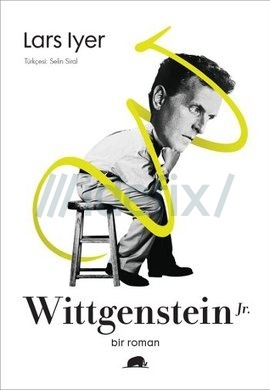
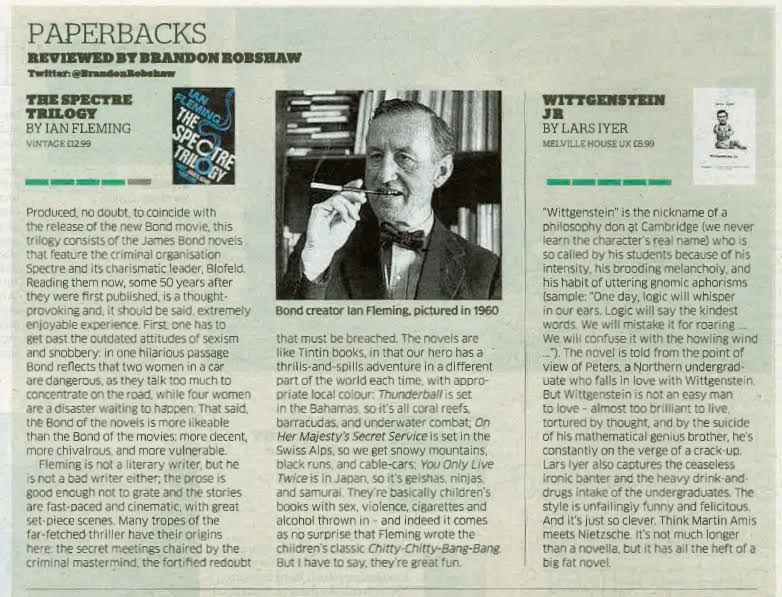
Wittgenstein Jr reviewed by Elizabeth Donnelly and commented upon by Kevin Guilfoile and John Warner as part of the The Morning News Tournament of Books. Lots of comments, too.

What does it mean to conceive of education as the mastery of the relationship between generations and not as the mastery of the younger generation itself? Following Agamben's reading of Benjamin, we could say it means neither must the older generation master the young generation nor the younger the older, nor must both generations be surpassed in a third configuration that would represent their dialectical synthesis. Rather, Agamben writes, 'according to the Benjaminian model of a "dialectic at a standstill", what is decisive here is only the "between", the interval or, we might say, the play between the two terms, their immediate constellation in a non-coincidence'. When the oedipal tension between the generations is deactivated, the both can see the other as a harbour of potentials or images that, when encountered in the space between, can propel the lives of each to a new, more intelligible mode of existence, the collective forward dawning of thought wrought by the disappearance of the subject.

Aaron Hillyer, The Disappearance of Literature

My life, my life, now I speak of it as something over, now as of a joke which still goes on, and it is neither, for at the same time it is over and it goes on, and is there any tense for that?

Beckett, Molloy

Politicians used to have the confidence to tell us stories that made sense of the chaos of world events.

But now there are no big stories and politicians react randomly to every new crisis – leaving us bewildered and disorientated.

And journalism – that used to tell a grand, unfurling narrative – now also just relays disjointed and often wildly contradictory fragments of information.

Events come and go like waves of a fever. We – and the journalists – live in a state of continual delirium, constantly waiting for the next news event to loom out of the fog – and then disappear again, unexplained.

And the formats – in news and documentaries – have become so rigid and repetitive that the audiences never really look at them.

In the face of this people retreat from journalism and politics. They turn away into their own worlds, and the stories they and their friends tell each other.

I think this is wrong, sad, and bad for democracy -…

Adam Curtis

Excerpts from Pieter Vermeulen, Contemporary Literature and the End of the Novel (Palgrave Macmillan 2015):

Lars Iyer: toward farcical life

A careful reading of McCarthy and Shields makes clear that their works deliver an affective dynamic that cuts across the borders of the individuals they present, and that exceeds their works' official messages. A third prominent intervention in contemporary debates over the end of the novel, Lars Iyer's 2011 essay 'Nude in Your Hot Tub, Facing the Abyss', is more clear-eyed about the power of affect to undo the alliance of feeling and the individual, as well as about the importance of that force for the question of the (im)possibility of the novel today. As the text's self-deprecatory subtitle ('A Literary Manifesto after the End of Literature and Manifestoes') indicates, this sobriety reflects the fact that Iyer is uninterested neither in epater le bourgeois nor in announcing a new departure for literature. For Iyer, these are struggles belonging to a  past when 'Literature' was still alive. Today, it is not only the novel that has ended, but the whole literary regime in which a radical break with the novel, such as that performed by Eliot, still made sense. literature today no longer has a hold on the lives of individuals: 'The dream has faded, our faith and awe have fled, our belief in Literature has collapsed'. Iyer's essay lucidly registers that the ambition to bury the middlebrow novel is a belated attempt to reanimate that dream – to affirm the continued relevance of literature while declaring the death of its most popular form. Such illusory ruptures today mean no more than 'play[ing] puppet with the corpse'; staged attempts to bury the novel are covert ways of re-sacrilizing with one hand with what one wishes to profane with the other. Instead of writing the next chapter in literary history, 'the only subject left to write about is the epilogue of Literature'. For Iyer, 'Literature is a corpse and cold at that', and taking that lesson seriously means that one does not even bother to bury that corpse.

Iyer's 'literature which comes after Literature' does not feel the need to concern itself with the perpetuation of its own existence. The paradoxical strength of this position is that it thereby liberates writing to attend to other needs – to those aspects of contemporary life that can no longer be heroically transformed or redeemed. In the next chapter, I show how J.M. Coetzee's late work gives shape to this awkwardly persistent life that 'faces its own demise and survives'. For Coetzee, this materializes as a species of 'creatural life'; Iyer, for his part, refers to it as 'gloomy, farcical life': it is a life 'whose vast sadness is that it is less than tragic', or indeed less than novelistic, and for which the loss of tragedy makes itself felt as farce.

Iyer ends the essay with 'a few pointers' about what a post-Literary literature should look like. Remarkably, many of these elements correspond closely to the 'key components' of Shields' new poetics. Iyer's insistence on 'unliterary plainness' resembles Shields' 'deliberate unartiness'; his injunction to '[w]rite about this world' resonates with Sheilds' emphasis on reality; and his imperative to '[r]esist closed forms' echoes Shields' investment in '[r]andomness, openness to accident and serendipity'. The difference is that Iyer's openness is a willingness to engage with 'the draft of real life – gloomy, farcical life', while Shields' is a readiness to render individual experience in confessional form. Iyer notes that '[t]he author must give up on aping genius. Rather show the author as ape, the author as idiot'. For Iyer, the author is implicated in the farcical life to which his writing must respond, not its sovereign observer – an insight that Coetzee, as we will see, embodies in the personal of Elizabeth Costello. Liberated from the obligation to either debunk or promote sovereign selfhood, Iyer's position opens up a broad range of affects; farcical life is 'sickly and cannibalistic, preposterous and desperate, but it is also, paradoxically, joyous and rings with truth'.

Iyer's own trilogy of novels. (Spurious, Dogma, and Exodus, published between 2011 and 2013) has drawn comparisons to the work of Thomas Bernhard and Samuel Beckett. The books narrate the uneventful friendship and inconsequential conversations of Lars and W., two British academics and intellectuals surviving in the ruins of the contemporary university. The books consist of sections that are only one or two paragraphs long; their very loose sense of order or development, and their elaboration of a limited set of motifs (Judaism, Hinduism, German idealism, Kafka, the university, alcohol, …) betrays the novels' origin in a series of blogposts that Iyer published in the years leading up to the publication of the novel. Even if the provenance of these chunks of texts is more straightforward than in Reality Hunger, Iyer's novels more successfully manage to escape the monological mode that overtakes Shields' book. They do this by almost never allowing their first-person narrator, Lars, to speak for himself; instead, Lars mainly renders W.'s verbal abuse of him, mostly in free indirect discourse (in which Lars is referred to as 'I'), sometimes directly (in which he appears as 'you'). Most first-person pronouns are in the plural – Lars himself is little more than an empty shell, and his 'I'm mainly appears in W.'s (that is, 'double-u's/double you's') discourse. Iyer's decision to lend his first name to his narrator reflects his awareness that authors are affected by the degradation and discomfort that their writing occasions. Both Spurious and Dogma open with Lars repeatedly being called 'stupid' on their first pages. Still, in the domain of the farcical, the two characters are riveted to one another precisely because it is the realm of farcical life, and not of an individual subjectivity: 'You can exorcise a ghost. But how can you rid yourself of an idiot?' (Dogma 31).

Most of the novels are taken up with inconsequential, rambling, and often highly intellectual conversations, which regularly deal with German philosophy and literature. There is a pervasive sense of bathos, as this high-minded talk is embedded in the pedestrian triviality of the actions of and the relationship between Lars and W., whose only way of connecting is by verbally abusing Lars and denigrating his (stalled) intellectual achievements. Their dialogue is propelled by intellectual cliches: 'long periods of warehouse work and unemployment' bring you 'into contact with the essence of capitalism' (Dogma 12); 'The Anglo-Saxon mentality is opposed to abstraction and metaphysics […] It is completely opposed to German profundity' (Dogma 81); Kafka's The Castle 'was literature itself!' (Spurious 19). these remainders of literary life float through the novels without informing transformations or provoking reactions – they are just part of the infertile cultural landscape in which the two characters live out their tragicomedy of contemporary intellectual and academic life. Their lateness offers no consolations: 'What did we expect? Some Kant-like resurgence, late in life? Some late awakening from our dogmatic slumbers?' (Dogma 47).

W. and Lars are literary characters who have come too late for literature. They are 'landfill philosophers' (Dogma 55), living 'each day as though it were the day after the last' (214). Even though the novels (especially Spurious) evoke ideas of apocalypse and of the messianic, their sad fate is that their lateness will not end: 'It's time to die, says W. But death does not come' (Dogma 223). Human life no longer has a purpose and a meaning that literature can give significant shape, and yet it persists. Lars's and W.'s gloomy, farcical lives are suspended between lofty insights that they do not comprehend and the basest animality – it is divided 'between the highest thought and the basest idiocy' (207). Lars and W. 'felt things, great things' (212), but they cannot ascribe meanings to the limitations of significance to which they are remorselessly exposed: 'Like great, dumb animals, we were only feeling […] What could we understand of what we had been called to do?' (208). For Iyer, the contemporary novel exposes a form of life that is protected neither from insights it cannot comprehend nor from its proximity to animal life; it is no longer a human possession that can be clearly separated from the realms of animal and supernatural being. In the next chapter, I theorize this precarious mode of persistence as 'creatural life', and I track J.M. Coetzee's literary figurations of it. Iyer and Coetzee share an awareness that the form of life to which the contemporary novel responds can neither be shaken off (as McCarthy wants to believe) nor valorized as significant individual experience (as in Shields): instead it is a farcical and creatural life to which the remainder of the novel finds itself attuned. (pp. 43-46.)

The disfigurement of human life by the anthropocene and the post-human comedy echoes tonalities and dissonances that this book has addressed before. If McGurl applauds genre fiction for its willingness to 'risk ludicrousness' ('Posthuman' 539), Lars Iyer's staging of farcical life and Coetzee's evocation of creatural life explore tonal and affective possibilities that make ludicrousness part of the repertoire of contemporary fiction. For Iyer and Coetzee, farcical and creatural life name a condition in which an outworn form of life(such as the novel) can no longer be comfortably inhabited, but cannot for all that simply be abandoned. This powerless persistence of disgraced forms of life also marks human life in the anthropocene: customary models of intention and agency, of responsibility and chance, are thrown into crisis as human life needs to think of itself as also a geological force, without that new designation cancelling its former attachments. The anthropocene reminds the human that it can never simply coincide with a particular form of life. The questions of the human, of form, and of scale come together in the close affinity between the anthropocene, on the one hand, and the novelistic elaboration of creatural – or farcical, or ludicrous – life on the other. (p.140)

To get back to how I go about writing my books: I’d say that it’s a question of rhythm and has a lot to do with music. Indeed, you can understand what I write only if you realize that the musical component is of uppermost importance, and that what I’m writing about only comes in secondarily. Once that musical component is in place, I can begin to describe things and occurrences. The problem lies in the How. Unfortunately, critics in Germany have no ear for music, which is so essential to a writer. I derive as much satisfaction from the musical element as from anything else; indeed, my enjoyment of the music is equal to my enjoyment of whatever idea it is I’m trying to express.

Not long after An Indication of the Cause came out, the German critic Jean Améry took me aside and said to me, “You can’t talk like that about Salzburg. You’re forgetting it’s one of the most beautiful cities in the world.” A few days later, after I’d read his review of my book in the Merkur, which I was still fuming over, because he’d understood absolutely nothing, I heard a piece of news over the television: the previous day Améry had killed himself, and in Salzburg of all places. That’s no coincidence. Just yesterday three people threw themselves into the Salzach. Everybody blamed it on the föhn. But I’m certain that there’s something about that town that physically weighs down on people and ultimately destroys them.

Thomas Bernhard, interviewed (translated by Douglas Robertson)

Sometimes, in April, there are limpid mornings, with a gentle, very fragile grace. It seems as if the universe has just been born, that it has just emerged from the original, boundless water, that it is still damp, that it retains something of the transparency of lakes. The world seems all pure and new, its light intact. All is light and water.

It is the first day. The world has just emerged, it is still unreal, everything is still only an assemblage of colours, the outlines of its forms stand out, ready to be blurred. The world makes its appearance. Flowers grow out of the asphalt; fountains suddenly well up in the deserts. All the people are young, the girls walk without touching the ground. The universe becomes completely transparent, like a bride's veil. The air stirs like gentle waves. 

The event will perhaps occur. The only event for which the world is created. Everything is no more than an expectation, a Sunday, and this light that is at once glorious and soft looks like a party dress. The great hope. A calm comes into being in the light and one hears the vibrations of the bells that are about to ring, organs barely hold back their sounds, the bows of violins are about to play. All the voices await the signal to sing the triumphal hymn. But the waiting is prolonged and the whole universe is now only arms stretched out.

The white bird is as motionless as the sky, the trees by the houses hold their breath to hear the announcement of the event. Will there be an outburst of joy? All eyes are fixed on the horizon to catch the moment when the light will melt into a greater light …

From Ionesco's Present Past, Past Present

Fernando Hernández Urias interviews José Luis Amoresof the Spanish publishing house, Pálido Fuego, which brought out Spurious in Spanish translation a couple of years ago (as Magma). Dogma to follow soon. 

Neil Stewart reviews Wittgenstein Jr at The Salt House.

I like this little post from Absolute Write Water Cooler.

All I do is lose my way. But I have a chance to find myself again if I keep retracing my footsteps, instead of taking the first step, if I return to the explosion of the first image, there where words express nothing but light. I find myself again, and understand myself only were words, faces, figures, walls, myself are no longer to be understood, where sounds are strangers and strange, with meanings dislocated by a very powerful light in which definitions and forms melt, like the shadow that makes light disappear. it is from this silence that speech is born again.

Ionesco, Present Past, Past Present: A Personal Memoir

I often have insomnia. I open my eyes in the shadows. But these shadows are like a different kind of clarity, a negative light. It is in this black light that the revelation of 'disaster', of 'catastrophe', of the 'irremediable', of 'absolute failure' comes to me, with the undeniable evidence of fact. Everything seems lost to me.

[…] I have been tortured, and still am, both by the fear of death, the horror of emptiness, and by the ardent, impatient, pressing desire to live. Why does one want to live, what does 'living' mean? I have waited to live. When one wants to live, it is no longer a sense of wonder that one is seeking but in its stead, since only childhood or a simple and superior lucidity can attain it, what one seeks is to be sated. One never is; one cannot be. Material things are not life. One can't manage to live. This 'will to life' means nothing.

I had sought a false path to salvation, I gave myself bad directions.

Ionesco, Present Past, Past Present: A Personal Memoir

Most gamblers are bad players who want to control chance. They throw the dice and only affirm the outcome that they like. If they shoot craps, they roll again in an effort to overcome the unlucky roll and erase its consequences. Nietzsche's good players, by contrast, roll only once, and whatever the result, they affirm the result and will its eternal return. In this way, good players avoid the ressentiment of finding the world guilty of frustrating their desires, and thereby genuinely affirm the play of the world.

Bogue, Deleuze's Way

To write is perhaps to … select the whispering voices, to gather the tribes and secret idioms from which I extract something I call my Self … A schizophrenic said: 'I heard voices say: he is conscious of life'. In this sense, there is indeed a schizophrenic cogito, but it is a cogito that makes self-consciousness … a result of indirect discourse. My direct discourse is still the free indirect discourse running through me, coming from other worlds or other planets. that is why so many artists and writers have been tempted by the seance table.

Deleuze and Guattari, A Thousand Plateaus

[Artaud] knows that thinking is not innate, but must be engendered in thought. He knows that the problem is not to direct or methodically apply a thought which pre-exists in principle and in nature, but to bring into being that which does not yet exist (there is no other work, all the rest is arbitrary, mere decoration). 

To think is to create – there is no other creation – but to create is first of all to engender 'thinking' in thought.

Artaud said the problem (for him) was not to orientate his thought or to perfect the expression of what he thought, or to acquire application and method or to perfect his poems, but simply to manage to think something.

Deleuze, Difference and Repetition

Each one risked something and went as far as possible in taking this risk; each one drew from it an irrepressible right. What is left for the abstract speaker once she has given advice of wisdom and distinction? Well then, are we to speak always about … Fitzgerald and Lowry's alcoholism, Nietzsche and Artaud's madness, while remaining on the shore?  Are we to become the professionals who give talks on these topics? 

Deleuze, Logic of Sense

I have a kind of personal woe I should like your advice on. I have noticed in the last two or three years a growing tendency to a kind of melancholy apathy or depression. [Its] effect is to make the positive value seem to disappear from the world, so that nothing seems worth the effort of doing it, and whatever I do or what happens to me ceases to matter very greatly …

[His depression might be] 'common to all people with an excessively logical education who work in applied mathematics: It is a kind of pessimism resulting from an inability to believe in what people call the Principle of Induction, or the principle of the Uniformity of Nature. Since one cannot prove, or even render probable a priori, that the sun should rise tomorrow, we cannot really believe it shall'.

Walter Pitts, in a letter to Warren McCulloch