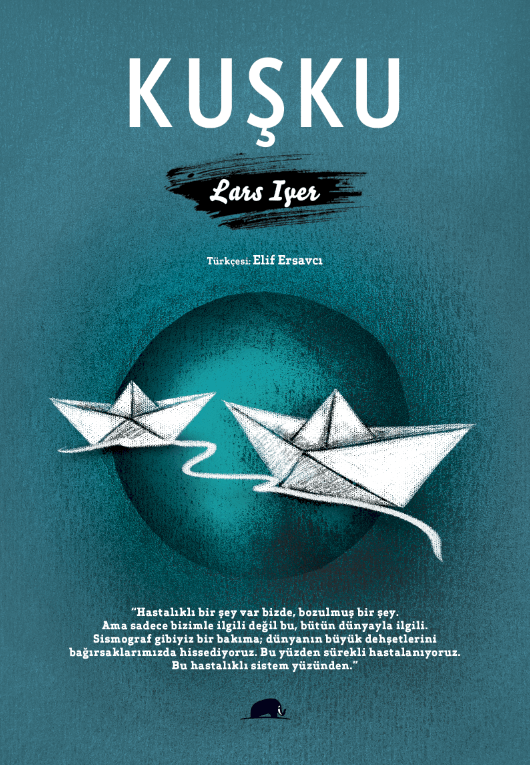
Croatian TV channel HRT review the Mudrovanje, the translation of Spurious.

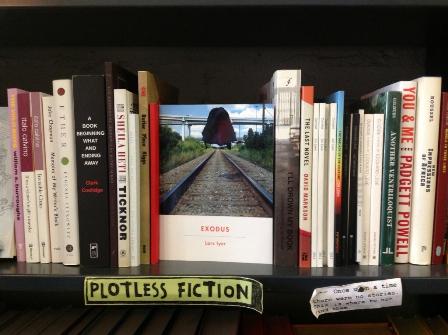
Jeffrey Zuckerman kind-of reviews Exodus at The Airship.

Someone anonymous at The Jackson Progressive blog thinks Exodus is Rabelasian.

Old link to a video of me discussing journalism and other things with Kabir Chibber and Jesse Norman MP. 

Old link to an excellent overview of Spurious and Dogma by Olga Silver from the Russian Journal. 

While the state in decline lets its empty shell survive everywhere as a pure structure of sovereignty and domination, society as a whole is instead irrevocably delivered to the form of consumer society, that is, a society in which the sole goal of production is comfortable living.

Agamben, Means Without End

'Product Placement'. Review of Exodus by Richard Jeffery in the Times Literary Supplement, 15th March 2013:

'To say that Literature is dead is both empirically false and intuitively true', wrote Lars Iyer in a manifesto released last year entitled 'Nude in Your Hote Tub, Facing the Abyss (A Literary Manifesto After the End of Literature and Manifestos)'. Despite the current abundance of writers and novels, declared Iyer, the disappearance of the last traces of modernist antagonism and tension represented a kind of apocalypse for fiction: 'Literature has become a pantomime of itself … prose has become another product: pleasurable, noteable, exquisite, laborious, respected, but always small'. Long past the point of exhaustion, all that remains for the literary author is to mark 'the absence of Hope, of Belief, of Commitments, of high-flown Seriousness', and to write instead about 'a kind of hope that was once possible as Literature, as Politics, as Life, but that is no longer possible for us'.

The pomposity of the manifest is certainly something of a joke (a parody of the kind of radical avant-garde statements nobody takes seriously any more), but the message isn't meant to be facetious. Iyer is a lecturer in philosophy at the University of Newcastle upon Tyne, and in both his manifesto and accompanying trilogy of bleakly comic novels - of which Exodus is the third – one of the principal questions is whether a longing for seriousness in art or philosophy today can be made to transcend farce.

The trilogy stars W. and Lars, two minor academic philosophers who spend their time travelling around Britain and America on an interminable circuit of university conferences, debating and drinking excessively along the way. Spurious (2011) and Dogma (reviewed in the TLS, April 13, 2012) were the first two installments in the series, but each book more or less stands on its own. Lars is the narrator, though he has hardly anything to say for himself. W. is the more magniloquent of the pair, given to impassioned outbursts on everything from Kierkegaard to Monsieur Chouchani to the futility of intellectual life under modern capitalism. Exodus takes place against the steady marketization of British universities, which is treated as a matter of despair and disgust. 'The language of the Last Days is wholly appropriate to our times', observes W., who copes with his sense of doom by relentlessly belittling Lars, who then narrates this belittlement to us, so that in the end most of what we're given is a picture of Lars through the medium of abuse: '"Do you think obesity gives you gravitas? Presence?" He pauses. 'At what stage would you consider gastric bypass surgery?'". It's a vaguely Beckettian double act, one that might be intended to resemble the intellectual bad conscience Iyer evokes in his manifesto.

Iyer's trilogy began life as a series of blog posts, and this makes it easy to see why the books take the shape they do: a succession of compact, almost interchangeable episodes that can be entertaining in small bursts. One can sympathize heavily with the ideas that animate Iyer's fiction, but Exodus can't have taken long to write, and it shows. Close to plotless, and too flimsy for any real engagement with the philosophers it cites, the book lives and dies on how much the reader enjoys Lars and W.'s idiots-in-the-end-time routine. The problem is that this quickly falls into a predictable rhythm, leaving Exodus in the awkward position of being neither sufficiently serious nor sufficiently entertaining

[In his photographs] He was a mountain of a man, very big, dark and handsome, square-jawed, earnest for the camera, somewhat imperious. A seer, a prophet, frowning as though accusing the viewer of levity in the midst of the general catastrophe.

Since I was working on my dissertaion, we talked about academe; we agreed that the university was covered in dust.

Of his friend Camus, to whom the wartime journal Leaves of Hypnos was dedicated, Char said, Camus knew that words could demoralize. He realised after the war that The Stranger had had a demoralizing effect. That's why he wrote The Plague. We were friends because both of us recognized that writing imposes duties, it does not grant rights.

We talked about the brutality of the Luberon, the mountainous region where he was a Resistance fighter during the war. We talked about meteors, snakes, insomnia. When he couldn't sleep, he used his nights to illustrate, by candlelight, the book he was about to publish, The Talismanic Night that Shone in its Circle. […]

Yet even during that warmest of encounters, my friendship with Rene Char felt as fragile as a goldfinch. […]

And he had another bone to pick with critics. The trouble is, he said, that critics want to find a plot in poetry. But poetry has no plot, no continuous development like a novel. Poems are inscriptions made here and there, on scattered rocks (he was standing, miming this). […]

As Helen Vendler once remarked to me, 'One feels Char writes with absolute candour, but in a secret language'.

from Nancy Kline, Meeting Rene Char

Contemporary politics is a devastating experiment that disarticulates and empties institutions and beliefs, ideologies and religions, identities and communities [only to reoffer them in] definitively nullified form.

Agamben, Means Without End

Appearances notwithstanding, the spectacular-democratic world organization now emerging runs the risk of being the worst tyranny human history has ever seen  and against which resistance and dissent will be ever more difficult – all the more so as, now more clearly than ever, this organisation will have as its task to see to the survival of humanity in an uninhabitable world.

Agamben, in his introduction to Debord's Commentaries on the Society of the Spectacle

I will be a guest of Frank Hanover's on the Words on Top Radio Broadcast on UCC radio this Wednesday at some point between 2.00 and 3.00 PM. Click the 'Listen live' button.

If people were once able to pursue their mode of living in an organic and unselfconscious manner, in today's cultural hegemony it takes a lot of persistence and resistance to hold one's ground. If for the frivolous life in postmodernity nothing really matters, for the form of life in the coming community everything always matters.

David Kishik

Were I to choose an auspicious image for the new millennium, I would choose that one: the sudden agile leap of the poet-philosopher who raises himself above the weight of the world, showing that with all his gravity he has the secret of lightness, and that what many consider to be the vitality of the times – noisy, aggressive, revving and roaring – belongs to the realm of death, like a cemetry for rusty cars. 

Calvino

David Kishik, with a question for academics:

I have a question for you:

What is the proportion between the time you spend, on the one hand, reading and thinking and writing in your field, and the time you spend, on the other hand, selling yourself by writing proposals and applications, shmoozing with colleagues and professors, and so forth?

And I have another question:

Did you know that the most cold-blooded corporations spend on advertisement anywhere between about %1 of their revenues (in the retail business) and about %7 (for companies selling packaged goods)?

This is just an educated guess, but I have a feeling that, on average, successful academics spend a much bigger chunk of their intellectual resources on self-promotion than what good capitalists spend on marketing their wares.

For a man can never be in death in a worse sense than where death itself is without death.

Augustine, City of God (Cambridge, p.558)

Our age is not the epoch of faith and not even the epoch of incredulity. It is more than anything else the epoch of bad faith [in which] the first duty of the intellectual must consist in the nonparticipation in this lie. 

Agamben, untranslated article from the '70s, cited here.

We are so accustomed to the old opposition of reason versus passion, spirit versus life, that the idea of a passionate thinking, in which thinking and aliveness become one takes us somewhat aback.

Arendt, 'Martin Heidegger at Eighty'