My solitude held in its grasp the grief of others until my death.

A plaque attached to Simone Weil’s gravestone. (via)

The challenges for reading are accordingly formidable. Whole sentences hang uncertainly in the void; snatches of unattributed dialogue gesture inconclusively towards scenes or situations that are at best conjectural; and a plethora of unfinished, incomplete, or otherwise interrupted phrases grope for an elusive main clause that might allow them properly to begin or to end. There is likewise a frequent paucity of finite verbs and a corresponding proliferation of enigmatic nominative clauses bereft of temporality, mood, transitivity, or syntactic hierarchy. Names too are conspicuous by their absence, and seem to have been supplanted almost everywhere by a series of mysteriously undefined third-person singular or plural pronouns, while elsewhere words collide, qualify or disqualify each other, or turn back on themselves, generating numerous paradoxical formulations at the very limit of intelligibility.

Leslie Hill on The Step Not Beyond, from his Maurice Blanchot and Fragmentary Writing

To write in ignorance and without regard for the philosophical horizon, as punctuated, gathered, or dispersed by the words that delimit that horizon, is necessarily to write with self-satisfied ease (the literature or elegance and good taste). Hölderlin, Mallarmé, so many others do not allow us this.

Blanchot, The Writing of the Disaster

Exodus will be published in the UK on the 14th Feb 2013, and in the USA on the 29th Jan 2013, according to Amazon. It seems to have gained a (probably provisional) blurb as well. 

Comment I made in an interview coming out next year, when asked about the comparisons critics have made between my work and Beckett's:

Who wouldn’t be flattered to be compared to Beckett? There are similarities indeed between my trilogy and Beckett’s Godot: both concern a pair of bantering frenemies, eternally wavering between hope and despair. But my novels are more fixed in a particular place and a time than Beckett’s fiction. They’re part of a postmodern age, an age of mass media, in a way that Beckett’s are not. My characters surf the ‘net and play computer games. They read gossip magazines and watch trash TV. These are not incidental details. My characters are very much on our side of the great mountain range of modernism.

I would make a similar claim with respect to the flattering comparisons which have been made between my work and Thomas Bernhard’s. My characters, unlike his, are engulfed in ‘low’ culture. They experience the distance between the contemporary world and the life of the mind much more acutely. The intellectual pursuits of W. and Lars are that much more absurd, that much more anachronistic, because they are undertaken in no supporting context whatsoever. Bernhard satirises Viennese high culture; but in Britain, there is no high culture to satirise. W. and Lars are almost alone in their interest in philosophers like Rosenzweig or Hermann Cohen. The thinker-friends they admire are likewise entirely cut off from contemporary British life. There is pretty much no interest in Britain, academic or otherwise, in the figures W. and Lars venerate.

W. and Lars remind me of Roberto Bolaño’s quixotic characters in The Savage Detectives, who are dedicated to living a poetico-political life – the life of Rimbaud or the Surrealists, the life of the Beat Generation – in a world in which poetry and left-wing politics are utterly irrelevant, and apocalypse waits round the corner. The story I tell of the lost generation of former Essex postgraduates reminds me most of all of the diaspora of Bolaño’s Visceral Realists. W. and Lars are as quixotic, hopeful and deluded as Bolaño’s Robert Belano and Ulysses Lima, driving into the desert. But W. and Lars are not even part of a movement, as Bolaño’s characters were. They’re quite alone… As alone as Beckett’s Vladimir and Estragon, albeit in very different way.

(I'll post the full interview next year.)

One often thinks – and I myself often make this mistake – that everything one thinks can be written down. In reality one can only write down – that is, without doing something that is stupid & inappropriate – what arises in us in the form of writing.

Wittgenstein

If my soul could only find a footing I would not be assaying myself by resolving myself. But my soul is ever in its apprenticeship and still being tested. I am expounding a lowly, lacklustre existence.

Montaigne

Life can educate one to a belief in God. And experiences too are what brings this about; but I don’t mean visions and other forms of sense experience which show us the ‘existence of this being’ but e.g. sufferings of various sorts. These neither show us God in the way a sense impression shows us an object, not do they give rise to conjecture about him. Experiences, thoughts – life can force this concept on us.

Wittgenstein, remark in Culture and Value

At the harvest, in the vineyard, wherever men must labour hard, they begin with songs whose words express their joy. But when their joy brims over and words are not enough, they abandon even this coherence and give themselves up to the sheer sound of singing. What is this jubilation, this exultant song? It is the melody that means our hearts are bursting with feelings words cannot express. And to whom does this jubilation belong? Surely to God, who is unutterable. And does not unutterable mean what cannot be uttered? If words will into come and you may not remain silent, what else can you do but let the melody soar?

Augustine

There are problems I never get anywhere near, which do not lie in my path or are not part of my world. Problems of the intellectual word of the West that Beethoven (and perhaps Goethe to a certain extent) tackled and wrestled with, but no philosophy has ever confronted (perhaps Nietzsche passed by them).

Wittgenstein, remark in Culture and Value

As to religious thoughts I do not think the craving for placidity is religious. I think a religious person regards placidity or peace as a gift from heaven, not as something one ought to hunt after. Look at your patients more closely as human beings in trouble and enjoy more the opportunity you to say ‘good night’ to so many people. This alone is a gift from heaven which many people would envy you. And this sort of thing ought to heal your frayed soul, I believe. It won’t rest it; but when you are healthily tired you can just take a rest. I think in some sense you don’t look at people’s faces closely enough.

Wittgenstein, writing to Drury, a trainee psychiatrist

I will be using this blog only for quotations as well as publicising details of events in which I am involved, reviews, etc.

I am writing a new novel here.

Spurious and Dogma will be coming out in Turkish, published by a new publishing company founded by the members of Kolektif Atolye, a design and architecture company.

Spurious will also be coming out in Italian, from the publisher, Casa Editrice Odoya.

A 40 minute video of me reading from Dogma at Northeastern University, Boston.

Apelles, the famous painter, wished to reproduce the foam from a horse's mouth in a painting. He was not able to get it right, and decided to give up. So, he threw the sponge he used to wipe his brushes against the painting. When the sponge hit the painting, it produced nothing other than an imitation of the horse's foam. In the same way, the Skeptics start off like other philosophers, seeking peace of mind in firmness and confidence in their judgements. When they do not achieve it, they suspend their judgement. No sooner than they do this than, by pure chance, peace of mind accompanies the suspension of judgement, like a shadow follows a body.

Sextus Empiricus

Have you seen the gigantic Tintoretto in Venice in which the earth and the sea, the terraqueous globe, are hanging above people's heads? The horizon is moving off into the distance; the depth, the ocean distances, and bodies are taking flight, an immense rotundity, a mappamundi; the planet is hurled, falling and rolling in mid-ether! … He was prophesysing for us. He already had the same cosmic obsession which is consuming us now…. As for me, I want to lose myself in nature, to grow again with her, like her…. In a patch of green, my whole brain will flow along with the flowing sap of the trees…. The immensity, the torrent of the world, in a tiny thumb's worth of matter.

Paul Cezanne

The dialogue with nature remains for the artist the condition sine qua non. The artist is a man. He is himself nature, a part of nature within the domain of nature. […]

Today, the artist is better and more subtle than a camera… he is a creature upon earth and a creature within the universe; a creature on one star among other stars. […]

[The artist's] progress in the observation and vision of nature gradually let him accede to a philosophical vision of the universe which allows him freely to create abstract forms… Thus, the artist creates works of art, or participates in the creation of works, which are an image of the creative work of God… Just as children imitate us while playing, so we, in the game of art, imitate the forces which created, and continue to create, the world… Natura naturans is more important to the painter than natura naturara.

Paul Klee

– The first man on the moon! There always has to be a first man. A discovery presupposes a first man and some surprises.

– Ah,

– In discovering other worlds, man will learn that all stars are empty and that he is alone. I say he is unique. I say he is alone.

– With a lot of sky around him.

– Too much sky. And a sky without colour.

– Without angels.

– Angels are in the mind and in books. And only man prints those.

– You imagine the universe made of empty closets turned into satellites by other closets.

– Empty closets, but occupied by a few clotheshangers swinging ceaselessly…

– Yes… hangers and trembling…

[…]


[…] Our most daily gestures, our simplest, most normal gestures are charged with our memory of the Bible without us really being aware of it. We come out of the Bible, we are the Bible. […]


After a long silence, then he continues:

– The forests are very old. The forests are older than man.  They have seen the gods die. And man is naked in a forest of dust, dry leaves and roads covered with leaves and dust.


from Jean Daive, Under the Dome: Walks with Celan

He thinks: I am a scream of God. A searching growl. Vacillation. Slowness. Perplexity. Different reading.

– But a scream can burrow into wound and scar. A kind of saliva, basically, that attenuates the pain.

– I believe the scream is the chosen stance of a voice evicted from itself, mortally wounded, silent, terribly, become non-instrumental from being dispossessed, blank. A drunken voice, crouching. That regards no one…

– A geometric scream.


He watches the goat tied to the biboquet. He watches it climb down the step-ladder to the roll of the drum. He smiles. There is applause. A crowd in purplish light. I ask him:

– How do you, Paul Celan, get from stammer to stutter?

– The stammer is linked to childhood, the stutter to knowledge.

– If I understand you correctly, your idea of stammer and stutter is close to Hoelderlin's idea of ideal states…

– That is…

– Hoelderlin says there are two ideals: extreme simplicity, childhood for you, and extreme knowledge, i.e. your stutter.

– Yes, the stutter is literally dumbfounded. He is 'stupid', that is to say aphasic, and we can think of Hoelderlin.

– The monkey is aphasic, therefore…

– Therefore he dances… he has seen the lightning. He is silent and dances.


[…]

– I have hidden the blood. My poems hide the blood. What do you think? I have paid … I have paid, he says.

[…]

– I have hidden the madness… My poetry masks the madness.


from Jean Daive, Under the Dome: Walks with Paul Celan

It allowed me personally to advance where there is no longer any path, to separate myself from the world of psychology and analysis, and understand that feelings and existences can be felt deeply only in a place where, in the words of the Upanishads, there is neither water, light, air, spatial infinity or rational infinity, nor a total absence of all things, neither this world nor another.

Blanchot, on writing Thomas the Obscure. From a letter to Jean Paulhan dated 27 May 1940. (Via)

When speech becomes prophecy, it is not the future that is given, but the present that is withdrawn, alongside any possibility of firm, stable, durable presence. Even the Eternal City and the indestructable Temple are suddenly – unbelievably – destroyed. It is like the wilderness once again, and speech too is a wilderness, a voice needing the wilderness in order that it may cry out, and continually reviving in us dread, understanding, and the memory of wilderness.

from Blanchot, The Book to Come

Has the time come for me to face the questions of my books?

As if I should, at least as far as they are concerned, accept responsibility for writing them,

when it seems to me that I am not responsible at all, when on the contrary in my innermost thoughts I would accuse them for having swapped my life for another that I have difficulty in living

but perhaps they are calling me to account precisely for the existence I owe to them.

In which case, through me, it is my own books that question my books.

from Edmund Jabes, The Book of QuestionsAely

<I'll put a permanent copy of this review up here, since it disappeared from the site recently …>

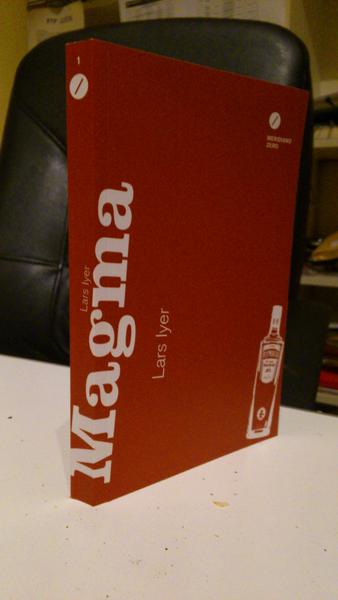
Dogma by Lars Iyer
Publisher: Melville House Publishing
Publication Date: February 2012
ISBN: 978-1612190464
Paperback, $14.95

The United Kingdom has a Thomas Bernhard, and his name is Lars Iyer. Dogma is the second novel in a trilogy that began with Iyer’s first novel Spurious. It is the story of two Kafka-obsessed windbag British intellectuals, W. and Lars, on a mission to devise and hawk an odd, spartan meta-philosophy they call Dogma. W. is a hardheaded and hyperbolic Jewish professor who spends much of his time devising eloquent ways to insult his colleague Lars, a slovenly and depressed Danish Hindu with an inexplicable obsession with the mysterious Texas blues musician Jandek. The two are unabashedly referential, pulling inspiration from (and speaking constantly of) numerous avant-garde artists and directors: Dogma is a reference to filmmaker Lars Von Trier’s manifesto Dogme95. W. seems to be constantly projecting Werner Herzog’s film Strozsek on a wall in his house. They quote Bataille, Pascal, Leibniz, Rosenzweig, and Cohen. Dogma is hilarious and bleak and loaded with illuminating, brilliant passages, and Iyer’s rapid-fire staccato prose is well-suited to the task. For those who like their dark, difficult books to be funny.

From Hey Small Press.

I hear the somber roar of two distinct sounds.

The weeping of Life and the laughter of Death. How eloquent they are!…

But why does Life weep? Why does Death laugh?

Renzo Novatore, Spiritual Perversity (1920) (via)

Self-criticism [is] clearly only the refusal of criticism by the other, a way to be self-sufficient while reserving for oneself the right to insufficiency, a self-abasement that is a self-heightening.

from Blanchot's The Unavowable Community (via)

We must believe in the body, but as in the germ of life, the seed which splits open the paving-stones, which has been preserved and lives on in the holy shroud or the mummy's bandages, and which bears witness to life, in the world as it is. We need an ethic or faith, which makes fools laugh: it is not a need to believe in something else, but a need to believe in this world, of which fools are a part.
 
Deleuze, from Cinema 2 (via)

I feel the value of my work is determined very precisely by the audience. What does entertainment mean, anyway, and what's the difference between that and art? I would say the main difference is that art isn't necessarily funded by the consumer, but entertainment always is. In that way, entertaininment is a million times more important to me than art, and being an entertainer is more important to me than being an artist. The relationship with the audience is so direct, while the government or rich collectors are going to pay for something that is art rather than the person who is actually going to have a relationship with the piiece. That's what most important to me about what I do. I think of eterntainment as being very serious and impoirtant, from Laurel and Hardy upward. It has to do with emotions of release, giving up or extreme hilarity and absurdity.

Will Oldham, interviewed in Will Oldham on Bonnie 'Prince' Billy

According to Krasznahorkai, the deepest loss is the loss of a culture of poverty – the ability to "sing wonderful songs when we are poor". Now, he says, "… we only have people who don't have money … everybody wants to be rich, everybody has only one dream, but people, do we really have one dream – I ask – is this the only aim in this shit, to have much more money?"

There's nowhere left beyond the reach of the market, he continues, "… no empty spaces with possibilities, only stupid spaces, spaces in which you can't do anything other than wait to return from this space …" There are perhaps theorists who could explain why this has happened, he adds, but after these explanations "… everything goes on – why? I see you, and I ask you – why?"

Krasnahorkai, interviewed

So yeah, singing as a way of expressing or escaping or expelling unbearable events: if you have a thinking brain, which some of us are cursed with, you have to have something, and it could be singing and it could be alcohol, but it's progressive rather than regressive – you don't get better by drinking.

The idea of ending each day in song implies a kind of ritual too.

Yeah, a ritual and a connection, 'cause even if you sing by yourself you are using things that have been given to you. The idea of singing is that it's communication from the past into the present and right on through to the future.

Will Oldham, interviewed, in Will Oldham on Bonnie 'Prince' Billy

As Jon Savage points out in England's Dreaming, the London of punk was still a bombed-out city, full of chasms, caverns, spaces that could be temporarily occupied and squatted. Once these spaces are enclosed, practically all of the city's energy is put into paying the mortgage or the rent. There's no time to experiment, to journey without already knowing where you will end up. Your aims and objectives have to be stated up front. 'Free time' becomes convalescence. You turn to what reassures you, what will most refresh you for the working day: the old familiar tunes (or what sound like them). London becomes a city of pinched-faced drones plugged into iPods.

Mark Fisher, introduction to Laura Oldfield Ford's Savage Messiah

Inside the heavily secured complex outside Shenzen, China, known as the Foxconn City, we find the home of about 420,000 workers[…] Foxconn is perhaps most famous for the recent string of suicides[…] On the surface, Foxconn does not look like a labour camp. A guided tour through the premises yields a picture quite unlike the factories of the industrial dark ages. Here we find swimming pools, tennis courts and gyms as well as numerous clubs for employees, in chess, calligraphy and fishing, to name a few. The only catch is that none of these facilities are to be used. Apart from short breaks for lunch and sleep, the workers have no free time[…]

To investigate the working conditions at Foxconn, the Chinese newspaper Southern Quarterly sent a team of undercoer reporters. After 28 days of immense suffering they came back to report about a life completely overtaken by work. As they reported: 'The workers we have spoken to say that their hands continue to twitch at night, or that when they are walking down the street they cannot help but mimic the motion. They are never able to relax their minds. As one of the reporters surmised, 'for many workers, the only escape from this cycle was to end their lives'. In the attempt to curb the suicide epidemic, Foxconn management have gone to great lengths. They have put safety nets between buildings to catch falling workers. They have opened a stress room, where employees can beat up life-sized dolls with baseball bats. Only a hundred counsellors have been called in. And thirty Buddhist monks have been summoned 'to release the suicide souls from purgatory'. Foxconn are now leading innovations in a new field of management … suicide management.

from Carl Cederstrom and Peter Fleming, Dead Man Working

The power of committing suicide is regarded by Pliny as an advantage which men possess even above the Deity himself.

David Hume