New podcast interview with Juliet Jacques for Suite (212).
References to this blog in the interview refer to Spurious from 2003-2007. Archives here.

Andrew Gallix reviews Nietzsche and the Burbs for The Stinging Fly.
New review of Nietzsche and the Burbs by Dan Fraser in the Dublin Review of Books.
By Andrew Irwin
Lars Iyer’s Nietzsche and the Burbs is the story of a suburban sixth-former so enthralled by proto-existentialist philosophy, and by “nihilism” in particular, that it consumes his life: he doesn’t do chit-chat or gossip; only the biggest talk will do (“So what should we do? Art asks. What should we want?”). He blogs (“Suburban events: eternally larval, eternally on the brink of happening. Suburban time deepens”). The local gang of outsidery, intellectualish teenagers take him on as their leader and spiritual guide (and lead singer of their band), nicknaming him Nietzsche and quickly coming around to the nihilist lifestyle themselves. Very markedly its premiss recalls that of Iyer’s previous novel, Wittgenstein Jr (2014), the story of a Cambridge professor of logic and the students who call him “Wittgenstein”.
This young Nietzsche’s life tracks that of the real Friedrich so closely that he starts to seem like a kind of Nietzschean reincarnation (perhaps just one of his eternal returns). Nietzsche struggles with his mental health, loathes his overbearing sister, falls for a girl called Lou (Salomé?), competing for her affections with a friend called Paula (Rée?), and eventually collapses into madness, to be cared for by his sister, delighted to find him under her control. (One wonders, though, why our hero, well versed in the real Nietzsche’s work, isn’t a bit more alarmed by all the weird similarities in his own life.)
The novel covers ten weeks in the lives of these sixth-formers, as they attempt to forge their identities, figure out romance, pass their exams and gaze into the endless post-school summer that will bridge their pasts and futures, conveyed in lyrical and often moving passages. And at the same time, it is an affectionate satire on intellectual life and a certain sort of grand philosophical thinking. With a kind of Nietzschean flair, Iyer illuminates the ways in which strongly held beliefs are often the product not of a “cold, pure, divinely unperturbed dialectic” (as Nietzsche wrote) but (as he continued) of a “desire of the heart sifted and made abstract”; and so the philosophical speculation that Iyer’s young protagonist expounds is born from his descent into misery, and that of his…
[…]
New podcast interview with me by Jon Day at the LRB Bookshop.
Paul Burke reviews Nietzsche and the Burbs for NB Magazine.
Michael Shapiro interviews me for Full Stop.
Jonathan McAloon reviews Nietzsche and the Burbs for the Literary Review.
In Lars Iyer’s 2014 novel Wittgenstein Jr, undergraduates follow their philosophy tutor around Cambridge, wishing to become, ‘if not fellow thinkers, then at least … companions in thought’. The narrator of Iyer’s brilliant trilogy of novels, Spurious, Dogma and Exodus, meanwhile refers to himself as ‘a friend of a friend of thought’. You might call Iyer’s books novels of ideas, though it is perhaps more accurate to think of them as novels of an idea of ideas: his characters always believe they live at a remove from things of importance. In Nietzsche and the Burbs, a chorus of hyper-intelligent provincial teenagers yearn to be at the centre of things, and for spiritual intensity.
Chandra and his friends Paula, Merv and Art are about to sit their A levels at a comprehensive in Wokingham, Berkshire. While they feel stifled by their suburban existence, it also gives them something to rail against. They talk about films by Lars von Trier and Andrei Tarkovsky. They hold themselves above – or are merely shunned by – the school’s acknowledged ‘cool’ kids. They glory in despair, mistaking malaise for serious depression (which they glamorise and envy in others).
Into this world comes a surly, mentally unwell former private school student. Chandra and the rest hero-worship him, nickname him ‘Nietzsche’ and ask him to join their band, where he sings ‘snatches of sense’, or words that are only ‘like real lyrics’. But as Nietzsche’s nihilism deepens, he comes to believe that the suburbs can teach him something about unselfconscious, happy living.
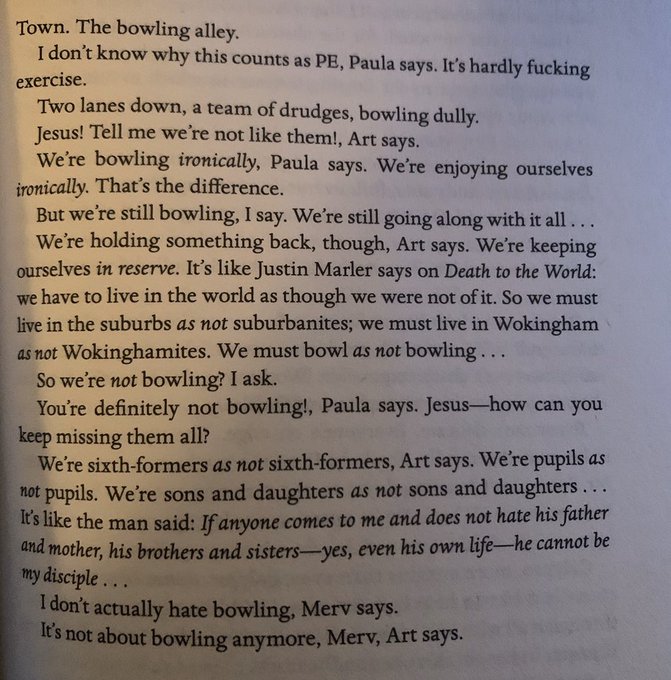
The teenagers’ lives are constructed day by day almost entirely through dialogue. Because there isn’t much straightforward narrative movement, the conversations have to be very funny, and they usually are. Chandra and his friends are relentlessly cruel and puerile. Theologians, for instance, ‘talk about how generally fabbo God is … How big God’s cock is.’ But nothing is above or below being mocked, even Anne Frank. This, one guesses, is nihilism in action, and it’s done with a spring in the step. Iyer isn’t quite so hot, though, when evoking the rhythms and rituals of today’s youth. Self-knowing sixth-formers probably wouldn’t call their peers ‘trendies’. They also probably wouldn’t do PE, which in the sixth form is no longer a dreaded compulsory activity foisted on the uncoordinated. They probably wouldn’t take the synthetic stimulant mephedrone as ‘tablets’, then have a ‘baaaaad trip’.
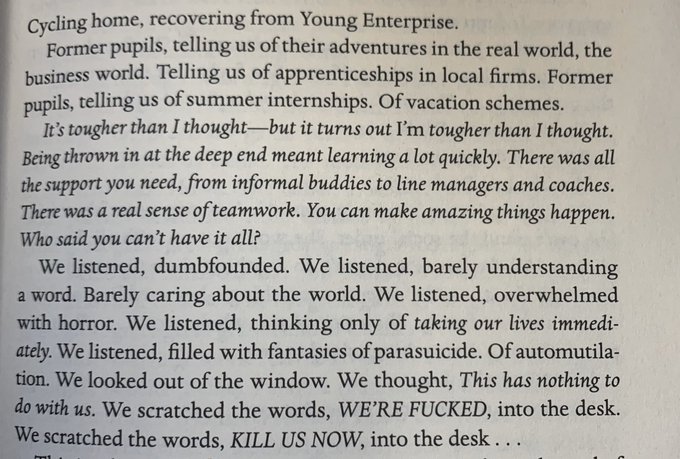
Nietzsche and the Burbs is Iyer’s most novelistic novel so far. It has delineated characters and a slowly building plot. But this in some way runs contrary to Iyer’s natural gifts. His comic style, bristling with italics and based on mirrored phrases and repetition, can itself become repetitive in a way that isn’t rewarding: ‘How can this be? The best mind of our generation, scooping peanut satay and taramasalata into tubs? The great philosopher of our time, scooping peanut satay and taramasalata into tubs?’; ‘We scratched the words, WE’RE FUCKED, into the desk. We scratched the words, KILL US NOW, into the desk.’ More than three hundred pages of this is overwhelming. His other books have been much shorter, offering luminous slices of the void. If his artistic goal has been to structurally represent the monotony of the suburbs, this is perhaps an unideal one for a novelist. Still, it is in some way true to form that Iyer should be seeking to subvert or sabotage his own victories.
By casting Nietzsche as a post-Nietzsche teenage nihilist, Iyer captures something of the real Nietzsche’s showy lack of substance and of the essential futility of nihilism in any age. He also captures the basis of his ongoing appeal. Chandra and his friends think they are ‘the most useless generation that has ever lived’. Many may be quick to concur. And yet for decades before the real Nietzsche came along, a good number no doubt felt the same, seeking to emulate the suicide of Goethe’s hero Young Werther in Teutonic conifer forests, wearing blue coats. Teenage nihilism is universal. Maybe that’s a comfort.
New review of Wittgenstein Jr by Dimitris Passas at Tap the Line.
New postcast interview with Matthew de Kersaint Giraudeau for Bad Vibes Club.
"Which is more painful," I asked him, "writing or not writing?"
"They're both painful, but the pain is different."
He spoke a little about the different sorts of pain, the pain of being unable to write, the pain of writing itself, and — as bad as any — the pain of finishing what he'd begun. I said, "If the work is so painful when one does it and so painful when it's done, why on earth does anyone do it?"
This was one of those questions that caused him, as I've mentioned already,to disappear behind his hand, covering his eyes and bending his head toward the table for what must have been two full minutes. Then, just when I'd begun to suspect that he'd fallen asleep, he raised his head and, with an air of relief, as if he'd finally resolved a lifelong dilemma, whispered, "The fashioning, that's what it is for me, I think. The pleasure in making a satisfactory object." He explained that the main excitement in writing had always been technical for him, a combination of "metaphysics and technique." "A problem is there and I have to solve it. Godot, for example, began with an image — of a tree and an empty stage — and proceeded from there. That's why, when people ask me who Godot is, I can't tell them. It's all gone."
"Why metaphysics?" I said.
"Because," he said, "you've got your own experience. You've got to draw on that."
He tried to describe the work he wanted to do now. "It has to do with a fugitive 'I' [or perhaps he meant 'eye']. It's an embarrassment of pronouns. I'm searching for the non-pronounial."
"'Non-pronounial.'?"
"Yes. It seems a betrayal to say 'he' or 'she.'"
from Exorcising Beckett, by Lawrence Shainberg
The Will to Posture
An affectionate satire on a life of grand philosophical thinking
Lars Iyer’s Nietzsche and the Burbs is the story of a suburban sixth-former so enthralled by proto-existentialist philosophy, and by “nihilism” in particular, that it consumes his life: he doesn’t do chit-chat or gossip; only the biggest talk will do (“So what should we do? Art asks. What should we want?”). He blogs (“Suburban events: eternally larval, eternally on the brink of happening. Suburban time deepens”). The local gang of outsidery, intellectualish teenagers take him on as their leader and spiritual guide (and lead singer of their band), nicknaming him Nietzsche and quickly coming around to the nihilist lifestyle themselves. Very markedly its premiss recalls that of Iyer’s previous novel, Wittgenstein Jr (2014), the story of a Cambridge professor of logic and the students who call him “Wittgenstein”.
This young Nietzsche’s life tracks that of the real Friedrich so closely that he starts to seem like a kind of Nietzschean reincarnation (perhaps just one of his eternal returns). Nietzsche struggles with his mental health, loathes his overbearing sister, falls for a girl called Lou (Salomé?), competing for her affections with a friend called Paula (Rée?), and eventually collapses into madness, to be cared for by his sister, delighted to find him under her control. (One wonders, though, why our hero, well versed in the real Nietzsche’s work, isn’t a bit more alarmed by all the weird similarities in his own life.)
The novel covers ten weeks in the lives of these sixth-formers, as they attempt to forge their identities, figure out romance, pass their exams and gaze into the endless post-school summer that will bridge their pasts and futures, conveyed in lyrical and often moving passages. And at the same time, it is an affectionate satire on intellectual life and a certain sort of grand philosophical thinking. With a kind of Nietzschean flair, Iyer illuminates the ways in which strongly held beliefs are often the product not of a “cold, pure, divinely unperturbed dialectic” (as Nietzsche wrote) but (as he continued) of a “desire of the heart sifted and made abstract”; and so the philosophical speculation that Iyer’s young protagonist expounds is born from his descent into misery, and that of his friends springs from their desire to feel superior to their fellow suburbanites.
Iyer’s prose is immersive, dominated by dialogue, and his plot is recursively repetitious (in the way that schooldays and revision are). The almost formless story is given order by precise time markers: the novel is broken down into weeks, each broken into days. Individual passages, read in isolation – with the friends’ meandering yet pugnacious ruminations, interspersed with bursts of sweary rudeness – form sharp, witty vignettes of bright teenagers grasping for meaning:
I like his death-to-the-world stuff, not his God stuff, Art says.
You can’t have one without the other, Paula says. Why do we have to believe in anything? I ask. Why can’t we just accept the world as it is?
Look around you, doofus, Art says. The world’s a shithole.
We don’t believe in the world: that’s the problem, Paula says. We don’t believe in anything.
So we’ve got to become religious again? I ask.
But with paragraph after paragraph of this stuff, chapter after chapter, it starts to feel relentless. Whole sections are dedicated to the friends’ opinions on their new, radical approach to music:
Music as open as the sky. Like the sea beneath the sky. Music mirroring the sky … This is what it means to Order. We’re continuing the Creation … We’re furthering the Creation … A controlled explosion. Energy, cascading. Energy, shaped.
At times it shifts from the merely tedious to the almost insufferable. What a relief when a character outside the core “nihilist” group gets a line: “Nietzsche – is that what you call him? Tana asks. Jesus. He’s a philosopher, I say. A philosopher of the suburbs. You guys are full of shit, Tana says”.
Why do I have such an interest/morbose fascination for the literature on climate change and generally the imminent planetary collapse? Is it because my strong morals impose upon me to deeply care for all human beings on earth and their fate? No. Let’s be honest. It’s because if the world is really going to go to shit in a few decades, the fact that my life was wasted can quietly slide into the background, and I can resort to the ultimate psychological palliative strategy: “oh well, no matter how realized I might have been, the world was fucked anyway”. Pathetic, I know. Hi, have you met me?
Brilliant essay by an ex-philosophy academic.
'Nihilism, the Suburbs and Redemptive Music': New interview with Austin Hayden Smith and Troy Polidori on the podcast Owls at Dawn. Starts about 29 minutes in and lasts for 30 minutes or so.
Long new written interview with Zac Smith at Vol.1 Brooklyn.
Stuart Kelly reviews Nietzsche and the Burbs for The Scotsman.
There is an old puzzle about writing. Can you write a novel about boredom that is not boring, or a novel about pornography that is not pornographic? The latest of Lars Iyer’s philosophically nuanced books produces a similar impasse. Can you write about pretentious teenagers and not be arch and a bit adolescent? Can you find meaning in the lack of meaning? In many ways this is a startling and often very funny and well-observed novel. It is also somewhat frustrating, but being frustrated is part of the point of it all.
The novel begins with a quartet of self-conscious misfits, Chandra, Paula, Merv and Art (yes, the name has significance) who define themselves by not being in with the brutes, the trendies or the drudges. They have a band, but cannot decide on its genre, despite having a vision. This seems an apt metaphor for the novel itself. Into the group arrives a new pupil, whom they nickname Nietzsche. The first few pages are full of nicknames, which are both derogatory and slightly envious. Nietzsche has been transferred from the posh private school into the local state school, with a shadow of glamour and despair around why. He also advocates nihilism. The school is in Wokingham, and it seems that he is going to awaken the place.
Iyer has previously written a trilogy of books about a philosophy lecturer (Spurious, Dogma and Exodus) and Wittgenstein Jr – a good book, but not a patch on Thomas Bernhard’s Wittgenstein’s Nephew. This may seem like a continuation of a particular style, but its virtues lie elsewhere. There are plenty of knowing references for those that know: Nietzsche gets a girlfriend called Lou (a nod at Lou Salomé, with whom the real Nietzsche was infatuated), he has a domineering and self-serving older sister (again, a reference to Elizabeth Nietzsche, who co-opted her brother’s legacy to Nazism), and, of course, there is an inevitable breakdown brooding just over the horizon. The idea of the foursome having a band already is a way to look at Nietzsche’s own obsession with music – his own is passable, but his love-hate affair with Wagner more interesting. Since they are all sixth-formers there is a lot about ecstatic, drunken Dionysius and much less about the severe Apollonian. Readers who know the work of the real Nietzsche will no doubt have a snicker when phrases like “human, all too human” or “eternal recurrence” or “Übermensch” or “God is dead” appear. They aren’t the only literary allusions: Beckett, Cioran and Dostoyevsky all get name-checked, and perhaps the best joke is when a character asks if there is “An Idiot’s Guide to The Idiot”.
In a way, these philosophical curlicues are not as interesting as the book’s virtues. It is very good on the elation and lassitude of being a teenager, especially in the intense friendships which one knows are brittle and not going to last. It is touching in its depiction of the hierarchies, bullying and moral apathy of the young. It can be properly comical when the now-quintet of sixth-formers make snarky remarks to their teachers or pose them difficult questions. Parts of these sections are almost like a grunge version of Lucky Jim, although I suspect Iyer would rather be compared to Martin Amis than Kingsley Amis.
Where the novel truly shines is in its analysis of suburbia, the other half of the title. It is not merely a re-run of the notorious lines by John Betjeman (“Come, merry bombs and fall on Slough / It isn’t fit for humans now”), nor is it an elegiac psychogeography in the vein of Iain Sinclair or Will Self. It is keenly observed, describing the mediocre modernity of new build estates. At the same time there is a form of tenderness in suburbia. “Nietzsche” says that “Everyone used to believe in betterment” and that “there’s only the sheer positivity of the suburbs in their infinite sprawl”. It is worth noting that one subplot involves cancer, and like cancer, the suburbs grow and are immortal. The teenagers rage at the homogeneity of the suburbs, and yet the novel suggests a world without difference, of equality, might also be found in the burbs. They yearn for some kind of apocalypse.
Stylistically, the novel takes its key from Nietzsche himself, in that I can’t recollect reading a book with as many “!”s and “?”s. It also has a hallucinatory repetition. I can see the point, but it can be wearisome. Iyer’s previous works have been lithe, and although there is a meaning behind the recurrences and repeats here, it is a meaning that in some ways battles against the reader.
Yet there is a human heart here, with some beautifully done cadenzas on love, on loneliness, on the self-absorbing and endlessly cycling ennui of being on the cusp of school and whatever-comes-next. By the way: the protagonists cycle the whole time (another pun), but the real Nietzsche thought he could only think when walking.
Calum Barnes reviews Nietzsche and the Burbs at The Morning Star:
Witty novel on the blank millennial midset
IN HIS book American Utopia, Fredric Jameson argues that the high-school drama is a utopian genre, depicting a world where all material needs are met and there is no need to work.
It is into this idyllic realm, with its cycle of eternal recurrence, that Lars Iyer releases Friedrich Nietzsche. He lands him in a high school in the sleepy town of Wokingham in the south east of England to preach the consolations of nihilistic philosophy.
Like Iyer's previous fiction, Nietzsche and the Burbs is a novel of ideas. But it departs from his usual university setting to a high school more recognisably rooted in our world rather than the rarefied life of the mind.
When the shy, introspective protagonist is dropped from the local private school and ends up at the nearby sixth-form college, he finds himself falling in with the misfits and losers who nickname him Nietzsche for his bleak, oracular utterances and recruit him as the vocalist for their metal band.
As they rush headlong into their final exam season, they experience the usual sex, drugs and rock and roll one expects to dabble in at the tail end of secondary school. But, rather than gazing at their future with hope and possibility, they are paralysed by the yawning nothingness that lies before them.
They channel their angst into their music, while Nietzsche takes to his blog and one wonders why he doesn't join Twitter, a medium surely perfectly suited to his aphoristic style.
Narrated in Iyer's terse but breezy prose, primarily composed of unpunctuated dialogue, there are plenty of knowing winks to the philosophically literate reader. It becomes evident that Nietzsche's life in Wokingham closely resembles his namesake's in the 19th century, with an overbearing sister and a romantic infatuation with a girl called Lou.
Besides the jocular references to the high priests of pessimism like Thomas Bernhard and EM Cioran, the levity is freighted by the gloomy lectures of Old Mole, the pupils' economics teacher, predicting the collapse of capitalism.
This is not only a critical juncture in the lives of these high-school students but for the world as it hurtles towards climate emergency, aided and abetted by a destructive economic system.
In his final project on the stultifying suburbs, Nietzsche remarks that while they seem impossible to escape, a reversal can occur, when the impossible becomes possible and an escape route opens, not to another world but to right here, where we already are.
Iyer's rollicking coming-of-age tale entertainingly demonstrates how Gramsci's old call for a pessimism of the intellect is necessary to reveal the latent utopian possibilities of our world in the here and now.
'Life needs to be struggled for'. New interview with Gayle Lazda for London Review Bookshop.
New 1 hour podcast interview with Patrick O'Connor on Thales' Well. I'm less than coherent, but it's about the philosophical aspects of Nietzsche and the Burbs.
Review from the Sunday Times, 5th January 2020:
A rock-music caper loaded with adolescent yearning.
Houman Barekat
Lars Iyer is not one for changing the record. Between 2011 and 2014 he published three short, satirical novels inspired by his time as a philosophy lecturer. The Spurious trilogy affectionately skewered the pretensions and anxieties of over-earnest intellectuals; a fourth nove, 2016’s Wittgenstein Jr, ploughed a similar furrow. The theme is reprised in Nietzsche and the Burbs, albeit this time by focusing not on cloistered scholars but a gang of sixth-formers at a comprehensive in a Thames Valley suburb.
The narrator, Chandra, and his pals, Art, Merv and Paula, are united by a hatred of all things mainstream. When they’re not tormenting their teachers with precocious backshat or sabotaging the annual cross-country (‘Sure, we could have run. But we chose not to, like gods’), they enjoy knotty discussions about madness, suicide and the climate apocalypse.
They befriend an engimatic new boy, whom they nickname Nietzsche on account of his brooding demeanour and love of philosophy, and invite him to join their dodgy band as lead singer. The group, rechristened Nietzsche and the Burbs, is plagued by creative differences: ringleader Art – who regards potato chips as ‘false consciousness’because they keep the masses happy’ – wants them to play ‘tantric dub metal’; Paula denounces this as ‘aural wanking’ and would rather make music people can dance to.
Iyer’s co-protagonists don’t entirely convince as a depiction of contemporary youth: when Chandra declares that ‘No one will ever have been more bored than we are. More purely bored’, he sounds more like a 1970s punk-rocker than a 21st-century digital native. Their cud-chewing – on the redemptive power of art, the yearning to transcend the banality of modern existence and so on – grows wearisome.
But Iyer does a good line in pithy dialogue, and the landscape of late adolescence is evocatively rendered, encompassing everything from the ‘Hieronymus Bosch grotesquerie of the PE changing rooms’ to the thrill of anticipation of nights out: ‘Why not secede, sit life out, bury ourselves in our bedrooms? Because of possibility. Because of what might happen’.
Matthew Duffus reviews Nietzsche and the Burbs for The Critical Flame.
Anthems for Bored Youth
In an 1886 addendum to The Birth of Tragedy, his first book, German philosopher Friedrich Nietzsche wrote, “today I find it an impossible book—badly written, clumsy, and embarrassing.” The book, originally published when the writer was only twenty-seven, deals with the history of tragedy, from ancient Greece through the music of Richard Wagner, focused specifically on the presence of two concepts, the Apolline and the Dionysiac. He equates these with “the separate art worlds of dream and intoxication.” At the risk of losing the uninitiated, let me dive deeper into these concepts for a moment. Like Schopenhauer, Nietzsche viewed ordinary life as an illusion—experience coming to us “parcelled up, especially including our awareness of ourselves” in Michael Tanner’s words in the notes to the Penguin Classics edition—which means that Apolline art, “the illusion of illusion,” is two-steps removed from true, undifferentiated reality. In contrast, Dionysiac art transcends the Apolline in its unvarnished, objective view: “the image that now reveals to him his unity with the heart of the world is a dream scene symbolizing the primal contradiction and primal suffering, as well as the primal delight in illusion. The ‘I’ of the lyric poet therefore sounds from the very depths of being; his ‘subjectivity’ in the sense used by modern aestheticians is falsehood.” The Dionsyiac work is therefore able to see reality as it truly is, not merely the dream or illusion of life. One may create Apolline art without achieving the heights of the Dionysiac, but the Dionysiac cannot exist without the baseline presence of the Apolline.
Why bother mentioning all of this? Because Lars Iyer—author of the Spurious trilogy, Wittgenstein Jr, and two monographs on Maurice Blanchot—has made use of these concepts in his latest novel, Nietzsche and the Burbs. The novel concerns a group of disaffected high school students who become obsessed with their school’s newest pupil, referred to only as “Nietzsche.” The new kid has NIHILISM scrawled across his notebook and maintains a blog at Last-philosopher.com with the tagline The Uselessness of Everything. “Nietzsche” announces the reason for his url by writing, “I am called the last philosopher because I am the last man. No one speaks to me except me myself, and my voice reaches me like that of a dying man.” The last man, as explained in Thus Spoke Zarathustra, is the polar opposite of the superior man, the Übermensch. The last man searches for security and comfort and remains passive in the face of the Übermensch’s arrival.
Like the majority of those in Zarathustra, Iyer’s characters exist in this kind of relative comfort in Wokingham, a suburb less than an hour from London. But all is not well, as Chandra, the narrator, explains when he considers the future he and his classmates are being groomed for: “They’re preparing us for the outside world—we know that. They’re readying us for office cubicles. They’re measuring us up for our customer-service headsets. Customer service, if we’re lucky. Selling insurance, if we’re lucky. Telemarketing, if we’re lucky. There won’t be much work by the time we’ve finished our studies.” These are common enough complaints from high schoolers—my own crowd had their own version in the early 1990s. Unlike those who abandon themselves to drugs and alcohol, video games and binge-watching, however, Chandra believes that “All adolescents are philosophers. And all philosophers are adolescents at heart.” The adolescent impulse seems to be what Nietzsche rejects in “Attempt at Self-Criticism” when he calls The Birth of Tragedy “a youthful work, full of youthful courage and youthful melancholy.”
Chandra and his friends Art, Merv, and Paula attempt to transcend the ordinary adolescent funk in their unwavering dedication to pessimism. But even they meets their match in “Nietzsche”:
That’s nihilism, right? Art says, turning to Nietzsche. —Not wanting to believe in the world?
Nietzsche: When life turns against life—that’s nihilism.
But why does life turn against life? Merv asks.
Nietzsche: Because we see meaninglessness everywhere.
This is typical of the conversations the group has with their new friend. They ask questions, “Nietzsche” responds, and they aim to absorb his ideas into their versions of ordinary subjective experience. While the characters do “see meaninglessness everywhere,” this does not keep them from entertaining readers.
Two pages after the above conversation, as the quartet discusses their encounters with “Nietzsche,” Art declares, “He might be the leader we always wanted.” Chandra responds, “Nietzsche looks too depressed to lead us,” and Paula adds, “I’m too depressed to be led” (17). Here, as in many other places, Iyer follows the comedy writer’s “rule of three,” upping the ante with each comment. Paula, the most sardonic of the group, often makes the last quip.
This band of malcontents seeks authenticity— “Transfiguration. Dionysus,” in “Nietzsche’s” words—through their experiences in an actual band. Even this goes awry. Paula diagnoses what ails the group when she says, “We can play anything we like. All this freedom, and we don’t know what to do with it.” By this point, they’ve copied Bob Marley and The Heptones and criticized fellow school mates for performing classic rock covers or playing in trendy synth bands. Art, the group’s Brian Eno, is unable to play an instrument, but this doesn’t stop him from pontificating at length about what the band should play: “We’ve got to do something real, Art says. Something serious. These are serious times, man. Doom metal’s serious. Tantric metal’s serious.”
While Art probably has the most lines in the novel, he is also the most impressionable. He thinks he’s a nihilist; he thinks he’s into tantra; he thinks he’s a Gnostic; he thinks he’s a musical visionary capable of flying by the nets of conventional society. His enthusiasm for each of these leads to passionate monologues intended to cow any opposition.
The band doesn’t come together until “Nietzsche” joins as lead vocalist, though he doesn’t actually sing: he talks, half-talks, whispers, chants, and murmurs. Most of all, he improvises lyrics such as, “I no longer understand / the most ordinary things / I’ve forgotten / how to count” and “I open my eyes / in the shadows. / All I do / is lose my way.” Only Chandra realizes the truth: “We’re blind. We’re wanderers in the dark. And Nietzsche, blind, too—only he’s a little less blind than we are. Nietzsche, wandering with us—only slightly ahead of us, leading us….” Hence, the band’s name: Nietzsche and the Burbs.
“Nietzsche” is no more the leader Art seeks than any of them are. As Chandra acknowledges, “Nietzsche” is merely one step farther along the path they trod, if only in his ability to espouse the philosophy of his namesake.
It’s easy to be the smartest person in the room when one is surrounded by dimwits and sycophants, and this is one of the novel’s great challenges. “Nietzsche” is often questioned by teachers and other adults and prodded on to greater heights by the Burbs, but he rarely faces an obstacle that is equal to his rhetoric. The school year builds toward several climaxes, one of which is “Nietzsche’s” project on the vacuity of the suburbs, a common enough topic for a disaffected teenager. But even his teacher, Mr. Varga, falls under his sway, offering naïve encouragement rather than serious objections: “But why should nihilism have become visible here, now—in the suburbs?, Mr Varga asks. In postwar Paris, yes. In Dostoevsky’s St. Petersburg, perhaps….”
“Nietzsche” falls back on obvious critiques such as, “No one expects anything to happen. These are just suburbs with ‘urbs, without a city, without a centre. There’s only the sheer positivity of the suburbs in their infinite sprawl. Their sheer obviousness.” Varga, who Chandra previously admired for his intelligence, is impressed by the teen nihilist: “I think I understand: this is a way of talking about the end of history, Mr Varga says. The end of ideologies. The triumph of liberal capitalism and the last man….” But “Nietzsche” does not stop there. Like an inexperienced driver at the wheel of a sports car, he can’t help himself. He continues revving his intellectual engine, lecturing his teacher—his fellow students are largely forgotten by this point—until Varga is left speechless at the end of an almost page-long account of “Nietzsche’s” turn to nihilism. It’s understandable that these teenagers would dismiss the adults around them, but the fact that Iyer allows them to do so un-ironically weakens the book.
Interestingly, the only thing that does push back successfully against the meaninglessness espoused by “Nietzsche” is love. Like the real Nietzsche, the last philosopher falls for a young woman named Lou. During a drug trip with the Burbs and assorted other friends, “Nietzsche” wanders off into the woods with Lou, after which Chandra, ever the devotee, exclaims, “Nietzsche’s in the throes of a Great Love. He’s more refined than we are. He’s capable of Emotional Depths….” He envisions them “walking ahead of us in the woods. Nietzsche and Lou, above us in the woods. Higher than us. Translated into light. Astral-bodied, ether-bodied, having left the world behind.” But “Nietzsche” isn’t the only one who finds love, even if it isn’t as lofty as Chandra makes the young philosopher’s out to be. Merv finally commits to Bill, with whom he forms a popular disco band, and Chandra succumbs to Noelle’s oft-expressed desire. In a reversal that comes close to driving “Nietzsche” to madness, Lou leaves him for Paula, as the actual Lou left the German philosopher for another man.
Like Paula, Noelle provides a needed break from the gloom and doom and pontificating of the male characters. She chides Art for not recognizing his “privileged” existence in Wokingham, declaring that “most people live in Hell compared to this.” Art is undeterred, but so is Noelle: “I’ve got you guys diagnosed, Noelle says. It’s all about imaginary revenge. You want Wokingham destroyed because it doesn’t recognise your genius, or whatever. You just want a pathetic kind of payback for your comprehensive school lives.” At last, a character who speaks the truth. “Nietzsche” and the others can cloak their discontent in whatever philosophy they want, but Noelle is unimpressed. For good or ill, the odds are that they will age out of this phase, just as Paula believes she has once she finds Lou: “I know my own goodness…. I feel better—like I’ve recovered after some long illness….” She has rejected “Nietzsche’s” appeal as his namesake dismissed The Birth of Tragedy.
Readers unfamiliar with, or even uninterested in, Nietzsche should not be put off by Iyer’s book. Through five works of fiction, he has investigated so much more than the philosophical underpinnings of his oeuvre. Nietzsche and the Burbs, in particular, broadens his critique of education to include the vacuity of a high school experience that does so little to provide guidance that students must look to one of their own for direction. That this direction comes in the form of a nihilistic belief in the meaninglessness of their existence should come as no surprise, within Iyer’s world. Whether writing about the shift from educator to “learning facilitator” for the “Microsoft philosophy package,” as Iyer did in his scathing critique of higher education in Exodus, or the “new don [who] has sold his soul,” as in Wittgenstein Jr, Iyer cautions what will happen if society continues along its current path.
“Nietzsche” is conspicuously absent by the end of the novel, having suffered yet another nervous breakdown. After a disastrous debut performance, the Burbs try to regroup only to find that
We haven’t got a leader, Art says. And we haven’t got a band. We’re just the Burbs. And the Burbs are nothing….
Now you can be your own men, Noelle says.
We don’t want to be our own men, I say.
The group that had been so independent initially, so set on opposing the status quo, finds themselves lost without “Nietzsche.” This doesn’t last long. The leaderless become their own leaders, deciding that “This is the summer when we’ll all go mad” and, conversely, “We’ll be steeling ourselves. Hardening ourselves.” After the latter comment, Art recites the actual Nietzsche from memory, this time from The Joyful Wisdom. Notably, the chapter he quotes from begins “What our Cheerfulness Signifies.” By the end of Nietzsche and the Burbs, the group has moved past the gloomy nihilism of their former leader and begun to forge a new path, one that may end in failure, as Paula assures them it will, but that offers another attempt at transcending their circumstances. Readers may find this too easy a conclusion—why can’t they grow up and accept the illusion of life, the Apolline, for what it is?—but the ‘burbs may never be the same.
Leo Robson reviews Nietzsche and the Burbs for the Guardian:
Nietzsche and the Burbs review – deadpan philosophical comedy
Lars Iyer’s ambitious follow-up to Wittgenstein Jr tracks a gang of smart-aleck sixth formers as they explore nihilism in the suburbs
Lars Iyer’s follow-up to the celebrated Wittgenstein Jr is another attempt to treat his erstwhile academic specialism, European philosophy, as the basis for deadpan observational comedy. The more specific aim this time around is to examine the meaning of existence through the indulgent chatter, curricular and otherwise, of smart-aleck sixth-formers at a present- day comprehensive school in Wokingham, Berkshire. Topics include free will, the end of history, Gaia, wellbeing, the concept of “basic needs”, Beckett’s play Endgame and the virtues of nothingness. The result is certainly creditable – vivid, tickling and spry. It’s also remarkably unkempt.
The narrator, Chandra, is firmly ensconced in a gang of four when he befriends the “new kid”, a former private-school boy who physically resembles Friedrich Nietzsche (minus the moustache) and promotes a familiar nihilist agenda. Before long, Chandra and co have started a Dostoevsky book club and are on the hunt for an idiot’s guide to The Idiot and wondering how you pronounce the name of the Romanian-born essayist and Nietzsche-worshipper Cioran.
Iyer is eager to exploit the rich opportunities for comic juxtaposition. When it is discovered that the Beckett archives are held in nearby Reading, it’s taken as proof positive that there isn’t a God: Reading, the gang decide, is the “opposite of Paris”, antimatter to Endgame’s matter. When Nietzsche – the new kid is never known by any other name – gets a part-time job at the local Asda, Chandra wonders how the best mind of his generation has ended up scooping peanut satay into tubs. And when the gang start a band that shares its name with the novel’s title, someone asks if they will really have performed the gig if no one is present to hear it.
But Iyer also sees past putative incongruities to something continuous or mutually illuminating – Berkshire as a cousin if not to Paris then perhaps to Nietzsche’s Basel, the suburbs not as an enemy of rumination but a breeding ground. Nietzsche’s blog is full of his responses to the spaces around him. “Nothing can happen here,” he writes. “Unless the nothing-is-happening is itself an event.” He even goes so far as to suggest that only in the suburbs is “nihilism to be truly encountered”, though it might be said that neither tack – philosophy and mundanity as foes or as allies – is by this point exactly original.
Nietzsche and the Burbs isn’t really a philosophical novel: ideas are discussed and even dramatised, but not embodied. Questions about the elusiveness of reality or truth, embraced by the cast within the fictional world, have had no discernible impact on the way that world has been constructed. Despite the characters’ continental appetites, the tradition in which their creator is working proves to be sensible, chipper and English, and the writer that Nietzsche and the Burbs brings to mind isn’t Beckett or Maurice Blanchot, about whom Iyer has written two books, but Julian Barnes – in particular the early pages of his 2011 Booker winner The Sense of an Ending, another tale of sixth-formers dabbling in existential nihilism, which begins with a new boy joining the narrator’s gang.
It’s hard to avoid noting that Nietzsche and the Burbs, though less ambitious and portentous than that novel, is easily twice as long. That’s due partly to the routine-bound structure, with virtually every school day of exam term chronicled, and partly a product of rhetorical excess. If the set-up – insolent know-it-alls saying “sir” a lot – recalls Barnes, the language is derived more directly, and perhaps less coincidentally, from Martin Amis: the italics, the hyperbole, the acts of near-synonymous rephrasing, the endless lists …
As in Amis’s work, a strange process occurs whereby something that looks like shorthand – a bit of thumbnail scene-setting – soon gives way to obsessive completism. The threat of prose-poetry often hovers and doesn’t always dissipate. (“There was no dignity in the PE changing rooms. There were no human rights, in the PE changing rooms. The Geneva convention didn’t hold in the PE changing rooms.” And so on.) Iyer’s attempts at sadsack sentiment read like Amis on an off-day: “Everyone’s fucking everyone and no one’s fucking us.” “The worst thing about Wokingham is that it smiles back at your despair. Wokingham hopes that you’ll have a nice day in your despair.”
What’s frustrating about these local tendencies is that the novel is also distinguished by genuine conceptual compactness. Iyer makes light work of exploring the ways in which a 19th-century German philosopher, or his present-day descendant and doppelganger, would and wouldn’t feel right at home in the home counties. But his tendency to make the reader live that reality, in all its blog-friendly and italics-worthy drabness, seems less like a crucial part of the project – intentional immersiveness, perhaps, or self-conscious garrulity – than a straightforward failure of craft.
Marshal Zeringue interviews me for My Book the Movie at Campaign for the American Reader.
And interviews me for P.69 for the same blog.


 Lars Iyer's Blog