
Mark Sarvas reviews Wittgenstein Jr at Barnes and Noble Review.
Category: News
Wittgenstein Jr reviewed at Pop Matters.
Galley Beggars have reissued Denton Welch's A Voice Through a Cloud as a digital classic, with my introduction.
Brief review of Wittgenstein Jr as one of '8 books you need to know' in GQ.
Will Rees's extremely interesting review of Wittgenstein Jr for the Quietus.
The characters themselves don’t really develop at all; it is that which binds them together—friendship, disappointment—which grows. It is this, the apparent background to the novel’s action, that shines through.
Wittgenstein Jr now in this best novel and fiction list in the Daily Telegraph.
The great Steve Mitchelmore on Wittgenstein Jr at This Space.
A long way off, but I'll be discussing Wittgenstein Jr in Cambridge on 30th October at Heffers Bookshop, from 6.30 to 8.00. Tickets here.
I'll be doing the same thing at the Newcastle Centre for the Literary Arts on 6th November, from 7.15 onwards. I'll be reading with Evie Wyld. Tickets here.
More news to come on an event in London on 1st November.
<Transcription of the review of Wittgenstein Jr by Jon Day in the Daily Telegraph, Saturday 13th September.>
Bonfire of the Humanities
Jon Day relishes a clever satire on academic life that is also a love letter to the world of ideas.
Lars Iyer's previous three novellas – Spurious (2011), Dogma (2012) and Exodus (2013) – followed a pair of academics as they travelled around the country attending conferences and exchanging gnostic utterances. They were hilarious and unsettling books about the limits of friendship set against the backdrop of what Iyer calls the 'suburbification' of professional philosophy. As well as being terrifically funny they were stylistically bold: critics invoked the name of Beckett in hushed tones.
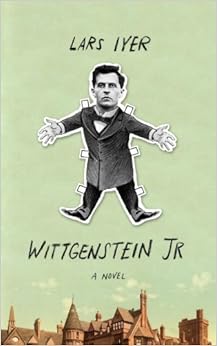
Wittgenstein Jr is both a continuation and a development of the themes of the Spurious trilogy. The book centres on the relationship between a group of Cambridge philosophy students and their don, an enigmatic, lonely figure they take to calling 'Wittgenstein'. He has gone to Cambridge to 'do fundamental work in philosophical logic' (Iyer, himself a philosophy don at Newcastle University, is fond of italics, always seasoned with a deep irony) and to write a book – Die Logik – so profound as to end philosophy.
Wittgenstein himself is not quite a character but rather a collection of aphorisms. 'It is never difficult to think', he says, 'it is either easy or impossible'. His classes are, by the standards of the contemporary academy, terrible. His students complain they have no idea what he is talking about. They revere him anyway. He is tolerated by his fellow dons.
The book is written in the repetitive, lulling metre that Iyer perfected in the Spurious trilogy. Clauseless sentences do the job of description: 'Eating in class. Mulberry, chewing gum. Titmuss, sucking mints. Doyle, eating a packet of crisps and regretting it: the crackling! the rustling! the grease!'
Wittgenstein Jr is as much a satire on the contemporary academy as it is an existential novel of udeas. But is is also a love stroy. Ultimaitely it's a novel about the idea of philosophy, about what Wittgenstein's students call 'the romance of learning' and that all-consuming erotic yearning for knowledge that you sometimes experience as an undergraduate.
It is also an elegiac book. 'There's a fire backstage, the clown comes out to warn the audience. Laughter and applause. They think it's a joke! The clown repeats his warning. The fire grows hotter; the applause grows louder. That's how the world will end', Wittgenstein says, 'to general applause, from halfwits who thik it's a joke'. Amid the humour, or despite it, Iyer is deadly serious. The bonfire of the humanities is upon us.
David Rose reviews Wittgenstein Jr at Quadrapheme.
The group of students, including the narrator Peters, who seem to behave more like third formers than undergraduates, act collectively like some uncomprehending Greek chorus similar to that in Murder In The Cathedral; witnesses to Wittgenstein’s agony yet not fully touched or involved. They represent brute Life, destined always to be creatures of the sun-suffused shallows.They act out being philosophers, realizing they are only going through the motions. Significantly, they play-act death, play-act the deaths of philosophers: the death of Socrates; the death of Nietzsche. Displays of ersatz despair which throw into relief the real despair of ‘Wittgenstein’, which is fictionally underwritten by the suicide of his brother and the temptation to follow suit.
Yet maybe the students’ desire for despair is real? Maybe there is hope for them, spiritually?
Karl McDonald reviews Wittgenstein Jr for the Independent.
M. A. Orthofer on Wittgenstein Jr at the Complete Review.
Wittgenstein Jr on The Millions' Most Anticipated list.
New interview with me at The Honest Ulsterman.
Fairly new interview with me at Biblioklept.
New blog for a new novel.
Exodus reviewed in The Bay (scroll down). Not sure of the name of the reviewer.
Wittgenstein Jr, my new novel, will be published on September 2nd this year.
I feature on this episode of KCRW's The Organist, interviewed by Ross Simonini.
Merritt Mosely reviews Spurious, Dogma and Exodus at The Fortnightly.
Colin Dickey chooses Spurious, Dogma and Exodus as his favourite novels of 2013.
JAAC muses on Exodus at Being in Lieu.
Susan Medina mentions Exodus in an interview with Booktrust.
John Williams (New York Times) on Exodus, at NY1.
Wittgenstein Jr, my new novel, will be published by Melville House in early autumn, 2014.
I'll put up a link for a new blog for a new novel starting in the new year.
Here I am, speaking at Goldsmiths.
Spurious the blog, Spurious the book, being taught on the MA course Theatre, Film & Media at the English Institute of the University of Lodz
Exodus shortlisted for the Goldsmiths Prize.
Gabriel Josipovici, one of the judges, on Exodus:
Who would have thought that a book about two disillusioned teachers of philosophy travelling round the country, talking about, among other things, Kierkegaard and the death of philosophy could be so gripping? Lars Iyer, however, has made it so, partly because he is often so funny and partly because he and his protagonists really do believe, and persuade us to believe, in the values they see disappearing before their eyes, under the pressure of successive philistine governments. In the end this, like the work of Patrick Keiller, but much funnier, is a book both about Britain today and about what is precious and needs to be preserved.
Reading in Newcastle, 26th Sep, 7.1.5 PM. With Patricia Duncker.
Venue: Culture Lab, Newcastle University. Details here.
David Morris interviews me for The White Review.
Exodus discussed at the Jackson Progressive Blog.
Randy Metcalfe reviews Exodus at Transformative Explications.
Shamed by Exodus.
Paul Davies at Architecture and Other Habits has a few words on Exodus.
And this from Chris Robinson, from the Spring Reading List of the Readers & Writers Book Club, North Country Public Radio:
Lars Iyer, Exodus. It is my job to inform you that there is a contemporary author who writes in a manner reminiscent of Samuel Beckett. That is, Iyer in his trilogy – Spurious, Dogma and Exodus – presents two characters (W. and Lars) that appraise and represent the decline of contemporary Western culture. These books are often hilarious, and unfailingly poignant. Exodus is the best volume of the trilogy and covers the neoliberal destruction of the university and the messianic turn in W’s thought.
 Lars Iyer's Blog