He seemed to be divided between a need to be happy and a feeling that he would be deserting his duty if he let himself be. What prevented him from feeling happy was the book in which he was trying to say something he felt deeply [. . .] From time to time I used to open the door to bring him some cookies: Aren’t you getting hungry? Would you like to have coffee with me? I haven’t seen you in hours. He would look at me as if he hardly recognized me, then smiled graciously: I’ll be out a little later! Hunched over his papers, he looked like an old man, his face looked old, everything about him looked old. It made me wonder; Is that Louis?

[…] He’d go in his study and come out an entirely different person, staring with a desperate look on his face that would make you want to cry. He’d look at me as if to say: ‘Well, you don’t understand anything, you just don’t understand how tragic life is!’

Sometimes he’d come out all excited: ‘I’m going to read this to you, this is good! I’m going to read it in French.’ I’d catch a few words here and there, but most of it escaped me. He’d translate the words, interpret the idiomatic expressions and explain the slang. He’d read it again in French, warned me that it won’t be as good in English, translate it once more, then ask me:

– What do you think?

– I don’t know enough about the characters you’re developing, who they are, what caused them to feel and act that way. They seem to me rather brutal.

– Well, they are brutal.

– Not everybody is brutal.

– Oh yes they are! Inside they all are!

Elizabeth Craig, remembering Louis-Ferdinand Céline (cited.)

From Bergman's Autumn Sonata:


Erik drowned the day before his fourth birthday. But you know that. It was too much for Viktor. I grieved a lot, outwardly. Deep inside, I felt like he was still alive, that we were living close to each other.
All I have to do is concentrate, and he's there. Sometimes, as I'm falling asleep, I can feel him breathing on my face and touching me with his hand. He's living another life, but we can reach one another. There's no dividing line, no insurmountable wall.
I wonder what reality looks like where my little boy is living. I know it can't be described. It's a world of liberated feelings. Do you know what I mean?

To me, man is a tremendous creation, an inconceivable thought. In man, there is everything, from the highest to the lowest. Man is God's image, and in God there is everything. So human beings are created, but also the demons and the saints, the prophets and artists and iconoclasts. Everything exists side by side. It's like huge patterns changing all the time. Do you know what I mean?

In the same way, there must also be countless realities. Not only the reality we perceive with our dull senses, but a tumult of realities arching above each other inside and outside. It's just fear and priggishness to believe in limits. There are no limits.


I loved you, Mama.  As a matter of life and death. But I distrusted your words. They didn't match the expression in your eyes. You have a beautiful voice. When I was little, I could feel it all over my body. But I knew instinctively you didn't mean what you said.


We may as well have this out for once. Then we won't refer to it again.


You're shut up inside yourself and always put yourself first. You managed to injure me for life, just as you are injured. Everything that was sensitive and delicate, you attacked. Everything that was alive, you tried to smother.

You talk of my hatred. Your hatred was no less. Your hatred is no less. I was little and malleable and loving. You bound me because you wanted my love, just as you want everyone else's love.


Do you mind if I lie down on the floor? It's the only thing that helps.


I remember very little of my childhood. Sometimes, when I lie awake at night … I wonder whether I've lived at all. Is it the same for everybody … or do some people have a greater talent for living than others?


Leonardo drank too much and played all the Bach solo suites. He wasn't himself, heavy and gentle, as if he were enlarged. He played badly but beautifully.

I can't die now. I'm afraid to commit suicide …  and one day maybe God will have a use for me. Then he'll set me free from my prison.


Are you stroking my cheek? Are you whispering in my ear? Are you with me now?

From Bergman's Winter Light:


We must trust God. We live our simple daily lives, and atrocities shatter the security of our world. It's so overwhelming, and God seems so very remote.


God's silence.

God's silence?

God's silence.

Jonas Persson and his wife were here, and I could only spout drivel. Yet I had the feeling that each word was decisive somehow.


God's silence. God won't speak.
God has never spoken because God doesn't exist. It's as simple as that.


You must learn to love.
And you can teach me that?
I can't. That's not in my power.


I have never believed in your faith. Mainly because I've never been tortured by religious tribulations. My non-Christian family was characterized by warmth, togetherness, and joy. God and Jesus existed only as vague notions. To me, your faith seems obscure and neurotic … somehow cruelly overwrought with emotion, primitive. One thing in particular I've never been able to fathom:  your peculiar indifference to Jesus Christ. You were going to pray for my weeping hands, but the rash left you dumbstruck with repulsion, something you later denied.

God, why have you created me so eternally dissatisfied? So frightened, so bitter? Why must I realize how wretched I am? Why must I suffer so hellishly for my insignificance? If there is a purpose to my suffering, then tell me, so I can bear my pain without complaint. I'm strong. You made me so very strong in both body and soul. .. but you never give me a task worthy of my strength. Give my life meaning, and I'll be your obedient slave.

This autumn, I realized that my prayers had been answered. I prayed for clarity of mind, and I got it. I realized that I love you. I prayed for a task to apply my strength to, and I received one. That task is you. This is what the thoughts of a schoolmarm might run to.

I love you. And I live for you. Take me and use me. Beneath all my false pride and independent airs, I have only one wish: to be allowed to live for someone else.


I loved her. My life was over. I'm not afraid to die, and there was no reason for me to hang on. But I did. Not for my own sake, but to be of some use.

I had great dreams once. I was going to make my mark on the world. The sort of ideas you have when you're young. I knew nothing of evil or cruelty. When I was ordained, I was as innocent as a baby.

Picture my prayers to an echo-god who gave benign answers and reassuring blessings. Every time I confronted God with the realities I witnessed … he turned into something ugly and revolting. A spider God, a monster. So I sought to shield Him from life, clutching my image of Him to myself in the dark.

Forgive me for talking in such a confused manner, but all this suddenly hit me. If there is no God … would it really make any difference? Life would become understandable. What a relief. And thus death would be a snuffing out of life. Cruelty, loneliness, and fear …  all these things would be straightforward and transparent. Suffering is incomprehensible, so it needs no explanation.

There is no creator. No sustainer of life.  No design. God … why have you forsaken me?

I had this fleeting hope that everything wouldn't turn out to be illusions, dreams, and lies.

How can we be neither living (client or agent of this whorehouse-world), nor dead (or too quickly lethal, particularly for oneself)? Proletarian gnosis offers a solution to this problem: be a living-suicide. A saint without any glory except some ravaged intensity much like the sovereign in his act of being. Go to the sea.

Gilles Grelet

If there is something to be healed, the brokenness is within the world. To ask for the eradication of brokenness as such is to wish the annihilation of the world. To heal the broken relations within the world, requires first that we acknowledge the reality of these relations (instead of fleeing into the imaginary) + then drawing from the tree of life, science, art, wisdom, cultivate + transform them. The powers of creation, of life are also the powers of destruction: every transformation passes through chaos.

SusanTaubes to her husband Jacob, April 4, 1952

Let me put it metaphorically. While the Berlin Wall was falling, Soviet TV brought on a psychic, a guy to do séance sessions. And the idea was that he would tell people, if you have back pain, bring a cup of water, put it next to your left ear, move it around. He was kind of controlling people’s minds. A very conservative reading of that event would hold it as proof that the whole Soviet experiment, as they call it, was just mass hypnosis, daydreaming, mind control. And the fall of the Berlin Wall was like penetrating that dream. An alarm clock — reality waking up. Now, we are 30 years after that supposed penetration of reality into the dream, and it’s obvious that that’s not what happened.

What happened is more like a Luis Buñuel film. We fell into a deeper dream where we think we woke up. It’s called false awakening. We are in this long false awakening where we are inside the dream, but we think we are awake. So, we don’t have access to the dream of, say, socialism. But we also don’t have access to reality. We are stuck in this false awakening. And of course, the digital amplifies this false awakening. Specifically, in terms of fascism, the energy of the extreme right everywhere today — admiration of the state and hate for government, which follows Alberto Toscano’s concept of late fascism. But where did they get this hatred for government? They got it from neoliberalism. Fascism is now the heritage of neoliberalism.

Interview with Joshua Simon

Why do I have such an interest/morbose fascination for the literature on climate change and generally the imminent planetary collapse? Is it because my strong morals impose upon me to deeply care for all human beings on earth and their fate? No. Let’s be honest. It’s because if the world is really going to go to shit in a few decades, the fact that my life was wasted can quietly slide into the background, and I can resort to the ultimate psychological palliative strategy: “oh well, no matter how realized I might have been, the world was fucked anyway”. Pathetic, I know. Hi, have you met me?

Brilliant essay by an ex-philosophy academic.

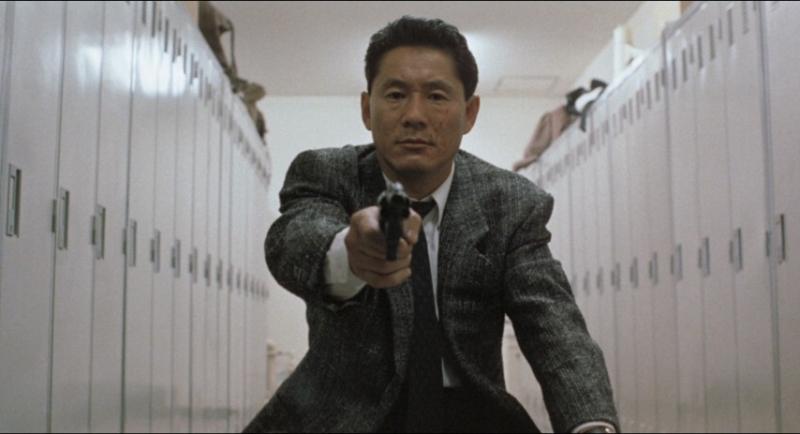
Violent Cop

Kitano's films are largely built around his own body's formidable presence as the leading actor in most of his films. Beat Takeshi, Takeshi's acting name, becomes the image of a wounded masculinity in two intersecting ways: through the pursuit or experience of death, and through a consistent performance of exhaustion as the affect that allows for the commingling of life and death in one single body. […]

The most characteristic imagine of Beat Takeshi in many of the films where he plays a tough, yet affectively wounded yakuza (or ex-cop) [….] is a frontal, purely exhibitionistic shot of his body dressed in a black Armani suit and white shirt, and wearing shades. His hands are either kept in his pockets in a relaxed stance or they are brandishing a gun at somebody in utter confidence of his shooting powers. His expression is invariably deadpan, and, as such, beyond sadness. 

Elena del Rio, The Grace of Destruction

Beat Takeshi is always fatigued in his movies. His roles never require him to act lively…. Sonatine's Murakawa appears to have already passed beyond the state of exhaustion [found in Boiling Point's Uehara]. He does not ahve sexual intercourse in this film … he has already fallen into a state of sexual impotence.

Casio Abe, Beat Takeshi vs Takeshi Kitano

The idea of becomings as encounters we have with partial deaths while still alive takes us back to Deleuze and Guattari's notion that 'the experience of death … occurs in life and for life … in every intensity as passage or becoming'. From this stanspoint, processes of becoming, in which we undergo continuous small deaths, can put us in the path of a more impersonal more sober relation to our own death. if we are successful at confronting and sustaining their intensity, processes of becoming can soften the rigidity of our selves, weaken our grasp of permanent realities and identities, and mitigate our fears and anxieties toward change. In fulfilling the immanence of death to life – offering us rudimentary but real instances of the experience of death-in-life – processes of becoming help us accept the idea of life continuing beyond 'me'.

Elena del Rio, The Grace of Destruction

Life itself is eternal … when it is lived with maximum intensity, or when the extrinsic and durational existence of a mode is brought into line as closely as possible to its essence's 'force of existing' … its elan vital, or 'life-force'. 

Bruce Baugh, 'Death and Temporality in Deleuze and Derrida', on Spinoza

Thought today about what I, an old man, should do…. Several times in my life I've considered myself close to death. And – how foolishly! – I would forget, or try to forget it…. And now, because of my years, I naturally consider myself close to death, and there's no point in trying to forget it, and I can't forget it. But what should I, an old feeble person, so?, I asked myself. and it seemed that there was nothing to do, that I had no strength for anything. But today I realised so clearly the clear and joyful answer. What should I do? it's already been revealed – I must die. This is my task now, as it always has been. And I must die. This is my task now, as it always has been. And I must perform this task as well as possible: die, and die well. the task is before you, a noble and inevitable task…. This made me very glad. I'm beginning to get used to regarding death and dying not as the end of my task, but as the task itself.

Tolstoy, Diaries, 1906

Proust says that Dostoevsky is original in composition above all. It is an extraordinarily complex and close-meshed whole, purely inward, with currents and counter-currents like those of the sea.

Robert Bresson

Style is … all rhythm. Once you get that, you can't use the wrong words. But on the other hand here I am sitting after half the morning, crammed with ideas and visions … and can't dislodge them, for lack of the right rhythm. Now this is very profound, what rhythm is, and goes far deeper than words. A slight, an emotion, creates this wave in the mind, long before it makes words to fit it; and in writing … one has to recapture this, and set this working (which has noting apparently to do with words) and then, as it breaks and tumbles in the mind, it makes words to fit it.

Woolf to Sackville-West, 1926

When Tarr ceased to be a marginalised outsider and became one of the touchstones of the mainstream high-brow art-film culture, he decided it was time to stop.

For Tarr filmmaking has always been a  question of inner moral conviction rather than a profession.

For Tarr no film of his was 'just a film'. Each of them was a 'cause' to which everybody in the crew had to dedicate himself or herself entirely with inner conviction.

Each shot is a long sequence, a block of time, and it has to have an exact atmosphere, an opening and closing, and a dramaturgical curve of its own, depending only to a small extent on the next or previous shot. 

The basic theme of all Tarr's films is entrapment. The main problem Tarr resolves in different ways in different films is how to create the deceptive sense that the characters' situation is evolving toward some solution and, at the same time, to make one feel the hopelessness of this situation right from the beginning; the art of Béla Tarr is thus to make believe without hiding anything.

On The Turin Horse:

In no other Tarr film is the helplessness of the characters laid bare so powerfully as in this film[….] everyone in this film faces ultimate helplessness, and for the first time in Tarr's oeuvre, the characters do not make their own life or others' lives any harder. They are entirely at the mercy of exterior circumstances, and these circumstances have no mercy for them. No real human qualities are manifested by the characters of this film; be it good or bad, there is only base human existence reduced to its simplest physical and biological substance. That is why the last sentence uttered in the film is what the father says to his daughter; 'One must eat'.

… extensive representation of temps mort is more excessive in this film than in any other Tarr film. In fact, what is represented all through the story is empty time, since nothing is envisaged in the plot, nothing adds up, and the characters' acts lead nowhere. The story represents the time elapsed between two extraordinary events: Nietzsche's final mental breakdown, related to the beating of the horse, and the final apocalyptic blackout. But this is not the empty time within a process between two significant events representing important turns in an event series. The empty time in the story will not end. This is the process of time emptying out for good, which is represented on the concrete level by the events contributing to the disappearance or the fading out of the world. The last event, the fade out, therefore, is not an event. It is the end of all events, the end of time. The time of the plot takes place in a kind of 'day after', where the apocalyptic event in Nietzsche's mental breakdown followed by an undetermined natural catastrophe where the chances of survival are zero.

The most spectacular thing about the narrative is that there is no progressing element in it related to the characters. The characters have no intentions, goals, plans, or desires that could become the motivational basis of the narration. 

… since the last human connection is the manifestation of the final mental collapse, the apocalypse occurring in the story can be interpreted in a way as a result of nor as a metaphor for Nietzsche's mental breakdown, as if Nietzsche's collapse were a premonition, the first sign of the apocalypse. Or else, as if the latter were a consequence or the physical continuation of the former. 

On Damnation:

Causes and effects go round and round and everything is part of the same web of circumstances that takes it impossible for anyone to step outside of this infernal circularity. this conspiracy-like structure is what evokes the universality of this human condition, which is not specifically moral, social, historical or psychological. It is not geographically located either. It is also natural (no consolation in natural beauty), meterological (constant rain and mud) and physical (run-down environment): universal, in one word. 

… the only hope they have is to push back the inevitable bad ending a little. His only hope is to slow down the process leading to his downfall, or, in other words, slowness is his only hope. We can see now how how the only positive element of the story is intimately linked to slowness. Slowness postpones the tragedy, making the characters and the viewer believe that there remains some hope. On the other hand, slowness together with suspense raises a presentiment of something inevitable to come.

In Damnation, it is no longer 'Hungary of the 1970s or 1980s', but an unspecific degraded, deserted semi-urban, semi-rural landscape on the way to slow, gradually disintegration displayed in a careful visual composition, fitted with meticulously chosen objects and architectural elements, and lit in a strong chiaroscuro style. Yet the elements are recognisably East European, bearing the signs of a destroyed tradition and an unfinished modernisation blocked halfway to completion. 

András Bálint Kovács, The Cinema of Béla Tarr

He just loved to work. It was ingrained in his personality. He was happiest when he was working and I think that’s what made him so prolific. He was also smart and aware enough to see when he was on a roll. He made a lot of incredible albums in a very short amount of time – in just a few years. He knew he had to capture that 4-5 year span as he was really growing into his own as a master songwriter. I think he was afraid it’d go away as he’d seen with so many of his heroes; so he decided worked fast as he was on a clock. And to an extent that happened. His talent never disappeared, but I think there came a point where he had to work a little harder to expand his boundaries, to “get there”. That probably happens in every profession, and I think its a real challenge when musicians are faced with that.

Ben Swanson on Jason Molina

Imperious images and letters force us to read, while the pleading things of the world are begging our senses for meaning. the latter ask; the former command. Our senses give meaning to the world; our products already have meaning, which is flat. they are easier to perceive because they are less elaborate, similar to waste. Images are the waste of paintings; logos, the waste of writing; ads, the waste of vision; announcements, the residues of music. Forcing themselves on our perception, these low and facile signs clog up the landscape, which itself is more difficult, discreet, silent, and often dying because unseen by any saving perception.

Michel Serres, Malfeasance

Jim Jarmusch: The subject is not coffee and cigarettes — that’s just a pretext for showing the undramatic part of your day, when you take a break and use these drugs, or whatever. It’s a pretext for getting characters together to talk in the sort of throwaway period of their day.

iW: Why would viewers find that interesting?

Jarmusch: Well, I think our lives are made of little moments that are not necessarily dramatic, and for some odd reason I’m attracted to those moments. I made “Night on Earth,” which only takes place in taxi cabs, because I kept watching movies and where people, like, say, “Oh, I’ll be right over,” and you see them get out of the taxi, and I’m always thinking, “I wonder what that moment would be like.” The moment that’s not important to the plot. I made a whole movie about what could be taken out of movies.

iW: The interstices.

Jarmusch: Yes. One of my favorite directors is Yasujiro Ozu. On his gravestone, which I visited in Japan, was a single Chinese character that means, roughly, “the space between all things.” That’s what I’m attracted to.

Interview with Jim Jarmusch, Indie Wire

The last day will be so imperceptible, that we shall not notice its dawn or its twilight, or the last night. Perhaps the last day he’s passed, unnoticed? Maybe we live in the twenty-fifth hour.

Is the world around us a sad epilogue to reality? Is this world the entrance gate to nothingness?

The world must end because it is intolerable. The prophets proclaim the end of the world so as to cause it.

Empty shells of a once burning hope.

Mine was a life without religion, and is this not, after all, a definition of philosophy? … I am a failure, because I live philosophy. Which is to say that philosophy is my life.

Vilem Flusser

Human life is made in such a way that many problems that pose themselves to all human beings without exception are insoluble outside sainthood.

God alone, and absolutely nothing else, is worthy of our interest.

How can a being whose essence is to love God and who is located in space and time have any vocation other than the Cross?

Crucifixion is the end, the accomplishment of a human destiny.

Simone Weil

 A failure of communication – that’s what my film is about. If there was communication, we wouldn’t need to speak, or make music, or make films. Cinema comes at a moment when there is a failure of communication.

Godard, JLG/JLG:

 The Russian people in accordance with their metaphysical nature and vocation are a people of the End. Apocalypse has always played a great part both among the masses of our people and at the highest cultural level … In our thought the eschatological problem takes an immeasurably greater place than in the thinking of the West.

Berdyaev, The Russian Idea

In a rare lyrical outburst, in the Critique of the Power of Judgement, Kant describes what would befall such a philosopher like Spinoza:

Deceit, violence and envy will always surround him, even though he is himself honest, peaceable and benevolent; and the righteous ones besides himself that he will still encounter will, in spite of all their worthiness to be happy, nevertheless will be subject by nature, which pays no attention to that, to all the evils of poverty, illness, and untimely death, just like all the other animals on the earth, and will always remain thus until one wide grave engulfs them all together (whether honest or dishonest, it makes no difference here), and flings them, who were capable of having believed themselves to be the final end of creation, back into the abyss of the aimless chaos of matter from which they were drawn.

Before the tsunami arrives, before big one arrives, before the capsizing blow, before the tsunami, the sea recedes, for a time that is maybe short or very long. The sea recedes, it leaves sand. It leaves swamp. It leaves a huge feeling of depression, the sense of not being there, the sense that everything is finished, and that it may never begin again. 

Well, I have the impression that in this passage, we are in the undertow and I can feel that this undertow is preparing a comeback so overwhelming, so frightening, that we do don't even have the guts to think about it, the guts to imagine it. You can feel it around, on the train, on the bus, in the streets, you feel it distinctly, this sense of every energy receding, of depression, the cynicism – the only thing that remains in our culture – but a cynicism made of fragments of desperation, of moments, of deja vu, of an inexplicable, unspeakable word.

Well, the undertow, the cynicism, the depression, the sensation of not being able to coordinate will and action anymore. The sensation of an incapacity of the body to move, to perform actions for desire, for pleasure, for communication, simply for freedom, joy of being there, all this has vanished, finished.  […]

Wait for the tsunami, wait but great ready, because you'll have to think of something, what clothes to wear, a gesture to make, the moment before the wave finally wipes you out. 

Franco 'Bifo' Berardi

… it's a little bit what we could say of Rothko and his work, which opens up and closes in all directions at one and the same time – it's unassailable. This seems to be characteristic of every singularity: impregnable from outside and totally open towards the inside – initiatory. Such sentences are more precious than a whole explanatory presentation. They are, by their transparent opacity, a kind of miracle, since they have behind them, nonetheless, a clandestine intuition of meaning. It isn't nonsense; it's just before meaning arrives; before the trap closes again. 

I think of Hölderlin […] when he speaks of rivers, trees, cities and mythical heroes. He doesn't speak of them in mythological terms at all, in allegorical or romantic terms. He's the site of their dramaturgy. He's the place where the gods metamorphose, the place where rivers metamorphose, the site where all the fragments of becoming converge. He doesn't liberate the world, he doesn't express it. He's at the confluence of the forces that come from all sides, and he's in thrall to their metamorphosis. You find this in Rimbaud, too, from Illuminations to A Season in Hell: it's a continual metamorphosis from one sentence to the next, and the form conveys this surprise of the whole world in a few sentences.

 … the wonderful story of John, for example, who reaches the age of 14 without saying a word and then, one day, suddenly begins to speak in order to ask for the sugar. They ask him why he's never spoken before and he says, "Up until then, everything was perfect" …

The world is perfect if you take it as it is, as absolute self-evidence. Then that self-evidence is disturbed, and you have to begin to explain it, to give it a meaning – and that's the beginning of the end.

Human beings can't bear themselves, they can't bear their otherness, this duality; can't bear it either in the world or in themselves. They can't bear failing the world by their very existence, nor the world failing them. They've sown disorder everywhere, and in wishing to perfect the world, they end up in a sense failing themselves. Hence this self-hatred, this detestation that fuels the whole technological effort to make the world over anew. A kind of vengeance on oneself or on the human race arising out of our having contravened the order of the world by the very act of our appearance. We can't do anything about this, but it in no way diminishes the fact that the situation is unbearable. It's on this failing of existence that all religions thrive. You have to pay. In the past it was God who took the reprisals, now we do it. It's we who've undertaken to inflict the worst on ourselves, and to engineer our disappearance in an extremely complex and sophisticated way, in order to restore the world to the pure state it was in before we were in it.

… evil is made over into misfortune. Evil is soluble in misfortune. That's what 'victimhood' is.

… ressentiment is the product of an – inevitably – disappointed idealization. Cioran says, for example, that it's the desire to give a meaning to life that makes us failures. 

… everything's idiomatic. What remains strange is that we strive remorselessly to disenchant this singular object, to pervert the real, precisely by giving it meaning. 

… thought is something different from – human, all too human – reflection; it is, rather, the refraction of what there is that's inhuman in the world. We might equally say: it's the inhuman that thinks us. 

… this world, the virtual world, no longer asks itself the question of impossible exchange: it has swallowed its own mirror; it has swallowed its own reference; it is its own truth. No transcendence any more, and hence no questioning. 

… the space of the screen, of virtual reality, is the space of the abolition of night, the abolition of the alternation of night and day and of waking and dreaming – in a kind of perpetual watchfulness. One of the great differences between a future 'trans-realised' species and ourselves will be the definitive absence of night and dreaming. Now, consciousness exists only by passing from night to day, from sleeping to waking.

Never being able to rest from oneself is the worst of hypotheses. Might that have happened to God? to indulge in more fantastical hypotheses of this kind, might God also be a victim of insomnia? Might we be the product of his insomnia rather than his dreams?

It's an abominable vision: we'd be a species akin to those battery hens who never see the light of day. The lights are permanently left on so that they lose all sense of time, so that they eat constantly and fatten up at great speed. This is how those hormone-inflated species grow, having never walked and never really been able to sleep. 

It seemed to be that, in the guise of libidinal deregulation, Deleuze and Lyotard were simply ratifying the future state of things. 

There are styles of writing […] that have no secret to them, where you see how they've been manufactured – like a technical object. But sometimes, in writing, you have the delightful impression that something has worked secretly, something unforeseeable, something you have no sight of. A secret which is, in the end, a bit like the secret of birth – your own birth remains forever a secret to you (your own death too).

… art isn't useless in itself […] it is useless additionally; it's beyond usefulness and uselessness. Unfortunately, it doesn't remain in that sublime zone: from the nineteenth century onwards, it aspires to be useless, it plays at the uselessness of 'art for art' and at that point it sinks into aesthetics.

… dysfunctioning is a variant – and perhaps the most successful variant – of functioning, that inadaption is the most successful form of adaptation, etc. Things are more complicated today, because the fact of dysfunctioning is part of the game. Everyone's required to be different, singular, anomic, subversive. And even disablement is a bonus. There's a whole paranormal conformism going on.

… what is worthless is precisely that which has forgotten the nothing. […] from time to time, the nothing draws attention to itself as what it 'is'; the absent term of every exchange resurfaces in the breakdown, the accident, the crisis of generalized exchange.

Everything is exchanged for nothing – that is 'traditional' nihilism. By contrast, nothing is exchanged, the nothing is inexchangable – this is impossible exchange, though here we have the superlative dimension, the poetic dimension of impossible exchange. This is the opposite of nihilism. it is the resurgence of the nothing at the hear of the essent, at the heart of the something. Warhol talked, for example, of bringing out the nothingness at the heart of the image. And Barthes's punctum in photography is this too: the blind spot, the non-place at the heart of the image. what, then, would the opposite of nihilism be?

… it's the dual form that creates the void and preserves the void, whereas oneness, being always the oneness of the whole, of the something, no longer leaves space for the noting. Antonio Machado says that we always credit God with having created the world ex nihilo, with having created something out of nothing, but we ought to acknowledge in him a much higher power, that of having created nothingness out of something.

Let's go back to the question of nihilism. In the Heideggerain version, it's the forgetting of the nothing, and hence its exclusion. In the Nietzschean version, that of active nihilism, it might be said to mean pushing things, value systems, to their limits, where it turns out that there's nothing, that they lead to nothing. It is, all the same, a way of making the nothing appear in the end – a sort of forceps delivery.

… we're devouring history, this time retrospectively. For so long as it was unfolding, we could retain the illusion of understanding it. Today, it's coming to an end without our knowing why. We're trying, therefore, to revive it, so as to guess its meaning, to 'digest' it. 

Nihilism, (which is the forgetting of the nothing) is technically realized.

… the story of a deep-sea creature with a minimal brain, which wanders around for a long time before finding a spot to which to affix itself. As soon as it's found one, it survives by devouring itself. And what it devours first is its own brain. this modicum of gray matter that served only to help it find its place is no longer needed, so it devours it. I wonder whether the human race isn't following the same course.

Endowed with a superior intelligence, which has perhaps enabled it to find its own place, the human race is devouring it. It's using its brain as an operational mechanism to the point of sacrificing it to artificial intelligence. There it is in its fixed spot. The operation's over. It's come to its end. And so it devours its own thought, that function that has now become useless. The species, having arrived at its ends, gives up on itself and its own specificity. 

Q. Does a universe expurgated of its shadow (and its death) exert an absolute fascination? As Heraclitus said: "How will one hide from that which never sets"?

Baudrillard (roman) and Enrique Valiente Noailles (italics), Exiles from Dialogue

In another mental constellation, can we imagine time becoming a sort of space in which you can move in all directions, return to the point of origin etc.? Conversely, could space become like time: irreversible, so that you can't retrace your steps or get back to the point you started from? Or having, like time, its absolute horizon: eternity? What would be the equivalent of eternity where space is concerned? the negation of motion, stillness, or perpetual motion?

The events of a thousand years ago have shot off a thousand light years into space. Hiroshima is already sixty light years off. The moment that has just passed is already a light-second away. There is, then, no presence. Even if the discrepancy is infinitesimal, nothing is ever present – neither the wall nor the person opposite. we are barely even contemporaneous with our own existences.

Presumptiousness of the artist (John Cage; Bob Wilson?). 'We dream for those people who have no dreams of their own to keep them alive'. Always the same condescension – even worse when it relates to dreams and mental faculties. 

We should invent days without afternoons, nights that stop before the dawn, seasons overlap at a quicker and quicker pace, a year that ends before beginning, and an endless alternation of joy and adversity.

What is exceptional hardly deserves to live. What is banal does not even deserve to die.

Everything is becoming functional. irony is disappearing in the critical function, the word is disappearing in its phatic function. Worse: critique, ethics, aesthetics become functions of each other, as they wait to become useless functions.

The best thing would perhaps be to remove consciousness surgically in utero, together with irony, criticism and intelligence – all those qualities that are so fragile and so dangerous to existence in general.

At last, a genuine madman in the street – someone who doesn't need a mobile phone to talk to himself.

All these novels in which the authors try desperately to dramatize their own histories, their experience,s to recount their own psychological dramas – this is not literature. It is secretion, just like bile, sweat or tears – and, sometimes even, excretion. It is the literary transcription of 'reality television'. It is all the product of a vulgar unconscious not unlike a small intestine, around which roam the phantasms and affects of those who, now they've been persuaded they have an inner life, don't know what to do with it.

To move in the space of deafness is like moving in an aquatic milieu. the same foetal, amniotic strangeness, the same cautiousness of gesture, the same mental lethargy – the same silence of the depths: it isn't you who are deaf, it's the world that's dumb. But the inner noise, the organic murmur is there. the body is all ears towards the inside.

Against Machiavelli's Prince, a treatise on the ploys of domination, we should set a treatise on the ruses of servitude. Its ploys are not those of the lion, but of the fox; not those of the eagle, but of the moray eel and the chameleon.

The truth they defend is merely the astrological sign of their stupidity.

Memento mori: Not: remember that you must die, but: don't forget to die, remember to die (before it's too late).

'History is speeding up? No: history has stopped, but it has left us with the acceleration' (Philippe Muray).

Artificial intelligence? The intelligence has left it, but we are left with the artifice, which flourishes the better on the ruin of intelligence.

The extreme of happiness leaves room for only one question: might we not already be dead?

… there is too much of everything everywhere. Too many people, too many places too many images on television, 'too many notes in Mozart', too many ideas and too many words to express them – too many old people among the old, too many young people among the young. And, ultimately, the worst of it is that there's too much culture on France Culture.

… cancer is the epitome of all our pathologies: the subdivision of cells to infinity provides a reflection of the proliferation of everything, and of the species itself in its transgenic frenzy.

Already God existed only in the desperate attempt to prove his existence. It is the same today with human beings, whose existence we attempt desperately to verify by the very means that make it improbable.

Strange disappearance of the idea of solitude, of the pathos of solitude. No one speaks of it any more, no one feels it any more. there is today only psychical isolation, mental, sensory insulation. Everyone is deterritorialised, or rather extra-territorialised from inside. The melancholy tone has disappeared.

But haven't human beings had enough of their own consciousness anyway? Why deck machines out with it? Except to be rid of it? Passing consciousness and intelligence on to machines so as to be rid both of machines and intelligence.

A mad idea is to manipulate ape genetically to the point where they conceive the idea of suicide, which was previously the prerogative of human beings. The ape is developed to the point where it prefers to kill itself because it can no longer even see itself as an ape.

The cultural greenhouse effect: the toxic cloud caused by emissions from million of museums, festivals, conferences and symposiums is much more catastrophic than the disappearance of the ozone layer.

The asphyxia caused by the activity of thousands of creative brains damages the quality of life more certainly than all the world's industrial pollution.

In the cinematic studios of Vancouver, it is specified contractually that no one must look the stars in the eyes, 'for fear of disturbing them or breaking their concentration'.

Time tightens and condenses to the point where it no longer lets time pass. A substance so intense, so dense, that the future will not be able to pass through it. 

Against the advice of doctors, the governor refuses to allow an incurably ill man to be put out of his misery. This is the other face of capital punishment. On day we shall have to fight for the abolition of the death penalty.

Shadows have always precede us, and they will outlive us. We were dead before we were alive, and we shall be again.

… speech always begins with stammering. Acts and action always begin with trembling. there is no continuum of the will. It acts on the body by fits and starts and is the product of an interval, a rapid alternation, between tension and release: to act is to produce a difference – even a slight one – between you and yourself. If you eliminate the intervals, tetany ensues: you shake all over.

We have lost our shadows, not simply for the lack of a light source, but for lack of a ground on which to shine. So, the trapeze artist doesn't need a net now, given the absence of ground to crash down on.

*

… everyone today, at the steering wheel or sitting in front of his screen, seeing all the world's events pass by as he pleases, can imagine himself the epicentre of universal consciousness, and see the world spirit pass before him (no need to be Hegel to see the Weltgeist pass by on horseback – Napoleon).

… the banalized individual has only to look at himself to see the Weltgeist pass by. The world spirit is full achieved, not now in the form of the state or the end of history, but in every monad that is now the centre of the universe.

*

The weakness of many novels and films can be seen in the fact that one is forced to interpret them ironically to find any depth in them.

One is everywhere trapped between a literal and an ironic reading. A more or less conscious calculation that aims to disorientate any value judgement. It is particularly flagrant in the field of art, where this studied vagueness as to how a work is to be read has supplanted illusion and aesthetic judgement.

Deep down, however, it is reality itself that has  become so banal and insignificant that it has induced us into an ironic reading. It has become so homogenised that it breaks off from itself into a parallel reality. It is out of nostalgia that we embed it in another order: in the face of this insignificance, we are forced to hypothesise a more subtle realm beyond, a dimension beyond our grasp. A critical masochism by which all the speculative arts have found success.

*

Blanchot is dead and the homages are raining in.

He will have lost the gamble of effacing effacement, and his proselytes and commentators will, in the very glorification of silence, have missed a fine opportunity to be silent. He could not have been unaware, himself, that his self-effacement made him an object of insatiable curiosity (of an ironic kind, of course!), a thwarted great game,  the absolute snobbery of absence.

Ultimately, though, Blanchot (like Duchamp) is the original and all the rest is a joke. All this subtle, non-academic philosophy, imbued with his ideas, all this philosophically correct philosophy of the unsaid, the forbidden and the inexpressible in the end merely reaps the dividends of an experience of thought that is not its own.

Moreover, there is no need whatever to be a philosopher to play that particular game (self-effacement). Everyone effaces himself but no one speaks about it. The entire history of ordinary life is one of an effacement much more radical than that of thought yearning to disappear.

Simple folk, the uneducated, the artless are the thought of Blanchot. They have succeeded in effacing effacement. The philosophical exigency is embodied in those who know nothing of it.

Baudrillard, Cool Memories V

Suffering is a always a suffering of the world's pathetic indifference towards us (the pathos of the Stoics).

We should be amazed not that there is so much chaos and violence, but that there is so little and everything functions so well. Given the level of aggression of every car driver, the frailties of the equipment and the mad scramble of the traffic, it's a miracle thousands aren't killed every day, a miracle we only rarely slaughter each other and only a few of these disastrous possibilities come to fruition. When you see the immense bureaucratic chaos, the number of absurd decisions, the universal fraud and squandering of our civic virtues, you can only be amazed by the daily miracle of this machine which, somehow or other, keeps on going, dragging its detritus along in is orbit. Apart from a few episodic breakdowns (no more frequent, ultimately, that earth tremors), it's as though an individual hand manage to telemonize all this mess, to normalise this anomie. This is perhaps the same miracle as the one which prevents everyone from succumbing daily to the idea of death or to suicidal melancholia.

In a system as perfect as this, you only have to be deprived of breakfast to become unpredictable.

Philosophy would like to transform the enigma of the world into a philosophical question, but the enigma leaves no room for any question whatever. It is the precession of the answer which makes the world indecipherable.

The political class's current problem is that what is required today is not that it should govern, but that it should maintain the hallucination of power. And this demands very special talents. Producing power as illusion is like juggling with hot money, like dancing in front of a mirror.

The compact disc. It doesn't wear out, even if you use it. Terrifying. it's as though you'd never used it. So it's as though you didn't exist. If things don't get old any more, then that's because it's you who are dead.

At Disneyland in Florida they are building a giant mock-up of Holly wood, with the boulevards, studios, etc. One more spiral in the simulacrum. One day they will rebuild Disneyworld at Disneyworld.

It is easy to adapt to Australian or American life because they are the zero degree of the style of life. but the zero degree is also that of the extermination of all others, and the temptation of ease is the temptation of death.

The perfect crime, the only one, is suicide. because it is unique and final, whereas murder has to be repeated endlessly. Because suicide achieves the ideal confusion of executioner and victim.

The absolute precondition for thought is the creation of a void, for in any void the most distant objects are in a radical proximity. In the void, any body whatever, whether celestial or conceptual, shines out with a silent abstraction.

Prophesying catastrophe is incredibly banal. The more original move is to assume that it has already occurred. 

There is no point questioning reality when more than ten are present. Every audience of more than ten automatically turns defensive and reacts violently to any challenge to reality and manifest truth. no radical statement can be made to more than ten people.

Why don't we accord more importance to the star signs of death, when we pay so much attention to birth signs? It's barely imaginable that the star sign you are going to die under doesn't exert an anticipatory power equal to the one you were born under … This final determination certainly influences us like a strange attractor …

… the serenity with which Brazilians take the failure of their projects or programmes. Nothing is destined to go straight to its target, no one can expect to take an operation through to its conclusion. No the end, the remainder, the denouement have to be left to chance, to the devil, to fatality. 

Crisis is for the upper echelons of the capitalist class, who rake in all the profits from it on a world scale. Catastrophe is for the middle classes, who see their reasons for living disappear. The others (80 per cent) are so far below the level of the crisis, they don't even experience it. they survive it, if they can, instinctively. Having no economic existence, it is easier for them to find a symbolic catastrophe equilibrium.

Intellectuals are doomed to disappear when artificial intelligence bursts on the scene, just as the heroes of silent cinema disappeared with the coming of the talkies. We are all Buster Keatons.

God exists, but I don't believe in him. God himself doesn't believe in Him, according to tradition. That would be a weakness. It would also be a weakness to believe we have a soul or a desire. Let us leave that weakness to others, as god leaves belief to mortals.

Captive events, like captive animals and captive audiences; they no longer reproduce in captivity. over-information leads to their gentle extermination.

Communism had succeeded in wresting entire generations away from the work ethic, in killing in them the slightest desire to produce, in making them lazy. This historical scandal is coming to an end. The whole of Europe is going to work in concert. But the question still remains: shouldn't we have preferred a certain enforced idleness, linked to voluntary servitude, a certain aboulic and apathetic ethos to our frenzied go-getting utopia? to our suspect feverishness? Which will win out in the long term, enforced idleness or frenzied activism?

Our cultivated, high-society set only gorge themselves on Beckett, Cioran, Artaud and all today's hallowed forms of cynicism and nihilism the better to evade any analysis of the current forms of despair. they denounce with the greatest moral and political energy every present instance of nihilism, of the nihility of our values, while 'culturally' savoring the heroic but anachronistic forms of nihilism and the inhuman. They glorify the accursed share, but keep the holy water handy.

The transparency of those whose images, whose secrets, whose obscurity have been stolen, and who stand there, full in the light, more naked than naked, the transparency of people whose shadows have been stolen, of the hostage whose death has been stolen, of the world from which all appearance has been stolen, of the real from which all illusion has been stolen.

*

True poetry is that which has lost all the distinctive signs of power. If poetry exists, it is anywhere but in poetry. Just as, in the past, the name of god was scattered through the poem in accordance with the anagrammatic rule, today it is the poem itself which is dispersed into non-poetic forms. the same goes for the theatre: theatre today is anywhere but in the theatre. True theatre is elsewhere.

So it is with philosophy: if it exists, it is anywhere but in works of philosophy. And the only exciting thing is this anamorphosis, this dispersal of philosophical forms into all that is not philosophy. the whole world has become philosophical, since it has disavowed reality and the self-evident. There is no point questioning it as to its end: it is beyond its ends. Nor as to its cause: it knows only effects. So philosophical criticism is, in substance at an end. Cynicism, sophism, irony, distance, indifference and all the philosophical passions have passed in to things. All of philosophy and poetry come back to us from places where we were no longer expecting to find them.

Baudrillard, Cool Memories II

The point where the meridians meet and where, consequently, it is every hour of the day at once.

Modern activities have the same subtle function as scavengers in the desert: by devouring dead time, they leave pure time at our disposal. By putting an end to free time, they deliver us from the anguish of full time.

[Ambiguity] in the line from the Bible: 'Without him nothing was created'. In the Cathar version, this became: 'And without him the Nothing was created', which, in quite contrary vein, sets forth the principle of Evil.

When one looks at the emptiness of current art, the only question is how such a machine can continue to function in the absence of any new energy, in an atmosphere of critical disillusionment and commercial frenzy, and with all the players totally indifferent? If it can continue, how long will this illusionism last? A hundred years, two hundred? This society is like a vessel whose edges move ever wider apart, and in which the water never comes to the boil.

Memory is a dangerous function. it retrospectively gives meaning to that which did not have any. It retrospecively cancels out the internal illusoriness of events, which was their originality. But if events retained their original, engimatic form, their ambiguous, terrifying form, there would doubtless no longer be any history.

Everything, before taking place, should have the chance not to take place. This suspense is essential, like the negative of a photo. It is this negative that enables the photo to have meaning; it is this negative which enables it to take place – never the first time, always the second. For things have meaning only the second time, like baptism in anabaptism, like form in anamorphosis. Hence the fantasy that there will always be a second meeting, another chance, in another world or in a previous life.

The beauty of the dead when they are laid out on their sides. Not with their faces upturned to the sky – a sign of annihilation and Last Judgement – but on their sides, their legs tucked up, as a mark of foetal coiling and of sleep.

Our feelings, which we delightfully term emotions in order to salvage the fiction of an emotional life, are not effects any more, merely a psychological affectiation, having lost all credence in our eyes.

Boredom [ennui] is a subtle form of filterable virus, of fossilized tonality, which might be said to pass invisibly across the substance of time without altering it. fine particles of boredom striate time like neutrinos, leaving no trace. there is scarcely any living memory of boredom. This is why it can superimpose itself on all kinds of activities, even exciting ones, since it lives in the interstices.

One must free oneself from one's ideas in writing, not take charge of them. One must free language from its purpose, free concepts from their meaning, free the world from its reality – which is an even greater illusion.

Artificial Intelligence inevitably produces an Artificial Intelligentsia, a body of intellectually correct, genetically immunized experts, which re-forms around numerical intelligence data and the digital mastery of the code.

Neurotic and erotic abreaction in every place marked out for discourse or for writing: libraries, conferences, 'round tables', examinations. A desire to climb the curtains and swing from the chandeliers as soon as the discourse of culture makes its appearance.

Under the heading of everyday atrocities: the daughters of Moscow apparatchiks buying up on the black market from the Mafia the foreign travel scholarships granted to the irradiated children of Chernobyl.

The stupidity of all commercial or cultural anti-Americanism. As if Americanism did not run through every society, every nation, and every individual today, like modernity itself.

Even in the daytime, a part of us is perpetually asleep. When we are fast asleep, part of us is constantly awake. This is how, even when we are asleep, we can wish for sleep. How, even when we are fully alive, we can want to live.

At the heart of the Pyramids, there was a central space from which immortality radiated. At the heart of our civilization, there is now merely a hole into which the dustbins of history are emptied.

That male beetle which dies without being born, since it is doomed solely to fertilize the other females in the womb which conceived them, after which it perishes without seeing the light of day.

The revolution of 'lived experience' is without doubt the worst, the revolution which swept away the secrecy with which everyone surrounded their own life and has transformed tat life into a huge 'reality show'. What has been liberated by all the revolutions of desire, expression, fantasy and analysis is not the dramaturgy of the unconscious or the theatre of cruelty, but the theatre of banality. It is not the taboo on the drives that has been removed, but that on triviality, naivety, idiosyncrasy and idiosyncretism. What has been liberated is not each person's singularity, but their specific stupidity – that is to say, the stupidity they share with everyone else.

Cards, that virtual money , protect us from the vulgarity of cash. but money itself, that artifact of value, protects us from the vulgarity of the commodity. and the commodity, that artifact of desire, protects us from the vulgarity of human relations. In this way, we are marvellously protected.

Those toadying intellectual curs, always wondering how it is possible to be both a genius and politically despicable (Celine, Leni Reifensthal …), it being understood that the essential thing is not to be a genius, but one of the right-thinking. This is where the whole ambiguity of contemporary art resides: laying claim to worthlessness, insignificance, non-meaning and banality; staining for worthlessness, when it is in fact already worthless. Aim for non-meaning when it is in fact already insignificant. Aspiring to superficiality in superficial terms. 

Gut reaction against yobbery, the masses and solid Frenchness. But an equally visceral distaste for the elite, for castes, culture and the nomenklatura. Do we have to choose between the moronic masses and the arrogant privileged classes (particularly when they have an odour of demogogic humility about them)? No solution.

Have I actually wiped away all the traces, all the possible consequences of this book? Did I reach a point where nothing can be made of it; did I abolish every last desire to give it a meaning? have I achieved that continuity of the Nothing? In that case, I have succeeded. I have done to the book what the system has done to reality: turned it into something no one knows what to do with any moire. but something they don't know  how to get rid of either.

The advantage of being happy is that one is rid of the question of happiness. The advantage of being free is that one is rid of the question of freedom.

Baudrillard, Cool Memories III

Malraux is more than a nihilist. Not only is God dead, but so is Man, like a figure of the voice incarnated in history. But what they leave after them is not a void; it's a vitality swarming with larvae, spiders, octopi, and soft crabs; a nightmare in which the cycle of putrefaction and regeneration endlessly repeats itself. Without end and without purpose. The stars in the sky form a spider's web, indifferent and threatening; and 'more interior in one-self than the self', man does not discover the voice of God, as Augustine thought, but horrifying beasts vegetating in the bottoms of pits. The nihilism here is not philosophical; it's the body that experiences it like a filthy Repetition.

Lyotard, 'Being Done with Narrative by Cubism and Malraux'

If we went back only 20 or 30 years, we would be astounded by the sheer non-utility that made up good parts of society, which to us today look incomprehensibly wasteful, irrational and non-transparent: jobs maintained to keep people in employment, national sports team still amateur and unregulated, universities free of league tables and regimented performance assessment exercises. Even at the level of everyday culture and aesthetics, our currently condition perspective would view the formalities of the early 1970s as alien, meandering and uneconomical.

The tactics and practises of everyday life recorded by Certeau still implicitly hold onto the rather liberal assumption that a life is indeed possible within the universe of capitalism.

… our attempts to live, that futile optimism that fools even the most enslaved, is stymied at every turn by an existential darkness that denies complete synthesis. Our embodied and inexorable modi operandi are defined by a breathless and depressing, ‘It cannot go on like this’, things must change. But they never do change, and somehow continue as before.

… the most politically abject and ignored in our society must be considered foremost  if the totality is to be understood. The absolute ‘worst off’ that part of the whole life we like to consign to the status of an exception or aberration, is really what gives the totalized system its false positivity. Its part is the part of everything. That is why society despises its untouchables so much, because in them we see the untruthful structure that bears witness to society’s own mendacity.

We now need to give our abandonment depth so it corrupts the smooth plane of one-dimensional rationality that makes the curve of capitalist reality seem unending. This is the ‘lost dimension’ of industrialised modernity. Are you worthy of your abandonment? If you are, then what are you going to do with the absolute impossibility that is now the defining quality of the late-capitalist worker? Where will you go, what will you say and who will you take with you?

Fleming, Mythology of Work

The apocalypse is typically depicted as humanity reduced to mere life, fragile, exposed to all forms of exploitation and the arbitrary exercise of power. But these dystopian future scenarios are nothing worse than the conditions in which most humans live as their day-to-day reality. By ‘end of the world’, we usually mean the end of our world. What we don’t tend to ask is who gets included in the ‘we’, what it cost to attain our world, and whether we were entitled to such a world in the first place.

What contemporary post-apocalyptic culture fears isn’t the end of ‘the world’ so much as the end of ‘a world’ – the rich, white, leisured, affluent one. Western lifestyles are reliant on what the French philosopher Bruno Latour has referred to as a ‘slowly built set of irreversibilities’, requiring the rest of the world to live in conditions that ‘humanity’ regards as unliveable. And nothing could be more precarious than a species that contracts itself to a small portion of the Earth, draws its resources from elsewhere, transfers its waste and violence, and then declares that its mode of existence is humanity as such.

To define humanity as such by this specific form of humanity is to see the end of that humanity as the end of the world. If everything that defines ‘us’ relies upon such a complex, exploitative and appropriative mode of existence, then of course any diminution of this hyper-humanity is deemed to be an apocalyptic event. ‘We’ have lost our world of security, we seem to be telling ourselves, and will soon be living like all those peoples on whom we have relied to bear the true cost of what it means for ‘us’ to be ‘human’.

Claire Colebrook, 'End-Times for Humanity'