Dogma, out in Spanish from Palido Fuego.
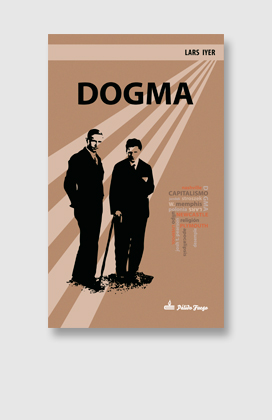

Dogma, out in Spanish from Palido Fuego.
Wittgenstein Jr longlisted for the Jerwood Fiction Uncovered Prize.
The White Review visit Newcastle. I will be speaking at the Newbridge Project on Thursday 14th May. Details here.
Trust in the eternal laws of the gods has vanished, and the Oracles, which pronounced on particular questions, are dumb. The statues are now only stones from which the living soul has flown, just as the hymns are words from which belief has gone. The tables of the gods provide no spiritual food and drink, and in his games and festivals man no longer recovers the joyful consciousness of his unity with the divine. The works of the Muse now lack the power of the Spirit, for the Spirit has gained its certainty of itself from the crushing of gods and men. They have become what they are for us now – beautiful fruit already picked from the tree, which a friendly Fate has offered us, as a girl might set the fruit before us. It cannot give us the actual life in which they existed, nor the tree that bore them, nor the earth and the elements which constituted their substance, not the climate which gave them their peculiar character nor the cycle of the changing seasons that governed the process of their growth. So fate does not restore their world to us along with the works of antique Art, it gives not the spring and summer of the ethical life in which they blossomed and ripened, but only the veiled recollection of that actual world.
Hegel, Phenomenology of Spirit, on the unhappy consciousness.
Fernando Hernández Urias interviews José Luis Amores, of the Spanish publishing house, Pálido Fuego, which brought out Spurious in Spanish translation a couple of years ago (as Magma). Dogma to follow soon.
Neil Stewart reviews Wittgenstein Jr at The Salt House.
I like this little post from Absolute Write Water Cooler.
John Yargo discusses Wittgenstein Jr at The Millions.
Sam Cooper has written an essay, 'The Novel After Its Abandonment', about Stewart Lee and I.
McKenzie, of A Girl With Red Hair, posts on Wittgenstein Jr.
Some quotations from Jens Bjørneboe:
Literature must have a religious dimension if it is really to be literature at all. An unmetaphysical poem is artistically speaking an unrealistic poem; it is false if it conveys nothing of life's macabre double bottom, of all things' ambiguity. If a writer is not clear that our whole crumb of a human life is one long wandering on thin ice over coal-black water, then everything he writes is boring. It is insignificant.
Arnulf Øverland at 70
I've been writing for eight years, and it is only now that I'm beginning to discover what I've actually let myself in for. It's incomprehensible that anyone engages in something which is so utterly impossible. Every word, every comma, every sentence is a problem. Nothing writes itself any more, every page I produce I regard with the very deepest suspicion.
from an interview in Aftenposten (1959)
It's well known that madness doesn't always express itself in a lack of logic, but just as often in the fact that logic is all that remains of reason; counting and ordering is all that's left of the lunatic's consciousness. The meaninglessness screams, but the pedantry is perfect. Everything is made by a mad schoolmaster.
from Powderhouse
Laughter means distance. Where laughter is absent, madness begins. The moment one takes the world with complete seriousness one is potentially insane. The whole art of learning to live means holding fast to laughter; without laughter the world is a torture chamber, a dark place where dark things will happen to us, a horror show filled with bloody deeds of violence.
from Moment of Freedom
Podcast of Ray Monk and I discussing Wittgenstein Jr at the London Review Bookshop last August.
Koen Schouwenburg reviews Wittgenstein Jr in Tzum. (In Dutch)
Wittgenstein Jr shortlisted by the Morning News for its Grand Tournament of Books.
Wittgenstein Jr mentioned by Stephen Mitchelmore in his year-in-reading overview.
Wittgenstein Jr on the long longlist of the Folio Prize.
Here's some footage of me reading from Wittgenstein Jr at the Newcastle Centre for Literary Arts on November 6th this year.
Simon Armstrong picks Wittgenstein Jr as one of his best reading-on-the-way to work books of 2014.
William Duffus reviews Wittgenstein Jr at Open Letters Monthly.
Laish record a tribute to W. and Lars: 'Vague and Full of Pathos'. Listen to it here.
Emily St John Mandel reviews Wittgenstein Jr at The Millions.
Wittgenstein Jr a book of the year at the Daily Telegraph.
And of one the best indie books of the year at Flavorwire.
Here's a video of a reading I did last year for the Newcastle Centre for the Literary Arts.
Wittgenstein Jr reviewed by Lily Hollins in Varsity.
Tony's Book World reviews Wittgenstein Jr.
Steve Mitchelmore interviewed at Ready Steady Book.
Here I am speaking on Two Book Minimum, a podcast from Cave Comedy Radio, with Alison Lieby, Dan Wilbur, and Marcus Parks.
David Fraser interviews me at The Quietus.
Rough Diamond reviews Wittgenstein Jr at Amazon.
Jacob Knowles-Smith reviews Wittgenstein Jr for The Literateur.
 Lars Iyer's Blog