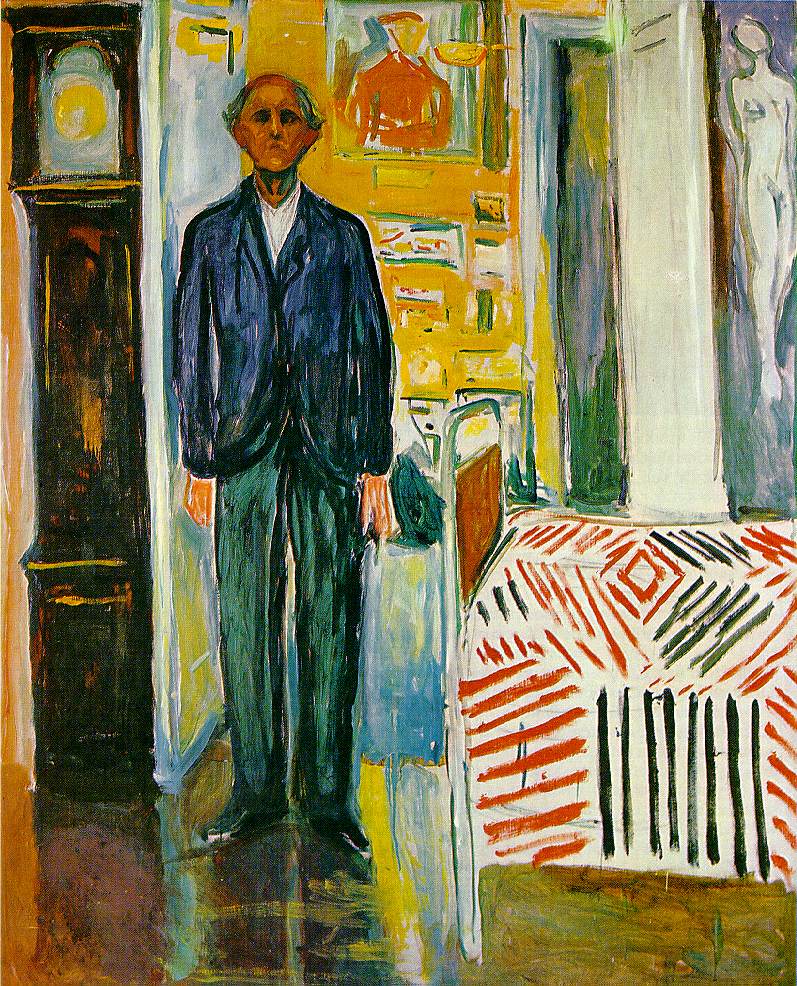
The Cell

It is true I gave in to the desire to make a work of what I write here. True that I printed out the writing of this or that month and read through those pages in bed, underlining this and correcting that. I thought it was time to assess my progress, to discover what works and what does not work. Time, I thought, to set the blog on a firmer course, to discipline my waywardness and discover, through the patient work of many days, the form of the work to which, all along, my writing would have tended.

How foolish! What stupidity! The hex fell on me almost as soon as I set a course for myself; didn’t I understand there was to be no course here, and that to write was blindness, and what was written was written blindly? Not, here, the step by step movement that would beat the path to the work – not the slow accumulative advance whereby each day would let the work come to itself. Only rewriting – only the same said again, writing coming to itself and then dispersing as soon as it made its mark.

So what have I learnt since those days of ambition? The print-outs are put away and all thoughts of the work have fallen from me. I am like the figure in Munch’s painting, whose arms have fallen by his side. Nothing is to be done with this, this writing. Nothing can be made of it, this writing so weak it barely comes to itself.

The soul, after death, needs to be fed and looked after; it is search for the doorway to heaven – or hell, depending on its deeds in life. And in the meantime? It searches; it is vulnerable. Pity too this writing, which barely sets out on the journey only to disperse again. Strange gathering that is the beginning of dispersal; strange work that unworks itself, leaving nothing but the attempt to come to itself anew, to begin, to make a beginning, and then to lose hold of the beginning and fall back into nothingness.

Nothingness: that’s what divides these posts. Life is not lived elsewhere, only here; life comes to itself only here – writing marks the return of life to itself, and its imminent dispersal. That will have been your life, that by which you marked your days like a prisoner in the cell. That was it, those lines and cross bars, where weeks pass, years pass, but nothing passes.

But then I know too that by the same strokes – by the same non-strokes – in which passage fails to mark itself that there is also passage of a sort. It is enough to pass from one day to another – enough that what returns does so across time, and not as the same instant endlessly repeated.

Across time – comfort of a strength that does not fail to find itself. Each stroke says ‘here I am’, and I was here – then, and then, and all those times. Strength of weakness – strength present even in the weakness of a writing that speaks of nothing but its advent.

Here I am

What day is it? What night is it? The curtains were closed when I came home; I opened them and then opened the window. Now to write something, I told myself. To write – what? I began to write on a topic to which I felt attuned by my sadness. I gave up; it gave me up. I saved what I had written and opened a new window. Again, start again.

I pour a glass of Cava. Sadness. But the question comes, what can I make from this sadness? Where will it lead me? Silence in the flat, but for how long? My student neighbours absent, but for how long? Make the most of these hours, I tell myself. Write. But why write? Why the desire to live as it were over again – to record this moment, if only the moment of writing?

Begin with nothing at all, I tell myself. Write; form nothing, seek nothing. Just as the yard out there in the night is open, so should writing should be open. Just as it is open, the yard to the whole sky, to the night, so too must this writing be roofless, open to the night like the Roman temples to the sun and the moon.

How many times have I sat thus, and not only since I started writing the blog? For a time, I wrote letters to friends, and then imaginary letters to friends who were too busy in their own lives to write back to me. Letters like the one which open Pessoa’s The Book of Disquiet in the Quartet Encounters edition which seem to say very little, nothing at all – letters which, like Blanchot’s to Monique Antelme, contain barely anything but a greeting, a ‘here I am’. But who is here?

The temptation to begin writing by noting the date, the time, and my own age. It is February 17th, ten minutes to eight, and I am —. Surprise, always, that it is as late as it is, that it is 2006. How could it be? How have I grown so old? And how is it, as I begin to write, that nothing has happened – that nothing seems to separate these acts of writing, these dates I would mark, from one another.

Once, I wrote, it is 1994, February 17th and I am —. What age was I then? I remember the letter; I remember a whole stream of letters; they’re all lost now. I didn’t keep copies and my recipient, I knew, burnt the letters a few years afterwards. Burnt those letters and others as she sought to purge life of her presence. To purge the world of herself. Happily, she didn’t succeed – she is alive as I am alive. And doesn’t she still write – she did so just the other day – to say ‘here I am’?

She is there, in the South, and I am here in North. It was ever thus, always distance for letters to cross. That distance is what gave us hope; we never met – but one day, we would meet. One day – we would meet, and what would happen then? We met and nothing happened – or rather, we met, and what did not happen was enough to make that distance that separated us a kind of closeness. We knew what we would not be to one another; that was just. The issue was settled; justice was done to us both. But there were to be no more letters; e-mails, yes, but letters, which reach the other by way of distance and in the discretion of an envelope – no.

So I gave it up, writing, even as I took it up again here a few years later. Writing – I can hardly call it that. Writing that only marks itself and speaks of this marking; writing that is no more than a record: I was here. But who was there? Who was it who wrote letters in 1994 and posts in 2006? Who would mark his presence by way of writing?

It is already too late. 2006 – I should have stopped years ago. 2006 – why haven’t I stopped, why couldn’t I have brought it all to an end? I’ve missed some vital stage in life, I took the wrong turn. Here I am – but who is here?

Why this need to clear a space, to smooth down the page, to open the Post Introduction? A kind of worship perhaps – an act of prayer. But to whom? To what gods? Perhaps to what, too, ruins the gods, to the darkness like that above the yard in which there is neither sun nor moon.

The Beast on the Wall

It’s true that when I thought of you, I thought forgetting had drawn back before writing – I carried a torch into the darkness and observed the expanses of my history, like the beasts from ancient cave paintings. It came to me almost all at once – you, and the world I encountered with you, through you. Then I thought: I haven’t changed, my world’s the same – I relive the same over and again; is this the truth I’ve been made to confront, as if the beast on the wall, splendid and terrifying, embodying by itself the forward-movement of an animal, its soul, was only another version of the beast I was? I saw myself; I remembered myself – confirmed was the past that wouldn’t cease to arrive.

But then, another experience, this time of the darkness around the beast and from which it emerged. How was it the shining ochre of the beast gave darkness itself more depth, more presence? The night itself became dense; darkness was more heavy and more strange – without form, without name, it was of oblivion that the beast was made to speak. So forgetting, which is not merely the absence of memory. So forgetting which is what redoubles itself in writing, for it is memory that is made to draw back, not the opposite – memory that sets off forgetting, in which forgetting presses forward with its own force.

I remember you, but I also forget with you. That is, as it came to me, a world – our world, the world to which you introduced me and that we lived together – brought with it what was not yet a world and would never be: the return, from the past, of that for which forgetting is only one name. Oblivion: it is not that the soul comes back to itself in successive rebirths, but the opposite: what is lost over and again is the soul; what cannot lift itself from the flesh is the soul; what dies there repeatedly, over and again is again the soul.

The soul: locus of forgetting-in-memory. It is with the soul that I remember you and that I forget with your memory. Come close to me, bring it to me, let it return: death must be reborn in life, forgetting must give birth to itself in memory. That is how I remember, and it is how remembering draws back before forgetting. The beast is coming forward, but now it is made of darkness and not light. The beast: forgetting, the forgetting that is memory.

Wicker Man

What does it mean to be reborn? By what power might you give birth to yourself? What must draw back in order for you to live? Soul, that you do not live is because you are too close to memory. Let it draw back, memory, remembering. Write, but not to remember, but to set forgetting off against memory. Write – not to remember, but to allow the shining of remembering set off the darkness of forgetting, and the return of forgetting.

Do not write in order to conserve. Do not seek to bring memories forward by means of writing. I remember – only to forget. I remember – but only to sacrifice my past to forgetting, and that is writing – sacrificial ritual, the Wicker man of memory. Writing, cage that binds together those memories that will be sacrificed by writing. So does writing sacrifice itself to itself. So does it seek to return to itself as a calm, burning surface – sun that is lit from the sacrifice of time.

The Interval

1

I am happy that the month is so long – happy there are so many days, eleven more, in which to make up for the days I was absent. In lieu of writing, writing to catch up – but how is that each day I write the same thing? The month is long; I am glad, but of what did I fall short? Days missing, days not underlined in the calendar; a great deal happened – everything -, I was on the other side of the world, but it is of the same I write, which is to say, of nothing at all.

Nothing begins, but this is fitting. I live in the interval; real work has not begun; there is work, to be sure – tomorrow (Saturday) I will be in the office as I am in every day, but I know I will push even the few tasks I have left away from me. Those affairs do not concern me. It is not because I resent them in particular that I push them aside, but their urgency offends me. Nothing is urgent. My attention is elsewhere. But what is it, my attention? What is it, this salt-marsh of the interior? Am I stagnant? Has life ceased to flow? Why then do I imagine of my heart that what was once closed is now opened, and opened beyond itself so that it becomes a new organ? My heart – and this is what I am – is all surface, and that surface is touched at every place by the outside.

Is it jet-lag? I am out of synch with the world; it is five hours behind me. Five hours: what might I perceive in this, the interval?

2

I’ve just finished a book. I took two hours and finished it off, the novel that lies face down on my pillow. I lived and died with its protagonist; right now, because I accompanied her to death, I feel wise. We died together, she and I, we lived a long life, she and I; but I also survived in the man who was with her.

I died; now I am alive; I have passed from one room to another. How is it that the flat is now large enough for me? How is it that I do not feel the usual claustrophobia? ‘I pass from one room to another’: in truth, I have wanted to write this sentence for a long time. Wanted to write of my passage through a room, as though that room were infinitely large, or the crossing infinitely long. As though the room was the desert, and I would never reached the promised land. Or was the room to be desert and promised land at once; that to wander was also to discover, and that this was the meaning of the diaspora which occurred across my sanded floors?

3

In the pub, a tall Zimbabwean presses his fist to my cheek when I ask when he and his friends come to sit around me that he reserve a seat for my friend. ‘Of course I will keep a seat’, he says, and now they sit, the ‘Z-club’, talking of their country. I thought, I would like to record this moment. I thought, is this what the interval requires: that I should remember the small events of the day?

I remember. My attention slackens; memories float indifferently like dust in the air. What else should I write? Where are you, interval? Now I know I cannot reach you by writing, even though it is by writing that you call. How to write of the failure of events, of the drifting air in which the dust motes move? I would like to stuff a book with details, that is true; but how then to remember what must fall between them?

Interval, hinge, it is you who open between each post; it is you who interpose yourself so that no continuous narrative is possible. Always a break; always white space between posts, even when they are written as they are here at the moment three times a day.

Three times! But there were sins of omission; I did not fulfil my quota; there is a pressure of writing behind me and I must write. Interval, it is of you I must speak. Who waits? Who waits inside me? It is my inside-out heart, which aches along its surface. Three times – but my heart asks because it waits; the marsh is open beneath the sky. Asks – and there is a landscape that is a question, like the exposed wood of the floorboards in the flat.

Hour of the Wolf

I’m tired, I know that, I see the evidence. Tired: heavy eyelids and darkness beneath the eyes. Why these early mornings? Why, early, do I want to write, and that first of all? To write, yes, and before the dawn – to begin before the day begins and even before it begins to begin. For it is not yet dawn; there is not yet the intimation of light which does not glimmer, but comes all at once, the whole sky, not glowing – this is a northern city, in winter – but blandly and flat, the whole sky at once. The dawn will say: I am here, I am absolute. The day in the dawn will say: I am arriving; you will not resist me.

But it is not yet dawn; the day has not begun to begin. What, then of this hour, which is not yet dawn but lies at the end of night? The hour of the wolf – is that what it’s called? But I’ve never heard anyone call it that; it is something I have read. And isn’t it too grandiloquent a name for these hours, mine, at the desk by the window? The wolf? – There are no wolves here. What mammal could find its way into the concrete back yard? I’ve never seen a cat jump down to the yard floor.

Sometimes, birds come – magpies, to peck at the bin bags when the bin lid is open, and blackbirds, inspecting the muddy grime around the drain. There are insects, of course – a summer trail of ants from my kitchen to the wall opposite, under the bench. And towards the end of last summer, a daddy long legs, creature of the threshold; and then there are the flies circle in my rooms. When did I last see a wasp?

But this is not a place for animals, for life; nothing comes here. The concrete is absolute; it has no relation to life. Even the plants are dying – slowly, it is true, it may take years, but dying nonetheless, rotting up from the potted earth. No animals, no wolves. Only algae, which spreads itself greenly across the wet concrete. Algae, which makes the ground slippery when I go out to put bags in the wheelie bin.

What good is it to me, the yard? An open space, that is enough, a temple open to the mediocrity of the day, that is enough. But without it, what would I be able to write? How would I be able to take in the first breath that would allow me to begin? For that breath is necessary, even though I betray it. It is necessary, that first openness, that receptivity: the divine afflatus. Begin, it says, and even though I never begin, even though writing never unfolds itself into a narrative, I am in love with the thought of beginning. Who says that writing has been discovered?

Not yet dawn, and I can see nothing of it, the yard. In the predawn, there is blackness and dark indigo and the orange glow of the street lamps and that is all. How many more days will I live like this? I would like many of them, passing from one to another and so unto eternity. I would like to live a life like this, rising before dawn. But these are aberrant days, I know that. These are rare and exceptional days, I know. And I am tired, too tired; my eyelids are heavy and there is darkness below my eyes. How heavy my body, how dark! Heavy, and robbed of potential like a wave that falls back upon itself without breaking!

Yesterday, I set myself the task of writing of my body and the destiny of my body. Yesterday I thought to write of fatigues and vagueness, of that being out of tune which robs me of the ability to find my way through the day. Sometimes I find myself lost among objects; where am I?, I ask myself, what am I doing? There are tasks to perform, many of them, urgent tasks, but I fail them one by one. Tired, I lean forward in my chair, I open a book or surf the net and am lost from my duties, sinking below them. Is it because I use my strength elsewhere? Is it because it is already used up, my strength, before I come to my tasks?

The wave does not break; the sea roils in itself. There is no issue, no result. What is preparing itself here? What is about to unfold? But the sea does not reach its shore; it is ferment without event. It is the non-event which happens; writing speaks only of this, of what does not begin. How close I have come to it, writing – but to what am I close? Only to the event where writing seems to become possible and then, at the same stroke, moves out of reach.

Writing, beginning, non-beginning, is it not thus that you let speak the address that you are? Is that your call, and that first of all – the saying, now, which reveals in everything that is said? But I am not close to you; or if it is so, then it is another in me who is close. The stranger, the companion who writes in my place. Does he write? Or isn’t it that he stops me writing even as I write? Is it because of him that I do not begin?

Hour of the wolf, how laughable! Non-hour of the non-wolf; hour without wolves, without animals. Out there, green algae on concrete and the dying plants; I can’t see them. Out there, the concrete space, whose contours I cannot see.

The Membrane

Too much, here, for anyone to read, that much is obvious. Too much – but why so? Why this too much of writing which seems to pour endlessly from itself? Morning again, the pre-dawn again, the curtains closed again: I am at the crossroads. Or it is the crossroads have returned, and that they have only ever returned. Why, on these successive mornings, have I been so close to what returns thus?

Imagine me, reader, on the other side of what is written. Imagine that, as though writing were a screen between us. Imagine that screen is alive with a kind of light – that it is made of skin, that screen, or a kind of living membrane through which soft light comes. It is to that light to which I imagine I’m close as I write; the light of creatures of the deep sea, the deepest creatures with strange fishing rods of light and glowing, macabre bodies. And isn’t it at such depths that life strips itself down to light and to the attraction to light? Or imagine a membranous creature dug from the earth: a land-jellyfish, but who does not move, who only waits, impassive, in the earth, glowing. That is what this writing is. That is what is shared by way of writing.

The pre-dawn again, writing again; the room with closed curtains. What time is it? Any time, every time. What time is it? All hours cross here; all of time is present here. Nothing begins, but everything is gathered for the beginning. Nothing begins – this is where beginning fails, where the day is curled back upon itself, unable to dawn. It is a warehouse of things which will not bloom and will not potentiate; possibility is suspended here, even for me – especially for me. Space without place, time without production. Space without dwelling and time which gives no purchase on time.

But still, what is that light between us? What is that light, like the milky white lens of corrective glasses? I imagine that what we share is blindness, that what we see is blindness. Yes, that’s it: the creatures of the deep, the jellyfish in the earth glow with blindness. They cannot see us, but there is sight nonetheless. Blind sight, sight subtracted from itself – you, membrane, are alive with what knows without seeing, with life as it understands so it does not have to see.

The Last Word

Consolation of writing: to return to the page over which I would be the master. The last word is mine, I could say; I keep the right to the last word. But what if it is only that writing is driven into writing itself; in which, rather than enacting a kind of revenge on the world, writing revenges itself against me, who would have turned to it after the fact?

No longer is writing belated; I do not keep the last word, but writing keeps it for me. The last word? No: one which erodes all words from within – which attenuates, by stretching it beyond its limit and beyond all limits, the possibility of preserving anything by writing. What is kept by way of writing? What lets itself be kept? No longer anything that is possible for me.

The last word: impossible writing which is only the etiolation of writing. Writing blanched, writing on writing like the silk on silk rugs I saw in the Kashmiri shop which shimmered as though possessed of a life that was more than that of the intricacies, the details of its weaving even as it was no more than those intricacies, the patient work of weeks and months. 

The last word: cancer of language, devourer of stars, it is you who turn at the heart of light and around whom the day whirls like water to the plughole. To speak is not to see, says Foucault. It is only with cancered eyes that I can see the shimmering of language.

Move it On

I am incapable of the leap into fiction, that much is true. How would I begin? What story could I tell? I learn from Appelfeld and Coetzee the importance of details; the novel must proceed by way of details and observations minutely recorded. This shouldn’t stall the novel (Handke’s No Man’s Bay); isn’t Kafka the master of minutae that moves the story on. There must be movement – plot, incident. Coetzee’s Michael K. moves. Appelfeld’s Bartfuss moves; so does Handke’s Sorger – and the world through which they pass, and their passing, is minutely rendered.

It is true I lack the patience for such rendering. Always the leap into abstraction, as if the world could reveal itself at a stroke, all at once. Always the leap into reflection; description becomes treatise – and not even that: pseudo-philosophy, pseudo-musing anchored in nothing and speaking of nothing. What could I write, assuming I could write something? For what is my non-talent, my obduracy fitted? What I write always bears with it the circumstances of its genesis. The occasional: I cannot exclude the room in which I write, the view from the window. Thereby I remain at the threshold of fiction, unable to begin. But isn’t there a way of carrying the threshold itself into fiction? Isn’t there a way of fictionalising the non-beginning?

I would like to write fiction; I sit down at my desk and my keyboard and the back yard is outside, as disappointing as always. I sit down to write – but I remain on the threshold without crossing it. I am here – but where am I? At the beginning, trying to begin, and unable to advance beyond the beginning. At least Handke can write of the natural world, I tell myself. At least he has the attentiveness and the vocabulary. What patience he must have! But I am impatient; I want to write in grand gestures – to reflect without letting the cogwheel of the plot engages with its material.

Move it on, I tell myself. Begin. But it as though I am fascinated by the act of beginning. To pass across the threshold is an effort too far. Here I am – but where am I? Beginning, not beginning.

The Last Irony

And the day when you’ve had enough, when you done enough reading, enough writing? When the day comes and you’ve had enough, when reading is impossible – the words mean nothing – and writing is impossible – the words mean nothing -? It’s over – but what does this mean? It’s all over – what does this mean?

How did it seize me these past twenty years? Why did I spend twenty years in one room or another? And what would it mean to say, it’s over? To read from the book of nature? To disappear into manual work? To emigrate to a new country and a new life? There is nothing on the other side of reading, of writing. Unless this ‘nothing’ could be thought as a push or pressure within reading, within writing. As if it is experienced as a disjunction, as absent meaning, as the withdrawal of the measure of sense.

It’s all over. But wasn’t it over from the first? Wasn’t this ‘it’s all over’ what pressed against you in what you read? Pointlessness of reading, reading’s disinterestedness – was it at that point, exhaustion, that another kind of reading became possible? An exhaustion wherein it was still possible to read, but where what was read emerged as against the background of non-meaning and disjunction.

I’ve read everything, you could have said to yourself. I’ve read it all, and I’ve worn reading out, you might have said. I’ve followed reading everywhere, from book to book, and it’s led nowhere, I am where I began. I’ve followed it, reading, I’ve followed book to book, but what is it I read? It comes from the same and it speaks the same – not what is signified, but what withholds itself from signification.

It is the same with writing. What is writing except what is held against non-meaning? What comes forward as the written except that braced against the absence of sense? Completion: it was over from the first. There was nothing to say, but everything to unsay. Nothing to say, but this ‘nothing’ was not the ineffable.

Bear it in speech, that infinite murmuring. Bear it, that humming along the edge of non-sense. As though it were the trace of the first explosion. As though, like the cosmic radiation that is the remnant of the Big Bang, it was the remnant of the origin all around us. What is that reading, that writing that is able to bear absent meaning?

It belongs to the origin, not to the first appearance of signs, but to the appearance of the one to whom signs could mean nothing. Isn’t it by the withdrawal of meaning, the withdrawal of sense that we should know the human being? There they were, the first ones, who knew the pressure of non-sense beyond sense and whose sentience was hollowed our by nothingness?

Non-sense: meaningless suffering, meaningless events: crucible from which everything was born. But first of all non-sense, as though the Big Bang that distributed the marvellous galaxies and star-systems was also the nothingness which burned at the heart of galaxies and stars. The galaxy turns around the black hole; the star collapses into the black hole; all around us, in every direction, and as far as our instruments can chart, there is the first radiation, the darkness without significance and against which significance emerges.

So too the nonsense in our language systems and sign systems; so the breakdown of sense, that cancer that has devoured sense from the start. What’s it all for? What is spoken by language, what signified? Everything, but also the nothing of nonsense. Everything – but then, too, the ‘there is’ which speaks the undoing of everything. The cell does not obey; the signal does not reach it: cancer is the evacuation of the sign, spreading everywhere. It speaks; it undoes speech. It signifies, but as the withdrawal of sense.

What trace does it leave, by reading, by writing? By what does it mark itself and its withdrawal? Evacuated speech, speech of no one: wasn’t this the old claim for music, and for a musicality of language? Rhyme, onomatopoeia: signs of Benjamin’s pure language. Signs of the first language, that was spoken by Adam, humming and singing along with the humming and singing of Eden.

But what music can hold itself out into nonsense? What music can let speak the backdrop of nonsense, the cancer which devours splendorous sound? I think of the contorted music of Shostakovich, of an ‘irony’ that turns on itself and devours itself. What hatred there is in his music! A hatred turned on itself and devouring itself. A cancerous hatred that maintains itself by destroying every classically musical gesture. The motif from Rossini stretched across the 15th Symphony and worn away. And in the 15th String Quartet? And in Smog’s The Doctor Came at Dawn?

Suspended sense – sense held into its suspension: is that what repeats itself as written irony? The irony of reading, the irony of writing – so is the great work of the book suspended, and the culture of the book. Irony: of what does it speak, writing, reading? What does it mean to read when as though at the end, after everything has been said? Exhausted cosmos. Entropy. Cancer that has devoured the stars. What is there to read now? What is there to write?

Froth

I know to what kind of writing I aspire: the text I would write would outwardly seem thematically disconnected, but would have a strong rhythmical coherence, carrying the reader from one point to the next, from one image or association to another. Ah to keep the reader’s interest whilst all the while spreading as it were beneath the text a great and simple movement. On the surface of the text, all would be motion like the froth on the waves; beneath it, stiller, there would be the simplicity of a body that rests in itself, virtually unmoving. From this depth would steadiness of wisdom reach the upper waters. From this depth and this silence, the incidents of the text would as it were well upwards, bearing the reader, laying claim to her interest.

The dream: my life – what I remember of my life – would be the substance of this text. Not because I would write personally or autobiographically, but because it is through the recounting of ostensibly personal details that I dream a kind of impersonality might bubble upwards from the depths. As though the details that would comprise my account would thin our and stretch, dispersing as an oil film over water. Welling up, breaking up the film, the particularites of my life would give way to a life: life lived by anyone today, at least in our world, and then life lived anywhere, everywhere, and then non-human life and non-organic life, then the opening of the world as becoming.

I would like – say it simply – to write a book which would allow my memories to vanish as they are transcribed and my own name to come apart as it is signed beneath that writing. Conversation with X., much older than me, who says, ‘but no one does anything’. He speaks of the young who have not tried to paint or write or build or make but who have wandered as along corridors without trying any of the doors. Perhaps this is always what is said by the old, but for my own part, reading Nabokov, I wonder whether my past isn’t simply lighter than his, or is it just that Nabokov’s memory is just stronger and more vivid than mine?

Wrestling

I remember as a child another child running up behind me and then wrestling me to the ground. Stronger than him, I let him do so for no reason other than to punish myself for my strength. I saw him coming but knew my yielding should be my punishment, deliciously endured. I was punished for strength by weakness; strength punished itself in me. Or perhaps I found myself in that punishment, in the contorsion or shame whereby strength became ashamed of strength.

A soul, you might say, was born; it hollowed itself out. I was not weak, but drawn to weakness. The strong, as Nietzsche argues, remember nothing. Was I weak in the manner of Nietzsche’s slave, remembering every slight and dreaming of an imaginary revenge? But I did not resent my own strength but was ashamed of it, as if it were implicated in the bullying which afflicted other children and in the tyrannies of our teachers.

Jacob wrestles the angel as one stronger than he. The name Israel, the one who struggles with God, was given to the one who had struggled with the angel. Henceforward he would walk with uncertainty just as Moses was said to speak with uncertainty (he stammered). Philo of Alexandria will see in Jacob’s hip wound ‘the crown of the victor’: he lost, he won. Jean-Louis Chretien comments:

For Philo, to allow oneself to be outstripped by what is better than oneself is the wound of humility, the loving wound, sincerely desired and accepted. No one is stronger than him when he gives place in such a way to that which surpasses him, without, however, consenting to separate himself from it, but, instead, following it and pursuing it with a limping step.

Defeat, then, is victory and victory defeat. Remember the story: Jacob has helped his family across the ford of Jabbok. He remains alone. Then he wrestles an unknown adversary. ‘There was one that wrestled with him until daybreak who, seeing that he could master him, struck him in the socket of his hip, and Jacob’s hip was dislocated as he wrestled with him‘. The adversary asks to be let go ‘for the day is breaking’. Jacob answers, ‘I will not let you go unless you bless me’. Jacob receives his blessing. He is renamed Israel, the one who struggles with God, but he cannot obtain the name of his adversary.

Dream of a writing struck by a wound which gives it to the strength to bear weakness. A writing-struggle with the angel that allows its author to take on another name, to be born again – not, now, a rebirth into faith, and not even a proper birth, but that certain-uncertain setting forth which demands a new name be taken even as it stands in for what dissolves each name. A new name taken? – or is it that one is received, marked into writing as into the socket of Jacob’s hip? A name? No, not even a name, but that resurgence out of which all words form and that all words try to speak.

The Fact of the World

Why write, why the need to mark time by writing? Is it to reclaim time, drawing it back to yourself, retreating to an intimacy similar to that of a familiar and intimate dwelling place? Remember Beckett’s The Unnameable:

Mercier never spoke, Moran never spoke, I never spoke, I seem to speak, that’s because he says I as if he were I … perhaps it’s not he, perhaps it’s a multitude, one after another … some say you, it’s the fault of the pronouns, there is no name for me, no pronoun for me, it isn’t that either, I’m not that either, …. He, I, no matter … no, I can’t speak of anything, yet I speak.

The words I and you are the open sites through which a passing occurs. Not you passing, not me but that great passage as through prison walls. But what are those walls? The pronouns themselves. Then to write would not be to draw time back to oneself. Perhaps it is to experience the passage of time in another sense, to experience its pressure, its pressing forward, not for yourself, as if it were an experience you could keep, transmitting to others and to yourself, but because in writing you lose time, and first of all worktime, in which something useful could be done. Thus the great last sentence of The Unnameable is a sacrifice of time, time put out of use, made to pulse with what is useless in time, sheer exorbitance.

To write, you might think, is to retreat. Why write? Remember what Kafka’s hunger artist said with his last breath:

‘I always wanted you to admire my fasting’, says the hunger artist. ‘We do admire it’ says the overseer. ‘But you shouldn’t’, says the hunger artist. ‘Well then we don’t’, says the overseer. ‘But why shouldn’t we admire it?’ ‘Because I have to fast, I can’t help it.’ ‘What a fellow you are’, says the overseer, ‘and why can’t you help it?’ ‘Because I couldn’t find the food I liked’, says the hunger artist. ‘If I had found it, believe me, I should have made no fuss and stuffed myself like you or anyone else’.

The hunger artist fasts only because he could find nothing to eat. Likewise you would write because you like nothing else. What do you dislike? Ev’rything in the world by which you are separated by a pane of glass. That pane stands between you and the world. And so you write, in a room. Your life was lived in a succession of rooms. To pass through the outside would only be to seek what might be harvested inside, to pass through the world as Ulysses passes in the Odyssey back to Ith’ca, back to his home and then that place where writing could begin.

There is that minor writing which does not strive for Ulysses’s great journey through the world, contenting itself with recording what it sees from behind the glass – the world outside, the white sky, tarmac and plastic bags, the dead bird on the concrete. No longer is it a matter of personal memory. Memory does not animate what is written. There are facts: a cold morning, a white sky, a dead bird, and that’s all. This writing is the correlate of that which begins and ends by writing of what is found in the writer’s room, taking a voyage around framed pictures and plates of half-eaten toast, cold cups of tea and the fruitbowl.

But this is still to make a journey, in this case, a journey around your workroom. True, it is no longer guided by personal memory, by that great net of personal associations that Breton recommended as a route through the world. It lets the world be, one might say, just as Appelfeld might be said to give the world back to itself, to let it come to stand in its opacity, greater than us but also indifferent to us. Yes, there is the world, there where we are not. It is a blind face, a mouth which does not speak, it is not dead because it was never alive, it has no secrets because nothing is hidden.

Young children will speak to you of friend X. or friend Y. thinking you might know them. They do not yet know the vastness of the world; each person they meet must be close to ev’ryone else. There are only friends. Older children know the world is divided between friends and strangers; they are taught the danger which lurks within apparent friendliness. Still older ones know the world of concrete and tarmac but also that of grass and trees is no friend; it is neither the nourishing mother nor the tender father: it is the world, what remains of the world as it escapes the possibility of familarity: it is that mute, blind and indifferent reserve against which you can do nothing.

Older still, there is the indifferent passage of the world into which you must insert yourself. Find a place, a lodging, and be carried in its streaming. This is difficult, it is true; years stand between you and a job you might enjoy, and even when it’s yours, it might be swept away in turn. What is certain in such a world? Nothing at all. Fate is a word too strong for the world’s indifference. Now you understand the faces of others as part of the opacity. If you have children in turn, you must then protect them against that opacity as against the winds on the moor where Lear was stranded. Ev’rywhere there is indifference and it is such that, breaking yourself against the wall for the hundredth time, you will sink down in defeat and madness.

Blocked lives, stagnant lives: I think of that scene in Monster where the protagonist, Aileen Wournos tries to get a job as a secretary in the great buildings of commerce. She hasn’t the skills, the interviewers tell her over and again. She wants to look after her lover, but the world won’t permit it. She does sink down but rages in madness; it is still the madness of defeat and one without tragic grandeur. Meanwhile, there are facts: a murdered body, an abandoned car, bloodstains. She disappears into the penal institution to face another fact: the indifference of the world comes towards her in the lethal injection. She dies of the indifference of the world.

What of a writing too weak even to journey around one’s room? A writing as weak as the hunger artist as he slips into unconsciousness. Kafka was correcting the proofs of ‘The Hunger Artist’ on his deathbed. At least he had proofs and the prospect of a book that would survive him. What of those without consolation, who leave no trace in the lives of others, who will not be remembered? At least Aileen Wournos of Monster has her notoriety.

Our new economy, it is said, requires a populace educated enough to construct a ‘portfolio subjectivity’: what will carry you through your life are skills, transferable skills. With such skills you can survive short-term contracts and redundancies; they will see you through interviews. Skills, techniques: even for writing, they are necessary. But what of the barely skilled writer, the one so far from producing anything of worth he can record only what is happening in the present moment? What of the ineducable one without memory of the past or hope for the future, without the guiding hand of tradition or the hope of leaving a legacy?

Kafka and Beckett write in that space which brings us, their readers, against world’s indifference. No longer with them that technical facility which would allow them to realise a novel like other novels (remember the marvellous pillory of a conventional novel in The Unnameable: ‘They love each other, marry, … he goes to the wars, he dies at the wars, she weeps, with emotion, at having loved him, at having lost him, yep, marries again in order to love again …, he comes back, … from the wars, he didn’t die, … she goes to the station, to meet him, he dies in the train, of emotion, at the thought of seeing her again, having her again, she weeps’). This is an unsentimental writing. It does not console; it does not wring tears from the suffering of those close to death. It is a writing of facts, and if this word fact seems crude (Nietzsche: ‘facts are stupid’) it is because it is used while forgetting there is only one fact: the brute existence of the world and our brute arrival in it.

Many have said the human being is born prematurely; the infant’s head is too large, it is said, for the pelvis of the mother to contain; thus it is that a human infant is less able to survive than the infants of other species. Thus it is that a human baby needs care and devotion, a full childhood of adoration. Thus it is that the lesson of the indifference of the world is so acute for the human being and all the greater for the prolonged childhood of the middle class, through school and sixth-form and university and even into those first years of work when they will still be dependant on parental support. In truth, human life is lived prematurely, and the struggle to bring ourselves to birth is the struggle of a whole life. To have a child is to transmit the struggle and the means to struggle to another generation. So the generations are born and die.

What, then, of writing, of a life lived in a room behind a pane of glass? Outside there is work time. Outside, the time of a world bent upon the struggle against its own facticity. Work is a name for this struggle; but what does one struggle against? One day you will be unable to work. One day, the means will fail you. The weak writer knows this. He knows it in his weakness. He knows it as he fails writing by writing. Knows that non-writing is within writing and not outside it.

Kafka: ‘Nothing is granted to me, ev’rything has to be earned, not only the present and the future, but the past too – something after all which perhaps ev’ry human being has inherited, this too must be earned, it is perhaps the hardest work’. Perhaps there are bloggers too weak to write of themselves, of their lives, who write to earn back their lives, from the indifference of the world and the omnipresence of work. But perhaps they are too weak even to mark by writing the mark that witnesses their weakness. Perhaps they cannot write and have no access to the internet and not even a room or a pane of glass. They pass between the great buildings of commerce. Their wandering is blogging, if this means to mark one’s presence in time. Just as Aileen Wournos’s murders were blogging and so were the journals Beckett kept in the years of war.

Writing, Non-Writing

The dresser crab encrusts its shell with the disparate materials it finds on the ocean floor. Writing, the raw ‘to write’, clothes itself in whatever it finds. The one for whom words will not come, the beginniner who cannot begin, is like the crab without a shell. The wind that rips across her exposed body is writing. She suffers from writing in the form of non-writing.

But to write, too, is to suffer. The sinners Eden suffer because they are nude; the writer suffers from a surfeit of clothing. Every words exposes you; every sentence you encrust in your shell is a sentence too many. You suffer from non-writing in the form of writing.

Admirable, then, the ones who withhold themselves from writing even as they are sustained by its fascination. For them, to write and not to write would be the same. Admirable the oeuvre Guy Debord did not write; admirable, too, the compressed pieces to which Maurice Blanchot signed his name towards the end of his life.

Marguerite Duras was able to maintain the play of not-writing in her writing. Some say she descended into pastiche or self-indulgence in her later books. I know the opposite is true. Rewriting the stories over and again (The Man Who was Sitting in the Corridor becomes The Malady of Death, which in turn becomes Blue Eyes, Black Hair; there are several versions of The Lover) it is the infinitive ‘to write’ which repeats itself in her writing. As if the story (but there is only ever one story) frayed in its retelling and the ‘to write’ was able to speak of itself. No coincidence that in her very late years, Duras would allow herself to call a book Writing. What daring! What splendour! In that book, not-writing joins hands with writing. Writing says: I barely exist and disappears into the white spaces of the page.

The Blood of Time

When I wrote letters, I wrote first of the surprise I felt by the date I wrote at the top of the page. Is it really so late?, I thought to myself. What did I expect? Perhaps I thought I lived in the last days, on the brink of the great apocalypse, that unveiling where things would be revealed as they are.

Had I freed myself from that childish desire to know a kind of revenge in the coming of the apocalypse, as if I had always been a kind of salamander awaiting its flames? It was, I felt, as if I already lived like the protagonists of J.G. Ballard’s disaster novels, in the time after the drought, the flood or the great crystallisation of the world.

The great artist writes of the death which precedes writing. I was able to write because I nearly died, said Bernhard, said Selby Jr. But is there a way of living a death which has not yet arrived, of living in the last days, in the certainty of a death to come? I am thinking now of Mishima, who timed his ritual suicide, his small act of terrorism, to coincide with the submission of the fourth part of his tetralogy.

But Mishima’s death was a death of impatience. He sought to take revenge on time, which he confused with a hatred of the Japanese modernity to which he belonged. To truly suffer from time is not to seek to bring it to conclusion. Nor is it to write. Guy Debord knew this, I think, as he kept himself from writing too much. He drank instead. This, indeed, is the reason why writers drink: to avoid the non-writing in writing. To endure great gaps of non-writing which expose them to the malaise of time.

Debord’s drinking carries him to the brink of greatness. He drank until his hands trembled and he could barely stand. His teeth were red from wine. That wine was the blood of time.

White Fire, Black Fire

The Jerusalem Talmud: the Torah ‘was written with letters of black fire upon a background of white fire’. According to Rabbi Isaac the Blind, father of Kabbalah, two Torahs, it is in the white fire one finds the written Torah; the black fire is the oral Torah. Perhaps Moses could read the white fire; the prophets, too, were able to glimpse a little of the white flame, but only when the Messiah comes will it be legible for all.

The testamentary book that the Jews call the Tanakh is unread and unreadable, except by a few. But what of those theologians who argue the Messiah has come, that he is there among the lepers and the beggars at the gates of Rome. Strange thought: he is recognized; someone asks him: ‘When will you come?’ Strange question, for this is already to know he has come; that he is there by the gates.

He is here – but is he here? What if he replies to the question: ‘Today’? ‘When will you come?’ – ‘Today’. There he is – but there, too, he is not. But he adds: ‘Now, if only you heed me, or if you are willing to listen to my voice’. Now? But perhaps it takes a kind of prophet to listen to the one who is the tomorrow-in-today.

Writing Unknown

I’m tired, R.M. is tired. Why write in order to say: I am tired. For the gift of ringing changes on that tiredness. For that strange achievement which is words on the screen. As if to say: there is a part of you which is not entirely tired. Strange triumph. Why some people write and others do not: some need that peculiar alienation by which they need words to stand outside them. Not to express themselves – nor is there the desire to make a temple out of suffering, to draw a literary edifice into the air. But to leave a monument, a kind of tomb in which no one in particular lies.

Unknown. Walk home from work across the field. Hope the flat next door will be quiet. Pass the cows who sleep standing up. Along the row of houses until you can see you own. No flashing alarm, no burglary. There it is: the place to which you come in the hope, almost as soon as you are assured of its existence, to leave by another route.

The Rift

From what do you write? From where? What calls for writing? A kind of excess, perhaps – but this is vague. A kind of gift, a giving – but this, still, is vague, and still too passive. A rending, then – a kind of fissure or tear.

Heidegger called it a rift, that division in the work of art – that struggle between what discloses itself as a world and what withdraws from that disclosure, presenting itself even as it withdraws as what he called earth. Earth: the materiality of things, the hither side of a world which disappears too quickly into use and familiarity. The rift opens because that disappearance is too quick – because the heaviness of things still comes forward in their brightness or their clamour, because there is a weight in their very texture or because their scent is surprising. There is a struggle at the heart of things, and why not at our hearts, too? Isn’t it there, in the heart, that a writing asks itself to be written which would allow language to resound with the same earth Heidegger evokes?

But it is not a matter, as for Heidegger, of coming-to-dwell, of opening a time-space in which a folk would find itself at home. Nothing is inaugurated in the struggle in the heart. It is, rather, a turning from the dwelling place, an exile analogous, perhaps, to the one which took Abraham to Mount Moriah. But there is nothing to sacrifice – no Isaac in whom Abraham was given the future of the chosen people. Nothing begins; it is a sterile time, what happens is only a repetition, the same, the same which makes you despair of writing anything which would differ from itself.

Yet it is not a trap and it does not defeat you. Is it because this repetition is analogous to that response to the Other which Levinas calls saying? Is it because all writing can do is repeat the empty fact that it is and nothing more? Is it that writing is nothing more than earth as it struggles with world and does not cease struggling?

Writing: contentless affirmation. Writing: repetition of nothing, the return of nothing.

Writing, Events

Bad faith: you say yourself: I write to try and catch up with yourself, to render accounts with respect to events, to say: here I am, I survived, I learned, I mastered my experiences, I brought it all back home. But you know that what happens refuses this mastery. That each event eludes you now, today, tomorrow, echoing what eludes you in every other event, in everything that happens.

Tomorrow’s Page

The day disappears into a long meeting; there is little point, now, in beginning anything. What to do with these hours? I would like to write something, true, to pretend to myself that something happened – that writing would have allowed me to think. But when you are too tired or washed out to write, when you are too tired to begin to write anything except ‘there is little point in beginning anything’, nothing is possible and it is as though this nothing were a blank, immovable wall, the blank page you would like to incise with words of truth and fire.

But you know that marks you leave on the page will be absorbed by the page you will see tomorrow. For it is the same page as today’s and yesterday’s: the same page which calls for writing and refuses to disappear beneath it. You can write towards it, tomorrow’s page, only when you cannot write, when beginning is impossible and the writing you write is no longer written by your own hand. Writing of the origin, writing writing writing, repeating only the event to which it belongs and which it cannot bring to completion.

Daydream

To have the attitude of a great author, who guards his privacy, quarrels with friends who don’t understand him, disappears into the life of a recluse, drinks himself to death in a house with closed shutters – yes, to have that life, critical favour then critical neglect, visits from admiring young authors, lengthy decline … but without having written a line.

Uncreative Writing

You want to be seen, you don’t want to be seen. Anonymous writing, writing of no one, which is nevertheless present. You can’t escape writing by writing. Or if you escape, the path of that escape is legible, and any reader can follow you.

Writing sacrifices writing by way of writing. Places itself at the stake and does not cease doing so. Futile action: something always remains. Futility: writing cannot unwrite itself.

Renunciation

Kafka dreams of Palestine. What will he do there? Renounce writing; like Rimbaud, he will have left the world of writing behind him in order to step into the world of action. In this, he is like Mishima, too, who alongside writing his great tetralogy begins to practice manoeuvres in his own private army, which will lead him towards ritual suicide.

Renounce writing? Renounce, rather, the impatient renunciation which would measure the demand of writing by the world.

Obsession

Are you obsessive, obsessed? But what would this mean? To write of the same and always the same, to be possessed by the same thought all day and all night. Or is it that one finds a way to struggle to a certain thought and that thought is given in struggle: it is the gift of that struggle and struggles in turn?

In the end, if, here, everything is the same – if it seems the same is said over and again – this is only because it is the same struggle that is necessary to clear a space in order to begin. To begin what? To write, which is to say, to mark in writing, through writing, the capacity to begin. And after it is marked? You stop, surprised by the surplus of strength which made it possible and to begin to slip back towards murk and weakness. Stop, and you know, tomorrow, you will write the same thing and also fall away from strength.

60 Pages

A book … hardly a book. The magic words: 60 pages. Yes, 60. Then the book can find a reader in the bookshop, inexpensive – in large type, perhaps, but small enough for your pocket. Which calls for an intimate reading – for the intimacy of a reading which would be the correlate of an intimate act of writing. I have the pleasant dream of writing a book in a single creative gesture – in a sweep of a week, a fortnight….

The Idiot

The night, the sea, the earth: you like to write with these expansive words – words which substitute themselves for a reserve which can only appear ‘beneath’ other words (under erasure). In the end it is as if every word you wrote took the place of an indeterminable word which could not have been written but writes nonetheless, writing as writing writes, writing within writing.

Within you, taking your place, writing with your own words: the idiot who writes not to communicate, to transmit a message, but to get lost in writing – to lose writing itself in writing, before it can find the other shore.

You write; you congratulate yourself because you were strong enough to receive writing, to write with it and not to obliterate it, to allow the idiot to write within you. Strength? But it is also weakness – a fatal susceptibility. But strength is necessary to endure weakness, to bear the theft of words. Let the idiot write – if you can bear it (do you have the strength?) Give him the words he can unwrite as you write them, erasing everything you write in advance.

Tired

You say you are tired, but there are tirednesses which are propitious, exhaustions from which it is possible to assemble a few words. But then isn’t that to say you never reached the limit of tiredness or exhaustion? Or that tiredness bears you in the direction of a particular kind of writing, which begins when you declare tiredness is too much and, in that declaration, attests to the fact that tiredness is too little?

Caliban and Ariel

To write, I am unhappy is already to belie that unhappiness. Can I be unhappy if I can write? And why write of unhappiness – does this confirm it and thereby deepen the same unhappiness? I’m going to quote it again, my favourite passage from Kafka’s Diaries:

I have never understood how it is possible for almost anyone who writes to objectify his sufferings in the very midst of suffering them; thus I, for example, in the midst of my unhappiness — my head, say, still on fire with unhappiness — sit down and write to someone: I am unhappy. Yes, I can even go beyond that and with the various flourishes I might have talent for, all of which seem to have nothing to do with my unhappiness, ring simple, or contrapuntal or a whole orchestration of changes on my theme. And it is not a lie, and it does not still my pain, it is simply a merciful surplus of strength at a moment when suffering has raked me to the bottom of my being and plainly exhausted all my strength. But then what kind of strength is it?

A surplus of strength: to confess is, as Stock might argue (see my previous blog), to enter into the play, irony, theatrics, or ambiguity that opens when I write. Who am I? I have left a trace; what I have written has form, content. It is not simply a record of my unhappiness, since, when I write, I have, in a sense, left myself behind. Why, then, did I desire to write ‘I am unhappy’? It is a ‘merciful strength’, according to Kafka. Merciful because it lifts me from my unhappiness. Because, it might lift me, in some sense, from myself. I begin to write. Towards what? For whom? I write … and writing itself fascinates me. I can make grief sing; unhappiness becomes lyrical. But there is the danger in the very ease of writing. As you know, I like to write; it is, after all, something to do in the evening. It opens a vista before me, I can look into the distance. I write and I feel pleasant rhythms traverse me, it is sheer relief. But it is also a temptation to complacency.

Writing, as Mishima writes in Sun and Steel, which I was rereading last night, is like a horde of white ants that eat up everything. He remember words pouring through him like rain when he was a very young child. He learnt to speak, to write, before everything, he recalls. In so doing, he loses the world.

Mishima supposes that it is the body, the interior of the body that is lost to writing. He became a bodybuilder, a martial artist; he formed his own militia. In the end, he committed hari-kari, opening himself as if to the blazing sun. This was a way of escaping writing. But on the day he stormed the military headquarters and took a Japanese army General captive, before taking his own life, he delivered the final pages of his tetralogy, The Sea of Fertility. It is as though he sought to affirm a strength against strength, to fight the great ease he felt in writing with the ardour and discipline of physical training. Remember how much he wrote – a truly enormous quantity of material, across a variety of genres.

A strength against strength – I prefer Bataille’s attempt to write against discourse itself. ‘Experience is in the first place a struggle against the spell in which useful language holds us’ (‘Socratic College’, 16). It is as though Bataille would make the white ants devour themselves, to reach that point where there is nothing, just silence, affirming itself without content. Of course it one cannot remain at that point – to reach the summit is to experience decline. Nevertheless, the task is to shatter the forms.

To have that strength! But I have had to learn to write, it did not come easily (I haven’t learnt … I am learning). It is as though there is something tangled in me that prevented me writing in clear prose. A fundamental absence of grace. Which means I am attracted to authors whose work exhibit grace. I am an admirer of the beautiful perhaps because, like Caliban, I envy Ariel. But Bataille and Mishima are both Ariels; the grace and beauty of writing comes easily to them. Witness Bataille’s perfect novella, My Mother, which Mishima praises. All the more extraordinary then are shattered texts like The Impossible, ‘Method of Meditation’, ‘Nietzsche’s Laughter’ where Bataille becomes Caliban. And Mishima? Mishima becomes Caliban only in taking his own life.