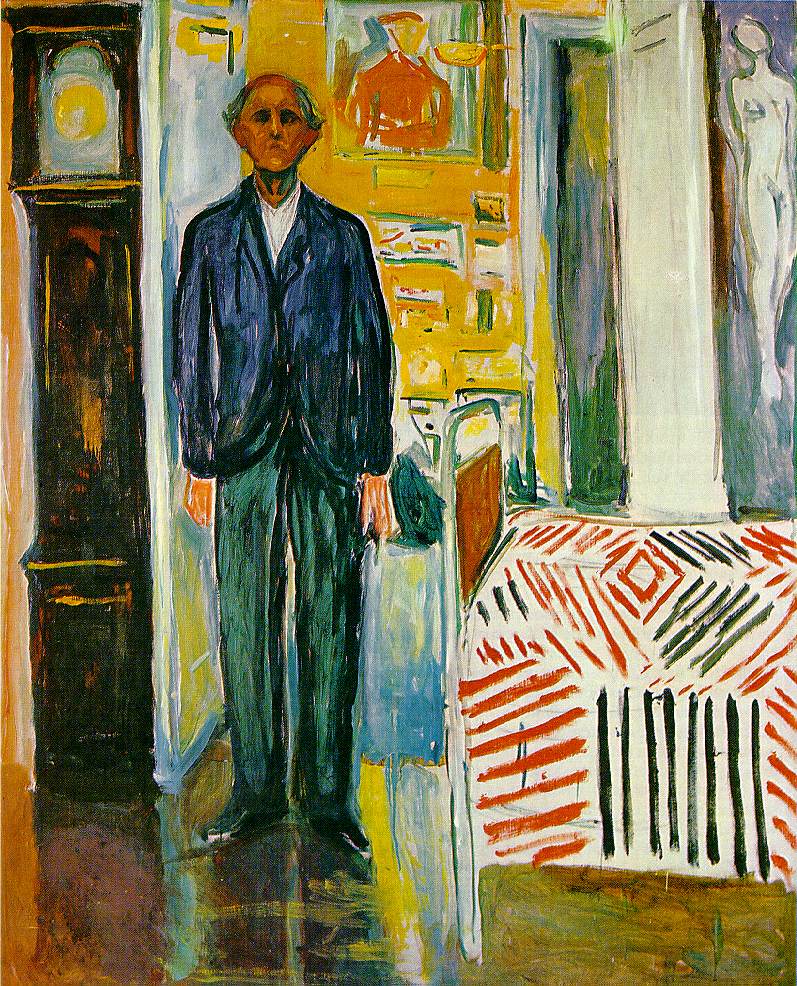
The Window

Fiction, non-fiction: did what I record here really occur? Did it happen to me? I am not sure, though I would say it had some place in my experience – that it was born there, and was not yet the walking over air I imagine fiction to require. It happened – but to me?

I have always wanted to write of what seemed to happen of itself and to no one – to remember when time seemed to lag behind itself, and space could no longer be kept to its place. It has always seemed that life never coincided with myself, that life was divided into what I could live and what I could not. How was it I was already my own ghost? 

Perhaps it is our bodies are our fate – that we live according to their dark law. Sometimes, it is true, I am alive, active – a great deal is accomplished. Who has more energy than me in the mornings? Who is more awake – as though awakening turned itself out, and the morning was inside me, and it was I who contained the sun?

Sometimes the morning is my kingdom; I rise very early and by the time the world has arisen, I have already created the sun and the stars and set the day turning. But who has less energy than me in the afternoon? Now the stream that once cut its way through mountain rock and meandered across valleys now lost itself in a marsh that spreads as widely as the sea. I am lost in the afternoon – I do not live. How to write of such afternoons? How to summon them to me as ghost to ghost? How to press them into something real?

I will not assign them to a subject, to one for whom they occurred. That would be the fiction, and not the other way round. I will not lay claim to them, those experiences. Did something happen? Did an event complete itself? Or was it rather that what happened failed to happen – that experience did not come to itself and the event did not eventuate? Passivity without subject, without object, the indefinite: these abstractions do not help me. What matters is to give flesh to a phantom, to give what was experienced a definite outline.

Confine yourself to details, I tell myself. Write of what was seen and heard. Write of the world. But is there a writing that can speak of the undoing of the world? Is there a way of speaking of that? I have dreamt many times of the expanses of ice, a glittering surface and the stars in the sky and across the ice, the stars redoubled in the ice. Yes I have dreamt of that: the stars which flash out and the aurora borealis that flashes above the stars. Abstraction: when I hear these words, I imagine those stars, that ice, and the raw wind which passes between them.

Stick to details: write of what is seen and touched. Write of the monitor before you and the desklamp beside you; write of your television guide and your phonebill; write of the pot of moisturiser and the CD remote. But another voice says: write of what causes each item to fall apart from the others: write of what stops your hand from reaching them and your eye from seeing them. For that, too is necessary, even if it does not lend itself to the power of memory.

The world become ice. The body exposed, all along its edge. The body unravelled and flayed across the ice. What kind of images are these? Substitutes, allegories – but for an experience which will only permit allegories and substitutes: the sole content, I tell myself, of what is written here. I confirmed it this weekend, did I not, archiving all my posts, transferring them into Word? I saw it, didn’t I – it became clear how those thousands of ghosts seemed to condense into a single pane of glass through which I could not see but that seemed to look into me, pouring a gentle, glowing light into the room of my life?

For isn’t that, too, another aspect of the experience: at once, it is pain and dislocation but also comfort – the reassurance of a presence beyond me, as if I learnt the world was alive, the expanses, the sky and the ice; that we had merely exchanged places. But let me be more precise: it was that the experience voided me, flayed me, until my body was a single surface, occupying two dimensions. It was the ice-plain, it was the child’s idea of the sky in which the stars were pin pricks. In the end, ice, sky and stars were one – they were part of a single two-dimensional space that was twisted upon itself.

But it was also that when I was returned to myself – when the word, I, was mine again, I contained the same plain and the same sky; they burned inside my heart, where I was exposed. Instead of that beating organ, there was a hollow space, and that was what my body was, the same hollow container in which the silence reverberated and through which flashed the arctic lights. A container – but one whose inside was infinite in depth, extending in every direction. So was my body a shell that, when cracked, would let spill the entire universe, its light and its coldness. Every post I had written was a creature of that world – a ghost, but one of a horde of ghosts that, when pressed upon one another, let the outlines of another creature be seen.

What was it, then, that seemed to bend down to my window? What was it, this creature of light that crouched so it could peer at me through the window of this blog? I knew it was somehow also what I am, and that my hand, touching the window would meet his golden hand. How was it I also lived in that body? I was burning – but that was how I lived, there, on the other side of the mirror.

Night, and I can write again. A weekend has passed, and what had I done? Backed up the blog, that was true. Prepared some documents for photocopying. Did I know that there was gathering in me a kind of push? That my body, into which I’d poured a quarter of a can of Irn-Bru, was readying itself for ecstasy? It was a little after that, when I was cycling home from the station, that the pressure began. I thought, how will I write of this? And then, but this is only a prelude to writing – it is the push of writing, it asks for words.

So it was; that I write here, now – it is half-past nine, one hour later – is tribute to the strength of that push, which has borne me through these sentences and paragraphs. I will be doubly tired tomorrow, I tell myself. I can only bear so much! But what have I borne? Nothing that happened to me. Allegories, fictions – it’s the same each time. How to speak of what will not let itself be spoken? How to write of what bears all writing?

Anonymity

What should I be called? By what would I have you call me, you who summon me into your booth? What should you call me, interviewer, who would draw me from my anonymity? A letter: you are to attend an interview on … Addressed to me, to my name, that letter. And so am I here, in the waiting space in an open plan office.

Open plan – everything is open, there are only two rooms that are closed off. Otherwise, booths, booths and booths, to which I will be called in turn. Still the question: what would I like to be called? What name, here, would I like to be mine, I who barely own myself? What name could be mine, what would I like to hear, interviewer, from your mouth?

The office is a reasonable place, that’s clear enough. We are not to be kept waiting too long; we are called clients, we are accorded the respect due to jobseekers as we are called now. Jobseekers, not the unemployed. We are seeking work and not just marooned from it – not left on an obscure island in the middle of the ocean that great ships pass by and ignore. Above all, we are not to be stranded – each one of us has an advisor, each is supposed to attend sessions to assess our jobhunts.

Do we need any help? Can we be offered any assistance? Yes, it is a resonable place, little is required of us, other than we attend, every now and again, in person. We will bring ourselves to the office and present ourselves for questioning – isn’t this to keep our side of the bargain? Isn’t this to keep up with our responsibility? We are called in, and summoned thus from the uncertain space of the outside. Called in, and made to account for ourselves here, in person, in our own voice.

But how to translate what happens out there to the language of the office? How to speak of infinite days and nights – how to speak of the expanse each of us knows and is there behind our eyes? For truly we have been marooned – truly it is as if the great ships have passed and we’ve forgotten everything but our shipwreck. What day is it? What date? Crusoe kept a record of the passing of days, but do we?

We are anachronisms, we know that. We’ve been passed by, we know it. You who would summon us know it well: we are lacking in self-esteem, your clients. We’re lacking in motivation. We need to be formed and molded. They’ve met our type before. We’re all the same! There are so many of us! We are a type, that is clear. There’s nothing special about me and nothing special about you. What petty narcissism to feel different to anyone else!

That’s why we can be summoned in the same voice. That’s why the call can ring out and bring us in. Summoned – the reasonable voice has remit over the infinite. It speaks, and the infinite becomes finite – the undetermined folds itself into a knot of hard determinacy: a name, each of us is to have a name. But what is I would like to be called?

You are reasonable, interviewer. I am your client. A client – this is who I am, it is my unity. And your client – I am at your disposal. You call me, and I come. You tell me you’re at my disposal – that you would like to help me. This is welcome. Who can doubt but that I need help? I’m stranded – the great ships are passing by, and where am I?

Help – I need that. I need to think of my future, to direct my thoughts into a plan for escape. Else a whole life will be spent thus – marooned. I have to take care of myself, to unify what I am, to pull myself together. That’s where you help, isn’t it? By writing to me, by calling out my name in the office, by having me come to you as your client, I receive my name, it comes to me again. A name, a social security number, a case number – so am I identified, and brought back to myself.

Outside, I was never in possession of that, a name. But inside? A name is fitted to me; it is mine. By my name am I picked out from the others. Mine – it is my name; the anonymous has been banished. The anonymous, which corrodes me and rusts me like the old cranes by the docks, is held at bay; it is a new morning; I belong to the present.

Summon me, bring me to myself. I was sleeping for my whole life, I know that. I was asleep – I lived in dreams, in my dreaming – that was not a life. It is to begin here, a life – my life. I will be bound to life – here. We will be joined, one to the other – here.

But how is it that my name in your mouth seems to miss me? How is it, as at the doctors when a name is read and then a buzzer pushed, that the name does not reach me, sounding out in vain? Am I am not to designated? Am I not to be picked out from the rest? Did it bring me to the limit of my strength even to come here, even to sit among others in the waiting room?

What would I have you call me? What name would be mine? What name could reach me and reach you by reaching me? I would like it to be known: I am different to you. I would like that to be known: the fact of my difference and that I remain in my difference. I will turn to you without facing you, do you know that? I have no face, not here, not inside, do you know that?

Every name is mine. Every name that is called here is mine. Who am I? The one called by each of these names, the faceless one who comes to you without coming, who is inside without being inside. Who am I, the one who remains marooned when he is rescued, who stays unemployed even when a job is found for him? Am I not present, too, in your heart, interviewer? Am I not the one who is marooned in you?

Summer Friendships

I knew it couldn’t last, and it couldn’t last. I knew it – how could it last, when it was so fragile? How is it we could come together, such a disparate group, and not fall apart straight away? We fell apart, that was true – but not for a while. There was a summer, and perhaps a little longer. A Spring and a Summer, before it fell apart and we left in different directions.

How was it I was always waiting to be included in a life – to be able to call on others as they would call on me, to be one of a crowd, but also one upon whom others would call. How was it we could come together then, for that short time? On my birthday, in the sun on the Ees, we picnicked. When the Eurovision came on, we watched it together. And didn’t I call in, every now and again, and sit with you on the roof in the sun? 

But I knew all around the city faded into nothing. This was an island, a reprieve; before and after, the usual anonymity. Behind this foreground, there was a background; the city retreated from us even as it seemed to press its way forward. Were we friends? What is a friendship that passes only by way of the moment? It was fragile, I knew it – such a disparate group! – but it seemed we turned in a kind of friendship. You came round to mine, and I to yours – were we friends? There was friendship, I would say that. Friendship – and we were friends by way of the spring, the summer and by sitting out on the rooftops, the city around us.

Deep time. Months would pass without event – years. And then, as though we breathed in those empty gaps in time, as though we took them into ourselves, did they seem to bloom – exhaled. They made sense, the days of waiting; they were heading in a direction. For a time you could call on others and they would call on you. And when it disappeared again, that chance? When it fell back into a time without event? Nihilism: nothing meant anything. Nothing kept its form.

Dispersal – why did we leave in every direction? Why wasn’t it strong enough, our friendship, to hold us together? But it was a friendship by way of the spring and the summer – by way of the floating pollen and the summer winds. How could it end but in dispersal?

But for a time, I remember walking along the streets – the usual walk, the usual streets – in the faith that something, today, would happen. It would begin today! It would continue today! Yesterday’s good fortune would continue tomorrow and so on from tomorrow to eternity. Continuity! Day after day would turn in friendship!

But then the grip on time would be loosened again; tomorrow was an empty as today; no meetings – no friendship, only the autumn streets and the winter streets, and everyone behind their doors. How could it be otherwise? Nihilism – what promise did the streets hold? Where did they lead? To spring, to summer – yes, but they were months away. And until then?

Overground

We are out of date, we know that. It is nearly here, the new world, and who are we to hold it back? We would prefer to get out of the way – to keep to ourselves so as not to detain it. Why does it demand that we stand in the open like everyone else? Why do we, too, have to be counted?

For a long time, we went unnoticed. They had other concerns, the bringers of the future! They had their eye on the new technologies and new investments. Theirs was the fervid South of the country, where everything was happening. The North was the rustbelt; the cities were like broken machines, they did not belong to the present. And who were we who lived in the rustbelt? Ignored, passed by, we knew they would not come for us.

What use could we be? We belonged to the past and the rotting of the past. We belonged to the tower block and the council flats and to those dark estates that were like the estates of Poland. How many of us there were, and all over Europe! How many of us, lost in the past and in the rotting of the past! When was it that time stopped going forward? When was time turned back upon itself?

This was our pride: the city had turned back on itself; it did not look outward. Darkness everywhere – we belonged to it, the city, as it rotted. How was it the city’s decay could welcome us? How was it that we were included in its self-demolition? Because it was by decay that our friendship passed. The city was the third term in our friendships. How was it that friendship was folded into the city itself? And how was it that they were lost, those friendships, when the city opened like a new fan?

We no longer recognised ourselves; where were we? Where were our friends? The old haunts disappeared, and when new ones came they were not for us. What of the warren of passages through the old estates? Gone too when the regeneration came. Gone, the towers and flyovers and the old club in its concrete bunker.

2

And didn’t it end as the money came from new Europe to our city? Wasn’t it then, when the great light came and we had to hide in darkness from the light? What it seemed to take it also gave – music was covered in the newspapers, in new magazines; it was everywhere, but then, too, it was nowhere, for hadn’t it retreated from the complex of which, once, it was part?

Then music, which was once the map of our city, withdrew into itself. Music, now, was only music – or if it was not, then it was so only for those in the know, and who were we, whose friendships were failing and for whom the city was turning into a new dawn? We fell apart into private bedrooms; friendship was privatised along with everything else.

This was the time of the narcissism of the Couple: since there was nothing outside, the domestic was all – people moved on, they found other things to do with their lives. Why not? Jobs had come; the regeneration provided for them. God knows, there was even arts funding – it had reached us, here. But it was already too late. We went in separate directions. We had to look after ourselves, we who no longer knew ourselves in the city.

3

It was happening elsewhere, but not for us. We were too late for one world, and too early for another. The internet would not come for several years, and meanwhile? We sold our records and boxed up our tapes; if we read, it was alone, and we kept our books for ourselves, that used to circulate between us. And didn’t we retreat into our private idioms? I couldn’t understand you – and you, could you understand me?

It was the New Realism: each of us was on the way to a career. How could it be otherwise? We’d missed our appointment with the present, and it was time to catch up. The future was coming, when it would all be different. And wasn’t there an interval in which we, even we, could enter its kingdom? But if we did, it would be alone – every man for himself and every woman. Every couple for themselves, that’s how it was, we who were now dispersed across the city in flats of our own.

No longer could you call on anyone. Phone first – better still, plan in advance, make an appointment: we’ll see each other on Sunday, on Sunday night. And you couldn’t meet anyone by chance, everything had to be deliberate – we were to carry calendars in our heads. Feb 15th – ok, we’ll see each other then. But when you no longer live side by side? When your room was no longer next to theirs?

Now friendships grew up around work. The world had shifted; if you didn’t have a career, what then? There was no one to be unemployed with; the old haunts had gone. No more sitting at the cafe in the sun; no more free gigs and in-through-the-back-door gigs. Everything was official; the future had arrived, pristine and gleaming. New supermarkets and cycle lanes everywhere – how could you resist? Nothing could go underground, because there was no underground.

Friendships took place in the light and by way of the light. That is, there were no friendships, only potential contacts, only those networks which are the negation of friendship and the negation of love. For hadn’t it reached love, the New Realism? Wasn’t love itself privatised – contracted upon couples in flats who saw only other couples in flats? Contracted upon them, become narcissistic – there was no love, or love had been bent back upon itself, half-destroyed. How was it that love wanted to destroy itself?

The North had become the South, which we had fled. Now the North was the South, when we’d escaped to the North to be away from the South. What we had escaped had come up to find us; we couldn’t postpone it any further: the South was no aberration; it was the future and the shape of the future. It was spreading from there, from the South, as it was spreading all across New Europe.

The destruction of love. The destruction of friendship, all the slack taken up – and we, who were the slack, were to be taken up. Time was not to lag behind itself. We were to be on the same time, to set our watches by the future. No more wounds and tracts of time; no longer days wandering in the open. Sadness: the retreat of time, the end of the open day.

The Idiot

I am not a spokesman for anyone else, God knows, I would like just to be a spokesman for myself! To be that, just that: a spokesman for myself, that would already be enough. What did you expect when you asked me those questions? What did you want from me, with your questions? Did you think I could answer you? Did you think I could summon myself to the edge of myself and answer you? But I cannot speak for myself, that’s what I wanted to say. I cannot even speak for myself.

My tongue is too thick, it is too big for my mouth. And there’s my stammer, remember that. I can barely squeeze a word from mouth, and when I speak – whose word is it? When it is spoken, when words are spoken from my mouth, whose are they? For they are not mine. I cannot speak, I know that – and what I say is not speaking. I will not say a word. No words – not one, not two. I am not the spokesman of myself. I speak for no one, and not even myself.

You’d like to ask me questions, I know that. There are questions to extract from me, I know that, too. It’s your job, it’s nothing personal. You bear me no particular grudge. It’s not between you and I, two people, I know that. Is that why you’re so friendly? Is that why it’s all first names and shaking hands? Nothing personal – but still, the questions. Nothing personal, but there are questions to ask, and we might as well get it over with.

I am to be assessed. For how long have I been sick? I can’t remember. For how long have I been claiming them, the benefits? That, too, I can’t remember. If you force me, I will speak. I will say something, but in so doing, I’ve said nothing, and that’s what you have to understand. I cannot speak – understand that. I cannot say a word – can you understand that? Or when I speak, those words are not mine. There is speech, but look at my eyes – look at them, imploring. Eyes which say, ignore what is being said by that, the mouth. Which say: no one can speak for me, not even myself.

I am not my own spokesman, and I will not be my advocate. I am not in my own corner as counsel or advisor. Am I a member of my own prosecution? Not even that. Nor even a case for or against. Because I cannot speak – I cannot say a word for or against. Do you understand that, you who would ask questions of me? Do you understand, interrogator? I know I’m taking too much of your time. I know you have more of us to see, other clients – that’s what they call us now. I know you’ll be gauged according to your success for getting us back to work. No promotions for you, otherwise. And perhaps you’ll not be able to keep your job. Perhaps, one day, you’ll be in the position I occupy, I who cannot speak in my own name.

Deal with me then. Fill out the form. I will give you answers, any answers, but understand they are not my answers. Understand – I do not speak for myself. Everyone speaks, they are always speaking, there is speech everywhere, but I am the one who speaks without speaking. Unless everyone is like me, unless there are no speakers, and none of speak. Unless I am the only one who sees it; I am the one to whom it falls to experience it. I have no words. I speak – but they are not mine, those words. And I have no name, I who have fallen beneath all names.

My body says no. My body refuses. My body’s is the dark word of negation. And what does your body say? In what words does it speak? Does it struggle with you? Does it struggle against you and leap up against you so you know every word you speak is a lie? Does it ever turn upon you and say: ‘I will not’, except without those words, without the ‘I – will – not’?

How old am I? I have no age. Where am I? I am everywhere; my body is joined to the body of the world. Why do they want us to speak? Why is speech demanded of us? Why must accounts be rendered and these great structures impose themselves between us? I want to say to my questioner, you have a body like mine. I want to say, our bodies are joined, do you understand that? I will say, there are no words, and these are not words, only words that undo words. Only anti-words, which uncurl themselves in the ones in your sentences. Only the weight of words, their idiom, as every sentence falls in upon its own heaviness and draws the world into it.

No words, and no silence – not even that. No words, and not even the consolation of silence. Who am I, who speaks? The same no one who is writing now. The no one who, through the mercy of strength, is able for a few moments to write of what he cannot do. Who, strong for a moment, writes words that would undo themselves as they are written. Double negation: this post would be the white snow. This post would be a twig or a wall, obdurate and thing-like, contracting upon itself and taking with it the world, the whole of the world.

They’re going to dock our money, £10 for the first interview we miss and £20 for the second. We’ll be interviewed, each one of us, up against the wall. But why don’t they know – I can barely speak of myself? Why isn’t it clear to them: I am not even my own spokesman? Idiot – that’s the word. Barbarian – that’s the word.

But there are more like me, you should know that. There are others, too, like me – know that. Each of us bears all of the others, know that. Eliminate one and the others will come. Pass us through training, process us and send us back to the world, there are always others to be trained and processed. But that doesn’t bother you, does it? Questioner, interrogator, you know you are not a member of the S.S., but part of a vast, benevolent army. There is love in your eyes; you’re thinking of me – you’re sympathetic. And in my eyes, that give onto nothing in particular? What do you know by them – my eyes?

He needs a job, you tell yourself. He needs to get off the sick, and that first of all. He needs confidence, you say to yourself. He needs to return to the world. But what do you know of my needs? What do you know of the size and the shape of my desire? For it is without contour, my desire, and without shape. We are stretched from horizon to horizon, each of us. Our bodies are taut, and stretched across the horizon. We are each the size of the world. That’s what I want to say, though I can say nothing. That’s what I’d like to say, if I could speak in my name.

Dragging Down the Average

We are of old Europe, and the new Europeans are coming. Yes, we know it – of old Europe, of the old and the relapse of the old and this is not our time. The future! How bright and dazzling it is! How splendid! But it is not for us. Splendid, we know that, dazzling – its marvellous – but it is not for us, we’ve been counted out, and it’s only right. What place would we have there, in the new Europe? How would we know what to do?

Better old Europe for us, we old Europeans. Better the rust belt for us, we who are used to the old world. Let us rust with the rusting machines! Leave us there to rot, with the machines that rot! Do not let regeneration touch us! Keep the new European money away from us! It would be wasted, if it came to us. What would spend it on, we who have dim eyes and clogged ears, we who stagger to the pub in the evening and stagger home from the pub at night? What have we to spend money on? Let it be spent on others! Let the others be regenerated, and not us!

For we do not want bright new bodies. We do not want to be reborn in the new dawn! Better our bent and coughing bodies! Better the old degradation, the old wheezing and complaints! But you are coming, aren’t you, technocrats of the new order? You’re coming with your investment and your plans? No stagnancy – no corner of the world untouched. Nothing unregenerated and no one who will not acquire the new skills. We are to be trained, we know that. Everyone is to be trained and retrained, we know that. Our skills will be transferable; we will go wherever we are told to go; a new life awaits us and our bodies will no longer be so sluggish and so dull.

Why do we smoke so much? Why do we drink so much? Why our obesity? – it is a living affront, our healthlessness, our obesity. Because we are not yet fitted to the new world. Because our bodies, which could be the bodies of anyone, are holding us back. Why should Europe lag behind itself? Why is it that Europe is snagged by our pale, obese bodies? We are an affront, a challenge. Not an embarrassment, but a challenge. For the lifestyle gurus are coming to find us. They’ll track us down and find us. The life-coaches will get us. We’ll be assessed and our needs identified. We’ll be assessed and motivated and sent on courses and trained and fitted to the new world.

And those who train us will weep with happiness. Those who reform us will tell their spouses and friends about us. I’m working with the long term unemployed, they’ll say. I’m doing some voluntary work with the long term unemployed, they’ll say, trying to get them back to work. What miserable lives they have, they’ll say, they look terrible, they dress terribly and they spend all their money on beer and cigarettes.

We are to be made new. Millions will be spent on us – making us new. Because the new world is coming! New Europe! And all of Europe must be prepared – every corner! No one must be untouched! Our names will be called! Our social security numbers will ring out! Each of us will be judged and assessed and then trained! Each of us will report for training! And our lives will be like our podgy bodies – a residue. And our lives, trailing sickly behind us, will be a flabby residuum.

Old Europe! We will forget we were ever alive then, in the old Europe! We’ll be trained out of it, the habits of old Europe and the welfare culture of old Europe! Because the new Europe is calling! It’s time to be trained, time for the body to be slimmed down and toned! New bodies for new Europe! New, trained bodies for new Europe! Trained minds – and trained bodies! For that’s what’s coming: a lifestyle politics. That’s what’s on its way – a politics of the lifestyle, where training passes through every part of your life, through every sinew. How sleek we will be in the future! How fit and how sleek, we men and women of the future!

We’ve seen something like it before, that’s true. We’ve been sent on courses here and there, that’s true, and we’ve met them, our trainers, the Christian-capitalists, the socially responsible executives of the new order. We’ve met them and known our own failure. How could we measure up! What good are we who can barely tie our own shoelaces! The world has moved beyond us, that much is clear.

How we will disappoint them, our bright, new trainers! How we will disappointed them, us clients! Because they know we’re not happy, they’re certain of that. They’re doing it for our own good, that much is clear. For our own good! For the good of everyone! For the good of the new Europe, where everyone is equal and equally empowered! For the new common sense of the new Europe! That’s what you really want, isn’t it – to lay off the booze and lay off the fags? That’s what you really want, they say, speaking our language – to lay off the drink and lay off the smokes? It’s what you really want, isn’t it, an interview suit? It’ll make you much happier – losing some weight. Interview skills, back to work – it’s what you really want, isn’t it?

How stupid we are, how dense, we who do not dream with them! How slow we are, how stubborn, we who will not change in the flames of the future! For our own good, we know it, and hang our heads. They’re working for us, for each of us, and we feel ashamed. Every one of us – targetted and assessed. New Europe comes looking for every single one of us! New Europe itself in the sleek bodies of our trainers! What fools we are! How retarded we are! For they’ve come, the assessors and trainers, right to our doors! Knocking on our doors, each of one of us! They have our names, and their working their way down the list. One by one, by name, by social security number – we are all to be accounted for.

We know we’ve been spolit, we know we’ve had it easy. £50 a week – too much. £50 benefits – too much. They want to see something from us. We are to be helped to help ourselves. Old Europe has made us soft. We are too fat for the future!

For a long time, we thought they hadn’t noticed us. For a long time, after we were laid off, we thought – this is it, we’ll never be reached, we’re too low on the list. But New Europe has its eyes everywhere. New Europe – the all knowing, all seeing eye has our number!

Who’ll bother with us, we thought, there are more pressing matters, after all. There are wars to occupy them, the Eurofighter to build. There are regulations to prepare – they won’t need us. We won’t be needed by the New Europe. We are defunct, like the scrapped machines in the rust belt. We are as East Germany to West Germany, as the cosmonaut to the astronaut. We are the space station Mir falling to pieces in the sky. Why should they bother with us? Why shouldn’t we escape their attention? Because New Europe knows we are a cancer that devours it from within. A cancer – devouring it, New Europe, from the inside.

For my body is also your body, New European. My sluggishness, the vagueness of my thoughts – yours. Yours my dim eyes and clogged ears. Yours my fat body and blackened lungs. Yours – New Europe, never yet itself, never having achieved itself, you will not close the circle. It is our bodies that detain us. It is by our bodies that we will fall behind. What are your plans to us? What are your programmes? Who reads the brochures that fall through our letterboxes? Who listens at the training sessions and back to work sessions?

We resist – through inertia. We will endure – because we can’t be bothered. Happy stubbornness of our limbs and entrails! Happy our shortness of breath! Happy that we die below the average age and drag your averages down! Happy that we smoke in doorways and on thresholds! Happy that we take no exercise, except to stagger to the pub and stagger home from the pub, all the while getting fatter, all the while dragging the averages down! Happy that we fail or drop out of every course you tailor for us! Happy the cancer that will creep through our bodies!

For that’s what we are: a cancer. That’s what we are – disobedient cell, that has not heard the signal. New Europe is calling – but we are not listening. New Europe is blazing above us – but we are not looking. 

The Errand Runner

Does the failure know he’s a failure? I know it, everyone knows it. I am watchful on the street, lest he see me before I can avoid him – watchful, but also fearful, for I do not want to see him, I want to avoid even that. In truth, I do not even want to see him. The failure: how can I bear to look at him, I who am a success? Why should one successful be even confronted by them, by any of them, the unsuccessful?

By any measure, I’ve succeeded, that’s clear enough. I’ve worked my way clear of non-success; I made my way, though it was difficult, and took much concentration; though it is difficult still, and I am always concentrated on one task or another, even when I descend to the street. Even when I pass among others on the street, and perhaps especially then. For a successful man never relaxes. Concentration is the price of his success; he must keep his eye on the ball, must be watchful and careful, and keep himself in good condition.

Oily fish every day, a visit to the gym every other day, five portions of fruit and vegetables a week: such is what is required to maintain success and the trappings of success. Health! You can’t take it for granted! As a successful man, I must keep up my health; I exercise. And you, who are not successful? You who drink too much and smoke too much and have red eyes and yellow teeth? You whose body is neglected and walk hunched over? Why should I consort with you?

How is it you still presume to recognise me? How is it I still recognise you? What is it in me that knows you, I ask myself that. What is that betrays me? Some measure of non-success, no doubt. Something in me that is not yet successful – or, worse, that I will never be able to transform into success. Then it is a mirror I confront when I see you. There for the grace of God go I, they say, the pious, when they give a quid to the alcoholic. But I say nothing; I cross the street to avoid them; I avoid underpasses where there are beggars. I am of them, which is why I avoid them.

And you, the failure – why is it I would avoid you who are shiftless? Why do I avoid you, workshy one, non-worker, for whom the afternoon is his kingdom? I am at work – and you? I am working as I walk, as I do my errands, and you, wanderer, how can you tell one day apart from another? I was up early this morning, and you? I forewent my lunch hour – and you?

They’re hunting you down, every one of you. They’ll hunt you down, unemployment claimant, disability claimant. One by one , you’ll be caught. Punished – by degrees. £10 if you miss you first interview, £20 if you miss your second: that’s what will be docked from your wage. £10, £20, for not joining our brave new world. But it’s for your own good, failure. For your good, I know it, you know it. For I know you fear me, too – I know it.

Wouldn’t you like to have what I have? Isn’t it what you want, what I have? There is desire in you to work, I know that. You’ll only have to be straightened out, I know it. Straightened – then all your desire will work in the same direction. No dissipation, no vagueness: concentration, concentratedness – life lived in a single direction. And you like me will serve the whole and the good – the greater good. We’ll work alongside one another, at different firms, perhaps, at different agencies, but you will be a worker like me and I will not fear to meet your gaze in the street.

But until then – there’s a long way to go. Until you get there, still a long way. Still must you be straightened out and enskilled, still you will need lessons with flipcharts and teamwork, still there’s a long way to go before you even begin to be employable. And until then? Stay away from me, unemployed one. But you are already with me, I know that, which is why I hate to see you. Below my office, in the broad streets of the everyday, there are dozens of you – anyone on the street could be the non-worker that I dream I am.

Anyone – the unsuccessful are everyone, anyone, and this is the horror. For isn’t my body the body of anyone? One day it will come, the crossover. One day, I will find myself on the other side of the mirror. Who am I, I will ask, who drinks all night? Who am I without a thought in my head? Who am I that my desires run out towards the far horizon? Yes, that is what I dream. Or is it the other way round? Is it that I am one who dreamt he was successful? Is it that I failed and had failed from the first? Then I must ask myself, Who am I, the failure? Who am I, king of the afternoon?

Afternoon, no one’s kingdom. Afternoon, kingdom of no one in particular. The successful have not yet come – and who are we, who have not succeeded? Substanceless, our light borrowed, we are dull moons in the obscurest orbits. Occasionally, one of them will pass us by. Now and then, one of them will come, one of the successful, on one errand or another. They pass us by – how can they do otherwise, we who would only slow them down! They pass us by; our time is rotten – every day, for us, is a wearing away of the same, but theirs? Theirs is linear; it is unidirectional, thrust towards the future’s edge. What it must be to plunge into that future like an eagle plunging to its prey! What keen eyes they must have! What sharp talons!

We see it in the ones who descend to the streets – these are men and women of the future! Theirs are the sleek bodies of the future! How pale and flabby we are! How ill-disciplined! They are all concentration, and we are all – dissipation. How is it that it as though they have stolen our substance? How is it their strength seems drawn from ours, we who are so weak? Some among us talk of revolution, or at least of dragging one of the errand-runners into an alley and showing him or thing or two. But the rest of us, who have heard it before, who have heard everything before, know it’s too late and it was always too late.

It’s part of the order of things, the way things are that there are the successful and there are the unsuccessful. What good is there complaining? What good raising our fists? For they’re hunting us down, one by done. Hunting us down – we are to be trained, enskilled. We are to attend interviews; they’ll summon us up from the street – £10 if we miss the first one, £20 the second, we who only earn £50 a week. They are training us, our pudgy bodies, one by one. One by one – but don’t they understand that we are without number?

I am not one, not a unity, not even that. Not one, and not zero either. Not nothing and yet not a unity – how can I be expected to hold myself together. I can’t count – to one. Who can count, among us, the people of the street? None of us is one, each of us is everyone. I cannot count – who is there to count? But when one of you passes us – when you descend from your offices on one errand or another, it it as though I am awakened from a long sleep.

How quickly you move! How straight your back, as though a cord pulled you upright through your body! How purposeful you are! How concentrated! We wake in the wind of your passing – we come to ourselves then. It is as though each of us were a little eddy of your energy. And do we change you, too? Do we change you, we whose bodies are so heavy and thoughts are so vague?

Sometimes I have dreamt I was one of you. Sometimes, when I am strong, a dream comes that I am one of you, who has come down from the office to the streets. I am the errand runner, that’s who I am, with a lean body and focused mind. The errand runner! To think that I could be trusted to run errands! To think I could blaze with my own light! But already I am moving out of reach of my dream. Soon, again, I will be unable to write, I who only possess borrowed strength. Who am I? soon I will not know that either.

Indifference

Am I lazy? I am not sure. Certainly my old ambitions have withered from me. I no longer write; I do not read difficult books as I used to, and whereas once I would copy out a fifth of the book I was reading to lay bare its arguments, its strategy and the way theory and practice came together, I take no notes other than a few phrases here and there. Laziness! I do not practice French; German is long since out of my grasp. I do not keep up with films; my television is never on, and slowly I fall from the surface of current events. Why have I no kept up with the elections in Latin America? But I have not, just as I no longer watch the news or read the better papers and weblogs on the news. How is it that my world has collapsed upon itself, until it assumes no more than the dimensions of this room?

Indifference – it is true I feel a great tiredness, especially in the afternoons. How many afternoons have been wiped out this way! I read novels, it is true, but only short ones, easy ones and of those I keep no record. I can hardly say I’m reading; a whole oeuvre passes before my eyes in a week, but what have I learnt? What I captured from that reading that I can bring back to my life? Nothing. I leave no record of my reading. Sometimes, I will read the essay of a friend, or write a brief essay for a friend, but that is all. My friends are noticing. – ‘What are you reading?’ – ‘Nothing’. – ‘What are you working on?’ – ‘Nothing’.

And what has this blog become? Once, it was a place for the play of voices – an experience, an experiment, when different tones and voices were allowed to vie with another. That was the thought: I would learnt to write, learn to make idioms, and speak in a happy idiocy that was not allowed elsewhere. And now? Those voices have fallen back upon this one, with which I am least satisfied. Reading back in the evenings, I know a disappointment: where has it gone, the outrage voice, the voice of sweeps and gales? Where is it, the comic voice – and above all, that was what I seeking: the comic, a writing that sweeps with black, bilious laugher?

Is this the voice left to me? Is this the one which remains, amalgam of author’s voices, pale and imitatory, residue of too much reading and not enough living? This, I know is the voice of this room which spreads out indifferently around me. Indifference: I used to think there was a curse on the weblog for whenever I tried to write of it, this room, the prose would go wrong. Whenever I tried to write of crossing this room, I would have to abandon the post. Of course you could cross it in two steps – but when those two steps become an eternity? And I used to avoid the phrase ‘the head of the day’ for the same reason: those were my writerly superstitions, even as I dreamt from the first, of a writing without topic and without speaker; a writing whose ‘neither … nor’ gave and withdrew that of which it spoke.

Sceptical writing that allowed nothing to stand. Could it be that my indifference is the path to that? But there are no paths, not here. Just as Bela Tarr sometimes leaves the plot to bring us close to beer glasses, to a concrete wall, this weblog voids itself. There is nothing here but this room, and, before it the yard. Nothing but the room and the yard as though they stood at the head of creation as the stuff from which everything was made. Indifference – wasn’t this the state Krishna commends in the Bhagavad Gita (a clod of earth, a lump of gold, a beautiful woman: all mean the same to the wise man)? Ah, but that was indifference coupled with an awareness of a supersensible God. What, then, the indifference of one without God?

Sometimes I rebel against it, this indifference. Looking back over long posts, I see a desire desperate to fill itself with content. But how hollow those posts! How unpersuasive! I will have to delete them just as this post, in turn, will have to be deleted. My new dream – how naive – is to marry in each post form and content so that an idiom is born in which there crystallises a writing that embodies and speaks of what there is to say. Each post or string of posts will become a universe enclosed upon itself like Schlegel’s hedgehog. How foolish! Is this the last dream? Is it the last remnant of the dreams I had? But it only spreads itself, this dream, like the aurora borealis above the frozen earth. And in truth, this writing room and the yard before are that earth and I am like the traveller of Basho’s poem who has fallen asleep while his dreams wander on.

Leela

I saw them so recently, the three surviving brothers, their smiles, the shapes of their profiles. They are old, but they are young, young in their smiling. The oldest brother walks me up the stairs and says, can you sit on the floor, and when I say yes, we sit cross legged on the bedroom floor and go through the suitcases that my father left when he died. Here we are, an old man and younger one, on the site of that patch of land in what was called Madras where the family lived in an old building that was demolished so that the present one could rise, four-storeyed, many-balconied in its place.

How is it that the dead do not die all at once – that the deceased is also alive in our memories, but also in that forgetting which leaves a gap in our remembering, a loss irrecuperable and necessary if the dead one is not to be forgotten; a necessary forgetting, and one intertwined with memory, accompanying it? I remember by way of them, the three brothers, but also in the others – in their sons, in their daughters, and in the sons and daughters of the dead sisters and the dead brothers. By way of them – by way of their faces and their smiles, above all their smiles. But I also forget – if forgetting is the name for that hole in memory by which the memory of the dead is to be kept alive.

Irrecuperable loss. Mourning without cease – henceforward that will also be part of what I am. But are you not there, too, dead one? Are you not there, witness, the one who watches in me? Are you not there – dead one who survives in me; alterity of the dead? When I think of you, the other that is the you in me also thinks. He watches, the other in me, the dead one. I am alive, this is true, but with me I also bear the dead. Alive – but with me, the dead one, who keeps watch within me.

When I asked myself that night – when the question was asked in me as I crossed the Byker bridge – I knew what you would have wanted: a cool head, a practical mind. And so it was. Strange hours passed. I went to collect my bike, and then to meet R.M. at the station. It was already late – I had left a party when I heard, then I heard. Back here in the flat I made R.M. something to eat. The next day, we woke early and biked to the station and then down south and biked across London and then the train to the west and we biked from the station to the house. A cool head, a practical mind.

And now? It is as though I have been tuned to perform the most solemn raga. As though I was the instrument itself – or rather, the raga, as it denotes a framework that is not to be played, but played within. So is my loss what attunes my living. A steady sadness that accompanies everything; I can only play on these notes, not others; this is the raga that I live.

What is nihilism? Forgetting which does not live, which is not of the gap which resists the other’s incorporation. What is it, nihilism? The destruction of memory, the destruction of that propitious forgetting by which the dead bring themselves to us and live in us. Do not forget that forgetting. But what choice is there? It already keeps watch; already it is there, on the brothers’ faces and on the faces of their sons and daughter and the other sons and daughters. And wasn’t it there, too, in Madras, which is now called Chennai? We were there. A week ago, we were there.

On Chennai beach, the tsunami struck. 800 died that morning. But there are still people on the beach, that night as we walk along it, still sellers of shells and snacks; still a few out wading in the water. A few hundreds yards of sand to the sea. The bay of Bengal, which stretches along the east coast of India. My cousin speaks: not far from here is where they carried what remained of his body, my father. Carried out, ashes and remnants of bone, into the water. And he speaks, my cousin, of the thirteen days after death, and of the rituals that will endure the soul of the departed reaches the other shore. So, I am sure, did it reach there. Above us, the wide night – some stars are visible. Rishis, says my cousin. They are Rishis of our family; they watch over us. As he, too will watch over us. But I know, then, that he watches, too, within me.

Watches, and what do I see in this city? My cousin stroll downs to the beach some lunchtimes, he says. It is his Chennai, this city; he is happy here – it has everything, he tells us as we walk back to the car from the beach. Everything; it is all here. He had picked up my father from the airport; he seemed fine then, some trouble walking, but he was safely delivered to the flat in which he would say. But then … the details are known to us. But we are told again, and in my cousin’s voice, they acquire a new significance. He was there, my cousin; he speaks, simply and directly, of what happened. He was there, and we relive it through him as we drive through Chennai.

Oblivion: unto that were you delivered, ashes lowered into the Bay of Bengal. To be scattered in water, that was your wish. Why that, water? Why the vastness of the ocean? Along the coast, driving to Mahabs, we see crosses, markers of the Christian dead of the tsunami. Thousands died, all along the coast. The Indians asked for no foreign aid. Asked for no aid, but provided of themselves, and we see the thatched resettlement villages on the long drive. Thousands dead! So many dead! All the dead taken by the sea whose great crashing waves we see at the Shore Temple at Mahabs. How fierce those waves, from the Bay of Bengal.

The brothers carried the body into the ocean. Carried it out into the same sea from which the tsunami came. Catastrophe, benediction, brought by the same waves. And the sea is all of life, and death – it is the cosmos that rolls in and away in the waves on the sand, just as it is the cosmos we see above the orange glare of the streetlights of Chennai. It plays, the cosmos, we know that. It is a divine sport – lila, it is called, or leela (the spelling of my sister’s name). The divine sport, which can also be capricious, cruel. But it is the matrix of all things; from that, all things are given and all things return.

Given, yes, but as they are given, can you not detect the great departing wave, the darkness which sinks back through all things? Does it not leave its trace thus, in all the things, the trucks and rickshaws, the new construction sites and advertising hoardings of new Chennai? Departing – but also, too, coming forward, reaching us by way of things – by way of their play in the granite statuette from Mahabs my sister and brother in law bargained for, and in the CDs which I bought in Chennai and Delhi. Given – but also in the smiles, the brothers’ smiles, and in the play of resemblance between us all. The cloud-shaped nose, the dimpled mouth – don’t these, too, witness the play of leela?

The Bay of Bengal is a name for all oceans, and the oceans for the cosmos, and that for the giving-witholding of leela, by which we live and we will die.

Germs

They piss everywhere, the men here. They piss, unashamed, and on the walls you can see where they pissed. A damp patch, darker than the wall, and then a trail across the pavement and into the road – someone pissed here. Smell it! Pungent, acrid! Smell it – evidence of a recent piss.

As you drive, you can see them pissing. Men, backs turned to the road, and an arc of urine, they do not spare us that – the golden arc. They piss by the roadside and drive off again.

Sometimes you will see children squat by the roadside, taking a shit. Shitting children and pissing grownups – how has it come to this? The adults are pissing, the children shitting: this is how it is.

And what of us, who are driven in our cars? Is our driver – one of them? Does he, too, when we are not looking, piss with his back turned to the road? Are the hands that turn the driving wheel of our car covered with piss? Are there germs even here, in our car?

We close the window as tightly as we can. The air-con is on as high as it will go. What of us, we ask ourselves – are we ever clean enough? Are we clean? At the dentists they give you a dye to show you were you are not brushing your teeth. And if there was a dye to show germs – germs all around us and all over us? We shudder.

We are in charge, we know that. We rule here, we know that, but for how long? How long with the germs multiplying, with men pissing and children shitting? Isn’t it the germs who rule? Aren’t we ruled by them – the germs? Germs: hold a magnifying glass to your skin and you will see them: men pissing and children shitting. Germs: pissing and shitting in our hearts.

Dogs Fucking

The dogs are fucking in the sun. The dogs, back to back, fucking – in the sun. It’s sunny, and on the grass, away from us, there are dogs, a small group of them, one lying in the grass, one sniffing along the edge of the rocks – and there are two who are fucking. Fucking, the dogs in the sun, tongues out, panting, not ardent, not distracted, fucking just as they would do anything else, sniffing, playing – it’s all the same. Fucking, playing, sniffing: all part of the whole, part of a dog’s life.

Who owns them, these dogs? Whose property are they, these sandy coloured dogs you find from one end of the country to another? Why aren’t they neutered? Why can’t someone disperse them, or lock them up in pounds? For they are everywhere, these dogs, fucking contentedly. Resting in the grass, playing in the dust, sniffing along the pavements and then fucking, wherever it strikes them to fuck. In the sun, generally. In the sun, before everyone – fucking. Dogs! Fucking! It’s a long, hot day, and what else is there to do? A dog must fuck; it’s part of what it means to be a dog – to fuck. To play, to rest and then – to fuck.

In the dust, on the grass, along the pavements they go, packs of sandy-coloured, medium-sized dogs, inoffensive, really, keeping to themselves, pausing only now and again to fuck. Pausing, in the heat of the sun, in the long afternoon, for a fuck. Sometimes you’ll see the bitches with their teats hanging down. More dogs – always more to come. More dogs, and if there are dogs, aren’t there rats? Dogs – but where are the rats? Because dogs and rats go together. Where there is a dog there is a rat, and where dogs fuck, somewhere, not far away, rats are fucking.

Dogs – plenty of them, and rats – plenty of them, enough to crawl over the pavements and the dust and the grass. Enough to crawl everywhere, until the surface of the world is a million-footed rat-body. The dogs are the amiable counterpart to the rats. But if there are dogs, there are rats, that is the law. Wild dogs – and they are wild, for who owns them? Who lays claim for them? Who is responsible for them? therefore wild rats, one and the same. Dogs, check – and rats, check. I haven’t seen any, but they come with the dogs. The dogs chase the rats and the rats stay underground, but they are there, nonetheless.

And what about the cockroaches? Where there are rats, there must be cockroaches. For any one rat, a dozen cockroaches – two dozen. Do cockroaches fuck? It is hard to imagine them fucking, one hard-carapaced cockroach atop the other. One cockroach doing it to the other. But if rats do it, cockroaches must do it. First the dogs, then the rats – then the cockroaches. Everything is at it, all of nature is at it, in the grass, in the dust, along the pavements and beneath them in the sewers and the pipes, it’s all happening. Everything is fucking. There will be more and more of them, the dogs, the rats, the cockroaches. They’re on the increase.

Why doesn’t someone do something about it? Why isn’t something about them, the dogs. The rats are underground, but the dogs – above ground, unashamed. But if they did something about them, then the rats would come overground, that’s the truth. To lock up the dogs would be to encourage the rats. Rats, fucking in the sun – it’s unbearable. Rats, everywhere, brushing your ankles as they swarmed – terrible. And what if you got rid of the dogs and the rats – that’s the worst. Dogs, rats gone, then the cockroaches would be everywhere, crawling over your face as you slept, falling into your mouth. Cockroaches under your blankets and in your fridge. Better rats. And better still the dogs, who fuck in the sun.

Crying in my Bovril

Conversation with W. He’s reading Radical Thought in Italy. ‘It’s pure DOGMA’, he says. ‘They’re all mates. No quotes, no references, they all have the same ideas and write about them as if they were world-historical’ – ‘That should be a DOGMA rule’. – ‘Exactly. Write about your ideas as if they were categories in Aristotle’. W. sends me a quote:

Forms of behaviour such as opportunism and cynicism derive from this infinite process in which the world becomes no more than a supermarket of opportunities empty of all inherent value, yet marked by the fear that any false move may set in motion a vortex of impotence.

‘You can mull it over in your stupidity’, he says. We have a new rule, now that we’ve become co-writers: we have to give each other a list of books to read. The first one is Radical Thought in Italy. ‘That’s how we should write’, says W. Co-writers: he’s coming to visit me here, and I’ll go and visit him there.

‘I keep getting up early’, I tell him. So is he. 5.00, the pair of us. ‘What do you do when you get up?’, he says. – ‘I’m writing an essay’. ‘Why don’t you try reading? Why don’t you read something?’ – I tell him I’m going downhill. I’ve reached that age in which I can’t do anything: ‘It’s like all these artists who begin well and end up ropey. I could never imagine it, and now it’s happening to me’. – ‘But they produced something before they went downhill. What have you produced? What hill have you climbed? How do you go downhill from downhill?’

I tell him I’ve been reading X. – ‘what did you think?’ – ‘He mesmerises me. He’s everything I’m not; I feel guilty when I read him’. W.: ‘He’s a swan and you’re a bear’.

I tell W. I’ve been feeling ill. it’s my stomach. Perhaps I’m going to die. ‘You’re not going to die. You’re just fat and greedy’. W. says I should read more. ‘I can’t be bothered. I’m getting old’. – ‘You’re not old. 35 – that’s when philosophy begins. When you’re 60 you might have something to say:’ I tell him it’s too late for me. ‘I’m done with it. I’m not writing anymore’. A year ago, W. had said I was nearly running on empty. Now he says it: ‘your tank’s dry. You’re empty’.

He doesn’t like the recent posts. ‘Go back to doing what you do best. Whining. Go back to whining, like an ape crying in his Bovril’. He’s not persuaded. ‘Stop trying to be profound. You’re not profound, you’re an ape’.

The Interval

1

I am happy that the month is so long – happy there are so many days, eleven more, in which to make up for the days I was absent. In lieu of writing, writing to catch up – but how is that each day I write the same thing? The month is long; I am glad, but of what did I fall short? Days missing, days not underlined in the calendar; a great deal happened – everything -, I was on the other side of the world, but it is of the same I write, which is to say, of nothing at all.

Nothing begins, but this is fitting. I live in the interval; real work has not begun; there is work, to be sure – tomorrow (Saturday) I will be in the office as I am in every day, but I know I will push even the few tasks I have left away from me. Those affairs do not concern me. It is not because I resent them in particular that I push them aside, but their urgency offends me. Nothing is urgent. My attention is elsewhere. But what is it, my attention? What is it, this salt-marsh of the interior? Am I stagnant? Has life ceased to flow? Why then do I imagine of my heart that what was once closed is now opened, and opened beyond itself so that it becomes a new organ? My heart – and this is what I am – is all surface, and that surface is touched at every place by the outside.

Is it jet-lag? I am out of synch with the world; it is five hours behind me. Five hours: what might I perceive in this, the interval?

2

I’ve just finished a book. I took two hours and finished it off, the novel that lies face down on my pillow. I lived and died with its protagonist; right now, because I accompanied her to death, I feel wise. We died together, she and I, we lived a long life, she and I; but I also survived in the man who was with her.

I died; now I am alive; I have passed from one room to another. How is it that the flat is now large enough for me? How is it that I do not feel the usual claustrophobia? ‘I pass from one room to another’: in truth, I have wanted to write this sentence for a long time. Wanted to write of my passage through a room, as though that room were infinitely large, or the crossing infinitely long. As though the room was the desert, and I would never reached the promised land. Or was the room to be desert and promised land at once; that to wander was also to discover, and that this was the meaning of the diaspora which occurred across my sanded floors?

3

In the pub, a tall Zimbabwean presses his fist to my cheek when I ask when he and his friends come to sit around me that he reserve a seat for my friend. ‘Of course I will keep a seat’, he says, and now they sit, the ‘Z-club’, talking of their country. I thought, I would like to record this moment. I thought, is this what the interval requires: that I should remember the small events of the day?

I remember. My attention slackens; memories float indifferently like dust in the air. What else should I write? Where are you, interval? Now I know I cannot reach you by writing, even though it is by writing that you call. How to write of the failure of events, of the drifting air in which the dust motes move? I would like to stuff a book with details, that is true; but how then to remember what must fall between them?

Interval, hinge, it is you who open between each post; it is you who interpose yourself so that no continuous narrative is possible. Always a break; always white space between posts, even when they are written as they are here at the moment three times a day.

Three times! But there were sins of omission; I did not fulfil my quota; there is a pressure of writing behind me and I must write. Interval, it is of you I must speak. Who waits? Who waits inside me? It is my inside-out heart, which aches along its surface. Three times – but my heart asks because it waits; the marsh is open beneath the sky. Asks – and there is a landscape that is a question, like the exposed wood of the floorboards in the flat.

The End

What if all you had in common was what would, in time, set you apart? What if that was all there was for you both – that prospect of being set apart, one from the other? Doesn’t it make you draw closer to one another? Isn’t it, now, that you come closer because you will soon be set apart? You are close to the end, you know that. But you are close, now, only by way of the end and it what is you know in one another. Might there be a way, in that knowing, of deferring the end? Isn’t the end deferred by that knowledge until it becomes the beginning, once again, of your relationship? Friendship born from its finitude, friendship as infinite contestation of finitude. 

Hour of the Wolf

I’m tired, I know that, I see the evidence. Tired: heavy eyelids and darkness beneath the eyes. Why these early mornings? Why, early, do I want to write, and that first of all? To write, yes, and before the dawn – to begin before the day begins and even before it begins to begin. For it is not yet dawn; there is not yet the intimation of light which does not glimmer, but comes all at once, the whole sky, not glowing – this is a northern city, in winter – but blandly and flat, the whole sky at once. The dawn will say: I am here, I am absolute. The day in the dawn will say: I am arriving; you will not resist me.

But it is not yet dawn; the day has not begun to begin. What, then of this hour, which is not yet dawn but lies at the end of night? The hour of the wolf – is that what it’s called? But I’ve never heard anyone call it that; it is something I have read. And isn’t it too grandiloquent a name for these hours, mine, at the desk by the window? The wolf? – There are no wolves here. What mammal could find its way into the concrete back yard? I’ve never seen a cat jump down to the yard floor.

Sometimes, birds come – magpies, to peck at the bin bags when the bin lid is open, and blackbirds, inspecting the muddy grime around the drain. There are insects, of course – a summer trail of ants from my kitchen to the wall opposite, under the bench. And towards the end of last summer, a daddy long legs, creature of the threshold; and then there are the flies circle in my rooms. When did I last see a wasp?

But this is not a place for animals, for life; nothing comes here. The concrete is absolute; it has no relation to life. Even the plants are dying – slowly, it is true, it may take years, but dying nonetheless, rotting up from the potted earth. No animals, no wolves. Only algae, which spreads itself greenly across the wet concrete. Algae, which makes the ground slippery when I go out to put bags in the wheelie bin.

What good is it to me, the yard? An open space, that is enough, a temple open to the mediocrity of the day, that is enough. But without it, what would I be able to write? How would I be able to take in the first breath that would allow me to begin? For that breath is necessary, even though I betray it. It is necessary, that first openness, that receptivity: the divine afflatus. Begin, it says, and even though I never begin, even though writing never unfolds itself into a narrative, I am in love with the thought of beginning. Who says that writing has been discovered?

Not yet dawn, and I can see nothing of it, the yard. In the predawn, there is blackness and dark indigo and the orange glow of the street lamps and that is all. How many more days will I live like this? I would like many of them, passing from one to another and so unto eternity. I would like to live a life like this, rising before dawn. But these are aberrant days, I know that. These are rare and exceptional days, I know. And I am tired, too tired; my eyelids are heavy and there is darkness below my eyes. How heavy my body, how dark! Heavy, and robbed of potential like a wave that falls back upon itself without breaking!

Yesterday, I set myself the task of writing of my body and the destiny of my body. Yesterday I thought to write of fatigues and vagueness, of that being out of tune which robs me of the ability to find my way through the day. Sometimes I find myself lost among objects; where am I?, I ask myself, what am I doing? There are tasks to perform, many of them, urgent tasks, but I fail them one by one. Tired, I lean forward in my chair, I open a book or surf the net and am lost from my duties, sinking below them. Is it because I use my strength elsewhere? Is it because it is already used up, my strength, before I come to my tasks?

The wave does not break; the sea roils in itself. There is no issue, no result. What is preparing itself here? What is about to unfold? But the sea does not reach its shore; it is ferment without event. It is the non-event which happens; writing speaks only of this, of what does not begin. How close I have come to it, writing – but to what am I close? Only to the event where writing seems to become possible and then, at the same stroke, moves out of reach.

Writing, beginning, non-beginning, is it not thus that you let speak the address that you are? Is that your call, and that first of all – the saying, now, which reveals in everything that is said? But I am not close to you; or if it is so, then it is another in me who is close. The stranger, the companion who writes in my place. Does he write? Or isn’t it that he stops me writing even as I write? Is it because of him that I do not begin?

Hour of the wolf, how laughable! Non-hour of the non-wolf; hour without wolves, without animals. Out there, green algae on concrete and the dying plants; I can’t see them. Out there, the concrete space, whose contours I cannot see.

The Membrane

Too much, here, for anyone to read, that much is obvious. Too much – but why so? Why this too much of writing which seems to pour endlessly from itself? Morning again, the pre-dawn again, the curtains closed again: I am at the crossroads. Or it is the crossroads have returned, and that they have only ever returned. Why, on these successive mornings, have I been so close to what returns thus?

Imagine me, reader, on the other side of what is written. Imagine that, as though writing were a screen between us. Imagine that screen is alive with a kind of light – that it is made of skin, that screen, or a kind of living membrane through which soft light comes. It is to that light to which I imagine I’m close as I write; the light of creatures of the deep sea, the deepest creatures with strange fishing rods of light and glowing, macabre bodies. And isn’t it at such depths that life strips itself down to light and to the attraction to light? Or imagine a membranous creature dug from the earth: a land-jellyfish, but who does not move, who only waits, impassive, in the earth, glowing. That is what this writing is. That is what is shared by way of writing.

The pre-dawn again, writing again; the room with closed curtains. What time is it? Any time, every time. What time is it? All hours cross here; all of time is present here. Nothing begins, but everything is gathered for the beginning. Nothing begins – this is where beginning fails, where the day is curled back upon itself, unable to dawn. It is a warehouse of things which will not bloom and will not potentiate; possibility is suspended here, even for me – especially for me. Space without place, time without production. Space without dwelling and time which gives no purchase on time.

But still, what is that light between us? What is that light, like the milky white lens of corrective glasses? I imagine that what we share is blindness, that what we see is blindness. Yes, that’s it: the creatures of the deep, the jellyfish in the earth glow with blindness. They cannot see us, but there is sight nonetheless. Blind sight, sight subtracted from itself – you, membrane, are alive with what knows without seeing, with life as it understands so it does not have to see.

The Companion

Without blogging, I would have given up any ambition I had had to write. Let me rephrase that: without blogging, I would have written on writing at one remove; I would have kept myself from writing. A second rephrase (but how many are required?): without blogging, I would have been content to let it go, this writing, which will not be arrested in thesis or argument, and whose method is to go by going, to live as pure means without end.

This writing – but what is written here? What is allowed to write? I will call it a push – a counterpush: that force of resistance which presses back, out of itself. Writing: pushing back against what is written; pushing against the said and the order of the said, who is it you would address?

Without blogging, I would not have written without name. Without it, there would always be my name, and writing would have lagged behind itself. Writing, saying: what kind of companions will you call into existence? What readers do you seek? And I am not one of them, the first reader, but one among others? Am I not the first and most avid of readers, the one who will feed writing his own life; who will let what he writes become the said through which writing would speak? Yes, the keenest reader, the one who writes in order to know the surprise of what resists him in his own words.

My words – not mine; who are you that writes on the other side of the mirror? Who are you that struggles with me and that I know only by his resistance? Sometimes I think I would like to reach you, like those rubber-gloved mirror-crossers in Orphee; sometimes it is into your darkness I would drown like Blanchot’s Narcissus, who sees in the pool only what he is not. I tell myself, then, I am coming, and think these words will bring you close to me, close in your distance. But then I know that you are not here even when you are here; that I miss you most when I know your proximity.

For aren’t you there in my own heart? Isn’t it in my heart that you live, close one, distant one? My heart is already the mirror; what is inside is outside. I write to find you, but also to surprise you. Did you know I was coming? Yes, you knew; you had already set out to find me. You had set out from the furthest part of the universe to find me. How was it that you were waiting all along? And how is it that you still wait, that all you are is waiting? You will never arrive; and will I arrive for you? I know you by the blindness of your push – but by what do you know me? By this writing: you who have never lived ask for my life.

What am I to write? It is 7.30 at night; it’s dark again, and I’m at my desk again. 7.30 at night, when 12 hours ago it was dawn and in 12 hours time it will be dawn again. I should tell you a story, companion. I should speak of my life, and know you draw close. But what will you understand, you who I know as a mother her unborn child. You push; you reach me from inside. You are not alive, not yet. But it is as though you had died, you who had never lived.

Isn’t this what Kafka feared – never to have lived, despite living? To live meant more for him than to exist. Existence is what you do not possess, companion. It’s what I give you. Stories, that’s what you ask for. Events. There must be material. And through that you will push, through writing will I know you, as, perhaps Philip K. Dick knew his dead twin through the Dark Haired Girl.

Without blogging, I would have eluded you, that I know. Without it, I would have forgotten you, golem, on whose forehead I write these words. Will they wake you? But you will never wake. Unless there is an awakening that is also a slumber – a vigil that is kept in a dream. Sometimes I imagine you are dreaming of me, companion. Sometimes I think you know me. Why, when I imagine your face, it is mine with the eyes sewn shut? Why, when I think of it, is it mine without eyes and without mouth?

One day, on the other side of the mirror you will mouth the name that will dissolve my own. One day, every word I write will be unwritten. And until then? Write to lose; write to forget. Write – lose; write – forget.

2

But let me continue these reflections. Without blogging – what then? A book a year; a book and several essays a year: slowly I would find my way to work of which I would feel unashamed. And now? – ‘What are you working on?’ – ‘Nothing’ – ‘What have you been reading?’ – ‘Nothing’.

How confused he is when he is told, the narrator of Tarkovsky’s Mirror, that he is dying. Confused – is it a dream? I think it is – a dream. How is it that that scene draws the whole film around it (what does Lacan call it? A quilting point?)? But what is it to dream you are already dead? What is it to experience your life as it was dreamt by the dead one, by your companion, death-in-life?

Statues move for the Alexander of Bergman’s film, and Ismael can see the boy’s wish fulfilled. All the while, Alexander’s dead father, who died playing the ghost in Hamlet, reappears to his son in a white suit. He says nothing; he looks doleful, but he is there for Alexander, the son (and doesn’t he appear, the ghost, to his own mother, as a living reproach, as an entreaty, saying: help my son?). There – but is he there?

Without blogging, which does not require a name? I would not know you; you would not have come. Or is it I who comes to you, as the ghost, the companion. It is dark and I am unsure. Who is the ghost? Who lives? But this is the sign: we are merging; I have reached the crossing point. You are as close as you can come. Will it be possible to press my hand into the glass as into a pool of water? Of course not. But tonight I know whose hand it is that presses against mine.

The Sacrifice

The day: white sky, light falls evenly; leafless branches, the white garage door. How ugly, the two wheelie bins, numbers painted on their sides! And why is the concrete floor on the yard always wet? All that fails to happen, happens now; the day triumphs in its blank enormity.

Then I see it: the yard is like those Roman temples to the sun and moon that were left open to the sky. And isn’t this writing, too, an offering to the sky, a way, for a moment, to hold itself back, to retrieve my measure so I can give to it as I have been given to? But then I know that my writing is a ruined temple and that it is the day that has come here to write of itself; the day that shimmers across a writing that is voided of content.

As supplicant, I would like to offer the garage door in sacrifice. I write, garage door – but the words do not reach what they name. How is it that sense suspends itself?

Brahma to Vishnu: ‘Without a sacrifice, nothing can received. To create a new world, what shall I sacrifice?’ Vishnu: ‘sacrifice me’. – ‘What shall I use as the sacrificial knife, the sacrificial altar and the sacrificial post?’ – ‘Use me’. – ‘Where do I find the sacred fire and the sacred chants?’ – ‘In me’. – ‘Who shall be the presiding deity?’ – ‘It will be me. I will also be the offering and the reward’.

So with the day, which is both sacrifice and supplicant. So the day that asks for writing to sacrifice writing. New day, when will you reach me? Sacrifice, when will you happen? I write, The leafless branches, the garage door; the two wheelie bins, the concrete floor, but it’s no good; they mean nothing. Who am I to think I can use language? The day is part of these words; it shimmers across them. It has already happened, event, non-event, in the blandness of the sky, in the blankness of writing.

The Exception

Morning again; the pre-dawn again; this time I’ve kept the curtains closed. The room is an island that belongs to no particular time. The window cannot see me and I am not witnessed by the night. The exception – what it is to have awoken earlier than anyone! What it is to awaken upstream of the day and know its unfolding as it separates itself from night! I know at this time I am close to the gods and to my ancestors; here, at the crossroads the spirits awaken, and am not I, too, a spirit?

There are ragas of the morning, afternoon and night. Why shouldn’t there be a writing, too, that belongs to a time – or rather to a time that seems to unjoin itself from time: the pre-dawn? Who are you, exception, that writes these sentences? The one who knows that any life lived away from writing is a double life; the one who waits for his return and is no more than this waiting. For the appointment will not be kept; the pre-dawn is not punctual. What returns does not cease to divide time from itself.

Exception, will you always miss what you seek? But writing is also divided from itself; the saying of writing and the said are not one. How then to hear the address of the exception that would bear what is written here? How does it reach you, this saying? When a cat seeks your attention, it reaches a paw to touch you. How soft this touch! Barely a touch! But you are reached; the cat’s paw has spoken. Dream of a writing that would touch by way of what is said. Dream of a saying-touch that would reach you by way of writing.

The castle K. sees from the wooden bridge is neither strange nor familiar, neither remote nor welcoming; it is at one with the houses of the village. So it is with saying, the address – nothing other than writing, but other than writing. And isn’t K., by standing on the bridge, elected? Isn’t it that the castle has chosen him to witness its neither … nor? So too with the writing that elects the exception.

The pre-dawn: space without place and time without possibility. The pre-dawn: name of the event in which writing divides itself. Exception: name of the writer and name of the reader; who are we, elective community? Who are we, set aside from others and from ourselves by the address?

The Altered Night

7.30: dawn is coming. Purple light; the outline of the pipe that runs along the kitchen’s edge, the white wooden door to the road; the wheelie bin. Purple and black and white: those are the colours of this threshold. This morning – is it morning? – I feel as though I have kept vigil all night; that I have seen to it that the body of the departed was watched over. I watched; I was vigilant – but who was it that died?

I kept vigil over my own death; I was awake aside the corpse I am. You should not die alone and no one should be alone in their death. Of course, it is in the memories of others that you will live – your friends, your sisters and brothers give you a kind of life. As long as you remember, you will remain in limbo; neither in this world or the next. When will they release you into forgetting? When they, too, are forgotten. But when will that day come?

Last night, this night, which is becoming morning, I outlived myself. Upstairs I can hear my neighbours passing from one room to another. Water drips from their bathroom into mine: there are others around who are alive. But last night, was I alive? Who was I, who watched over my own death? Who was I, companion to the one who died?

Ulysses passes among the shades, but where do I pass? Alongside myself; among myself – but that is not right either. The body is a stone withdrawn into itself. The body has turned aside from the world; its attention is turned to its heart. That is sleep: the body is turned to the heart and the heart expands to become the whole night. And you who watch over your body? You, awoken, who watch over your own sleep?

I still remember how the night was altered. I remember it: altered night, hell spread across the world. When Sankara speaks of the witness it is by first evoking the self that sleeps. Who is the locus of deep sleep he asks – and then we are told to imagine a sleep deeper than sleep. Witness, vigilant one, who are you that withdraws from me now, at the shore of morning?

Light in the bathroom of the house opposite; the sky is light blue, and the colours of the world reveal themselves. It is 8.00 AM; two hands wrote this post. As night crossed into morning, so was there a crossing from death to life. The body has awoken; its attention is drawn into the world. The companion withdraws; no one is required to keep vigil.

The Crossroads

5.00 AM, and what I can see by day in the yard has not yet emerged from darkness. What do I see in the window? This room; the light from my desk lamp, the back of my monitor – this room, and behind it, the darkness of the night. This room and there am I, too, in the window, the light of my face, the green of my dressing gown filled with darkness as though I were already a ghost.

Am I dead or alive? For myself, now, it is as though I surprised myself returning from the day – as though I had met myself returning from the future. I crossed myself here, before dawn; my future came towards me and my past rose up to meet it. And who was I, at the crossroads?

The protagonist of Peace by Gene Wolfe is awoken from his grave when the oak tree falls that was planted on his grave. He wanders through an old house whose rooms are joined across the decades of his life: it is the house of his life, the closed space in which everything happened. To wake up at this time, before dawn, is to wander through that house where everyone is alive but you.

It is said that everything is recalled at the moment of death – you remember it all again, your life. And at the moment of awakening? It as though you recalled your death – that it is death that remembers, like the night behind your image in the mirror. What do I remember? Death remembers itself in me; death – forgetting – destroys my memory.

I lost my place in the night; I slipped from my place and all places. I should be asleep; I am not asleep. I should be dreaming, and my dreams anchored by my sleeping body, but I do not sleep and if I dream, it is merged with my wakefulness. It is very late or very early; this is the crossroads of the night where the soul wanders from its home.

The Last Word

Consolation of writing: to return to the page over which I would be the master. The last word is mine, I could say; I keep the right to the last word. But what if it is only that writing is driven into writing itself; in which, rather than enacting a kind of revenge on the world, writing revenges itself against me, who would have turned to it after the fact?

No longer is writing belated; I do not keep the last word, but writing keeps it for me. The last word? No: one which erodes all words from within – which attenuates, by stretching it beyond its limit and beyond all limits, the possibility of preserving anything by writing. What is kept by way of writing? What lets itself be kept? No longer anything that is possible for me.

The last word: impossible writing which is only the etiolation of writing. Writing blanched, writing on writing like the silk on silk rugs I saw in the Kashmiri shop which shimmered as though possessed of a life that was more than that of the intricacies, the details of its weaving even as it was no more than those intricacies, the patient work of weeks and months. 

The last word: cancer of language, devourer of stars, it is you who turn at the heart of light and around whom the day whirls like water to the plughole. To speak is not to see, says Foucault. It is only with cancered eyes that I can see the shimmering of language.

Concrete

Yesterday I had great plans to write here; what happened to them, those plans? Coming back up on the train, great plans – I would write this, and then that, and writing would be freedom, the free act I would have waited for all the time I’ve been away; but today? Perhaps it is that I had too much coffee yesterday. Too much coffee on the train coming up. Perhaps it is because I barely slept the night before last, and there is also the jet lag -. Or was it that yesterday I was borne too strongly on the wind of a strong book – that divine afflatus, not mine, that would allow me the reader to dream that I could become the strong writer.

But isn’t there a great deal to write? Haven’t I had experiences enough to narrate? It should be no effort at all, to write. No effort: make a beginning and then narration would bear me from one experience to another; I would be able to write and even experience the benediction of writing – the saying that, regardless of what is said, is writing’s beatitude, the gift it gives of itself and from itself like the emanation of the good in Plotinus. That’s what I would experience, spreading the page on which I would write open like the new year, and allowing that newness to bear what I wrote.

I am back at the flat after a couple of weeks away. Back, and the water drips through the bathroom ceiling from the shower upstairs. Back, and the same mediocre view through the window: the sewage is gone from the back yard, that is true, but there is still the soaked concrete, still the walls with flakes of paint missing. Mediocrity: it is dawn, but dawn comes late in winter. I should buy some paint and fill in the long scar left when they pulled the pipe away from the world – the pipe that had leaked dirty water into the walls of my kitchen and even into the kitchen itself, until blackened water ran along the tiled wall. They pulled it away, but there is still the long blackened scar, still the evidence of the damage done.

Out of the window: clothespegs on the washing line, an oval rock from the beach on the concrete. The backs of the flats opposite and above them the trees. This is what I see in the dawn. This is how the dawn is no new beginning, and the new year brings the return of the old, untransfigured and obdurate. Isn’t the yard the place where the beginning fails to begin? Isn’t the concrete yard the failure of the beginning and the failure of any beginning? Everything that begins also ends here. The end is here, where there should be beginning.

Of what could I have written that would not have ended here, where time does not advance and space is voided of itself? What saying could be borne by writing that would have spoken by way of the concrete that is saturated with rain water? Nothing begins here; everything that begins fails again. What would a narrative be that did not begin and end with concrete?

You would imagine, wouldn’t you, that to write of the yard would be merely a clearing of the throat, only the step into writing, writing’s occasion? You’d imagine, then, that the occasion of writing would then be absorbed by writing and lifted into it, as though the contingent would become necessary and mediocrity redeemed. But what if writing’s occasion becomes itself the saying of writing – a way in which writing speaks of itself, as if the concrete yard is an allegory of what leaves itself behind even as writing seeks to leap beyond the circumstances of its birth?

Concrete: mediocre substance, beginningless and endless. Concrete that closes the earth to the sky – crust across the dreaming earth that would answer the dreaming sky. Nothing begins here; there are no dreams. Nothing begins – there is nothing that can lift itself from what cannot begin. Over the last fortnight, I’ve travelled, I’ve read – I was overwhelmed by experience. So many thoughts! Marvellous conversations! So much drama! But today? Today – this perpetual first day on which writing begins only to fail to begin I know that what I have learnt is already covered by concrete. Today, the day did not begin. Today, writing did not release itself from itself.

Have I failed? Has writing failed? Or does saying let speak by disengaging the beginning from itself. Bataille will call himself the man of unemployed negativity. What will he do, he asks, with his dissatisfaction – what can he make, what can he affirm? He wants to know whether his unemployment is significant – what does it mean and what can it mean today, when everything is finished? Or is unemployment the experience of the endlessness of finishing, of the endlessness that voids time from within?

I cannot begin; I cannot advance. By this non-step does writing succeed in its failure. It’s true, I’ve failed and failed by writing. It’s true I’ve fallen behind the said. But by this lagging behind, by this division of writing, doesn’t writing let speak the saying that it bears by way of what it cannot achieve? A great deal has happened; I travelled, I read, I conversed. But today I know these adventures are only another way of living what does not begin.

Move it On

I am incapable of the leap into fiction, that much is true. How would I begin? What story could I tell? I learn from Appelfeld and Coetzee the importance of details; the novel must proceed by way of details and observations minutely recorded. This shouldn’t stall the novel (Handke’s No Man’s Bay); isn’t Kafka the master of minutae that moves the story on. There must be movement – plot, incident. Coetzee’s Michael K. moves. Appelfeld’s Bartfuss moves; so does Handke’s Sorger – and the world through which they pass, and their passing, is minutely rendered.

It is true I lack the patience for such rendering. Always the leap into abstraction, as if the world could reveal itself at a stroke, all at once. Always the leap into reflection; description becomes treatise – and not even that: pseudo-philosophy, pseudo-musing anchored in nothing and speaking of nothing. What could I write, assuming I could write something? For what is my non-talent, my obduracy fitted? What I write always bears with it the circumstances of its genesis. The occasional: I cannot exclude the room in which I write, the view from the window. Thereby I remain at the threshold of fiction, unable to begin. But isn’t there a way of carrying the threshold itself into fiction? Isn’t there a way of fictionalising the non-beginning?

I would like to write fiction; I sit down at my desk and my keyboard and the back yard is outside, as disappointing as always. I sit down to write – but I remain on the threshold without crossing it. I am here – but where am I? At the beginning, trying to begin, and unable to advance beyond the beginning. At least Handke can write of the natural world, I tell myself. At least he has the attentiveness and the vocabulary. What patience he must have! But I am impatient; I want to write in grand gestures – to reflect without letting the cogwheel of the plot engages with its material.

Move it on, I tell myself. Begin. But it as though I am fascinated by the act of beginning. To pass across the threshold is an effort too far. Here I am – but where am I? Beginning, not beginning.

Our Visit to India

6th January

We arrive at Chennai airport. Warm night. An uncle and his daughter meets us; we are conveyed by taxi to the hotel. It’s been a long time since I was here last. Roadside shrines to Ganesh. Advertising hoardings painted by hand. Construction sites. Argument with the night porter at The New Woodlands Hotel: we’d booked the Krishna cottages but they only have double rooms. In the hotel foyer, a map of South India and then a map of Chennai.

7th January

Masala Dosai for breakfast. Thinner and crisper than in London. Coffee sweet and milky. I read The Hindu and then we change rooms to the Krishna Cottages. Then the oldest uncle comes, and his son. I present my uncle with my book. We talk about it, briefly. We are given a car and driver, and arrangments are made to meet later. To Anna Silai through what seems at first the madness of Chennai traffic. But there is a logic to it; you have to work it out. No more people die on the roads here than in England. Business of the streets: bicycles, mopeds, rickshaws, cars. People run across the street. Horns constantly sounded: be careful, I am here.

Chennai pollution and chaos. I visit a bookshop and pick up Deleuze’s Francis Bacon and Delanda’s Intensive Science for £2.50 each and books about the future of India. In the evening, to the family’s new block of flats. Happiness to see everyone again. My sister and brother in law married again, she in a sari, he in a veshti. Photographs, conversation.

8th January

With our car and driver to Mahabs. Tsunami damage along the coast. Resettled villagers. The Shore Temple by the sea, surrounded by granite sculptors. Wild dogs, hawkers and beggars. Great waves crashing in from the Bay of Bengal. Beauty of the landscape south of Chennai: palm trees, grass. Folk art on the trucks: written, Sound Horn Please, and then images of birds and animals on yellow and blue.

In the evening, dinner Bengali style as a guest of my cousin. He loves Oscar Wilde, and quotes from Earnest. We talk about film; he hasn’t yet seen any Bela Tarr. We walk on the beach. 6,000 died here; the Tsunami came early in the morning. It was further along the beach that my father’s ashes were scattered in the water, my cousin explains, and talks about the 13 days after death, as the soul finds its way to heaven. Above us, he says, the rishis are the stars. And so will our father find his place there, among the stars.

9th January

To another uncle’s for lunch. A gift of gold sovereigns. Then to the school to which we have donated in memory of our father. A plaque by the door of the Chemistry lab: from the heirs of N. Ramakrishnan Iyer, Wokingham, England. Ceremony. Shawls placed on our shoulders, milky tea and biscuits in the classrooms. Outside, the children at drill. Seeing us on the balcony, they march towards us and hold thumbs aloft when we do the same. My mother stops in an embroidery class to look at the childrens’ work. We feel rather like the Queen; beneficient guests who receive great hospitality. Later, in the car, my oldest uncle commends the school on the ceremony they arranged for us. A long conversation with my cousin: what is like to study and then work in America? He tells me of the tax reform of which his cousin in Delhi, with whom we will be staying, is an advocate.

10th January

To The Music Box and Landmark in the shopping mall in Chennai. Purchase of a good stack of Carnatic music. Western books and CDs readily available. Later to receive our gifts from the uncle who came with us in the taxi from the airport. I choose a big statue of Natarajan and a little statue of Ganesha, who is everywhere here. Then to a wondrous Sari shop. Beautiful fabrics, lined up in order of colour. Counters where the assistants spread saris before us. What magnificence! I buy a shawl for RM. Later, out for dinner, we eat talis on banana leaves, but I am unable to justice to mine. My sister and brother-in-law eat a two-and-a-half foot dosai.

Our last night in winter Chennai. We have been fortunate: blue skies, and as hot as our English midsummer.

11th January

To the airport to fly to Delhi. How cool it is in the North! What beautiful weather! A cousin to pick us up and the drive along the avenues to the Friends colony. My cousin lives in a luxurious flat with plants along the balcony. The same dogs as in the south everywhere, apparently ownerless. We stay in a hotel nearby, to which we return after a meal in a huge complex – more than a mall, more than an entertainment centre.

Conversations on the future of India. 50 years – we’ve been robbed of 50 years, says my cousin. Tax cuts; foreign investment; poverty to be wiped out by 2025 -but will the new wealth be redistributed? I think about our conversation all night. What has happened to Nehru’s socialist India? What of Ghandi’s dream of resisting industry and returning to small crafts and village life? The taxes were too high to encourage industry and investment, said my cousin. There is a great deal of work to do, he says, everyone realises that, he says, but there is a new self-confidence.

12th January

A long drive to the Taj Mahal, with one of my cousin’s drivers. As magnificent as you would expect; evening thermals bear birds around the dome of the building, setting off its massiveness. I walk barefoot on warm marble. A low wall and a sheer plunge to the river: what beauty! Three mischevous boys follow us around. Other tourists ask to have their picture taken with my sister and brother-in-law. We would like to spend longer here, but we do not have time. Back through the gardens to the doorway through which we first saw the Taj Mahal, when it seemed without size, until you worked out those dots at its base were people.

On the way home, a policeman stops us: we are white tourists be driven by an Indian – is this an illegal unlicensed taxi? Of course not; he is looking for a bribe. All of this outside of sight of us, the passengers; we learn what happened later, from my cousin. Our driver in a jumper, like many of the locals here. How strange, for us, to have arrived in the middle of the coldest weather in the capital for 70 years! But still the mosquitos reach us.

13th January

We are to visit the attractions of Delhi, but it is the Cottage that holds us. Crafts from all over the country; I buy another shawl for RM. Then to the open markets in Delhi and then to the Kahn market, which I’ve been looking forward to all day. I buy Hindustani music and Sufi music – at last, I have a recording of Hamd in Raga Mishra Khamaj, which I know as Allah hoo. Illustrated books about the gods so I will understand their iconography. Then we visit a Kashmiri clothing and rug shop in the Defence Colony. We marvel at the shimmer of the silk-on-silk rugs and drink Kashmiri tea. Rugs spread magnificently on the floor before us! What splendour! It is an enticing as the Sari shop in Chennai.

We learn it is Lhodi and on this day, branches are burnt to celebrate the new year. We are invited to a party to celebrate, but go out as a family to eat Italian style near the Friends’ Colony. My sister is in cahoots with my cousin’s daughter. Across the table, I drink a Margarita.

14 January

My cousin drives us to the airport. He explains how many cities overlie one another in Delhi. We pass along the great avenues and he points out the great buildings to us. Here we are in Delhi! But we have barely explored it; Chennai is familiar to us by now, but not Delhi. Roadside temples once again – Ganesh, his palm pressed towards us, his round pot belly. How many kinds of Ganesha icons there are! Sometimes he sits, legs in the lotus position or perched on a mouse or a lotus, sometimes he lolls, and sometimes stands, each time with four arms, with his trunk (he has an elephant’s head) to the left. Over his shoulder, the sacred thread.

Later, we see the Himalayas from our plane. Over the Black Sea and then grey Berlin, and then home to drizzle and clouds.

£2,600

Conversation with W., who has wheedled £2,600 from somewhere or other; he’s pleased with himself; he’s serious. We are to Do Things. What are we going to do? Give something to the world, he says, rather than taking. Because that’s what we always do, he says, we take something from the world. Our books are a taking from the world, not a giving to the world. They suck life from the world, rather than give life to it.

No original thought, no contribution to the world of ideas, only commentary, and there are better commentaries around, no question of that. And what of our much vaunted DOGMA movement in philosophy? W. sends me his latest DOGMA piece – it’s all there he says, the whining – that’s what DOGMA is about – the self-pity. Yes, that’s what it’s become, DOGMA, whining and self-pity, with everything dragged back to the ‘I’, the self-pitying and whining ‘I’.

We talk about Bela Tarr. Why don’t we send the money to him, says W. He’s right. Send the money to Bela Tarr. Send it all to him. By that we’d give something to the world. Yes, by that, we’d have given something rather than stealing something. W. asks me about my latest DOGMA piece. It was a disaster, I tell him. A disgrace – nothing worse. I made a real fool of myself, that’s what I told him. It was like performance art, I tell him. I got more and more manic – it was grotesque. A real disgrace, no question of that.

W. is impressed. He’s never heard me say something like that before: a disgrace. He tells me I remind him of the landlord in The Big Lebowski, the performance artist, who dances to Wagner. I tell him he’s like the idiot dancers in Damnation, splashing in the rain and the pools of beer on the floor. That’s what you are, I say, an idiot dancer. W. has the 7 hour Satantango, he says. He’s obsessed by it; it’s all he can think about. He’s going to use the money to visit me, he says. And then I can visit him. And we can watch Satantango, he says. That’s what we’re going to do. Night and day, over and over again: Satantango.

I tell him we should make a film, that’s what we should do. Imagine it! £2,600, and out first feature film. Von Trier’s already made a film called that, he says, when I tell him we should call it The Idiots. The Idiots! Imagine! Sucking life from the world! Taking life and giving nothing! Giving nothing back to the world! No ideas! Nothing creative! We’re anti-creative! We take and do not give! The opposite of creators! Anti-creators, idiots! You’ve achieved a new level in your whining, W. tells me. It’s my great gift to humanity, I say, it’s all I have to give.

He uses non-professional actors, says W. of Bela Tarr. We talk of the great speech in Damnation about madness and coal scuttles. It’s the best thing I’ve ever seen in a film, I tell him. He agrees. And the bit in the mud with the dog, with him barking at the dog. Nothing better. Because that’s where we’ll end up – in the mud, covered in mud, barking! And that’s too good for us! Barking – in the mud!

What else have you been doing?, W. asks me. Nothing. Admin. So’s he. Were you in, working, on New Year’s Eve and New Year’s Day, I ask him? He wasn’t. I was in, doing my admin. W. says he was so alone over Christmas he forgot how to talk. I’m not like you, he says, I don’t need people. I don’t need to be adored, he says. Look at you with your weblog, he says. I write just as much as you do, he says, but I don’t put it all online, he says. I’ve written about Spinoza, says W., and what have you written about? He sends me his lecture notes. He sends me a paper by someone cleverer than us. He sends me his introduction to a special edition of a journal. That’s what he’s been doing. He’s been busy. Not like me. I’ll tell you what your problem is, says W., you’re lazy – l-a-z-y! And you want to be adored! And you’re a binge eater! All you think about is food! And adoration! You want to be adored!

W.: How are we going to get the money to Bela Tarr? Should we go to Hungary ourselves? I tell W. about the jobs in Kazakhstan – should we apply for them? Imagine that – Kazakhstan! It could be the making of us! The regenerators won’t have got their yet! The buying-second-homes lot won’t have got there yet! We should go! But we won’t go, will we?, says W. We’re not going anywhere, are we?, says W.

Bela Tarr made his first film when he was 16, W. says. 16! No chance for us then, he says. 16! Non-professional actors! When did you know?, says W. When did you know you weren’t going to amount to anything? It’s a curse, isn’t it?, says W. Knowing you haven’t really got it. W. says his students had to explain the plot of Damnation to him. He didn’t understand it. This after I asked him to explain the plot. He sold his friends to the police said W. Oh that’s what happened, I said, feeling stupid. But W. hadn’t understood the plot either. His students, whom he says are clever than him, explained the plot. Ah. I saw the film twice, I said, and hadn’t understood it. So had he – twice – and he, too, hadn’t understood it.

DOGMA!, W. says, we invented it, and look what it’s made us into! It’s true – it’s amounted to nothing. But X. liked us, didn’t he?, I ask him. Oh yes, X. liked us, that’s true. Yes, we’ll always have that – X. liked us. Was that our high point?, I ask him. Yes, that was probably it. Downhill from here. I tell W. I’ve already peaked. I’ve done it, I say, I’ve shot my load, there’s no more. But really, says W., who likes a running mate, what are you planning? Tell me, he says, because W. loves a bit of friendly competition, what are you writing? Nothing, I tell him. Not – a – thing. And nor do I intend to. I’ve shot my load, I tell him, that was it. There’s no more.

What’s he working on? Nothing, he says. He’s done his Spinoza lectures, and now he’s editing his special edition. It’s a real pain, says W. He doesn’t like it at all. He whines – it’s a lot of work! And he’s completely sick of Blanchot! He’s had it with him! We should introduce Blanchot to Kazakhstan, I tell him. They won’t have heard of him. We could make out fortunes – in Kazakhstan.

Bela Tarr – he was 16, says W. 16! That’s when he started, says W. When did you first realise you were going nowhere?, says W. When did you really understand you weren’t going to do anything with your life? I knew about Rimbaud, I say, but I wrote nothing when I was 16. I knew about Radiguet – but I wrote no novel by 18. And D.H. Lawrence was a prodigy, I say – but I was no prodigy. And it went on from there, I say, I fell at every fence. At every fence, I took a tumble.

It’s a curse, says W., with great feeling. Yes, we’ve always been united in this. Think of them, the great friendships – Blanchot and Levinas, Foucault and Deleuze, Blanchot and Bataille. And then us – who write on these great friendships – and are friends, that’s true, but for what? Often, in his cups, W. will talk passionately about friendship. It’s all about friendship!, says W. It’s true. I’m carried away. We’re in the only late night bar in Oxford, the only one open after closing time. It’s true, he’s right – friendship. That. But what has it become, friendship, with us? It’s soured. It’s curdled. Nothing was made, nothing was produced, by way of our friendship. The opposite, in fact.

W. and I have a game of over-praising the other. The praise has got to become more extravagant each time. That’s part of DOGMA, says W. DOGMA! What dreams we had for DOGMA! What a good idea it seemed, that night in Oxford! And what has it come to? £2,600. We should send it to Bela Tarr. How can we get it to him? Imagine it – we might be able to redeem ourselves if we can get the money to him! £2,600!

Over Again

I should have the strength of the morning, but I have no strength; where is the power to write, for I would like to write – where is it, the power that makes the incidents of my life, everything that has happened, only the fuel from which writing will burn? Until writing consumes everything but itself, solitary star. Yes, that’s what the morning should be for: the ardency of the star, the light absolute. And when it is impossible? When it’s impossible to write in the dream of the fire that would reach me from the other side of writing?

The drains have been unblocked; the yard is no longer filled with sewage. Two green wheelie bins and plants rotting because they have not been propped on bricks above the sludge; the long scar in the wall where the pipe was pulled away; the wall from which patches of paint have fallen: mediocrity, that’s what I see. The mediocre world, the backs of the houses opposite, and above them trees without leaves. The cold has returned, but the wet surface of the yard is not streaked with frost as it was a couple of days ago.

How stubborn and obdurate the world this morning! The yard: algae-covered stones, a couple of bricks, the rotting plants: everything that will not allow itself to be taken up in writing. The fire will not come; the world is a damp bonfire that will not ignite. What does it matter? This morning, the world won, not writing. Defeat is to be pressed up against those same things as would be dissolved by writing.

Isn’t that the struggle: to clear a space to live by way of writing? To clear a living space, a breathing space by a writing which folds the world back upon itself? But if it is freedom that is sought, it is not mine. It arrives, freedom, it is the event of that folding-back; it is the day no longer lived as necessity. Receive it again, the day, the mediocrity of the day. Receive it by way of writing and let it pass thus the test of the eternal return. It is the same returning; it is not the same. The same returns – and by returning it is not the same.

And if you cannot write? Receive nothing. Receive the same barren nothing that opens itself in the morning.

The Moon and its Planet

Sometimes it is nice to throw a memory into the air like a kite, hoping the wind will catch it. To throw it into the air, a memory, and let it be caught by the wind and borne into the sky. Why? Why throw it thus? To remember again, or just to know the play of the wind on your face – to know, by the way it is caught, that streaming of writing that catches everything as it streams. Writing! Not to conserve, not to remember now, once and for all, but simply to let itself be written – to play across the memories I give it like wind over a wind harp.

When he couldn’t sleep, David told me, he used to speak to God. Pray? I asked. No: he spoke. Was he on speaking terms with God, then? Did he have a hotline to God? His big, messy bedroom was next to mine. I was sleeping, he was speaking to God. I slept – though sometimes I couldn’t sleep, I kept awake, but he spoke to God; he knew God was close, and spoke to him. For a long time, I was afraid of the dark. For a long time, when I was already old, I was afraid of it – the dark. No God there; only thieves and criminals. David told me how his Aunts prayed – to this saint, to that saint. He said whenever he needed money, even to give to someone else, it appeared in his wallet – just like that. He wanted £1013, and it suddenly came to him – a cheque for £1013. Draw whatever conclusions you want from that, he said.

When he was young, David was clairvoyant. He’s still so now, but he’s too afraid of what he was made to see. Don’t make me do it, he says, don’t make me read your palm. But he does – he reads it, and not at my prompting. He spreads it out, my itchy palm, and reads what he finds there. I can’t remember what he said, although I wrote it down, just as I wrote down other things he said. What was it he said? Nothing; some banalities. Nothing in particular, something or other, but with great conviction.

He always spoke with that, with conviction. When visitors came to the house, they would sit at right angles from him, each in an arm chair and speak seriously of their lives. For my part, I wouldn’t stir from the computer game I was playing. I listened, no matter how irritating it might have been; I was there, listening – for after all, this was my house, too – I paid rent! They came, they spoke, and David would answer them in rolling sentences and rolling paragraphs, in a great torrent of speech.

He was not yet an old man, but he seemed infinitely old and infinitely wise; he had seen everything; he spoke. Was he right? He thought he was right. He spoke from his rightness; he rested in it, as he rested in God. How certain he was! And there was I, so uncertain! How certain he was, this planet among men, and we the orbiting moons of this planet! There were many who wanted certainty, and that’s what he gave them.

He rested in God; around him, icons, and in the corner of the room, holy water and a burning candle. God was there, in the room; he spoke; God spoke, one and the same. How marvellous that this grown man, nearly twice my age would lie prostrate in the church! But God lay down as he lay down; God lay down and worshipped himself – God was only his certainty, his sense of being right. Yes, that was all God was: the firmness and confidence of speech.

He is dead now, David, and I summon this memory only to remind me of those certain, self-certain men I have known, and into whose circle, stray satellite, I was drawn. Was I destined only to be a moon, glowing by borrowed light? Was that who I was, echo-chamber to those who talked in sweeps and gales? He spoke – did I listen? He spoke, and I was soothed in his immense speech.

In the mornings, he decided to come out with me for coffee. He talked in a single, uninterrupted monologue until we got there, the coffee shop, and then continued as we sat down, drank our coffees and walked home. And then he would keep me talking as we sat in the great lounge, he in his armchair and me at the other end, behind the dining table in a dining chair. We were surrounded by his things, by heirlooms, by possessions with stories; we were there in his great domain; that was the lounge and the house: his world.

And who was I, satellite to this planet? Who was I, turning around him as he turned round his own confidence, God? In the early days, we would drive out to the computer shop. What do you want, he’d say, looking over the games, pick anything you want. Then, the way home, he talking all the while and to the delicatessen to get groceries and our favourites – fisherman’s ciabattas with salmon and prawns. Then to the house, and I would set up the game, and the door to the garden would open and someone or other would come to consult him: that’s how the day would pass. One day, another, just like that. There were others, too, in the house – other tenants and guests who came and went, but I was the constant; I was in – I could be counted upon, willing ear, willing conversant.

In the evenings, often, to the restaurants; he had money; retired at 49 on a great deal – yes, he had money, and we ate at every kind of restaurant, returning late, bellies full, exhausted. And even then, guests would come, more guests, to speak, to be heard. But I was already dismissed; even David was tired; even he wanted to rest, to read a book, to watch television. And the next morning it would begin again, the great torrent, the wave of talk.

I will not deny the marvel, the brilliance of what he said. Often, it was marvellous, clear and fresh – the opposite of dogma, the contrary of received wisdom. He spoke quickly, ebulliently; everything had happened to him or someone he knew; to his house came all kinds, from all religions, all backgrounds. He had known them all – famous people and obscure ones; they’d ring him, the famous, the obscure – the phone would ring, and it was a well-known composer, a well known pop star, a dignitary of the church or a man high up in radio; he was a broadcaster, and spoke a high, clear voice, on Thought for the Day on Radio 4. And there he was, singing on a Channel 4 documentary; and wasn’t his good friend, who visited everyday, in the pages of Hello with Prince Andrew?

The world turned around him. Where he went on his high-arched feet, the world revolved around him. The answers he had! The confidence that was his! What a relief to be spoken to and told – what relief to be listened to by a man who knew! Taxi drivers vied for his custom. In they would come, having transported him home, for tea and conversation. In came the postman and the builders and the roofer! In they came – to be heard, to be spoken to.

And who was I, in the midst of this? Who was I, who was there every day and saw everything, every episode? His tenant, that’s what I was called; that’s how I was introduced, so there’d be no misunderstanding. I was invited to everything, I met everyone, dined with everyone – but I was his tenant, and there were others of us; he always arrived, this planet, with a moon orbiting him.

Some nights, at Michaelangelo’s, we would joke the road outside was the sea. At the Nehemet Kadaha, he would be invited to dine on quail’s eggs for free; at Kyria Tina’s, we would eat big plates of – what was it called – Greek pork; at Renos’s, the mezes that would keep coming through the night. At the Nepalese, Raj would bring us whatever he liked – yes, this was the world; they knew him when he arrived, everyone knew him, and would bring him something to surprise and delight him, and he was always delighted and surprised. Manchester was his; it was his city. Manchester – and Salford – and Bolton: the whole conurbation: his, his kingdom.

And when I spoke to him? I could barely say a word. When I spoke? A few words, a phrase, a sentence – but it was never mine, when I spoke to him; I fell short of it. His presence was like the court in the courtroom: what was said there was said by way of that instituted space; it could not be otherwise. I was the defendant and he the prosecutor, even when he spoke, as he did, with words of kindness. Who was I to be perpetually defending himself? And who was he, with his hotline to God the judge? The case would never be resolved in my favour; I knew that. I was losing – I knew it. So did my twenties pass – there, being spoken to, the echo chamber of conversation, the perpetual defendant.

Why these memories? Why now, these memories? Only to know the writing that bears them. Only to let writing make itself from what lets itself be borne. Is it true, then, that I, too, would like to be certain? That writing would be my God, the certainty in which I spin like a neutron star? Or is it that by writing writing spins everything from it but itself, and this is the struggle: that to write, to continue to write must be to feed it memories, not to conserve them but to break them, to let them be broken across the surface of forgetting. For isn’t that writing always turns aside when I’ve nothing more to remember? Isn’t it that it plunges underground, away from me, then when I’ve got nothing else to feed it?

One day, I dream, writing will collapse on itself. One day, the collapse and everything – my whole life – will be drawn across its event horizon. When I stop, when I stop remembering and writing, writing disappears, it withholds itself from me. Hasn’t it thus transformed itself into forgetting? Doesn’t it become at that moment the edge of a black hole?

Too much writing; too much remembering – that’s what I said today to myself. There’s too much of this – too much going on – that’s what I said. For my own sake before anyone else’s. Yes, for my own sake, as though I was addicted to feeding my memories to writing, as though it was thus I could keep writing turning, spinning – writing that was confident in my place; writing sure of itself in my place. Is writing God? Is that what it’s become? Or is it that place where gods cannot be – the chaos from which gods are born and into which they must return?

The Wilderness

In the Meantime

We’re at the sand dunes – they’re supposed to be building something here, but nothing is being built. A cliff of sand, a halted mechanical digger, a wide field of long grass: this is where us children play, the ones who will be the last to know patches of wilderness such as this in the Thames Valley. We bring our bikes here in the long summer, a few of us. And what do we do? Scramble up and down the cliff; start fires in the dry grass. Above all, it is a wilderness, it is not here for any reason; they were planning to build a school here, but did not; soon, it will be transformed into a golf course. But in the meantime?

In the meantime: that is our time. Our friendship includes our relationship to this space and others, that have not been transformed into places of leisure and work. Off by bike to find other such places – patches of land forgotten by others, woods behind houses, the barrows; all gone now, all disappeared. Now are the suburbs as if they had been there forever. The takeover is complete when all signs of a struggle have vanished. For us, at that time – we were eleven or twelve -, passing through a new housing estate was enough. An estate just like ours, but unalike in one detail or another. A lake, say, or a river – that was enough to make it exotic. But best of all, open space. Best of all, open space without function, a space torn from space.

Through the long grass to the pond with tadpoles. Through the grass, with nets and jamjars. Or, travelling further, to the lake under whose rocks leeches are to be found. We press them on our arms – suck! They never suck, but drop off into the water. We put scrap wood down among the trees and turn it over weeks later in search of slow-worms and toads. And there are snails with different coloured shells which we will place on one side of the road to watch them cross, risking being crushed by cars. Then there are the ant’s nest between kerbstones, and that day when they swarm, and winged ants crowded the pavement. And the drains, down which we drop stones and mud and whatever we find: drains by which we sit and make up songs. Our wilderness, the gaps in the housing estates.

How is it the labyrinth of roads becomes a prison? How is it that the estates becomes the obstacle to our lives? We buy maps and cycle out to the larger expanses, the ranges the army claims as its own. We wander into plantations and through farmer’s fields. What is it we’re looking for? Why do we climb the low hills and look into the distance? There is something missing from our lives – what? Something is missing from our lives, but what is it?

We are friends by way of the wilderness. Our friendship is one of movement; we cycle – we search. So do the days of summer pass. One day, another – summer is passing. What will we have done this summer? Of what was it comprised? Day lies down on day. Days accrete, until summer acquires a shape, like a coral reef. That was our summer: we turn the object over in our heads. Yes, that was it, our summer, and our friendship which passed by way of the summer.

Later, when we are older, there are parties. Our days are spent waiting for parties; we count down each day as it comes. Forty-one days … forty. We play computer games. We cycle to a far town to buy cheap cans of drink. All time is lived in the direction of the party; the days point ahead of themselves like an arrow. We live in the not-yet; the days stand out ahead of ourselves. For what are we searching? When will it come?

But they come, the parties. And then – the post-mortem. Detailed discussion of everything that happened. Analysis. Did it happen, what we were looking for? What happened, even as it seemed to vanish in the crowded details of the event? Our lives were turning. Our schooldays were ending. Was this it – life? Was this all it was? At sixteen, seventeen, our days were full of vast holes. We had time on our hands, all of time! But now time wasn’t liberation, but oppression. Time became oppressive. What were we to do? What were we doing with our lives? Was this life? Was this it – life?

Still we were friends by way of the wilderness. But now it was the wilderness of waste, the expanses of waste. The days were closing themselves down; nothing new was beginning. Gradually, it became clear – gradually, it revealed itself: the extent of the day, the day’s mediocrity. The fields were lost under houses. Sometimes we would go to the construction sites and break the windows of the new houses. One night we went on a vandal’s trip and the security guards shouted at us and we laughed. What could we do? The fields went; the ponds were drained. Now came the companies – Microsoft and Digital Electronics! Now they appeared, the great companies and their workforces. What of our friendship? What of the wilderness by which our friendships lived?

Already they were succumbing to drugs, our friends. Already they were making a wilderness of their evenings, tearing time apart. They were disappearing, our friends – lost in hashish, lost in the smoke-haze. No longer scavanger’s trips to the backs of the shops on Sundays to see what we could find.  No longer thief’s trips to construction sites (rolling home a huge ball of lead). No more vandal’s trips to the new houses.

Once, the wilderness was full of promise. Each gap in the world pointed beyond itself: there was the future – there it was in time subtracted from time, just as space was subtracted from space. The wood glade was an indication; the lake pointed beyond itself; the diving beetles prophesised. And now? The future had arrived; we fell out of the world.

And then, one day, I was the last one left. The others had gone away to study, and I was left. Now it came, the apocalypse. Now came the unveiling, whereby I knew the gaps were closed and there was no future. What did I see? The completion of the suburbs, the indefinite expansion of the housing estates: it was over, the world was over. Walls on all sides. Escape – but to where? I worked; I took no holidays. I worked – the day was over; this was the apocalypse.

No need to search, it’s all – here. No need to travel; the world was expanding from – here. No escape; apocalypse: everything that was to happen had happened. Time had stopped going forward. It was a circle: time and space, a circle. I lived the same day over and again. And when they returned, my friends, from their holidays, it was only a brief reprise. When they came back, it was only to seize upon those few moments from which the last drop hadn’t been squeezed.

We were friends by way of the wilderness. Now, when we visit them, our friends have disappeared from themselves. Haze of smoke; a rented flat – three of friends collapsed, half-dead. Was this it? This was the apocalypse: this was all there was and would be. I worked at Digital Electronics; I worked at Hewlett Packard: there was no more time.

Two Alterities

Time is the other, says Levinas; no surprise that it is to erotic love, to romance that he will first trace the gift of time (even if such love is subordinated by him to the engendering of the son, by which the relation to the infinite is accomplished). Love: is it by that the wilderness might be found again? It is true in those days I did find such love, even as it eluded me – even as it did no more than vouchsafe itself and disappear.

Was that enough to be able to look beyond the world – or at least, receive it, the world, by way of the gaps in its extent, its unbroken horizon? It was nearly enough. Nearly – but didn’t it, that love, set itself against the apocalypse of the everyday so as to throw the latter more starkly into relief? Didn’t it confirm the closure of the world it opened?

And would I say the same of reading? I know this: that it was not by success that such love as I refer to could be known, but by its failure. Impossibility was its path; the wilderness was revealed to me because of what did not happen. Only by its withdrawal could love be known: this was its pain, but also its promise.

By this love had I been elected – but to what had it returned me but myself? I could say I learnt then of a wilderness inside that was the correlate of an outer wilderness: that the horizon of the world was breached even as my own horizon – the closed space of my identity – was likewise breached. What was awoken outside was awoken inside me too; henceforward I would know that inner falling away by her name, the one I loved. So it became, this name, a magic charm.

And what of reading? I consumed books; I was hungry; I read several a week. Came the day when I could not consume the book I read: Kafka’s The Castle held itself from me even as I read it. What was I reading? That by which I knew the meaninglessness of the world, its very extent as promise. This was miracle: an affirmation occurred by way of reading, of the very closedness of the world – or rather, that closedness, the wall of the world, became the blank screen upon which the world was projected, just as, by night, the window reflects the lit room with darkness behind it.

What had I discovered? Something like the nothingness of the world, only I did not suffer from what the world was not. Was it Sartrean freedom I had discovered? Heideggerian authenticity? Rather, it was the fall away from the self – the giving up of those contours which had held me intact and held the world apart from me. Who was I? The ‘who’ resounded without answer. In those two alterities, which came almost at once, I received the world again. But how long it took to learn the lesson of what I received by love and by reading!

The Ogre’s Heart

But perhaps I never learnt a thing. Is it because I’m a certain kind of person that I was attracted to the thinkers I admire? Or is that what I am was made by that encounter; that I cannot subtract myself from what I read? Perhaps this is a false alternative: isn’t that I was ready for the encounter and was changed by it, such that I was not myself thereafter? But I was already changed by what I encountered by way of the two alterities. How did I know that Blanchot would become important to me, I who could barely understand a line he wrote? But I understood and that reading laid the path I am following now. That was my life: is it possible to say that? Or is it that to live was to have been dispossessed and to have known friendship by way of dispossession. Wasn’t it in the wilderness I was already lost? Wasn’t that what I always sought – to lose myself?

The ogre in the fairy tale buries his heart in a chest somewhere far away; the hero, to kill him, must discover its location. What of me is buried in the Thames Valley? What is buried there, such I lag behind myself, snagged so that it is necessary to pass by way of the Thames Valley in order to speak of myself? My heart? Only if the heart is the organ that turns the body inside out. Only if it is by my heart that I am claimed by the two alterities that opened for me, then.

Others

Protection

How old am I – nine? ten? – when it comes to me that if I do not meet him, dad, at the top of the road as he comes home from work, he will die. Nine or ten, no older than that, and if I am not there to meet him, he will have died, I am sure of it. Do I already know he is ill? Or is it something else, a greater threat that I sense? Now it’s up to me to meet him, to hide and then surprise him and then to walk home with him.

But why? Does he really need my protection? If I do not meet him, then what? If I am not there to meet him, what will happen? But I must be there, so I am there. As if he needed my protection – from me, still a boy. As if I, still a boy, can afford him protection. But then he is the only brown man in these parts. And didn’t a girl reach out her hand in class to scratch me with her fingernails to see if I was brown underneath the surface of my skin, I who am not really brown at all? And think what my friend’s mum says about the Jews who employ her: they so greedy! We are not Jews, of course not, but if they’re in for it, so are we, that much is clear.

Us and the Jews on one side, the rest on the other. Us and the Jews on one side – and blacks, but there are no blacks here, I’ve scarcely seen anyone black since we moved out of Southall – and the whites on the others. The odds are stacked against us, that’s clear. We have to stick together, and though I don’t know any Jews, it is clear they’re on our side. Jews, us, blacks – all of us together, not like it was in Southall.

Jews, us, blacks versus the rest. There’s a Polish family up the road – on our side. And there’s my half-Egyptian friend at school – one of ours. There’s the rest, the whites, a great undifferentiated mass, the whites, hundreds and thousands of them, everywhere. All the whites! And then us!

Deaf ‘Uns

Back in Southall, whites and the blacks got along fine, but the we played by themselves. The blacks had some cachet with the whites, and the whites, who never needed to be called whites, they were still the majority, rubbed along with the blacks, but we played separately from the blacks and the whites on the concrete playground, when the others played on the school field. They broke Baraj’s arm, the blacks and the whites, but it was just rough and tumble, I knew that. His mum came in, crying, but it was just rough and tumble, boys will be boys, and so on. But we were best off avoiding the whites and the blacks, that was the lesson.

Sometimes, the whites and the blacks would together hunt down the deaf kids, the deaf ‘uns. Off they went, a great hunt for the deaf ‘uns. Summer on the playing field, hunting down the deaf ‘uns and pulling down their trousers and their pants – that was the sport. The deaf ‘uns, taught in a separate terrapin, and with boxes around their necks to help them hear – they were the Others, and they were for it. Open season on deaf ‘uns! Chase them! Pull down their skirts and their knickers, pull down their trousers and their pants! Separate one from the other and give chase, all across the field!

Paki Shops

When we moved out to the Thames Valley, it was our turn to be Others, we who never thought of ourselves as exotics, but whose names gave us away. How unfortunate, our names! How unfortunate, to be asked to explain where it is our names came from! ‘How did you get a name like that’? Now there are no blacks and only a few Asians, who run what are called paki shops. That’s what they’re called – paki shops. The mums and the dads of our friends refer to the paki shop – ‘are you going to the paki shop?’ Paki – that’s the word, that’s what they’d call us, given half the chance.

The Poles run one shop, the Asians another shop. It’s clear: the foreigners are here to serve the whites. There are whites, and there are foreigners, and the foreigners serve the whites. How unfortunate to be lumped in with the Asians at the paki shop! A morose, expressionless old lady served there, her hand cupped for our money – how unfortunate to be lumped in with her! Back in Southall, there were Hindus and Muslims and Sikhs – but out here, just an undifferentiated morass: pakis, each one the same as the rest.

The vandalism is directed at us – pakis out; NF – initials in a circle. At us. As a reminder – we were not welcome here. My friend’s mum would talk about the greedy Jews and the paki shop, so what did she say about us? We were pakis, to her, no question about that. To her: pakis, and though her son was allowed to play with me, he later joined the British National Party with her approval. ‘It’s a free country. He can do what he likes’.

Middle Class Hatred

She didn’t like the Jews. She resented them, with middle class resentment. She spoke about their greed, with middle class hatred. Quietly, but with hatred. Satirically, but with hatred. We didn’t know any Jews. Jehovah’s Witnesses we knew, but no Jews. Mormons we knew, but no Jews. True, there was the Jewish home for the handicapped, where some of the mums worked, but no Jews, or the Jews amongst us had not declared themselves.

Where were they, the Jews? I wondered what their houses were like. Back in Southall, I’d visit Indian friends and drink sweet tea from stainless steel cups. We’d sit on the floor and drink sweet, milky tea from hot cups. What would a Jewish house be like? They were greedy, said my friend’s mum, but she was not to be trusted. We had a German friend, and her house was different – a samovar and china and portraits of old barons; we were served Stollen and unfamiliar biscuits and she would speak to the children in German; and I had a half-Egyptian friend, a Copt, though there was nothing particularly Coptic about his house; his mother was Dutch, but there was nothing particularly Dutch about his house.

I knew the white middle class had a special punishment waiting for the Jews. I knew it, for they were loathed for being so similar to the whites. At least we weren’t similar to the whites, us lot. At least there were clear identifying marks to tell us apart from the white middle class. But the Jews – what trouble! They had the temerity to look like them, the white middle class! What temerity! Special punishment for them, then! Special punishment for looking so similar and being so different! We’d be up against the wall, no question, but they’d have a special torture for them, the Jews.

The Pack

Later on, at secondary school, I was moved to the back to sit with the skinheads and thugs. Truce in the classroom, but open season in the playground. Truce in form period, when they’d carve WHITE POWER into their knuckles with compass points and Indian ink and talk about skinhead bands and setting their dogs on pakis and tramps, but open season in the breaks. But outside the classroom – avoid them! Keep clear of them! They went around in packs – avoid them! Keep out of their way!

Luckily for me, there were many Others, all sorts at our school. A sprinkling of all races – just a sprinkling. There were the weaker remedials, who were taught separately from the rest of us. Plenty of Others to pick out from the herd! Plenty of Others, where weakness and victimhood is all, regardless of anything else! So was the retarded boy thrown in the river in the winter. So did they break the ice with his body. So was the brown-skinned boy chased round the school and beaten to the ground and kicked and kicked. They were on the look out for weakness. For Others. Others didn’t have a chance. They’d be found. No bolthole could hide them. They’d be driven out, exposed. It was time for a kicking. Time for a beating. For the most part, I escaped. Mostly, I was cunning enough to escape. But for the Others – no mercy.

Sometimes, they were made to fight one another, the Others. The burnt boy whose hair grew in clumps and patches around his scars was set upon the big lad with learning difficulties. Let them fight it out! Let them fight, for everyone’s entertainment! Let them scrabble for a place slightly higher than the lowest rung, for everyone’s entertainment!

Like dogs in the mud, they fought. Like dogs – fighting, and around them, the crowd, the crowd encouraging them. Fight! And they fought, pathetically, one against the other. Weak blows, weak neckholds – the Others couldn’t even fight! How pitiful! They can’t even fight! And so the crowd dispersed and turned away. The Others – they couldn’t even fight!

Later, the pack would be kept busy with dramas with their girlfriends. They stand about smoking, their arms around their girlfriends, at peace for the first time. They’ve become gentler; soon it will be time for them to leave school. We come out from our boltholes and hiding places; they’re busy, the pack-hunters, the thugs; the school is ours again to pass out the long sentence of our childhood.

The Protector

Earlier, before the rot. I am 9 or 10, long before secondary school. Dad’s coming home in the sun. Would he die on the way home? Would he be stabbed on the way home? I’ll surprise him, I think to myself. I’ll meet him at the top of the road, I tell myself.

Then, behind me, an older boy on a bike calls out: ‘what are you doing?’ – ‘Waiting’. – ‘What for?’ – ‘My dad’. He cycles away. Then, later, when I am coming home with him, my dad, who has miraculously survived another day, I see him again on his bike, the lone boy, the lone hunter. Will he turn, this boy who would sometimes kick a football around with me on the wasteground? Will he join the great pack? I can tell: he’s on the cusp. I can tell already: he’s on the cusp. Like the others, he’s waiting for a Hitler. Like the others, he’s primed and ready and waiting for a Hitler.

But money is coming to the Thames Valley, and soon new people move into the area. The motorway reaches us; the big American companies set up in new industrial estates. In truth, this is what saves the region from being mired in hatred and mediocrity. It comes, the great tide of capital, and with it, new workers from all over the world. We are not the only ones anymore, the only Others. They have come, the other Others, from all over the world. The town is changing; the region is changing, it’s beautiful. They’re coming from all over the world, and there are plenty more of them to come. The white middle class can fantasise all they like; we’re here – this is no longer pioneer country; we’re here and Hitler’s coming is infinitely deferred.

I won’t have to meet him, my dad, from work any more. He’ll survive. And now another story begins – no longer the violence of bullies and tormentors, but the slow triumph of capital. No longer discipline, but control.