The illuminating mind is like lightning, it flashes rapidly over the greatest distances. It leaves everything aside and shoots for one thing, which it does not know before illuminating it. Its effectivity begins when it strikes. Without some minimum of destruction, without terror, it never takes shape for human beings. Illumination per se is too boundless and too shapeless. The fate of the new knowledge depends on the place of the striking.

Canetti, The Human Province

Redemption is not redemption from time, but a redemption of time. Happiness would not be to free oneself from time but to free time in oneself.

Werner Hamacher, ‘Now’: Walter Benjamin on Historical Time

An old interview (2013) by Foyles now with missing parts left in:

'Exodus' is the third in a trilogy – will we be seeing more from Lars and W. (and perhaps those elusive Essex post-graduates) in the future?

That’s all from Lars and W. for now. You have to know when to quit! Think of the last few seasons of The Sopranos! Having said that, there are some interesting real-life events coming up which might lend themselves, one day, to fictional treatment. For example, we’re bringing some of the Italian philosophers I mention in the trilogy to Oxford in April. And there are some parts of the backstories of Lars and W. still left unexplored …

 This book is almost as long as Spurious and Dogma put together, and feels more expansive somehow – was there a reason for this wider scope?

I wanted to say everything, in some way. To say it all in this strange new style I’ve developed, to say everything it can allow me to say. And I wanted to draw together everything I’d written so far, to follow all the hares to their lairs …

 Would you say Exodus is a more serious work than the previous two novels? There seems to be a more overtly political aspect to this one. Do W.'s feelings about the current state of academia in this country chime with your own?

The trilogy is set in neoliberal Britain in the mid- to late 2000s, but I also wanted to explore the way its characters had been shaped by the turn to neoliberal capitalism in the Thatcher years. There’s some of this in Dogma. But Exodus deepens this account of the characters, depicting a younger W. studying in the 1980s, as part of a group of highly politicized and utopian Essex postgraduates, and a younger Lars, studying in the late ‘80s and early ‘90s in a rapidly regenerating Manchester. For his part, W. still burns with the desire for politics, but the case of Lars is more difficult to determine. Lars seems too ravaged by what Wendy Brown has called ‘quotidian nihilism’ – a general, barely individualised sense of despair – to have any real faith in political transformation.

You ask me whether I share W.’s feelings about academia. Like many others, I am worried by what Bill Readings long ago diagnosed as the collapse of the ‘idea of culture’ on which the modern university was based. The notion of ‘excellence’ that replaced this older ideal is a technocratic one, being concerned with narrow notions of productivity and market performance. For me, as for my characters W. and Lars, the humanities are in danger simply of servicing neoliberal capitalism, training students to fit in with the new ‘knowledge economy’ rather than encouraging them to more general ethical and civic reflection, and weeding out would-be academics who are not content simply to produce yet more academic papers, monographs and funding proposals.

 You've mentioned daily cartoons like Peanuts as influences in previous interviews – I certainly saw elements of Garfield and Jon's relationship in that of Lars and W., a kind of outwardly relentless cruelty punctuated by moments of affection… Do you agree? Would you consider printing Spurious as a cartoon?

I’ve always thought of the W. and Lars material as a kind of comic strip. That’s how it functioned on the blog, back when I wrote in a greater variety of styles – it was supposed to be a kind of light relief, my equivalent of the ‘funnies’ at the bottom of the newspaper page. I wanted it to work in exactly the same way as Schultz’s Peanuts and George Herriman’s Krazy Kat: each daily ‘strip’ (in my case, each W. and Lars blog post) was to be free-standing enough to introduce new readers to these characters and their situations, but, at the same time, part of a longer story arc, part of a larger ‘mythology’. When I found it difficult to come up with new twists on the W. and Lars relationship, I reminded myself of Schutlz and Herriman, and what they were able to do with a tiny number of characters and a restricted range of situations.

But the trilogy could not be printed as a cartoon, for the same reason that it couldn’t be made into a play, or a film: so much of its effect depends on a narrative distancing, which means we can never be sure of the veracity of W.’s account of Lars. Is Lars really as fat as W. suggests, or as stupid? For me, it’s vital that the audience is unsure about the answer to these questions.

All three novels are written from an interesting perspective, from Lars' point of view but mainly reporting W.'s speech – yet somehow it feels natural. Why did you settle on this way of writing? 

The critic and novelist Gabriel Josipovici praises those kinds of narrative which free us from believing that the stories we tell about the world are anything other than stories, thereby allowing the world to be what it is. I hope my fiction is freeing in this way, even if the ‘otherness’ of the world, in my work, is presented as a kind of horror.

I wanted to give a sense of Lars’s presence beyond the stories W. tells about him. I wanted him to be there

My novels are centred on conversation, around the reporting of conversations. For me the human capacity to communicate is of central importance, even if it seems so obvious that we forget it. The narrative technique I employ is supposed to remind the reader of this capacity, in all its wonder.

At many points in my trilogy, nothing seems to make sense to my characters. They feel bewildered – they feel that time is out of joint, that there is no intrinsically meaningful action that they can perform, that nothing is worthwhile. Sure, W. is capable of great hope, of believing in the possibility of writing a great philosophical work, or being part of some great revolution, but he slumps back from those moments into a kind of listlessness, regathering strength only by tormenting his friend Lars, and by sharing his frustrations. For his part, Lars is sometimes presented as a contemporary equivalent to Rabelais’s Gargantua, obsessed with his appetites, but Lars, too is someone who falls victim to ‘quotidian nihilism’.

In the narrative technique I use in the trilogy, I wanted to convey to the reader the sense both of the political and philosophical energies W. feels able to summon, but also of the failure of those energies – to give a sense of W.’s efforts to project political or philosophical meaning into the world, but also of the ultimate otherness of the world, its refractoriness and even indifference to those efforts. W. is constantly running up against this meaninglessness, he’s constantly rebuffed – not least by the Gargantua-like Lars, who seems to incarnate this meaninglessness, or at least enjoy a privileged link to it.

Lars is linked in the trilogy to chaos, to the passage in the book of Genesis about ‘welter and waste’, about the world ‘without form or void’. The character of Lars, considered from W.,’s point of view, in the trilogy, as well as the damp in Spurious and the rats in Dogma and the building noise in Exodus, were ways, for me, of presenting the world in its remoteness, its otherness – the world as it is totally refractory to human concerns. Commenting on the damp and the rats in my first two novels in an essay in The New Inquiry, Saelan Twerdy writes, ‘reality is infinitely more complex and multilayered than our frame of reference normally allows for and the forms of our entanglement in it often escape us.’ I think he is right, and appreciate his reading.

But I had something else in mind in deploying my particular narrative technique. My novels are books of chatter. We hear W. speaking. We overhear the conversations he has with his friend. We encounter their banter, their faux-profundity, their sense of fun in their exchanges. In focusing on the to-and-fro of these friends, I wanted to convey the importance of human communication in allowing us to speak of the chaos that lacks both form and void. I wanted to convey the significance of friendship as it permits such communication – of a joy which remains after despair – the joy of being able to talk (and write) about contingency and meaninglessness. For me, this capacity to communicate, is part of what allows us to live in the world without experiencing it as a solely impersonal fate, as sheer otherness. In speaking, we clear our little patch in the wilderness, we live our small human lives …

You've touched on the philosophers that are frequently mentioned in all three books. Did you feel it was a risk to include some of the more esoteric references, that the average fiction reader may be unfamiliar with? I certainly had to scramble Wikipedia a few times. 

The most crucial philosophical references in the trilogy are to those late-nineteenth and twentieth century Jewish philosophers, who saw the meaning-giving significance of human communication, which they understood as speech. Does it matter if the reader is unfamiliar with Rosenzweig or Hermann Cohen? Not at all! The ‘message’ of the trilogy – of the importance of friendship, of love, centred on speech, is present in the very form of the trilogy – in its most basic narrative technique. It’s my hope that the reader is made to experience what very obscure and difficult philosophers like Rosenzweig have taught without any knowledge of those philosophers whatsoever. 

I wanted to talk a bit more about the apocalypse, in its various forms. W. is convinced that the world is about to end, at times almost hopeful for it, and that 'the language of the end times is wholly appropriate to our times'. Do you think that the end of the world is something that we all secretly crave?

The characters do indeed believe that they are living in the ‘end times’, just as many thinkers have believed this before them. W. and Lars really do believe that the apocalypse is around the corner. But there is a crucial difference between W. and Lars and the millenarians that Norman Cohn has written about in his Pursuit of the Millennium (a book I explicitly reference in Exodus): my characters cannot believe that the apocalypse will actually reveal anything, will actually make things clear. Etymologically, the word, ‘apocalypse’, suggests a kind of unveiling, a revelation. The apocalypse is supposed to show God’s plan for the world. But what if there is no plan, and nothing to reveal? It’s no wonder that W. and Lars sometimes give in to despair!

Of course, as the work of Cohn shows us, there has always been a not-so-secret desire for apocalypse. It’s the moment of judgement, when the wicked are punished, and the meek rewarded. Yes, the apocalypse involves destruction, but it is a destruction in the name of a new hope, a destruction in the name of the Messiah, of the messianic age. The apocalypse is a moment in which the Messiah intervenes in human history. But what happens when you have no faith in a final judgement, in the coming of the Messiah, or in the opening of the messianic age? Instead of the ‘end times’, there is only an endless end, the continual resurgence of chaos and meaninglessness.

Things might seem hopeless for W. and Lars – they are overwhelmed by the ‘welter and waste’. But they actually have hope, which takes the form of their capacity to speak, to converse, to communicate. For the Jewish philosophers I have mentioned, messianism is to be found in human communication, in speech. Even in the ‘endless end’ of climatic and financial catastrophe, W. and Lars are still able to speak about the catastrophe. That, by itself, is a source of hope. Granted, it’s not going to prevent the catastrophe in question, but it does allow a kind of distancing from it. The characters, through their humorous exchanges concerning the catastrophe, are, for that reason, never its passive victims.

Let me make the point in another way. Beckett’s Waiting for Godot is not simply a play about absurdity, about the fruitless waiting for a messianic figure who never comes. It is about characters talking as they wait, making meaning and amusing themselves in the meantime. It is actually in this talk that the ‘messianism’ of Beckett’s play lies, its lived capacity for hope. Sure, all the speech in the world isn’t going to make Godot keep his appointment. The Messiah isn’t actually going to turn up. But the friendship between Vladimir and Estragon is rich with meaning, with messianism, even if it seems that the characters are obsessed with meaninglessness and failure. Beckett’s play shows us how chatter is anything but insignificant, since it is part of the all-too-human effort to make meaning. Not only that, but it sets this effort against the constantly acknowledged otherness of the world. It is in this tension between meaning-making and meaninglessness, between the human and the inhuman, that Waiting for Godot is alive to me as a work of art.

There is a yearning for other places in other times that dominates all three novels, and especially for 'Old Europe'. Kafka's Prague, Kierkegaard's Denmark… Yet Lars and W. are permanently grounded in monotony – lager on trains and reduced-price sandwiches. Was it important to you to harness them to the here and now, even as they try and escape it?

Yes, W. and Lars find themselves mired in the ‘endless end’ of ordinary life in neoliberal Britain, with all its petty frustrations. W., in particular, dreams of being part of a larger community – whether it be founded on political activism, in the manner of the Autonomia group of Mario Tronti and his friends, or on something more nebulous, as when W. dreams of migrating to Canada, or undertaking an expedition to the legendary land behind the North wind. W. longs to have a whole army of thinker-friends; some great unguessed-at politico-philosophical leap might be possible then, he hopes. Instead, he finds himself stuck with Lars on a train …!

I wanted, in Exodus, to give a sense of the ‘endless end’ of neoliberal Britain, with all its frustrations and trivialities. I wanted to convey ordinary, banal experiences of everyday life – those intervals when nothing much happens. It’s in such banality that you can experience ‘quotidian nihilism’, to be sure, but in which you can also find the ‘messianism’ of banter, the to-and-fro of aimless conversation.

And think my focus on the everyday allows for more than this. Absurd as W.’s dreams might seem, there is a legitimate sense that ‘life is elsewhere’ in these times – that a whole cluster of philosophical, artistic and political possibilities, linked to what my characters call ‘Old Europe’, to Modernism, has disappeared. By bringing together the dreams of this vanished Modern Europe with the mundane world of contemporary Britain, I want to indicate just how remote these vanished possibilities have become. I want the audience to feel these possibilities too, and to feel the sadness of their passing.

Of course, there is a danger, in presenting this remoteness, of falling into the very British trap of laughing at the utopian dreams of would-be intellectuals. There is a danger of reconfirming the hegemony of ‘common sense’ – of saying, in effect: of course we can’t transform the world!; of course we can’t rediscover our political agency! My aim, by contrast, was to give the reader a sense that a real loss has occurred, reawakening a sense of lost Modernist futures, even for those who live in an everyday world as seemingly devoid of possibility as W. and Lars.

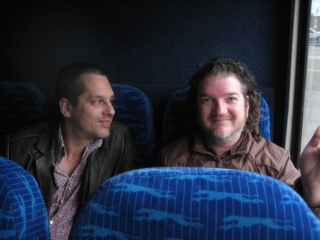
W. (William Large) and I will be discussing the Spurious trilogy at the great Cumberland pub in Newcastle on Thurs 6th July at 9PM. We'll be in the upstairs function room (free entry). Abstract below (though we won't be sticking closely to this.)

Will and I on the bus 

The Humour of Failure: Laughing at the Achievement Society

What does failure mean? Are you a failure? Do you find it difficult to remain upbeat and engaged? Does your capacity to hope seem merely a mocking reminder of your powerlessness?

In our world, what matters is success. We live in an achievement society, governed by a pressure to achieve and a stifling positivity. We are supposed to be entrepreneurs of ourselves – individual micro-enterprises, constantly networking and optimising skills. But this means burn-out and depression are never far away.

In this discussion, Lars Iyer and William Large, aka the fictional characters Lars and W. of Lars Iyer's Spurious trilogy (Melville House, 2011-13), consider how humour might permit a tactics of withdrawal from contemporary opportunism and cynicism.

I translated Blanchot’s texts because I felt a kinship there. I liked his lack of pretentiousness, his way of going deeply into a small, mysterious moment of interaction between people—or between abstractions that he treated as characters. I liked the fact that he didn’t need a dramatic story line.

Lydia Davis, interviewed

For a long time I had a system, I call it the 3-1-3 system. Three days of work. On the afternoon of the third day—drinking. Then you can get as drunk as you want. On the fourth day, you rest. Then you’re ready for three new days of work. I drink less now—age takes its toll. But when I was physically in better shape, I did that all the time. And it worked very well. It gives you a lot of work days, only one day off a week.

Dag Solstad, interviewed

Two fragments by Nietzsche written 1882-3:

I do not want my life to start again. How did I manage to bear it? By creating. What is it that allows me to bear its sight? Beholding the overman who affirms life. I have attempted to affirm it myself — Alas.

The instant in which I created the return is immortal, it is for the sake of that instant that I endure the return.

In a very fine article, Paolo D'Iorio comments: Nietzsche, the man of knowledge had attained the climax of his life at the very instant in which he had grasped the knowledge he regarded as the most important of all. When, at the end of his life, he became aware of having attained this summit, he ceased to need an alter ego in order to affirm the life that forever returns and as a conclusion to the Twilight of the Idols, which are the very last lines published in his lifetime, he let these words be printed: ―I, the last disciple of the philosopher Dionysus,—I the master of the eternal return.

A note on the relationship of Derrida and Blanchot, copied from this book. here, Derrida is being interviewed by Dominique Janicaud. Comments in square brackets mine.

[François Fédier asks Derrida to participate in a book of essays published in homage to Jean Beaufret, the French Heideggerian. Derrida agrees, after some persuasion, intending his piece to be critical.]

And then, one day, once he had the text, Laporte and his wife came to lunch at my house, in Fresnes, in the winter of 1967-68 (probably 1968 already). During a desultory discussion, Laporte, who had been [Beaufret's] student, spoke to me about some anti-Semitic remarks made by Beaufret. Disturbing remarks. He reported some of them, which concerned Levinas, or the fact that the alleged exterminations of the Jews were as little believable as the rumours that circulated concerning the horrors in Belgium after the war of 1914 (that the Germans were killing and slaughtering children); and finally, he spoke to me about remarks of this type that seemed shocking to me not just because of their anti-Semitism but because of their violence. And so I was shocked and upset. Laporte was a bit surprised. perhaps he had not predicted the effect that this could have on me. 

[Derrida writes to Fédier, asking to withdraw his text from the homage to Beaufret. Derrida is willing to do this discreetly, but Fedier would not accept this ('He reacted with violence: calumny, etc.!'). Fédier found out that it was likely Laporte who had spoken to Derrida about Beaufret's anti-Semitic remarks. Derrida arranges a meeting in his office at the École Normale between Beaufret and Laporte ('a confrontational meeting'). Following this, Laporte feels increasingly under attack from Beaufret's circle. His wife, Jacqueline, 'had alerted Blanchot in order to protect her husband'.]

Blanchot, too, was in the situation of having given a text to Fédier. Obviously, the Laportes knew that Blanchot was very sensitive, irritable, and anxious about these questions. So, as soon as Blanchot was alerted, he contacted me. I didn't know him at that point. I had read him, of course; we had exchanged a few letters, but I had never met him. It was on the occasion of this affair that I met Blanchot quite frequently, during this limited period in 1968, during the 'events' as one says. We met several times, asking ourselves what we should do – whether we should withdraw our texts or not. And then, after endless deliberations, we were in agreement: Beaufret did not admit to having said these things and we could not prove that he had – it was witness against witness, it was Laporte's word against his – we did not have the right to accuse Beaufret publicly of something that he denied, therefore we had to allow the promised texts to appear.

[Blanchot and Derrida agree to write to other contributors to the Beaufret homage once the book was published. Blanchot sent these letters to the publisher, who did not pass them on.]

Another thing as well: Blanchot said: 'we have to talk to Levinas about this'. Thus I remember one day when I had made an appointment with Blanchot and I picked him up with my car (he lived on rue Madame in those days), and I took him to see Levinas, to whom we then revealed this whole affair, since Levinas had been involved by name, having been the subject of the comments attributed to Beaufret. Levinas took things in a very relaxed way: 'Oh, you know, we are used to it'. He was less emotional about the affair than we were. So there you have it!

[Appendix 1. In a speech given at Blanchot's cremation on Feb 24th 2003, Derrida recalls the date of his meeting with Blanchot as being May 1968, and emphasises the importance of the Events for Blanchot. He also remembers 'the gentleness of a smile' that didn't leave Blanchot's face during their meetings. Appendix 2. Note that Derrida's account means Michael Levinas is wrong about the final meeting between Blanchot and Levinas, which he dates to 1961.]

If the fundamental ontological question today is not work but inoperativity, and if this inoperativity can, however, be deployed only through a work, then the corresponding political concept can no longer be that of ‘constituent power’ [potere constituente], but something that could be called ‘destituent power’ [potenza destituente]. And if revolutions and insurrections correspond to constituent power, that is, a violence that establishes and constitutes the new law, in order to think a destituent power we have to imagine completely other strategies, whose definition is the task of the coming politics. A power that was only just overthrown by violence will rise again in another form, in the incessant, inevitable dialectic between constituent power and constituted power, violence which makes the law and violence that preserves it.

Agamben, What is a Destituent Power? (draft of last section of The Use of Bodies – paywalled. Article can also be accessed here.)

[Reading In Search of Lost Time] gave me the powerful sense that it didn't matter if one could not see one's way forward, it didn't matter if one was silly and slow and confused, it didn't matter if one had got hold of the wrong end of the stick – what mattered was to keep going. I began to see that the doubts I had were in a sense the temptations of the Devil, the attempt to make me give up at the very start by presenting things in absolute terms (I can do it/ no, I can't do it); and that what Proust (like Dante before him, I later discovered) was offering was a way of fighting that by saying: All right, I am confused, then let me start with my confusion, let me incorporate my confusion into the book or story I am writing, and see if that helps. If I can't start, then let me write about not being able to start. Perhaps, after all, confusion and failure are not things one has to overcome before one can start, but deep human experiences which deserve themselves to be explored in art. Perhaps, indeed, the stick has no right end and therefore no wrong end.

Gabriel Josipovici, The Teller and the Tale

'What is surprising is not that things are; it's that they are such and not other', Valéry writes in the 'Note et digression' he appended to his Leonardo essay in 1919. This is profoundly opposed to the pragmatic and positivist English tradition, which takes the world and ourselves for granted and sees the task of art as the simple (or not so simple) exploration of the vagaries of life and the problems of mortality. it is this, we could say, that makes it difficult for the English to respond to the manifestations of European modernism, which is too often accused of 'abstraction' and 'deliberate obfuscation', whether it be the poetry of Rilke and Paul Celan, the philosophy of Heidegger and Derrida, or the novels of Alain Robbe-Grillet and Thomas Bernhard. For the English reader and critic, not to be interested in nature for its own sake, not to be interested in the moral dimension of murder and adultery, is not merely a literary but a human failing, a sign of a fatal abstraction, an unwillingness to engage with life as it is. For Valéry or Robbe-Grillet, to be interested in a tree or a bird – or a murder or a jealous husband – for its own sake, is to be concerned merely with the anecdotal and ephemeral. What interests them is what bird-leaving-tree tells us about our condition, it is the nature of murder and of jealousy. 

Gabriel Josipovici, The Teller and the Tale

Our epoch does not love itself. And a world that does not love itself is a world that does not believe in the world: we can believe only in what we love. This is what makes the atmosphere of this world so heavy, stifling and anguished. The world of the hypermarket, which is the effective reality of the hype-industrial epoch, is, as an assemblage of cash registers and barcode readers, a world in which loving must become synonymous with buying, which is in fact a world without love.

from Bernard Stiegler, Uncontrollable Societies of Disaffected Individuals

If this reign of despair causes suicidal behaviour to increase, then this desperation can itself give rise to desperate reasons, that is, transform this despair into struggle, by providing itself with objects of struggle. The problem is that it can get mixed up with some very bad intentions – and it is easy to let these bad intentions circulate, reproduce, and proliferate, more or less mimetically: youth needs to sacrifice itself. Youthfulness is an exalted state, tempted by excess because essentially transgressive, and this is where its very strength and beauty lie, as well as its future, and with this future, the future of the entire world: there lies its humanity. Because what is experienced by young people as exaltation becomes, in those with greater experience, tenacity, conviction, and patience, through which pleasure and reality are knotted together, and becomes the authority of those who pass into action –‘action’ here being understood in terms of those who work and act, and who transform the world through their practices. Such is humanity, a fact that Valery enjoined us to reflect upon, in the epoch of ‘the fall of spirit value’.

But whether or not such a maturity of adult belief exists, whether or not it offers reasons for hope to young people, they still need causes, however deceptive they may turn out to be, because the fundamental character of youth is not to be cynical, to not accept the cynicism that can reign in this world […], or that cynical reign of despair characteristic of the epoch of hyper-power, a hyper-power that shows itself to be nothing more than an effective impotence and an infinite injustice – therefore ceaseless reinforcing disbelief, miscreance, and discredit, drive-based behaviour and desperate reactivity, both suicidal and parasuicidal, both ordinary and pseudo-sublime.

Given this extremely serious context, it is the responsibility of the public collectivity to provide young people (and their elders, within whom they must find some of their resources) with reasons to hope -  failing which the different generations, and firstly the youngest, will find such reasons wherever they can or wherever they believe they can, even if they are being deceived. If society does not provide the objects of sublimation without which it would be capable of elevating itself or transindividuating itself (because transindividuation, being the condition of what is called the social bond, is the outcome of sublimation), it will instead incite desperation, with a far greater need for explosive compensatory objects, and will take these objects more easily for its own, regardless of their provenance – from extremist ideologies, religious sects, evangelical churches, clandestine mosques, videogames in which the score is calculated by the death drive, or from ‘reality television’, which measures how degraded and ‘available’  brains are for the hype and brainwashing of ‘power’.

from Bernard Stiegler, Uncontrollable Societies of Disaffected Individuals

They were the worst of times because they were the best of times; times in which dissent was forbidden, not by the dispersal of dissenters but by their assembly; times in which protest was refused, not by the containment of expression but by its freedom; times in which the people were kept in ignorance, not by narrow educational channels but by immeasurably wide ones; times in which we were made to forget the evils all around by hysterical remembrance of evils dead and gone; in which we were half-dead, not from neglect but from care, and half-mad, not from silence but from talk, and starved out of our wits from much too much to eat; in which want had the form of plenty, and dearth the form of glut, and no one could think their way out, not because there was too little time to think but because there was far too much.

There is in these times such an explosion of thinking, such licence to think and rethink, to think from all angles  and all perspectives, to think of ourselves and of others and of others like ourselves and of others unlike others, to think and think and think again, that we cannot any longer think straight.

the opening of Sinéad Murphy's forthcoming Zombie University

I read [Deleuze's] Logic of Sense a long time ago, 30 or 34 years ago, in fact I was in prison when I read Logic of Sense, and I think that it is reading Logic of Sense that permitted me to live in prison. Logic of Sense allowed me to live in prison and to adopt an ethics of prison. What I call an ethics of  prison is one which permits me to cultivate a virtue, for me an ethics cultivates a virtue.

Bernhard Stiegler, speaking in a seminar

If we have to live through what Nietzsche called ‘the fulfilment of nihilism’ that is, so to speak, the concretization of the ‘death of God’, then we must pose the question of God – which is obviously not the same as resurrecting Him. Today, we live the ordeal of nihilism; today, nihilism presents itself as such, that is, in the form of the experience that I am nothing. For a long time it did not present itself as this nothing. It presented itself as ‘anything goes’, ‘I can do it all’, ‘I can transgress’. When nihilism presents itself as such, can I recognize it? What is it that I am living? What is my experience? It is the experience of what Kierkegaard already described as despair. When despair becomes the most common experience, the most widespread, it is no longer possible to ignore the specific questions raised by the death of God, the questions, dare I say, worthy of the death of God. We are in the course of living through what we could call, in religious language, the ‘apocalypse’ of nihilism. It is here that we must become worthy of the ordeal of nihilism. By suggesting that he himself arrives to soon with this statement, Nietzsche in some way says to us: ‘I await the moment when you will truly encounter nihilism. Now I am speaking to you and you believe you understand me. But in fact you do not understand me at all. You believe you understand, but you do not understand because if you understood, you would be living through your apocalypse.’

Bernard Stiegler, interviewed

With its careful attention to Justine’s condition, and especially with Dunst’s amazingly sensitive and nuanced performance, Melancholia refutes clinical objectivity, and instead depathologizes depression. For depression is all too often stigmatized as a moral or intellectual failure, a kind of unseemly self-indulgence — this seems to be John’s attitude towards Justine. Or else, at best, depression is understood reactively as a deficiency in relation to some supposedly normative state of mental health — this seems to be Claire’s attitude. But Melancholia suggests that both these positions are inadequate. By focusing attention so intensively upon Justine’s own emotions, it treats depression as a proper state of being, with its own integrity and ontological consistency. This is not the least of the film’s accomplishments.

I would go so far as to say that, in this regard, Melancholia is profoundly antiNietzschean[…] For Nietzsche has no empathy at all with the state of depression. Rather, he stigmatizes it in emphatically normative terms. Nietzsche insists upon “the futility, fallacy, absurdity, deceitfulness” of any “rebellion” against life. “A condemnation of life on the part of the living,” he writes, “is, in the end, only the symptom of a certain type of life.” Even the judgment that condemns life is itself “only a value judgment made by life”: which is to say, by a weak and decadent form of life. Nietzsche seeks to unmask all perspectives — even the most self-abnegating ones — as still being expressions of an underlying will to life. This universal cynicism is the inevitable counterpart of Nietzsche’s frequent, and strident, insistence upon the necessity of “cheerfulness.”

Contrary to all this, Justine’s will to life has been suspended. Her depression is a kind of positive insensibility or ataraxia, or even what Dominic Fox calls “militant dysphoria”. This is a state of being that no longer sees the world as its own, or itself as part of the world. As Fox puts it, “the distinction between living and dead matter collapses. The world is dead, and life appears within it as an irrational persistence, an insupportable excrescence”. Through its refusal to affirm or celebrate life, dysphoria subtracts itself from the will to power, and therefore from Nietzsche’s otherwise universal suspicion about motives. Depression is the one state that cannot be unmasked as just another expression of the will to power. The underlying assumption of Nietzsche’s entire critique of both morality and nihilism is that the human being, and indeed every organism, “prefers to will nothingness rather than not will”. But depression, at least in von Trier’s presentation of it, must be understood as a positive not-willing, rather than as a will to nothingness, or a destructive (and self-destructive) torsion of the will.

From Steven Shaviro's great esssay on Melancholia

My mother gave me away.

In Holland – in Rotterdam – for a year, I was kept on a fishing trawler with a woman. My mother came to visit me there every three or four weeks. I don't think that she cared much for me at the time. However, this then changed.

I was a year old, we went to Vienna … and then the mistrust, lingering still when I was brought to my grandfather, who by contrast, really loved me, changed.

Then taking walks with him – everything is in my books later, and all these figures, male figures, this is always my grandfather on my mother's side … But always – except for my grandfather alone … the consciousness that you cannot step outside of yourself. 

All else is delusion, doubt. This never changes …

In school years completely alone.

You sit next to a schoolmate and you are alone.

You talk to people, you are alone.

You have viewpoints, differing, your own – you are always alone.

And if you write a book, or like me, books, you are yet more alone … 

To make oneself understood is impossible; it cannot be done.

From loneliness and solitude comes an even more intense isolation, disconnection.

Finally, you change your scenery at shorter and shorter intervals. You think, bigger and even bigger cities – the small town is no longer enough for you, not Vienna, not even London. You've got to go to some other part of the world, you try going here, there … foreign languages – maybe Brussels? Maybe Rome?

And there you go, all over the place, and you are always alone with yourself and your increasingly dreadful work.

You go back to the country, you retreat to a farmhouse, like me, you close the doors – often days long – stay inside, and the only joy – and at the same time ever greater pleasure – is the work. The sentences, words, you construct.

Like a toy, essentially – you stack them one atop the other; it is a musical process.

If a certain level should be reached, some four, five stories – you keep building it up – you see through the entire thing … and like a child knock it all down. but when you think you're rid of it … another ulcerous growth like it is already forming, an ulcer that you recognise as new work, a new novel, is bulging somewhere on your body, growing larger and larger.

In essence, isn't such a book nothing but a malignant ulcer, a cancerous tumour?

You surgically remove it knowing of course perfectly well that the metastases have already infected the entire body and that a cure is completely out of the question.

And of course it only gets worse and worse, and now there is no rescue, no turning back. 

Thomas Bernhard, extemporising in 3 Days

One of the ironies of a song like ‘The Golden Age of rock n’ Roll’ is that it is based on a bygone period that was unaware of its own status as a golden age (because busy living it) and furthermore had no interest in or consciousness of any previous golden age (because full inhabiting the country of Now). Retro is dependent on the existence of the un-retro: moments of newness and newness that get trapped for ever in the amber of the archives. Revivals never require earlier revivals; they must always re-enact what was new in its own time, the truly nourishing and vigorous stuff.

from Simon Reynolds, Shock and Awe: Glam Rock and its Legacy

“Friend” and “free” in English, and “Freund” and “frei” in German come from the same Indo-European root, which conveys the idea of a shared power that grows. Being free and having ties was one and the same thing. I am free because I have ties, because I am linked to a reality greater than me.

To the question, “Your idea of happiness?” Marx replied, “To fight.” To the question, “Why do you fight?” we reply that our idea of happiness requires it.

Writing is a vanity, unless it's for the friend. Including the friend one doesn’t know yet.

Life and the city have been broken down into functions, corresponding to “social needs.” The office district, the factory district, the residential district, the spaces for relaxation, the entertainment district, the place where one eats, the place where one works, the place where one cruises, and the car or bus for tying all that together are the result of a prolonged reconfiguration of life that devastated every form of life. It was carried out methodically, for more than a century, by a whole caste of organizers, a whole grey armada of managers. Life and humanity were dissected into a set of needs; then a synthesis of these elements was organized. It doesn’t really matter whether this synthesis was given the name of “socialist planning” or “market planning.” It doesn’t really matter that it resulted in the failure of new towns or the success of trendy districts. The outcome is the same: a desert and existential anemia. Nothing is left of a form of life once it has been partitioned into organs. Conversely, this explains the palpable joy that overflowed the occupied squares of the Puerta del Sol, Tahrir, Gezi or the attraction exerted, despite the infernal muds of the Nantes countryside, by the land occupation at Notre-Dame-des-Landes. It is the joy that attaches to every commune. Suddenly, life ceases being sliced up into connected segments. Sleeping, fighting, eating, taking care of oneself, partying, conspiring, discussing all belong to the same vital movement. Not everything is organized, everything organizes itself. The difference is meaningful. One requires management, the other attention—dispositions that are incompatible in every respect.

From The Invisible Committee's magnificent To Our Friends

Psychologically, Justine’s reactions are not willful, so much as they are compelled by extreme distress. But beyond this, Justine’s depression is ontological in scope. It cannot be characterized as just a contingent response to one particular set of circumstances. For it involves the rejection of any “particular circumstances” whatsoever. Justine’s depression marks a rupture with the social order as such: an order that cannot function without the tacit complicities and denials that are understood, and entered into, by everyone. In refusing this, Justine enters into a condition that is absolute and unqualified. Her depression is ungrounded, self-producing and self-validating. It needs no external motivation or justification. It is just what it is: an unconditioned and nonreflexive state of pure feeling.

From Steven Shaviro's great esssay on Melancholia

The nations will fall. The old kingdoms. The old empires. The governments will fall. There’ll be no more progress, expansion or growth. The gypsies will take what they always took – the rubbish, the ruins, the alms. Nothing else mattered to them. Centuries of thrift and tradition. The gypsies will win. They’ll outlast us. They’ll know how to live. They’ve been practising all these years for the apocalypse.

Andrej Stasiuk, Road to Barbadag