[Draft of an article published in ANGERMION (de Gruyter )  XIV (Dec 2021)]

The Music of Friendship: Nietzsche and the Burbs

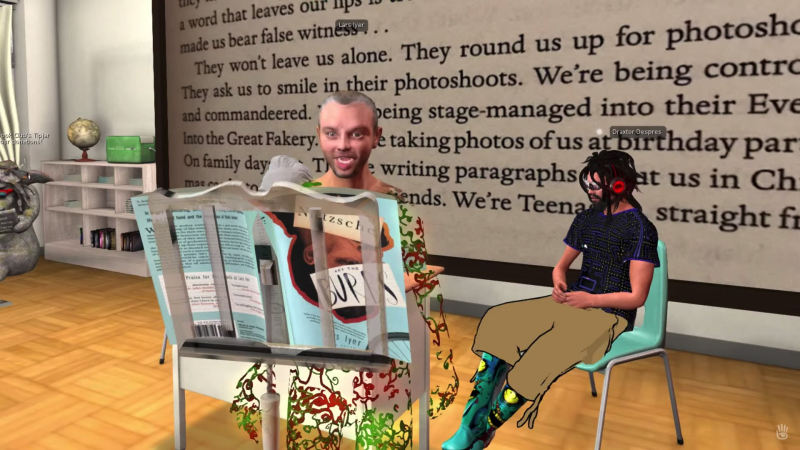
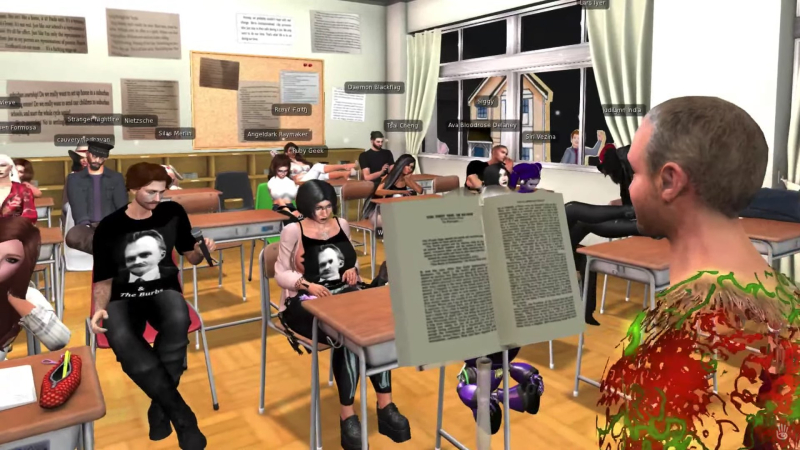
The opportunity to discuss your own work as a novelist is a curious one. ‘Life can only be understood backwards; but it must be lived forwards’, wrote Kierkegaard. It is only in an essay such as this one that I can begin to understand a literary project that occupied me for several years. We only know what we were working on once we’ve finished work; we can only know our pro-ject – etymologically, what we throw ahead of us – as a re-ject, as what is thrown behind us. Writing is lived; it is experiential and experimental, a projection into a future whose course is unknown. But understanding is retrospective; it presupposes a corpse.

This means that I confront my own work as a kind of Sphinx, an enigmatic monument the riddle of which is hard to solve. Literary fiction plays a different language game to an essay of the kind I am writing, particularly with regard to what might be called the materiality or even musicality of its language: its rhythms and sonorities, its grain. Yet it is the exactly the music of my work – both the imaginary music I write about and the music of its prose – that is my topic. 

What follows is my attempt to respond to the Sphinx, in which I remember the music of friendship at play between my characters, but also in early relationships of my own to which I want to pay tribute. This is an answer to her riddle – it’s a way of understand what I was doing, even as I know there could be many others.

*

Nietzsche and the Burbs (2019) is the second in a trilogy of novels, each of which takes a historical philosopher as its central figure, introducing an avatar of them into the contemporary world. The anachronism of these characters is the point; in each case, the reborn versions of the real Wittgenstein (Wittgenstein Jr, 2014), the real Nietzsche and, in my next novel, the real Simone Weil live at a freeing remove from their surroundings, allowing them to diagnose and attempt to address the ills of our present. Their charisma – the fascination they elicit from those around them – is a result of their seeming to come from elsewhere.

The novel is set in the contemporary UK among seventeen year old sixth-formers just about to take their A-levels. One of its central characters is a reborn Nietzsche, now a privately-schooled nineteen-year-old boy of partly German descent, who, following his father’s death and his own mental breakdown, joins a local comprehensive school sixth-form to complete his A-levels. He’s aloof, quiet, but is inveigled by some of pupils of his new school – a group of friends bored and dissatisfied by their suburban lot – to become the lead singer of their band. The friends are looking for a leader, a role which Nietzsche, as they nickname him, is reluctant to take on. But he does set them a salutary example, exuding philosophical seriousness and depth and encouraging them to deepen their supposed despair, allowing them to confront the nihilism of the suburbs.

My main characters – Art, Paula, Merv and Chandra (the narrator) – spend their time pondering life and its meaning, lamenting their suburban fate, discussing their favourite music and films as well as getting high – all that ordinary teenage stuff. The novel traces the catalytic effect my character Nietzsche has on these friends, especially as it revitalises their music-making, guiding them towards a new ethos, a non-nihilistic way of living. The title of my novel, Nietzsche and the Burbs, is the name the band takes after Nietzsche joins them as lead singer.

*

The novel is set Wokingham, a commuter-belt town about thirty miles west of London, which is part of the so-called knowledge economy spine, the so-called innovation engine, that runs through the Thames Valley. You can find most of the big multinational businesses there; tech companies thrive, along with the financial and business services firms, the pharma-bio industries, the great retail firms … There’s a huge demand for highly educated workers, a brain economy of software engineers, telecoms people and commercial staff. Housing estates are solutions to the growth-zone problem, the family-friendly problem and the easy-commute problem …The new houses aren’t exciting – they are mostly Georgian-style boxes – but they don’t need to be. Wokingham’s a pragmatic town, where there’s business to be done; aesthetics is a secondary concern.

My teen characters stand out. They don’t want to do what they’re supposed to – pursue a vocational course at uni, find an office job, settle down. They don’t want to make the suburban adjustment, and accept that this is the only world there can be. My teens have a sense of being totally managed – suburban life is paranoically controlled. Nothing, they feel, is allowed to happen. There’s no spontaneity or otherness. Pseudo-event follows pseudo-event; the future feels totally programmed, prescribed, modelled – indeed, it barely seems to exist at all. Nothing anyone says seems to mean anything – words like family, home, friend, have been hollowed out, seeming to only parody older meanings. Their families live through abstract representations that cover up a general evacuation of meaning. Homogenisation holds sway. Everyone, no matter what their origins, seems to become alike. If there are deviations – eccentricities, idiosyncrasies – they are permitted ones; there’s a way to be fun, wacky, surprising and so on in the suburbs. There’s a way to be diverse – to be gay, to be foreign, to be working class.

For my teens, formal education is mere processing, leading everyone into the office. There are a few maverick teachers at their comprehensive school: a Marxist economist, a doomy geographer obsessed with climate change, a Thomas-Bernhard reading émigré, but my teens informally educate themselves, learning from counter-cultural role models and musicians: Arthur Rimbaud and Kurt Cobain, Nadya Tolokno from Pussy Riot and the musician and former Orthodox Christian monk Jason Marler. 

My teens talk despair and suicide. They seethe with dislike for the drudge-like masses who populate their sixth form and yet feel inferior to the private school children they come across. They’re aware of the cultural capital they lack, of the great gaps in their education. They know their grades have been inflated, that their passage through school has been too easy and their time at university will be the same. What appeals (though they might deny this) is an aristocratic mode of existence; a sovereign splendour that would place them beyond the doings of the mundane world – beyond its blandness and fakery.

My teens are intellectuals of a sort, full of inchoate philosophical questions, but also crave excitement – altered states through drunkenness and drug-taking. Sometimes they search for peace, too – for open time, for interregna of various kinds: slow cycle rides, lying in the grass, smoking weed, truanting. And they have nascent artistic desires, which drive them to make music. They want to redeem their lives in some way, to make sense of their lives in the suburbs.

Enter my character Nietzsche – subdued, charismatic, ardent. He intensifies and focuses the discontent of my teens. He talks tersely about nihilism and the death of God and expresses suspicion of pity and compassion. He thinks my teens’ despair is sham and should be driven deeper. Crucially, his very presence makes them want to reform their band and to recruit him as lead singer. The novel builds towards the first gig of the band, Nietzsche and the Burbs. As the band rehearses, the teens begin to hope that their music-making might help them to overcome day to day suburban nihilism, allowing them to transfigure their lives, elevating the contingencies of their existence into something necessary. The band come to understand their music-making in philosophical terms, as a way of transforming their affective lives, allowing them to become conduits of revivifying forces.

*

Let me step back to the historical Nietzsche in order to understand the band’s ambitions.

The real, for the real Nietzsche, is in a constant state of becoming, without purpose or goal. Process is primary, not stable entities, which form and dissolve within a larger chaotic field. For Nietzsche, human life can be sustained by establishing horizons within which a community can live. These horizons are, in a sense, lies – ways of concealing chaos from ourselves. But lies are, Nietzsche argues, more valuable than truth when it comes to communal flourishing, since the lack of purpose or goal, the fact that meaning isn’t simply given, is too much to bear.

The importance of music, for Nietzsche, lies in its role in laying out the horizons in question – composing chaos into order. This is because music is able to operate directly on our bodies – on the multiplicity of passions that each of us is. We are not primarily minds or souls, but complexes of passions which, in turn, reflect deeper drives and impulses that work in and through us. These drives and impulses are manifestations of becoming – of the chaos that Nietzsche calls the will to power.

Nietzsche uses this term to refer to the fundamental struggle of becoming with itself. The will to power is the war among all things for dominance and self-overcoming. Particular entities exist insofar as they are moments of the will to power, in and through their antagonistic relations to other entities. This struggle holds sway among the passions, too. Each passion is a moment of the will to power and, as such, strives to overcome other such moments. Passions conflict. The danger is that the internal struggle of the passions leads to chaos. They need proper regulation – the body as such needs to be trained and marshalled.

*

This is where music comes in.

Traditionally, philosophers have argued that we need to exert rational control over our bodies and its passions, working to bring them into line with our intellect. However, Nietzsche argues that the role of rationality itself is relatively superficial. He argues that human beings are primarily affective rather than thinking beings and that our passions are barely open to self-examination at all. We are unable to recognise or understand the way we are shaped by drives and forces, let alone order these passions rationally.

So how, then, can we regulate our affective lives? For Nietzsche, music has a particularly strong effect on the passions. Musical modulation allows the passions to be co-ordinated or ‘rank-ordered’ as part of a harmonic whole. The dissonance of the passions can be harmonically resolved through melody, which trains and disciplines the human body not only individually, but collectively. In this way, musical discipline may produce an appropriately harmonized ethos for a community.

This is how music can be understood to transfigure the chaos of the real, to provide a communal form in the flux of becoming. Unlike rationality, which seeks to supress the passions altogether, musical harmony preserves passions in their difference, maintaining the internal tension of the body as part of a higher harmony.

*

The role of musical training is particularly important in the wake of what Nietzsche calls the ‘death of God’. Formerly, human passions were constrained and ordered by subordinating them to a rational God and rational cosmos. With the cultural decline of Christianity, this internal regulation – a whole system of instincts – begins to fail, and with it that sense of meaning, purpose and direction which comes from having a horizon within which to live.

Nietzsche isn’t nostalgic for Christianity which, for him, denigrated life, unfavourably measuring it against an eternal, rational order. But he’s also fearful for the future. New movements of thought such as positivism, materialism and utilitarianism threaten to perpetuate the unhealthy aspects of Christianity, preventing its final collapse and the possibility of rebirth. European civilization is no longer able to rank or hierarchize the passions appropriately, preventing that enlivening inner struggle on which a genuinely new, post-Christian psychic and communal ordering depends. There is the temptation of passive nihilism, taking refuge in pessimism and resignation – in a rejection of any hope in the world. The counter-temptation of active nihilism, exemplified by the fiery characters of Dostoevsky, might seem more positive, but seeks to fruitlessly destroy the world rather than prepare the way for anything new. It is, at best, merely transitional. But Nietzsche’s greatest fear is that we will lapse into the state of being of the last human [letze Mensch] – a banal, low-intensity hedonism, a self-satisfied happiness that is the consolation of those whose passions no longer struggle.

My teens see the last humans all about them, in their snacking and surfing peers in the sixth-form common room and in their parents, busy commuting to and from the offices of the Thames Valley ‘knowledge spine’. They themselves move between active and passive nihilism, depending on circumstances. But they sense the danger of making the suburban adjustment and giving way to low-intensity contentment. It is my Nietzsche who makes them realise what they half-know: that music-making opens them to intensities which suburban life cannot manage into quiescence. Music has, all along, loved for them and hated for them, desired for them and yearned for them. They’ve talked music for years. But music-making provides my characters with the goal they lacked, helping them to coordinate their passions and reshape their affective lives. Their band, with Nietzsche at the helm, allows them to become conduits of larger, trans-suburban forces. This is how they might overcome nihilism.

*

Before Nietzsche joins them, the band’s music is a muddle. We see them trying out a variety of different kinds of music, including doom or stoner metal and dub, but it all seems culturally exhausted; it’s all been done before. They lack the capacity to believe in themselves as musicians – and to believe in that they can create anything new. But when Nietzsche takes up his role as their a singer, they feel their way into an open-ended, improvisational music practice.

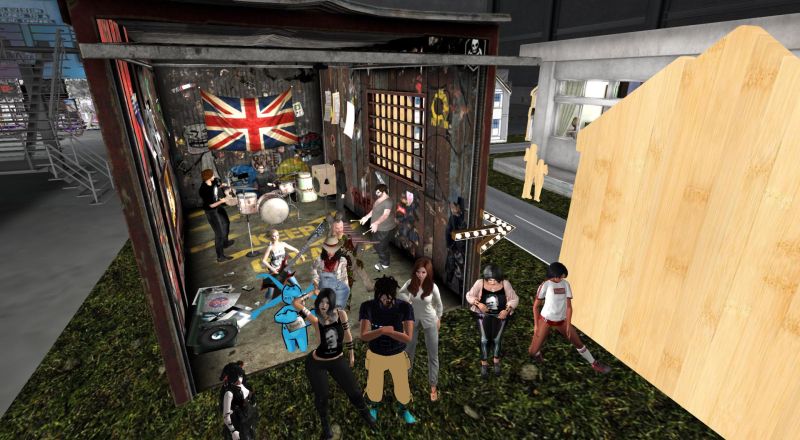
What do they sound like? They’re a five piece: Chandra plays guitar, Paula, bass, Merv plays marimba – an unlikely instrument for their combo – and Bill comes to play drums. Art, in whose bedroom they rehearse, produces them and adds effects – his role is similar to the ‘non-musician’ Brian Eno in Roxy Music and elsewhere, modifying the sound of musical instruments through technological treatments.

Initially, the band play a kind of doom metal, drawing on the slower, sludgier elements of Black Sabbath’s first six albums (1970-76). Doom is introverted, characteristically melancholy, emphasising sub-frequencies and minor key melodies, with lyrics focused on melancholy, madness and the occult. It is characterised by heavily distorted, lengthily sustained guitar chords and slow-building monolithic riffs, giving the music a ritualistic, hypnotic feel. My teens also show an interest in so-called ambient metal, an offshoot of doom, exemplified by Earth’s Earth 2: Special Low Frequency Edition (1993), a minimalist, beatless album of drone and feedback, entirely lacking vocals or verse/ chorus structure. Ambient metal reflects the influence of American minimalist composers like La Monte Young and Terry Riley just as much as Black Sabbath who make use of repetition and circular structures, producing pieces of long duration and little melodic progression foregrounding drone. My teens also admire a related American composer, Pauline Oliveros, who works directly with drones, encouraging ‘deep listening’, focusing on microscopic subtleties in sound.

My teens are also interested in beat-driven music, too. They try their hand at dub reggae, which, similar to doom and ambient metal, is immersive and bass-driven, focusing on texture and timbre. Dub is a producer’s or engineer’s genre working with completed songs, largely erasing the original vocal track and other instrumentation, leaving a raw rhythm track, over which extra sound effects might be added, filtered through reverb and echo units. It characteristically has a broken, unfinished feel, with disorientating, thickly textured shards of sound floating above an elemental, throbbing bass pattern and with fragments of lyrics evoking biblical apocalypse and Rastafarian belief. Paula, the bassist, finds herself reverting to classic reggae basslines when she tries to play something new. Art, for his part, shows an interest in dub production techniques, even attempting to recreate Lee ‘Scratch’ Perry’s famous Black Ark studio in his bedroom.

The band move on from doom and dub (and their unlikely-sounding hybrid of the two) towards an expansive and weightless kind of ‘kosmiche music’, the open-ended improvisational music of Can and other West German bands of the early 1970s, which broke away from the song structures and the blues scale, drawing on electronic music and avant-garde composition, making use of synthesizers and tape-music techniques. Kosmiche bands worked with drawn out structures without the theatricality and bombast of contemporaneous progressive rock, their musical collages often anchored by hypnotic, forward-flowing rhythms – the famous minimalist, syncopation-free ‘motorik’ beat first heard on Can’s ‘Mother Sky’ (from Soundtracks, 1970) and on the first, eponymous, Neu! album (1972). But it is the hazy, spaced-out soundscapes of Can’s Future Days (1973) that seem to most strongly influence my teens, with its scratchy, funky guitar, oceanic synthesizer, its lilting, intricate rhythms and buried, whispery vocals. The music of Nietzsche and the Burbs, the band, is characterised by the same serene tranquillity, the same egoless, ensemble playing, with its balmy inventiveness, its currents of warmth.

Finally, just before the gig, their sound echoes Miles Davis’s jazz-fusion band of the mid ‘70s as recorded on the 1975 albums Agharta and Pangea, which mixes free and modal jazz with psychedelic rock and rhythm and blues. Vamps and themes rest upon the polyrhythmic complexity of the rhythm section, a constantly evolving muscular groove. Much heavier, denser and unrelenting than Can’s Future Days, the music seethes and boils relentlessly, opening periodically into sonic equivalents of vistas — into unmetered flux.

*

What do these kinds of music have in common? They all come from, or are rooted in, the countercultural explosion of the ‘60s, when music had an ability to define a time, playing a leading role in communal revolution. ‘60s music – psychedelia, free jazz, reggae – had a utopian edge, part of a quest for new forms of social organisation – be it the commune (psychedelic rock) or the ‘repatrination’ to Ethiopia (reggae). Music-making in this period revived the old dialectic between bohemian creativity and bourgeois existence – between the struggle for a meaningful rather than comfortable life. Heightened experience was opposed to settled conformism; immediate gratification and expressive intensity to mundane self-preservation; and abandonment and exuberance to the flabbiness of middle class life. If, later on, the counter-culture came to collapse into narcissistic individualism and consumerism; if music no longer played a leading role in culture at large, its power of general transfiguration having withered, it continued to inform the imaginary of the strands of musical practice my teens admire.

What of the qualities of the music itself? Common to doom, dub and Miles Davis’s jazz-fusion is the use of pulsing, droning rhythms and the foregrounding of songscapes over songs. They depend on improvisation, often making use of mixing desk and studio manipulation. Textural layering is crucial – an interweaving of instruments over the bottom end of bass and drums have a central role. These genuinely collective, non-hierarchical qualities are present in the music of my teens. But I would like to emphasise something else, too. At each one of their practices, the band seem to recreate their music – to transform their repertoire of songs. Each time, they seem to draw from an inexhaustible origin, an Ursprung that springs forth dynamically in their music on that day. In the historical Nietzsche’s terms, we might understand them as drawing on a well of chaos, of the will to power that lies beyond the suburban horizon. It is this welter of forces they’re able to engage through their doom- dub- drone- fusion-influenced music.

What does my Nietzsche add to this music? At first, only a whispering speech-singing, close to a murmur, drifting in and out of silence, recalling Damo Suzuki’s vocals on Future Days, which are like a mist, a spray, another element of the shimmering texture of the music. There’s also Jandek’s Glasgow Monday, which features tremulous speech-song over piano and percussion. Nietzsche’s vocals are only part of a tapestry of sound; they are but an element of the music. But Nietzsche’s speech-singing gains strength, his lyrics become more intelligible, and it seems at their gig that he really might sing for the first time. His presence – if not yet leadership – gives the band direction. Doubts about their musical direction cease; improvisatory songscapes become songs and, for all their carping, all their supposed despair, my teens come to experience music-making as a joyful, affirmatory practice.

*

Chandra, my narrator, hopes that he and his friends might redeem their suburban lives by performing and recording their music, making sense of everything that has happened to them. Their creativity affirms its own conditions – the fact that my teens were born and brought up in the suburbs of Wokingham. Music-making would allow my teens to lift every ephemeral moment of their lives out of irrelevancy and contingency by establishing its absolute importance to their creative practice. Everything that’s happened to them would now be a necessary condition of their music-making and is thereby affirmed by it.

For this reason, according to Chandra, their hometown wouldn’t be just another knot in the great sprawl of the suburbs of southeast England, but the origin of this transformative music, indeed its only possible origin, which would make it a place of pilgrimage for their admirers. What would these admirers see? A town like any other, just the same as any other, but also a town that is unlike any other because it was the condition for the music of Nietzsche and the Burbs. And maybe these pilgrims could go back to their own suburban towns and make affirmatory, transfiguring music of their own.

As such, my characters dream of collective amor fati, a love of fate that would show their audience a way of affirming the suburban hand they were dealt. This would free them from the spirit of hatred and revenge of the active nihilist, since they could thereby overcome the resentment of being born and brought up in such an insignificant, philistine place.

The historical Nietzsche would reject understanding amor fati on a model of subjective volition. The philosopher challenged the notion of individual agency, seeing the individual will as a metaphysical fiction. Although we experience ourselves as causal agents, able to effect changes in the world, the autonomous, self-regulating subject is a myth. On the historical Nietzsche’s account, the real agent of our willing is the will to power, understood as multiplicity, as a field of power differences and relations, in all its indifference and amorality. This is also case for the suburban life that my characters would affirm, since the suburbs, too, are only ultimately a moment of the will to power. In the case of both self and suburbs, the will to power is causally and ontologically primary – it cannot be contained or channelled by any particular form. Indeed, the very creativity of the will to power always involves moments of destruction, of active nihilism, as it overcomes its current ordering.

This is why my teens can seek a new psychic ordering and way of life through music. By engaging with the elemental strife of the will to power, the band’s music would allow them to order their passions, and harmonise their experience – and to do the same for their audience. Granted, such a harmonizing can never be definitive – it can never happen once and for all. There will be need for more creative destruction, for more overcoming. But their amor fati might permit, for a time, a collective power of affirmation that reshapes the system of instincts of its makers and listeners, recreating the suburbs.

*

But we need to go further still to understand what the teens seek with their music. How is it actually supposed to overcome nihilism?

For the historical Nietzsche, the ultimate test on which amor fati depends is, paradoxically, to will the world exactly as it is – to desire that everything that led up to this moment to return over and again. This is his famous notion of the eternal return.

The question that faces my characters is whether they can affirm their suburban lives with its last humans, its banality, as well as its cruelties. To really love their suburban fate means envisaging enduring it countless times. Wouldn’t this lead directly to madness, as their Thomas-Bernhard-reading teacher argues? This depends on the interpretation of Nietzsche’s doctrine. Like any other entity, according to the historical Nietzsche’s ontology, the suburbs are a changing amalgam of forces rather than a fixed, unitary thing. To desire the eternal return of the suburbs means to affirm those energies as movements of becoming, which may in turn be productive of new ways of living.

Towards the end of the novel, my teens declare themselves ready to ‘play the suburban eternity’ – to play this particular traffic jam as every traffic jam, this particular roadworks as every roadworks, this particular town as it echoes with every other town. The band plays the suburban condition in its banality and nullity, as one element of their music harmony. But they give voice to something else: the flux and becoming of which the suburbs are but a transitional formation. The band’s music would bring together both the banality of suburbs and, in productive tension with it, the exuberance of volatile, mobile energies.

How is this act of musical harmony possible?

*

For the historical Nietzsche, the strength to will the eternal return is available only to the overhuman [Übermensch]. This kind of human life wants nothing more than to overcome its present form, rejecting any accommodation with prevailing notions of happiness. The overhuman is devoted to the art of transfiguration, seeking to redeem life through creative action, opening a future beyond the monotonous rhythms of the present. As such, the overhuman cannot think of itself as an end point, as a final evolutionary stage, in the manner of the last human. The ‘over’ in overhuman should be understood in terms of a continual desire for overcoming, of a thirst for physiological, cultural and spiritual metamorphosis. The overhuman is not interested in self-preservation, in what is usually called health (including mental health) or happiness. In this way, the overhuman is aligned most closely with the will to power, expressing and discharging overfulness.

What are the conditions for the appearance of the overhuman? The historical Nietzsche sometimes suggests that the overhuman will require generations of training – of ‘breeding’ – to appear. My characters, by contrast, seem to believe they can become the overhuman at one stroke, through a titanic act of affirmation. Their dream is that their performance, fronted by Nietzsche, would allow them to create themselves and to overcome suburban nihilism.

But this collective affirmation depends on their mentally fragile frontman, which, as it turns out, is too much to ask of him. The band look to Nietzsche to lead their attempt to affirm the chaos from which the suburbs were shaped and into which they will return. Nietzsche is enable them to welcome and endure the test of eternal recurrence, allowing the band a taste of overhuman existence.

What should have happened: Nietzsche’s song. Nietzsche’s singing.

What should have happened: Nietzsche, really singing for the first time. Nietzsche, gone all melodic, for the first time.

What should have happened: Nietzsche, letting his body resound, the whole animal. Nietzsche’s voice, from his deep body. Nietzsche’s voice, deeper than thought, deeper than philosophy.

What should have happened: Nietzsche’s body singing, not his mind. Nietzsche’s body reverberating. Nothing showy, or histrionic. Just Nietzsche, using his lungs, his larynx, his vocal cords. Just Nietzsche, letting his voice resound.

What should have happened: Nietzsche’s singing, gathering intensity. Becoming richer, darker. Nietzsche’s singing, projected on the out-breath, coming from the core.

What should have happened: Nietzsche, singing joy and mourning, both at once. Nietzsche, singing pain and dissolution, both at once. Nietzsche, singing death and rebirth, both at once. Nietzsche, singing fullness and loss, both at once. Nietzsche, singing gathering and dispersal, both at once. Nietzsche, singing tragedy and comedy, both at once.

What happens instead? The task is too great. Nietzsche tries to sing, tries to bind chaos into the structure of a song, thereby recreating the suburbs for his band and audience, but his effort fails.

What really happened: Scattered words, scattered speech-song.

What really happened: Nietzsche, stumbling, staggering.

What really happened: Unearthly screaming – from his throat. A quavering. A buzzing – from his throat. Nietzsche, fitting. Nietzsche, thrashing.

What really happened: Nietzsche hit his head so hard. Nietzsche’s lips were blue. Nietzsche’s eyes were completely rolled back in his head.

What really happened: Suffering – just that. Pain – just that. Madness – just that.

What really happened: Bar-staff standing around us. Calling an ambulance.

Nietzsche loses his mind. He ends up in the locked ward of a mental hospital. A disaster, then – a failure of a gig, a failure of music-making, to overcome the suburban form.[i]

*

But where Nietzsche and the Burbs, the band, failed, Nietzsche and the Burbs, the book, might be understood to succeed.

The novel itself is ostensibly autobiographical, telling the story of how Chandra, its narrator, together with his friends, sought to transfigure the suburbs, rank-ordering their passions through music-making. As we have seen, my teens sought to affirm the conditions of their creativity, redeeming their suburban lives in musical performance and recording. Could we understand Chandra’s memoir as doing something similar in another medium? Of course, the memoir is not itself a musical work. Nietzsche warns us that words are always falsifications of becoming – a problem that is even worse when they are subordinated to logic. But Nietzsche himself wrote prose – and very musical prose at that, making use of such musical devices as symmetry, crescendo, inflection, tone, and tempo to express and affect the body. It is by placing emphasis on the musicality of his prose that Nietzsche resists the traditional philosophical view that our affects, our passions need to be brought into line with our intellect. An appropriately musical prose, his example suggests, can access, evoke and communicate the clash of drives and impulses at work in our affective lives in a manner that parallels that of music.

Is something similarly musical at work in Nietzsche and the Burbs? The novel is unsparing in its accounts of suburban mundanity – the dreariness of sixth-form and family life; it is full of bathetic detail and the bored talk of adolescents. But on the other, it is, as many reviewers have noted, notably musical in its style, not least in the way it evokes the music of the band. There is its rhythmic flow, with frequent use of trance-like repetition with variation at the level of phrases, sentences and paragraphs in a manner that can sometimes recall Thomas Bernhard. There is very frequent use of anaphora, with the repetition of a phrase at the beginning of successive clauses (‘what should have happened …’; ‘what really happened …’); as well as epistrophe, with the repetition of a phrase at the end of successive clauses. Throughout, the use of clipped sentence fragments (recalling Louis-Ferdinand Céline and William S. Burroughs) gives the prose liquidity, a rapid flow, and there are frequent meter-accentuating italics. Perhaps such a musical prose style might be understood to all the play of wilder, chaotic forces at play in the suburbs in the manner of the band whose music its describes. 

*

But exactly how does it do so? Recent commentators have shown how Nietzsche’s own philosophical autobiography, Ecce Homo, sees him make use of the sonata form in order to recount his formation. He uses an overall pattern of exposition, development and recapitulation, thereby moving from dissonance and contradiction to consonance and harmony. This allows him to present the way in which his psychic order developed such that he could become the philosopher of eternal recurrence. Now Chandra’s memoir can also be understood to trace and perform a process of formation – an education of the passions that brought him and his friends to the brink of amor fati. It documents the results of musical discipline – the deliberate shaping of affective life that allowed the band to creatively engage with chaos, even as it led to their lead singer’s collapse. If Chandra were deliberately following Ecce Homo, then his memoir must likewise show a linear movement towards harmony, evidencing the musical shaping of his affective life. Is this in fact the case?

Rereading the novel, it seems that Chandra’s account of my teens’ experience seems more episodic than that. Nights of ecstasy fall back into days of boredom. Their rapture does not last; nihilism has to be overcome over and again. Nietzsche and the Burbs lacks the linearity, the telos of the sonata-form. How, then, should we understand its structure?

*

E.M. Cioran says in an interview that he finds the tone of Nietzsche’s letters completely different to that of his philosophical work. ‘When one reads the letters he wrote at the same time, one sees that he’s lamentable, it’s very touching, like a character out of Chekhov’. The historical Nietzsche may be lost in the thought of the will to power, but he’s also a ‘pitiful invalid’. His faith in his work is intermittent; he’s more vulnerable, he feels crushed by the world.

My teen characters might likewise be understood to be caught between rapture and the mundane. They can touch overhuman existence for a night, but they’ll wake into the world of last humans. They can try to affirm the will to power at play in the banality of the suburbs, but that same banality is their ineluctable horizon. My characters can get drunk enough, high enough, or wild enough with rhetoric to hold out for the musical transfiguration of the world, but they’re doomed to wake up from their dreams, even if, soon enough, they’ll start dreaming again. Suburban banality is not the last word, but nor is ecstasy; the life of my characters shuttles between the two.

Are we to understand the music of the novel in terms of this circular shuttling, this neither … nor, or is something else is going on?

*

The teens of my novel take great joy in dialogue – in the inexhaustible roundelay in which they share their so-called misery. They delight in not simply addressing their concerns to their friends and hearing them echoed back, but in collectively amplifying their discontent, letting it run wild. Much of the novel takes the form of a ‘choral speaking’, in which my teens echo one another, reaffirming and intensifying what they hear. Often, they combine their voices into the first person plural, leading to Bernhard-style hyperbolic build, to rising runs analogous to the arpeggiated flights of a jazz saxophonist. There are accelerations of tempo and the frequent use of exclamation points. Sure, there are italicised slow-downs, too – suspensions, especially in Nietzsche’s blog entries, which seem stoned, slurred, in dub. But the key to the musical structure of novel may be understood to lie in the talkative friendship of my teens – in the vibrant to-and-fro of their conversation.

As we have seen, Chandra, in his memoir wants to affirm the conditions of the music-making of his band – the way it allows my teens to engage with chaotic forces, giving them form. I want to suggest that the possibility of such engagement is first glimpsed in their dialogue, which is rooted in friendship. It is because my characters share an intimacy, a bond of trust sealed by a sense of what is important and unimportant, by what is worth taking seriously and worth deriding, by what is loveable and what is hateable, that they do more than what they accuse their peers, the last humans of doing: distorting and indeed hollowing out the meaning of words. For me, the creative practice of my teens is to be found not simply in their music, but in the exchanges Chandra records. Dialogue can become musical, accessing, evoking and communicating affective life insofar as it attests to what, for my teens, is genuine, truthful communication.

*

In his diaries, Franz Kafka reflects on the ‘merciful surplus of strength [Überschuß der Kräft]’ that allows him, seemingly miraculously, to write of his unhappiness in the midst of his despair – to ‘ring simple, or contrapuntal or a whole orchestration of changes on my theme’.[ii] Kafka doesn’t know where this surprising strength comes from, but it is the source of his writing, its Ursprung. Something similar could be said about my character’s ability to speak. They’re ostensibly unhappy, frustrated and bored by the suburbs; their futures seem bleak; they fear climatic collapse and economic ruination, and yet they’re always able to share their unhappiness with their friends – more, they are even able to ring changes on it, hyperbolising it, giving themselves over to collective rants. As Edgar says in King Lear, ‘The worst is not, so long as we can say, "This is the worst"’’; this capacity to speak, to respond to likeminded others, lightens the doomiest mood.

Such a capacity for dialogue belies the reported banality and dreariness of my teens’ suburban experience. They might feel managed, processed and homogenised, they are nevertheless able to give voice to this feeling, to share it and thereby triumph over it. They might feel overwhelmed by suburban meaninglessness, but they can communicate perfectly meaningfully. In this way, nihilism is overcome through the ‘merciful surplus of strength’ to which Chandra attests, even prior to their musical project.

How should we understand, then, the overall structure of Nietzsche and the  Burbs, understood as Chandra’s memoir? How does it help him accomplish the transfiguration that was also the aim of the band? It is not written in a linear, sonata form – but nor is written as a circular shuttling between lows and highs. For the teens’ lows are shared in inventive and lively conversation; hatred and despair are thereby lightened. The letter of what my teens say is born by a vibrant, even affirmative spirit: the spirit of their friendship as it allows them to share and amplify a perception of the world.

My Nietzsche reprimands his bandmates for talking of their misery too lightly. But such lightening is unavoidable for my teens it depends upon the ‘merciful surplus of strength’ that animates their exchanges. Nietzsche’s quietness and isolation means he’s never part of the roundelay of my character’s chatter. Indeed, this is one of the things that contributes to his madness. When he finds a companion, Lou, with whom he can talk, she leaves him. For Chandra, Nietzsche’s insanity results from the raw chaos of the will to power to which he is exposed when he tries to sing at the gig. But it is just as plausible to attribute it to Lou’s breaking up with him, which makes him into a ‘pitiful invalid’ who can no longer share and thereby lighten his misery.

*

The celebration of friendship might not have been Chandra’s explicit aim in writing his book, but it’s omnipresent. As I have suggested, it is in the teens' dialogue that we can find the amor fati that they seek by way of their music-making. Their dialogue already allows for a quasi-musical ‘composition’ of chaos; it is a way of shaping a communal horizon that makes their lives liveable.

Perhaps this is why Art was quite right to suggest the morning after the gig that ‘the band was the obstacle. Nietzsche was the obstacle’’, and Chandra was similarly correct to quote in response the historical Nietzsche’s fictional character Zarathustra, when he turns to his admirers and says: ‘You had not yet sought yourselves; and you found me. Now I bid you lose me and find yourselves’. In the final scene of the novel, the teens find themselves by going beyond music-making to life-making by deciding to live communally. Nietzsche’s passage through their lives was the occasion for their laying claim to the ‘merciful surplus of strength’ that always and already protected them from suburban nihilism.

And this, indeed, is how I look back on my own suburban life as a teen in the suburbs of Wokingham. The suburbs came alive when my friends and I could share our discontent – when we could ring changes on our boredom. That, for me, is where the transfiguration of the suburbs occurred: where nihilism was overcome if not once and for all then at least temporarily – for a wild evening, for a laughing afternoon. Writing the novel, I wanted to remember the creativity of such exchanges, when we were otherwise pressed up against the dreariness of sixth-form life and the stress of our impending exams; I wanted to affirm the capacity to improvise on the theme of suburban banality.

My characters are always ready for hyperbole – for some grand pronouncement about the end of all things, or some fiery new revelation of hope, thereby whipping up ennui into rapture. They’re ready for humour, too – for laughing at the absurdity and imposture they see around them. And it is this desire to communicate, speaking and laughing with others, that is the clue, I think, to understanding how the form of Nietzsche and the Burbs – its overall musicality – constitutes my own act of amor fati, a way of affirming my own formative years in the suburbs. Its musical features – trance-like rhythms, moments of accelerating hyperbole, dialogue-roundelays – attest to the friendships that were the condition of my transfiguration of the suburbs, allowing me to engage with intensities beyond their suburban ordering.


[This essay is based on a talk I gave at Queen Marys College back in Autumn 2020)


[i] But is it a failure? In his generous reading of my novel, Rüdiger Gürner suggests my Nietzsche is lost in rapture rather than chaos; that he hears an Übermusik in his rapture, a music intended only for the hearing of the Übermensch – a music beyond music, beyond dissonance and consonance, a music beyond madness … (Gedankenklänge – oder: Tanz der Denkschritte: Nietzsche und die Musikalisierung der Reflexion‘, unpublished paper, 2020.) Perhaps; but this is not something our narrator tells us.

[ii] Kafka, The Diaries of Franz Kafka, 1914-1923, translated by Martin Greenberg (New York: Schocken Books, 1948), 183-184
Swedish critic Gunnar Bergdahl makes clear the cohesion between the films, the silence, the director, and the nation in a 1990 interview with Kaurismäki. ‘Should we see Ariel as a depiction of Finnish reality?’ asks the journalist. ‘I take out a cigarette. I light it. Then the police arrive, and it’s over. That’s why I keep making my films shorter and shorter. Do you understand what I mean?’ replies Kaurismäki. Here Kaurismäki advocates narrative and visual concision; by showing very little, and including little dialogue, one empowers the spectator to read the film’s omissions and silences. Yet he also implies that the concision comes from a national mentality premised on the notion that verbal expression is a relatively weak form of social interaction, and moreover one ill-suited to social struggle, such as when the police arrive.

Kaurismäki’s humour – except for the surreal farce of the Leningrad Cowboys – is characteristically deadpan in the extreme … a humour that is so acute and economic that laughter seems a superfluous extravagance. As a result, many have walked out of his films uncertain whether they have seen a comedy at all … His detractors may think he’s a joke, but then so do his fans – they feel he’s the best joke the art cinema has to offer at its own expense. These films are jokes about the seriousness of the art-house tradition by a man who reveres Robert Bresson, Carl Dreyer and Yasujiro Ozu; and jokes about the stereotype of the national character by a man who has made a career out of presenting himself as a the gloomiest of Finns (his own lead actors excepted) who ever stared into a glass of Koskenkorva, the national tipple

Jonathan Romney

How can we be neither living (client or agent of this whorehouse-world), nor dead (or too quickly lethal, particularly for oneself)? Proletarian gnosis offers a solution to this problem: be a living-suicide. A saint without any glory except some ravaged intensity much like the sovereign in his act of being. Go to the sea.

Gilles Grelet

More crucially, now gone in L’argent is the psychological interiority that marked Bresson heroes like the country priest (Claude Laydu), or Fontaine (François Leterrier) chipping away alone in his cell in A Man Escaped. This is not simply a matter of Bresson progressively abandoning, over the course of his career, the device of a “thought track,” voice-over narration. Something colder and more despairing has occurred: it is not the case that Bresson denies us access to the “inside” of his characters, but rather that there is no longer any “deep” mind, heart, or soul to access. There is only a sometimes unpredictable mix of animal impulses and reactive behaviors, aggressive outbursts and defensive mechanisms.

Yvon, in a sense, “follows the money” all the way to the end, enslaved to its avaricious logic. Yet his ultimate question to his kindly benefactor—“Where’s the money?”—is (as Arnaud points out) almost the rhetorical riddle of a sphinx: it requires no real, practical answer. Yvon goes through the motions of theft and killing, but they are meaningless even to him at this point; there is no desired outcome or goal involved. Survival, revenge, redemption—these motives meant a lot to Tolstoy in his time, but they don’t count for much anymore in the completely dehuman­ized, alienated, anonymous world that Bresson captures here.

from L'argent: the Weight of the World, by Adrian Martin

I am teaching an online seminar with the European Graduate School on Auguat 13th, 14th, 20th, 21st, 27th and  28th. Title: Creative Writing in the End Times: Working With Apocalypse.

If there is something to be healed, the brokenness is within the world. To ask for the eradication of brokenness as such is to wish the annihilation of the world. To heal the broken relations within the world, requires first that we acknowledge the reality of these relations (instead of fleeing into the imaginary) + then drawing from the tree of life, science, art, wisdom, cultivate + transform them. The powers of creation, of life are also the powers of destruction: every transformation passes through chaos.

SusanTaubes to her husband Jacob, April 4, 1952

Alongside Bob Dylan, Fred Neil and a local folk singer called Bob Gibson, Callier was discovering John Coltrane, who had just released his free jazz album A Love Supreme. "He was playing at a little club called McKees, and I got there early to see Elvin Jones nailing his drum kit to the floor. Then the quartet rocks on stage, and I wasn't prepared for the intensity with which these guys threw themselves into the music – I had never seen men do that before in my life and it frightened me. It made me realise that everything in life was in this music: the beautiful and the ugly, the godly and ungodly. Not everybody wants to touch those places because there are things we have to forget in order to live with ourselves, and that music didn't let you have any secrets.

Terry Callier, interviewed

There is no doubt that Jesus was crucified in about the seven hundred and seventieth year after the foundation of Rome; there is no doubt that the Lamb of God is being crucified each day, and will be until the end of the world. Yet it is as if now the crucifixion has at last become fully a historical reality. It is in our day that Jesus is, in the fullest and most radical sense, being rejected by everything – I mean literally everything – and in every area of man’s endeavours: his thinking, his willing, his undertakings, his building of his world, his consumption, etc. It is in our day that Jesus is being, in the fullest and most radical sense, humiliated: simply left aside as possessing no interest or significance in comparison with what man discovers for himself and bestows upon himself. It is in our day that Jesus is, in the fullest and most radical sense, being put to death, since none of his words or actions or miracles have any relevance for Eros-inspired man.

As long as the crucifixion of Jesus was the focus of men’s interests and eyes and thoughts, he was not truly crucified. In our day, the means man has acquired have made him turn his eyes and thoughts and consciousness away from the cross; the cross is good for nothing now but to mark men’s graves. Now Jesus has truly been crucified, in the fullest sense that the word ‘crucifixion’ can have as the sign and symbol of scorn, derision, unimportance, failure, abandonment. But think what this entails. It means that God has been conquered and eliminate from the society to which he once issued his challenge. The cross of Jesus, which was meant to be the sign of God’s unconquerable love, has now become purely and simply the sign of his failure. Eros has triumphed through technical and political advances. God has fallen silent.

The silence is the great silence that the evangelists tell us descended at the moment of the crucifixion and which had such tragic meaning for Jesus. It is the great silence that the Apocalypse tells us fell upon creation as the Lamb broken open the seventh seal. It is the silence of God, who is Word yet has now withdrawn into speechlessness. The God of the Word no longer reveals himself, no longer makes himself heard. We cannot say that the noise of the world and the words exalted by the mass-communications media have drowned out the Word of God. No, it is simply that God no longer speaks.

Here, it sems to me, we have a new challenge issued by God to this world. The man of the modern age wanted to slay the father; now, by eliminating the Son as he has, he has in effect slain the Father. He wanted to substitute his own power for the supposed or revealed power of God. He has worked miracles which seem divine (like the Pharoah’s magicians, who were as powerful as Moses and worked the same miracles as he did: the whole hermeneutical problem was already posed at that moment). He has mastered creation and has no further need of providence. He sees within his grasp the fulfilment of the age-old dreams he used to tell God about in his prayers. He knows there is no need of forgiveness for sin, because sin is just a sickness. He need not look to God for truth, because he has taken the path of ‘research and development’, and this path will lead him to all the answers. Salvation is no longer from the Jews or from God; man saves himself through his sciences and his technical skill.

Indeed, we may ask, what could God still have to say to man? What could he possibly still mean to man? The God who was once revealed in his self-humiliation is still being revealed in his present humiliation, and only in this humiliation! It is nothing but a monstrous show of human pride to extend the humiliation that God deliberately accepted and experienced in Jesus, to all suffering, unfortunate, humiliated, and exploited human beings. The theologians who assert that only in the persons of the por do we encounter Jesus and tat the poor alone are god’s image (the famous ‘horizontal relationship’) are simply theologians of Eros and human pride. They are inspired by the spirit of the world and are contributing to the accomplishment of man’s purpose, which is to strip God of his work and his very identity, to strip him of what he chose to be.

These theologians are today’s chief priests and members of the Sanhedrin who rend their garments at the scandal of Jesus declaring himself God. They are today’s Pharisees, far more so than the priests and pastors of another day with their attachments to institutions, who are now lost in the shadows of a history that is over and done with. By thus stripping God in the realm of theology, these theologians are finishing the work western man has done in other areas. And by so doing, they are effectively humiliating God and crucifying Jesus. Like Jesus before Pilate, God remains silent in the face of the insulting accusation; in what may well be the final combat, God remains silent.

God’s silence means that the world that wanted to be left alone is now indeed alone. It is left to its own dereliction. In writing these words, I am not proposing a hypothesis or a personal interpretation. I am simply repeating what the entire Bible tells us, namely, that God adapts himself to man, walks with man along the paths man chooses, and enters into a relationship with man in which God is the Wholly Other and yet is also inexpressibly close to man.

God’s silence also means that an event has occurred that is of capital importance for the history of the West. If, as I have tried to show, the history of the West is constituted by the tension and conflict between Eros and Agape, between man’s ambition to be completely dominant and the humility of God among us; if this history is the ever renewed result of the reciprocal challenges of man and God; if the meaning of man’s undertaking’s springs precisely from this relationship that was established by the Word of God: then the silence of God entails the disappearance of the very meaning of western history; that history is now annulled and rendered impossible. The paradox that is the West exists no longer.

From now on, all that is left as a drab, insipid unfolding of implications, an interplay of forces and mechanisms. There will be structures and systems, but we shall no longer be able to speak of ‘history’. Man is now seeing the very purpose of his struggling being removed from him, as well as very opportunity for a more intense life; he may continue to ‘fight’, but his fists will encounter only empty air and unbounded darkness. God’s absence means the abandonment of the world, but in this world man will discover that he himself is likewise absent. When the West claims a monopoly of the truth and seeks to proclaim it to others, it will arouse only anger and hatred. The West is dying because it has won out over God.

Jacques Ellul, Betrayal of the West

I see Europe marching with giant steps to its end: not for economic or technical or political reasons, not because it is being overwhelmed by the third world (which is in fact impotent), not because it is also being challenged by China, but simply because it has decided to commit suicide. All the behaviour (and I mean literally all of it) of the technicians, the bureaucrats, the politicians, and, at bottom (despite appearances), the philosophers, the film-makers, and the scientists is suicidal. Everything of a positive character that may be found is immediately turned inside out, distorted, and stood on its head so as to become a new source of accusation or a new means of destruction. The Left has triumphantly joined the Right in this race toward death, while Christianity celebrates its marriage with Marxism and proceeds to slay the old, impotent flesh that was once the glory of the world.

[…] The first movement is that of blind negation, a retreat into unqualified negation of all the West has been and can yet be. Some of its embodiments: the frenzied pleasure in destroying and rejecting, in playing the man without a future or the artist without culture; the sadism of the intellectual who tears language – his own language – to pieces, and who does not want to say anything further, because in fact there is nothing to say; the explosion of words, because there is no more communication; the mockeries that are regarded as work of art; and finally, the suicides, physical among the writers, painters and musicians. All this is happening because these people regard the ‘system’ as utterly frightful, and see it immediately absorbing and rationalising every project whatsoever. They feel caught by an inescapable dilemma, since even their irrationalities serve as compensation for the system and thus become part of it (although it never becomes clear in what precisely the famous ‘system’ consists).

[…] Lacan, Derrida, and all their second-rate imitators who think that absolute incomprehensibility offers a way out, when in fact we have shut the door on all possibilities and hopes, and have sunk into a resignation that knows no future. There is no longer anything to live for: that is what these intellectuals are saying without realizing it; the blinding light they shed is that of a sun on the point of sinking into the sea. Virtuosity has never been a substitute for truth. Withdrawal into curiosity of this kind shows only that for these intellectuals, the last Cardinal Eminences of the western world, there is no longer any such thing as truth.

[…] We are content to die of dancing. Our generation is not even capable of cynicism. It takes a kind of terrible greatness to say, ‘After me, the deluge’. No one says that today; on the contrary, everyone is glutted with promises and regards the mad dance as a way to authentic renewal. Yet there is no goal, nothing transcendent, no value to light the way; the movement is enough.

[…] The intellectuals caught up in this directionless movement take the lids off bottomless wells; they lean over them and fall in.

[…] The nihilistic revolution has succeeded. Today’s political activists who still claim to be revolutionaries have nothing to put in nihilism’s place. Movement for movement’s sake, thorough study for the study’s sake, the revolution for the revolution’s sake: that, they say, is the only way to escape the system. It is a remarkable thing, however, that this system renders mad not only those who are part of it but those who reject it as well. The system is now the God who makes men mad, but it is a God we have created with our own minds.

[…] Yet once we strip away the illusionist’s veil of pseudo-scientific language or the layer of obscurity caused by a fragmented discourse, and look at what our sociologists, psychologists, psychoanalysts, Marxists, historians, novelists, and poets are trying to say, we are appalled at the emptiness, inanity, and incoherence of their thought. We realise that there is only a vast repetitiveness. Everything they say I completely familiar and has long since become commonplace.

[…] Today it is the myths of death, and they alone, that speak to us in our madness. The West is at its end – but that does not necessarily mean the end of the world.

Jacques Ellul, The Betrayal of the West

As the narrator of The Cheap-eaters says:

Life or existence was nothing other than the unceasing and actually uninterrupted and hopeless attempt to extricate oneself from everything in every possible department and drag oneself into the future, a future that time and again had nothing to offer but the renewal of this selfsame lethal process.

This is why all of Bernhard’s internal wrangling with form, with displacement, with beginning, is so important for the works as literatureThe Cheap-Eaters demonstrates that the process by which the novel is written, however futile, is not simply a stylistic feature but co-determinate and co-determining with the activity of life.

Rather than enabling us to forget the debility of language and allowing us to revel in its constructions, Bernhard’s self-questioning in The Cheap-eaters shows us that it is paradoxically by resisting literature’s act of creation that one remains closest to life. The reason for doing so is not merely to demonstrate the incapacity of literature, to reveal the wizard behind the curtain for its own sake. Rather, it is that making literature in this way reveals something fundamental about what it is to be human, about our human condition. In order for the world to mean something, we have to reach reduce it, whilst attempting to reach across, to make our reduction always more than what it is. To speak, to name, to narrate, to write: the ways we interpret and understand the world, all do violence against its richness and potentiality. Bernhard is a writer who reveals this in his self-appointed role as a story-destroyer not because he simply removes a traditional plot structure from his work, but because he attacks the conditions of possibility for that structure in the first place. He goes against the story that literature tells itself. Writing in and through such a catastrophe, what is there left to say? Well, for Bernhard at least:

There’s the non-existent conversation with the past, which itself no longer exists, which will never exist again. There’s the conversation with long, non-existent sentences. There’s the dialogue with non-existent nature, intercourse with concepts that are non-concepts, that never could be concepts. Intercourse with conceptlessness, cluelessness. There’s intercourse with a subject-matter that is unremittingly imperfect. The conversation with material that doesn’t answer back. There’s the absolute soundlessness that ruins everything, the absolute despair from which you can no longer extricate yourself. There’s the imaginary prospect that you have built for yourself in order to be able to keep only imagining it. There’s the attempt to brush up against objects that dissolve the moment you think you could have touched them. There’s intercourse with actualities that turn out to be shams. There’s the attempt to piece back together a period of time that was never unified. There’s always the same groping in your imagination towards a representation of things that by its very nature must prove false. There’s your identification with things that have emerged out of sentences, and you know neither anything about sentences nor anything about things, and time and again you know pretty much nothing at all.

Daniel Fraser

Another recent series of novels about the sad decline of academia also trades in apocalyptic thinking. The books are Spurious (2011), Dogma (2012), and Exodus (2012), by British philosophy don Lars Iyer. The novels center on a series of conversations between two philosophers, men steeped in belatedness (they contrast themselves regularly with Kierkegaard, Kafka, and Rosenzweig), pessimism, and bewilderment. At one point in the first book, they agree: “These are the end times… . It’s enough to be left alone like the alcoholics, but our time will come just as their time will come. We’ll be rounded up and shot, W. says. It’s only a matter of time, we know, before we are found out” (Iyer, Spurious 40–41). Another of their recurrent feelings is self-disgust: “What are the signs of the End?, I ask W. – You. You are a sign of the End, says W. Actually, we both are. The fact that we have careers or flourish at all is a sign of the End. Of course, the fact that we won’t have them for much longer is a sign that the End is coming closer” (41).

The apocalypse mostly threatens W., in Dogma: “There are rumours in the corridors, he says. There are murmurings in the quadrangle. Compulsory redundancies … the restructuring of the college … the closure of whole departments, whole faculties … It’s a bit like ancient Rome, before they stabbed Caesar to death, W. says” (8–9). Later the rumour is that “they’re going to close down all the humanities, every course. The college is going to specialize in sports instead. They’ve brought in a team of consultants to manage the redundancies, W. says… . They’ll probably make him a professor of badminton ethics, W. says. He’ll probably be teaching shot put metaphysics” (97). Things go from bad to (at least symbolic) worse:

W.’s college has become a vale of tears, he says… . Chaos everywhere. Petty vandalism. Dead bodies, face down in the quadrangle, with knives in their backs. It’ll go up in flames, soon, the college, W. says. There’ll be black smoke rising from the lecture halls. And after that, who knows? Cannibalism, probably. Human sacrifice. (144–45)

As the third instalment, Exodus, begins, things have not gone quite so far, but W. now teaches only sports science students, humanities having been abolished at his college; and he predicts that all humanities departments in the country will follow. Not because the government has anything against philosophy or the humanities. No, “they’re simply going to marketise education, W. says. They’re simply going to turn the university over to the free market, just as they are turning all sectors of the public services over to the free market. They’re going to submit philosophy to the forces of capitalism” (Exodus 15). The forces of capitalism, that is, similar to those acknowledged in Australia, where higher education has become “seen by government as an export service industry in which Australia could find comparative advantage, the cultural equivalent of iron ore” (Connell)

There can be few more uncompromising accounts of a destroyed university system than the one that W. and Lars share. The fullest obituary reads:

The corpse of the university floats face down in the water, that’s what I always tell him, W. says. We’re poking it with sticks. None of us can believe it. Is it really dead, the university?, W. asks me. Is that really its bloated, blue-faced corpse? Yes, it really is dead, and there it is, floating, face down, I tell him. There’s no point pretending otherwise, not anymore. The university is dead, and there is its corpse. O, there are signs of life in the university, I tell W. It seems that it’s alive. But that life is the life of maggots, I tell W., devouring the substance of the university from the inside, living on its rotting. (Exodus, 11)

To insist, now, that reading Lars Iyer’s novels is a rich and fascinating experience even for a fellow humanities professor, that reading them is exhilarating, and that it is almost irresistible to begin rereading them immediately after finishing, begins to touch on the paradoxical, indeed ironic, nature of the academic novel. These books testify to some real and terrible changes in higher education. But knowing this does not deprive these books that embody those truths of their appeal, their value. One can read about the destruction of the humanities, even when one is employed in and committed to the humanities, read even about universities dissolving into cannibalism and human sacrifice and – while hating every bit of the process that led us to where we are today – enjoy reading it, as Lars Iyer probably enjoyed writing it, even though his story is dire.

From Merritt Moseley's 'Smaller World: The Academic Novel as Canary in the Coal Mine of Modern Higher Education', published in The Campus Novel: Regional or Global?, ed. Dieter Fucchs and Wojciech Klepuszewski editor. 2019, pps. 20-26.

Nietzsche and the Burbs, in Italian translation

Review: PDE

At the public school in Wokingham it is time for the Old Mole, the economics professor with her inevitable graphs on government bonds, the performance of the stock exchanges, the real estate bubble. What do they mean? she asks, smiling grimly. Art, Paula, Merv, Chandra, apocalyptic last year students, put forward their catastrophic interpretations: hyperinflation, stagflation, financial despotism, resource destruction, and then fascism, trade wars, real wars… The Old Mole continues to grin. And what can be done? The newcomer raises his hand. He comes from Trafalgar College. Serious stuff, elegant buildings, elegant gardens, elegantly fenced to keep the proletarians out. Stuff a whole continent away from Wokingham and its suburban school. He looks like someone who has charisma, the new, indeed one who is not interested in having charisma and who, precisely for this reason, has charisma. Nothing, he says, that everything goes down the drain, the economy is the problem, the economy devalues ​​everything that matters. 

This is how the most apocalyptic of all of them announces himself to the small group of apocalyptic protagonists of these pages: Nietzsche the nihilist, the boy whose primary need is not to be dead and not to carry the corpse of a world that, according to him, is in irreparable ruin. It is a fateful meeting for Art, Paula, Merv and Chandra. They are not like the insatiable and inert losers who are always checking the phone, always gorging themselves, consuming; they want to lift the stones, question everything, leaving nothing intact. They have a band and they would like to do something new, play the end of things, the music of the ashes, the music after the music. This is why they would like to become philosophers, suburban philosophers, philosophers of Wokingham and the Thames valley! Could Nietzsche be their man, who came to open the heart of the nihilistic storm?

Publisher's blurb

Gellen's essay takes encouragement from Susan Sontag's critique of critical distance by questioning her own attachment to Bernhard's work: "why am I so drawn to him? And why, in turn, am I drawn to writers who are explicitly and implicitly drawn to him, too?". Her answer is that Bernhard and those drawn to his example offer a way out of the purely negative model of failing to write. When I asked myself this question, I realised that my attempts to write something about the chance events in Bernhard's work had always failed to begin because it isn't what had long fascinated me at all. It was that the chance events always happened at the beginning of a prose-text. Beginning is what had long fascinated me, or, rather, how Bernhard's novels continue to begin and don't stop beginning until they end.

It appears to be because twists in the tale, that a staple of storytelling, always appear at the beginning of Bernhard's work, with walking playing a role in them all. He began his adult life by refusing to return to the TB clinic for life-saving treatment. He walked in the opposite direction to what was wise and never went back, and began his life as a writer by going in the opposite direction to singing. He explains in the film monologue Drei Tage that:

the thing I find most terrifying is writing prose…it’s pretty much the most difficult thing for me…And the moment I realized this and became conscious of it, I swore to myself that from then on I would do nothing but write prose.

There is nothing wise in Thomas Bernhard's life and work: he caught tuberculosis also by going in the opposite direction. In the third part of his autobiography, he says that as a fifteen-year-old he chose to work in a bitterly cold grocery store in "the roughest and most dangerous district" of Salzburg after rejecting all the jobs in the safer, wealthier areas, telling the official he "wanted to go in the opposition direction". He uses the phrase thirteen times over two pages: "she offered me a number of apprenticeships, but none of them was in the opposite direction", I did not just want to go in a different direction – it had to be the opposite direction".

I kept on telling her this, but she was not to be put off and went on taking what she regarded as good addresses out of her card-index. I was unable to explain to her what I meant by the opposite direction.   (Tr. David McLintock)

He must have known at some level. It may well be a physical equivalent of Paul Celan's Gegenwort, the "counterword" he spoke about in his Meridian speech, which Dowden compares to in literary terms to Bernhard's "speaking against: against exhausted narrative ploys and forms" and "against Austria's complicity in the horrors of the twentieth century". And given that Celan's example of a counterword is spoken before an execution, Bernhard's life decisions might be compared to the Persian woman's answer to the narrator's question at the end of Yes, or perhaps Roithamer's self-destruction in the forest clearing: in Celan's own words the counterword is "an act of freedom. It is a step."

From Steve Mitchelmore's 'The Opposite Direction'

I could also say, it’s one of my favourite platitudes, I am the unanointed chronicler of a period in which high culture has permanently disappeared. There are still such old folk – myself included – teetering in the queue, paying no heed to their age, ridiculously shaking their medically prescribed walking sticks in the air, furiously wailing that there was such a thing as high culture once, but the bystanders don’t bat an eyelid, they don’t even understand what this man is croaking on about, why he’s holding up the queue in the pharmacy, or at the till in Tesco. The point isn’t that high culture is losing, or is in danger, but that we’ve arrived in a new era, when an area of culture that can’t be infected by the market, or is unable to adapt to its laws, and thus rendered useless, is simply wiped off the map, and all that remains in its place is what we once called mass culture, and we now call culture. That’s what can be found now in the last pages/minutes of the media, where it states which will be the bestseller, or which will catch the attention of those wanting to be entertained. To cut to the chase: today there’s nothing to compare to, to have to say mass culture. Nothing else exists. Homer is a comic, Shakespeare is a so-called difficult question in an idiotic television quiz, and Bach in a board game.

Krasznahorkai, interviewed

In their repetitions, their eddies of obsession, their personal entanglements and subtle variations, each monologist can resemble a comedian delivering seemingly off-the-cuff material, which is in reality highly practiced and refined. Callbacks serve to broaden and deepen the effect of each rant. Positions are taken, qualified, reversed. There is a dimensionality to these attacks, as if an idea has accumulated physical mass. Take Koller, for instance, on “the masses”:

Ninety-nine percent of all people sold out to the masses at the very moment of their birth, so he said. But any person of the mind was obliged to take up the struggle against the masses, to take a stand against them, to declare his opposition to them, at the very moment of his birth; that alone legitimated him as a person of the mind. Anybody who yielded to these masses, be it even on a single point, had forfeited his chance to be a person of the mind and was a mindless person. That every person of the mind naturally always had the masses and hence, to put it dramatically, the whole of humankind ineluctably against him as a matter of course, was transparently clear. . . . Everybody, even those who struggled against these masses and hence against feeblemindedness, ultimately hailed from these masses, and it was only logical and natural at the same time that they were gobbled back up by these masses.

Bernhard offers a formal attentiveness to refrain worthy of the villanelle or the roundel. These furious assaults contain a chorus-like center, an idea or judgment brought round again and again in habituating action; the original position is exhaustively established only to be abandoned after every possible reinforcement has already been made. But the patterning of Koller’s phrasing is as much structural as it is musical. Each recurrence of “the masses” is like a nail driven down at the edge of a billowing tent. It fastens the passage to the page amid great storms of extemporizing. Modification (“person of the mind,” “mindless person,” “feeblemindedness”) and exaggeration (“at the very moment,” “that alone,” “be it even on a single point,” “the whole of human kind”) prolong the attack or position it beyond retort. The final feint at rationality—“it was only logical and natural”—cheekily suggests the whole thing would have occurred to anyone had they only considered the matter more carefully. Bernhard is always extending these invitations to complicity. 

From 'OldMaster', Dustin Illingworth on Berhard in The Baffler.

You have to be always drunk. That's all there is to it—it's the only way. So as not to feel the horrible burden of time that breaks your back and bends you to the earth, you have to be continually drunk.

But on what? Wine, poetry or virtue, as you wish. But be drunk.

And if sometimes, on the steps of a palace or the green grass of a ditch, in the mournful solitude of your room, you wake again, drunkenness already diminishing or gone, ask the wind, the wave, the star, the bird, the clock, everything that is flying, everything that is groaning, everything that is rolling, everything that is singing, everything that is speaking. . .ask what time it is and wind, wave, star, bird, clock will answer you: "It is time to be drunk! So as not to be the martyred slaves of time, be drunk, be continually drunk! On wine, on poetry or on virtue as you wish."

 Charles Baudelaire, Be Drunk

He writes that ‘the sick are inevitably condemned to protracted illness and eventual death. Doctors are victims of either megalomania or helplessness; in either case they can only harm the patient unless he himself takes the initiative.’ It is possible that one may only truly appreciate Bernhard if one has suffered a long illness oneself. One may derive pleasure from him, one may even enjoy him, but one can only love Bernhard if one has spent months lying on one’s back helpless to do anything else, if one has seen the spectre of death toiling beneath one’s own skin, or heard it rattle in one’s chest, fearing that there is no cure. This is the root of his appeal: he makes us laugh precisely when he insists most outrageously that there is no cure, not for sickness or anything else. To again quote E.M. Cioran, whose statement about Beckett applies equally to Bernhard: ‘He is a destroyer who adds to existence — who enriches by undermining it.’ […]

At around the age of 32, he wrote that ‘Life is the purest, clearest, darkest, most crystalline form of hopelessness . . . There is only one way to go, through the snow and ice into despair; past the adultery of reason.’ Of Strauch, the painter whose endless rants fill his first novel, Frost, the narrator says: ‘He is one of those people who refuse to say anything at all, and yet are continually driven to say everything.’ As Gombrowicz puts it: ‘One can be all the more human the more one is inhuman.’

Despite all this, or perhaps because of it, we glimpse him in certain pictures — wearing a snowball on top of his head, carousing on a hillside in his underwear, eating an ice cream cone, sitting on a park bench surrounded by children, or wearing lederhosen and cracking a joke among friends — and we say to ourselves: this could not have been a serious man. And we are right, in the sense that only an unserious man could have so splendidly dynamited so many façades, so delectably destroyed so many illusions. When we read of his final joke — simultaneously a last excoriation — the prohibition in his will of ever having any of his works published, performed, or even quoted aloud in his home country — we cannot help cackling. Such impertinence delights us. It makes us want to weep with joy that there ever was such a person amongst us as him. For as long as we continue to read him, he will continue to strip away what is stupid, false, and illusory in our own selves; we suspect that his work — that schoolroom in an abattoir, that devil where there would only be God — will never lose its urgency, nor we our need for it.

From Nate Knapp's 'We Earn Nothing But Chaos: Some Notes on Thomas Bernhard'.

This, in part what makes me return to Thomas Bernhard: the ability to risk literature itself in the creation of literature. It is writing that shows that failure, not success, is what goes beyond. The narrator of The Loser suggests that what Wertheimer was unable to grasp which could have saved him from suicide was that:

Every person is a unique and autonomous person and actually, considered independently, the greatest artwork of all time

Literature and art are the only things capable of revealing such a thing to us, but, in doing so they must reject that very statement by creating something other: a shadow, a veil, something dead. The impulse toward art leads toward despair and failure because it denies the recognition of life by seeking to go beyond it. This is why any such work must always be uncertain, stumbling, collapsing, risking its own destruction; because it is the only way to even attempt to get closer toward that very thing from which writing moves away: life. The double shadow of writing cast by Bernhard’s work shows up literature as a frail and fragile thing, a thin pretence. It will not save you. And yet, despite this, indeed because of this, it just might.

from Daniel Fraser's 'A Double Shadow: Re-Reading Thomas Bernhard'

Repetition was the group’s first watchword; it became a declaration of intent in the song of that name, which was widely taken as a manifesto. But the lyrics of ‘Repetition’, released as the B-side of The Fall’s debut single ‘Bingo Master’s Break-out’ (1978), make no case for repetition – ‘the three Rs’ – other than the fact that ‘we dig’ it. The explanation Smith offers for the song in his (ghost-written) autobiography, Renegade (2009) – that it is about the ‘hell’ of living in a flat in Kingswood Road, Prestwich, with his first bandmates – is wholly unconvincing. The Fall’s hymn to repetition was no satire but a profoundly ambiguous statement: both a petition to ‘all you daughters and sons who are sick of fancy music’ and – in the same breath – a refusal to be their spokesperson. The song ends with a sudden shift from the four-note musical motif and accompanying verbal incantation into punk rock chords and direct mockery of lesser artists, such as Richard Hell, who would channel the discontent into some egoistic chant (‘I belong to the blank generation’). The paradox – in which it is impossible to distinguish the inflections of irony from those of earnestness within the same phrase – would come to define Smith’s most characteristic writing.

The same relation to paradox was pioneered in the pseudonymous works of a writer whom Smith never mentions: Kierkegaard, the first great thinker of repetition. Kierkegaard begins his philosophical novella Repetition (1843) with an enigmatic line: ‘Repetition and recollection are the same movement, except in opposite directions, for what is recollected has been, is repeated backward, whereas genuine repetition is recollected forward.’ Repetition does not mean mimesis or representation. Such words are its antitheses, because they imply the self-identity of everything that has taken place, the finished-with nature of the past. Repetition is possible for precisely opposite reasons: nothing that happens is over; everything, including ourselves, is always other than it is. Thus ‘the individual has a variety of shadows, all of which resemble him and which momentarily have equal status as being himself’. While ‘Greek philosophy’, says Kierkegaard (meaning Plato), taught that all knowing is recollection, modern philosophy ‘will teach that all life is a repetition’. […]

Smith gave many interviews; but only in the first year or two was he unguarded enough to reveal details of his compositional methods or ambitions for the group. One of the most illuminating was a 1979 article by Tony Fletcher in the magazine Jamming!, in which Smith articulates a long-term objective that, for obvious reasons, has been much cited since his death: ‘That’s my fucking aim in life, to keep it going as long as I can.’ More typical was the public conversation at the London Literature Festival held at the South Bank Centre in 2008 to mark the publication of Renegade, at which the interviewer (Ian Harrison, Associate Editor of Mojo) attempted to pin successive categories or images from Smith’s writing onto Smith himself: ‘Are you not appreciated, do you feel that?’ Smith is riled by the line of questioning and brings the interview to a halt. But this reluctance to talk about his personal life is not only a desire for privacy but a principled refusal of the autobiographical gesture. As he says in Renegade, ‘People think of themselves too much as one person – they don’t know what to do with the other people that enter their heads. Instead of going with it, gambling on an idea or a feeling, they check themselves and play it safe or consult their old university buddies.’ This observation, tucked into a paragraph on his hatred of nostalgia, is as close to an explanation of Smith’s worldview as we get anywhere. The extraordinary implication – although so far behind Smith’s vision are we that the idea is barely thinkable – is that the personality of Mark E. Smith was precisely as necessary, or dispensable, to the success of The Fall as that of any one of the sixty-six members who passed through the group’s ranks during its 40-year existence.

from Timothy Bewes's obituary for Mark E. Smith

I have always felt that my characters all belong to the same family, whether they be fictional or non-fictional. They have no shadows, they are without pasts, they all emerge from the darkness. I have always thought of my films as really being one big work that I have been concentrating on for forty years.

The characters in this huge story are all desperate and solitary rebels with no language with which to communicate. Inevitably they suffer because of this. They know their rebellion is doomed to failure but they continue without respite, wounded, struggling on their own without assistance. […]

There is nothing eccentric about my films; it’s everything else that’s eccentric. I never felt that Kaspar Hauser, for example, was an outsider. He might have been continually forced to the sidelines, he might have stood apart from everyone, but he’s at the true heart of things. Everyone around him, with their deformed souls, transformed into domesticated pigs and members of bourgeois society, they are the bizarre ones. Aguirre, Fini Straubinger and Stroszek all fit into this pattern. So do Walter Steiner, Hias in Heart of Glass, Woyzeck, Fitzcarraldo, the Aborigines of Where the Green Ants Dream and the desert people of Fata Morgana.

Look at Reinhold Messner, Jean-Bédel Bokassa, Nosferatu, and even Kinski himself, or Vladimir Kokol, the young deaf and blind man in Land of Silence and Darkness who connects with the world only by bouncing a ball off his head and clutching a radio to his chest, much like Kaspar, who plays with his wooden horse.

None of these people are pathologically mad. It’s the society they find themselves in that’s demented. Whether dwarfs, hallucinating soldiers or indigenous peoples, these individuals are not freaks. … I have a great deal of sympathy for these people, to the point where Jörg Schmidt-Reitwein joked that I should play everyone in my films myself. I function pretty well as an actor and in several of my films could have played the leading character if necessary.

I could never make a film—fiction or non-fiction— about someone for whom I have no empathy, who fails to arouse some level of appreciation and curiosity. In fact, when it comes to Fini Straubinger in Land of Silence and Darkness, Bruno S. in The Enigma of Kaspar Hauser or Dieter Dengler, these people are points of reference not just for my work, but also my life. I learnt so much from my time with them. The radical dignity they radiate is clearly visible in the films. There is something of what constitutes them inside me.

Herzog, on his characters

From Andy Wimbush's 'The wisdom of Surrender':

The mystic paradox is pithily expressed in a maxim of the French aphorist Nicolas Chamfort, translated and versified by Beckett:

Hope is a knave befools us evermore
Which till I lost no happiness was mine.
I strike from hell’s to grave on heaven’s door
All hope abandon ye who enter in.

Beckett would often inscribe the maxim in copies of his play Endgame (1957) for his friends. Chamfort’s words, Beckett said, were the perfect rejoinder to all those readers and audiences who had, erroneously, found ‘affirmations of expressions of hope’ in his work. It is worth noting, however, that hope is the only casualty of Chamfort’s erasure and re-engraving. Happiness and even heaven are, remarkably, left intact. Chamfort’s point was merely that, in order to reach happiness or heaven, we must abandon hope for them through resignation and giving up. Or put another way, resignation of hope is the only happiness and heaven we are likely to attain.

Beckett’s own embrace of such an attitude can be seen in a beautiful letter he wrote in 1968 to Barbara Bray, a BBC producer he met while working on his radio plays who became a close confidante and companion. Bray’s husband had died in an accident and she had written to Beckett to share the news. He replied:

Far from being troubled by your letter I am very touched that you should tell me about your great sorrow. I wish I could find something to comfort you. All I could say, and much more, and much better, you will have said to yourself long ago. And I have so little light and wisdom in me, when it comes to such disaster, that I can see nothing for us but the old earth turning onward and time feasting on our suffering along with the rest. Somewhere at the heart of the gales of grief (and of love too, I’ve been told) already they have blown themselves out. I was always grateful for that humiliating consciousness and it was always there I huddled, in the innermost place of human frailty and lowliness. To fly there for me was not to fly far, and I’m not saying this is right for you. But I can’t talk about solace of which I know nothing.

After some careful disclaimers about his lack of useful wisdom, Beckett makes the astonishing suggestion that Bray should move towards ‘the heart of the gales of grief’, since it is there that these gales have ‘already … blown themselves out’. His description suggests a place of stillness and peace in the midst of suffering, perhaps like the eye of a hurricane. Beckett’s solution is paradoxically both an escape – as suggested by the word ‘fly’ – and also a courageous refusal to turn away from pain. He suggests that the movement out of pain is one that flies right into it, that embraces it whole-heartedly, that resigns itself and surrenders to it. Salvation is found, oddly enough, in a place of weakness, humility and lowliness, right in the midst of suffering. This is Beckett’s mystic paradox.

And so, Vladimir, interminably waiting for Mr Godot, needn’t have weighed the odds of salvation quite so anxiously. For the quietist, salvation and damnation, heaven and hell, weal and woe, suffering and its end, are not distant poles, but perhaps two sides of the same coin. As Thomas à Kempis put it, in that phrase that Beckett confessed was made for him: ‘he that can well suffer shall find the most peace’.

At a certain point – a point that is usually only discernible retrospectively – cultures shunt off into the sidings, cease to renew themselves, ossify into Trad. Theydon't die, they become undead, surviving on old energy, kept moving, like Baudrillard's deceased cyclist, only by the weight of inertia. Cultures have vibrancy, piquancy only for a while. Lyric poetry, the novel, opera, jazz had their time; there is no question of these cultures dying, they survive, but with their will-to-power diminished, their capacity to define a time lost. No longer historic or existential, they become historical and aesthetic – lifestyle options not ways of life.

Mark Fisher, Is Pop Undead, K-Punk